UIP2000hdT – 2000 Watts Industrial Ultrasonic Homogenizer
The UIP2000hdT is a powerful 2000 watts, 20kHz industrial probe-type sonicator for liquid processing in pilot scale and production. It is used for homogenization, emulsification, dispersing, deagglomeration, wet milling, extraction, lysis, dissolving and sonochemical reactions.
This industrial ultrasonic processor is designed for companies that need reliable high-power sonication with precise process control. The UIP2000hdT combines strong ultrasonic performance with a color touch display, browser-based remote control, automatic data logging, an integrated SD card, and pluggable temperature and pressure sensors. This makes it suitable for process development, scale-up, quality-controlled production and continuous 24/7 operation.
Who Is the UIP2000hdT Designed For?
The UIP2000hdT is designed for users who need to move beyond small laboratory sonication and into larger, reproducible and production-oriented processing. It is especially useful when a process has already been tested at smaller scale and now needs more power, higher throughput or continuous operation.
| Use Case | Why the UIP2000hdT Fits |
|---|---|
| Pilot-scale process development | Allows users to test amplitude, flow rate, pressure, temperature and energy input for process optimization before full-scale production. |
| Small to medium production | Provides 2000 watts ultrasonic power and continuous 24/7 operation for industrial processing. |
| Inline liquid processing | Can be used in batch setups or combined with flow cells for continuous processing and recirculation loops. |
| Quality-controlled manufacturing | Automatic data recording supports reproducibility, documentation and process validation. |
| Scale-up from laboratory sonication | Maintains key ultrasonic parameters such as amplitude and energy input for controlled scale-up. |

Industrial liquid & slurry processing with the industrial sonicator UIP2000hdT
The Industrial Homogenizer UIP2000hdT at a Glance
| Ultrasonic Power | 2000 watts |
|---|---|
| Frequency | 20kHz |
| Operation | Heavy-duty industrial operation, 24 hours per day, 7 days per week |
| Process Modes | Batch, recirculation and continuous inline flow-through processing |
| Typical Flow Rate | Approx. 1.0 to 8.0L/min, depending on product and process target |
| Typical Daily Capacity | Approx. 2 to 10m³/day, depending on energy input and process conditions |
| Control | Color touchscreen and browser remote control via LAN |
| Data Recording | Automatic CSV recording of amplitude, power, time, temperature and pressure |
| Sensors | Pluggable temperature sensor and optional pressure sensor |
| Typical Users | R&D laboratories, pilot plants, production facilities and process engineering departments |
Industrial Sonication with Full Process Control
High-power ultrasound is used when conventional mixers, rotor-stator systems, bead mills or high-pressure homogenizers do not deliver the required result, or when a process needs faster, finer or more reproducible treatment. The UIP2000hdT generates intense ultrasonic cavitation directly in liquids and liquid-solid mixtures. This cavitation creates high shear forces that can reduce particle size, disperse powders, produce fine emulsions, extract compounds from cells and plant materials, or accelerate chemical reactions.
For industrial users, reliable sonication requires more than ultrasonic power. The process must be measurable, repeatable and scalable. The UIP2000hdT allows operators to control and document the most important sonication parameters, including amplitude, ultrasonic power, sonication time, temperature and pressure. These values are automatically recorded as CSV files on the SD card, making process optimization, documentation and quality assurance easier.

Flow-through processing with the UIP2000hdT
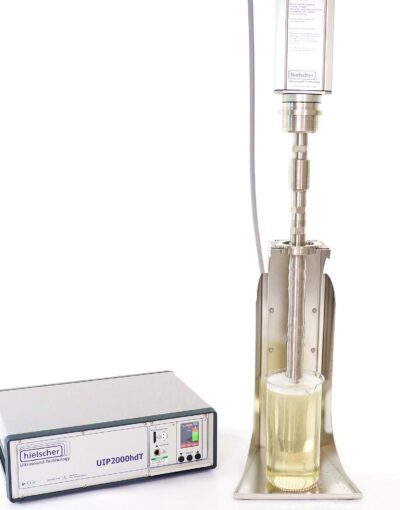
Industrial probe-type sonicator UIP2000hdT in batch setup
Typical Applications of the UIP2000hdT Industrial Probe Sonicator
The UIP2000hdT is used in chemical processing, food and beverage production, cosmetics, pharmaceuticals, biotechnology, nanomaterials, fuels, coatings and environmental technology. The same ultrasonic platform can be configured with different sonotrodes, boosters and flow cells to match the required process intensity and throughput.
Ultrasonic Homogenization and Mixing
The UIP2000hdT can homogenize liquids, suspensions and liquid-solid mixtures by applying intense ultrasonic shear. This helps produce uniform product quality, improves mixing of difficult components and can reduce processing time compared with conventional agitation. Explore!
Ultrasonic Emulsification and Nanoemulsions
For emulsions, ultrasonic cavitation creates very fine droplets and narrow droplet size distributions. The UIP2000hdT is suitable for producing stable emulsions and nanoemulsions used in food, cosmetics, pharmaceuticals, fuels, flavors and functional ingredient formulations. Explore!
Dispersing, Deagglomeration and Nanoparticle Processing
Powders, pigments, fillers and nanomaterials often form agglomerates that are difficult to break with standard mixers. The UIP2000hdT disperses particles into liquids and breaks agglomerates by high ultrasonic shear. This is useful for paints, inks, coatings, ceramics, catalysts, battery materials, graphene, oxides and other advanced materials. Explore!
Wet Milling and Particle Size Reduction
The UIP2000hdT can be used for particle size reduction and wet milling when smaller particle sizes, improved suspension stability or larger active surface areas are required. The process can be optimized by adjusting amplitude, pressure, flow rate, temperature and sonication time. Explore!
Ultrasonic Extraction and Cell Disruption
Ultrasonication improves mass transfer and can disrupt cells, tissues and plant structures. The UIP2000hdT is used for extraction of botanicals, bioactive compounds, flavors, proteins, enzymes and intracellular materials. It is also suitable for lysis and cell disruption in biotechnology and microbiology. Explore!
Sonochemistry, Sono-Catalysis and Reaction Intensification
Ultrasonic cavitation can accelerate chemical reactions by improving mixing, mass transfer and surface activation. The UIP2000hdT is used for sono-synthesis, sono-catalysis, precipitation, sol-gel reactions, phase transfer catalysis and other sonochemical processes. Explore!
Key Features of the UIP2000hdT
- 2000 watts ultrasonic power at 20kHz
- Industrial-grade design for demanding liquid processing
- Reliable 24/7 continuous operation
- Color touch display for direct operation at the unit
- Browser remote control via LAN without software installation
- Automatic data recording of power, amplitude, sonication time, temperature and pressure
- Integrated SD card for CSV process data
- Pluggable temperature sensor
- Optional pluggable pressure sensor
- Ethernet / LAN connection
- Automatic frequency tuning for stable operation
- Compatible with sonotrodes, boosters, stands, flow cells and sound protection enclosures
Which Ultrasonic Processor Should You Choose?
From laboratory research and feasibility testing to process optimization, pilot-scale trials and industrial manufacturing, Hielscher offers the ideal ultrasonic homogenizer for processing liquids and slurries at every scale. The table below gives you an overview of our most popular probe-type sonicators.
| Model | Power | Typical Use |
|---|---|---|
| UP400St | 400W | Laboratory testing, formulation development and small batches |
| UIP1000hdT | 1000W | Pilot trials and smaller continuous processes |
| UIP2000hdT | 2000W | Pilot scale, process scale-up and industrial production |
| UIP4000hdT | 4000W | Higher production throughput and continuous inline processing |
| UIP6000hdT | 6000W | Large-volume industrial liquid processing |
| UIP16000 | 16000W | High-throughput industrial production and multi-ton processing |
If you are not sure which ultrasonic processor fits your process, the most important selection criteria are target result, batch volume, required flow rate, viscosity, solids content, operating schedule and required energy input. Hielscher can recommend a suitable device, sonotrode, booster and flow-cell configuration based on your process data.
A Robust 2000W Ultrasonic Processor for Pilot and Production Scale

The UIP2000hdT is built for industrial environments. Its stainless steel and titanium transducer design makes it suitable for demanding operating conditions, including dust, humidity and elevated ambient temperatures. The unit is designed for continuous operation and requires little maintenance.
With 2000 watts ultrasonic power, the UIP2000hdT bridges the gap between laboratory sonication and large industrial ultrasonic systems. It is powerful enough for pilot production, process scale-up and many continuous manufacturing applications. For higher production volumes, multiple units can be operated in parallel, or larger Hielscher ultrasonic processors can be selected.
Suitable accessories, such as sonotrodes, cascatrodes™, boosters and flow cells, allow the system to be adapted to different process targets. For example, a cascatrode™ can provide a large active sonication surface for high-throughput liquid processing, while flow cells allow controlled inline treatment under defined pressure and flow conditions.

Industrial sonicator UIP2000hdT with flow cell for continuous inline processing

Industrial sonicator UIP2000hdT – ultrasonic transducer and generator
Batch, Recirculation and Inline Flow Processing

The UIP2000hdT can be used in several processing configurations. For formulation work, smaller process trials and parameter studies, the unit can be operated in batch mode with a sonotrode and stand. This allows users to test how their material responds to sonication before moving into larger volumes.
For batches larger than 5 liters, flow-cell processing is generally recommended. In flow mode, the liquid passes through an ultrasonic reactor where it is treated under controlled conditions. The product can be processed in single-pass mode or circulated through the reactor until the target result is reached.
Flow-cell processing improves reproducibility because important parameters such as amplitude, pressure, flow rate, temperature and residence time can be controlled more precisely. This is especially important for production processes, scale-up studies and quality-sensitive applications.
Get a Process Recommendation and Quote
Frequently Asked Questions about the UIP2000hdT
What is the UIP2000hdT used for?
The UIP2000hdT is used for industrial ultrasonic homogenization, emulsification, dispersing, deagglomeration, wet milling, particle size reduction, extraction, cell disruption, dissolving and sonochemical processing.
Is the UIP2000hdT suitable for production?
Yes. The UIP2000hdT is an industrial-grade ultrasonic processor designed for continuous 24/7 operation. It can be used for pilot production, small to medium production and continuous inline processing.
Can the UIP2000hdT process liquids continuously?
Yes. The UIP2000hdT can be combined with flow-cell reactors for continuous inline processing or recirculation. Flow-cell processing is recommended for larger volumes and for reproducible industrial operation.
What flow rate can the UIP2000hdT process?
In flow mode, the UIP2000hdT can typically process between 1.0 and 8.0L/min. The actual flow rate depends on the liquid, viscosity, solids content, temperature, pressure and required sonication result.
Can the UIP2000hdT be used for nanoemulsions?
Yes. The UIP2000hdT is suitable for producing fine emulsions and nanoemulsions when the correct sonotrode, flow cell and process parameters are selected.
Can the UIP2000hdT disperse nanoparticles?
Yes. The UIP2000hdT can be used for dispersing and deagglomerating nanomaterials, pigments, fillers and powders in liquids.
How does the UIP2000hdT support process documentation?
The UIP2000hdT automatically records process parameters such as amplitude, power, sonication time, temperature and pressure as CSV files on the integrated SD card.
How do I know whether the UIP2000hdT is the right size for my process?
The right ultrasonic processor depends on your target result, batch volume, required flow rate, viscosity, solids content and operating schedule. Hielscher can recommend the suitable device size, sonotrode, booster and flow cell based on your process requirements.
Ultrasonic Processes and Applications
- Mixing
- Emulsifying
- Dispersing
- Deagglomeration
- Wet-Milling
- Degassing
- Dissolving
- Extraction
- Tissue Homogenization
- Sono-Fragmentation
- Fermentation
Sono-Chemistry
Color Touch Display for Fast Process Setup
 The color touch display gives operators direct access to the most important settings. Amplitude, power and pulse mode can be adjusted quickly and accurately. The menu is focused on the settings that matter during daily operation, so users can set up and monitor the sonication process without unnecessary complexity.
The display can show amplitude and power as bar graphs or numerical values. A BIG NUMBER display mode improves visibility from a distance, which is helpful in pilot plants, production areas and test setups where the operator may not stand directly in front of the unit.
Browser Remote Control via LAN

The UIP2000hdT can be controlled using common web browsers. The LAN interface requires no additional software installation. The ultrasonic processor can be operated directly from a PC or Mac, through a router or switch, or from a tablet or smartphone when connected through a suitable network setup.
This is especially useful for process development, production monitoring and installations where the ultrasonic processor is integrated into a flow setup, sound protection enclosure or production line.
Automatic Process Data Recording
Every production process benefits from reliable documentation. The UIP2000hdT automatically records relevant process values on the integrated SD card. The CSV data can be used to compare trials, document production runs, identify process deviations and support quality assurance.
Recorded parameters include ultrasonic power, amplitude, sonication time, temperature and pressure when the optional pressure sensor is connected. This gives engineers and operators a practical basis for process optimization and repeatable manufacturing.
Automatic Frequency Tuning
The UIP2000hdT includes intelligent automatic frequency tuning. When the unit is switched on, the generator detects the optimal operating frequency and drives the ultrasonic transducer at that frequency. This helps maintain stable sonication performance and reduces the need for manual adjustment.
High Energy Efficiency and Industrial Reliability

The UIP2000hdT is designed for commercial production. It is easy to set up, simple to clean and built for continuous industrial use. Despite its ultrasonic power of 2000 watts, the unit does not require additional cooling by water or compressed air. It can be operated continuously in air.
As with all Hielscher industrial ultrasonic processors, the UIP2000hdT is designed for efficient conversion of electrical energy into mechanical ultrasonic oscillation. High energy efficiency means that more power is transferred into the liquid, improving process performance and reducing wasted energy. The overall energy efficiency of the UIP2000hdT is approximately 80 to 90% from the power plug into the liquid.
Full Amplitude Control for Reproducible Results
Amplitude is one of the most important parameters in ultrasonic processing. It defines the mechanical vibration at the sonotrode and strongly influences cavitation intensity. The UIP2000hdT controls amplitude electronically, so the selected amplitude remains constant even when process conditions change.
The amplitude can be adjusted from 20 to 100% at the generator. Additional amplitude ranges can be achieved by using suitable booster horns. This allows operators to adapt sonication intensity to the product, whether the target is gentle mixing, strong deagglomeration, cell disruption, extraction or particle size reduction.
Process Testing and Evaluation
Before selecting an industrial ultrasonic system, many users want to know whether sonication will achieve their target result and what throughput can be expected. Hielscher offers process trials to evaluate the UIP2000hdT with your material and application.
During testing, relevant process parameters can be evaluated, including amplitude, pressure, temperature, flow rate, energy input and sonication time. The results help identify the right sonotrode, flow cell and processing configuration for your product.
Standard accessories are typically available from stock. Customized sonotrodes, flow cells and process accessories can also be manufactured for specific requirements.
Throughput and Processing Capacity
The throughput of any ultrasonic process depends on the liquid, viscosity, solids content, required particle size, target extraction yield, temperature, pressure and energy input. As a general indication, the UIP2000hdT can typically process between 1.0 and 8.0L/min in flow mode. In daily operation, this corresponds to approximately 2 to 10m³ per day, depending on the application.
For higher production capacity, Hielscher offers larger ultrasonic processors and multi-unit installations. This allows processes developed with the UIP2000hdT to be scaled to higher throughput while maintaining the same ultrasonic process principles.
The UIP2000hdT in Research and Science
The UIP2000hdT is frequently used in pilot setups, industrial production and scientific studies. Published applications include ultrasonic extraction of bioactive compounds from botanicals, exfoliation of graphene-like materials, nanomaterial processing and wine processing. If you are looking for references for a specific application, please contact us.
- FactSheet UIP2000hdT – 2000 watts powerful sonicator for pilot and industry – Hielscher Ultrasonics
- Štengl, V., Henych, J., Slušná, M. et al. (2014): Ultrasound exfoliation of inorganic analogues of graphene. Nanoscale Res Lett 9, 167; 2014.
- Maria Lisa Clodoveo, Tiziana Dipalmo, Carlo Giuseppe Rizzello, Filomena Corbo, Pasquale Crupi (2016): Emerging technology to develop novel red winemaking practices: An overview. Innovative Food Science & Emerging Technologies, Volume 38, Part A, 2016. 41-56.
- Sena Saklar Ayyildiz, Bulent Karadeniz, Nihan Sagcan, Banu Bahar, Ahmet Abdullah Us, Cesarettin Alasalvar (2018): Optimizing the extraction parameters of epigallocatechin gallate using conventional hot water and ultrasound assisted methods from green tea.. Food and Bioproducts Processing, Volume 111, 2018. 37-44.
- Štengl, V.; J. Tolasz; D. Popelková (2015): Ultrasonic preparation of tungsten disulfide single-layers and quantum dots. RSC Advances 5, 2015. 89612-89620.

Powerful ultrasonic cavitation at the Hielscher Cascatrode