Ultrasonic Degassing and Defoaming of Liquids
Degassing and defoaming of liquids using ultrasonic is a very effective process. Ultrasonication removes small suspended gas-bubbles from the liquid and reduces the level of dissolved gas below the natural equilibrium level.
The degassing and defoaming of liquids is required for many purposes, such as the following processes:
- sample preparation before particle size measurement to avoid measurement errors
- oil and lubricant degassing before pumping to reduce pump wear due to cavitation
- degassing of liquid foods, e.g. juice, sauce or wine, to reduce microbial growth and increase shelf life
- degassing of polymers and varnishes before application, curing or vacuum infusion
When sonicating liquids, the sound waves that propagate from the radiating surface into the liquid media result in alternating high-pressure and low-pressure cycles, with rates depending on the frequency. During the low-pressure cycle, the ultrasonic waves can create small vacuum bubbles or voids in the liquid. The large number of small bubbles generates a high total bubble surface area. The bubbles are also well distributed in the liquid. Dissolved gas migrates into these vacuum bubbles via the large surface area and increases the size of the bubbles.
The acoustic waves support the touching and coalescence of adjacent bubbles leading to an accelerated growth of the bubbles. The sonication waves will also help to shake bubbles off vessel surfaces and will force smaller bubbles resting below the liquid surface to rise through and release the entrapped gas to the environment.

Ultrasonic degassing of oil using a Hielscher 200 Watts ultrasonic processor.
Put It to The Test
The process of the degassing and defoaming of liquids can be made visible easily. In a glass beaker of freshly-poured tap water, ultrasonication will force the small suspended bubbles to coalesce and to move up rapidly. You can see this effect in the progress image below.

Ultrasonic Degassing of Water (5 seconds)
Agitated oil contains a high number of suspended bubbles or foam. In particular in coolants, this is a problem. There, the gas bubbles promote cavitation induced wear in pumps or nozzles. The progress image below shows the ultrasonic defoaming effect.

Ultrasonic degassing: Entrapped gas bubbles are removed from oil using the ultrasonicator UP400St
Sonication will generate small vacuum bubbles in clear, stale water. These bubbles fill with dissolved gas, that migrates into the bubbles. Consequently the bubbles grow and move up. The degassing effect is well visible in any translucent liquid.
As the ultrasound improves the rising of small suspended bubbles to the liquid surface, it reduces the contact time between the bubble and the liquid, too. For this reason, it limits the re-dissolving of gas from the bubble to the liquid, too. This is of particular interest for higher viscosity liquids, such as oils or resins. Since the bubbles have to move to the liquid surface, the ultrasonic degassing works better, if the container is shallow so that the time to the surface is shorter.
Beyond the Visible Effects
The measurement of the degassing effects by visual inspection is limited in accuracy. Gas content measurements are a more accurate way to tell about ultrasonic degassing efficiency.
Fluids contain a certain amount of dissolved gas. The concentration of gas depends on factors, such as temperature, ambient pressure or agitation of the liquid. Under constant conditions, the gas concentration will approach an equilibrium. Ultrasonic degassing will change the conditions, because the liquid is exposed to low pressure bubbles and agitation. Therefore, ultrasonication will lower the gas concentration in the liquid to below the equilibrium level.
When the sonication stops and the initial conditions are re-established, the gas concentration will slowly approach the initial equilibrium level again, unless the liquid is not exposed to any gas, e.g. in a closed bottle. Because the re-dissolving of gas into the liquid is fairly slow, it is possible to work with the low-gas liquid after sonication. The graph below illustrates this effect.

Illustration of Ultrasonic Degassing of Water
Degassing before Emulsifying and Dispersing
Ultrasonic degassing can improve the quality of dispersions and emulsions.
The Problem
Often, emulsions and dispersions contain surfactants in order to increase their stability. The surfactants will inhibit the contact and coalescence or agglomeration of the dispersed material in the liquid phase. For this, the surfactants will form a layer around each particle. The same surfactants can also encapsulate gas bubbles that are suspended in the liquid phase. Such stabilized bubbles can prove to be very robust. Stabilized bubbles consume surfactant, reduces the quality of the emulsion or dispersion, and can generate erratic readings when measuring the particle size.
The Solution: Ultrasonic Degassing
In order to reduce the problem of stabilized gas bubbles, liquids should be degassed by sonication. Before adding the disperse phase, such as oil or powder, sonicate the liquid until the number of generated bubbles reduces. When mixing in other materials, avoid generating new bubbles or a vortex while stirring. This would increase the gas content quickly.

Water-based drilling mud before and after ultrasonic degassing with the sonicator UIP1000hd
Study and picture by Amani et al. 2016
Forcing Carbon Dioxide Out
The effect of degassing is being used in the leak-testing of cans and bottles containing carbonated drinks, such as cola, soda or beer. Please click here to get more information about bottle leak testing.
Ultrasonic Degassing in Brief
The ultrasonic degassing of liquids works better when using the following setup.
- Apply low to moderate ultrasonic amplitudes!
- Use sonotrodes with a large surface area, e.g. radially emitting sonotrodes!
- Provide a low pressure or vacuum above the liquid surface while sonicating!
- Heat the liquid, to reduce its viscosity!
- Use a shallow container for the gas separation during or after the sonication!
- Avoid turbulent agitation to allow the gas bubbles to move up!
Ultrasonic degassing can be used in batch mode or inline. In the case of an inline operation, a stand-pipe for the discharge of the gas should be installed and a gas pump should be applied.
Literature / References
- Rognerud, Maren; Solemslie, Bjørn; Islam, Md Hujjatul; Pollet, Bruno (2020): How to Avoid Total Dissolved Gas Supersaturation in Water from Hydropower Plants by Employing Ultrasound. Journal of Physics: Conference Series 2020.
- Mahmood Amani, Salem Al-Juhani, Mohammed Al-Jubouri, Rommel Yrac, Abdullah Taha (2016): Application of Ultrasonic Waves for Degassing of Drilling Fluids and Crude Oils. Advances in Petroleum Exploration and Development Vol. 11, No. 2, 2016. 21-30.
- Haghayeghi R.; Kapranos P. (2014): The effect of processing parameters on ultrasonic degassing efficiency. Materials Letter Volume 116, 1 February 2014. 399-401.
- Servant G.; Caltagirone J.P.; Gérard A.; Laborde J.L.; Hita A. (2000): Numerical simulation of cavitation bubble dynamics induced by ultrasound waves in a high frequency reactor. Ultrasonics Sonochemistry Volume 7, Issue 4, October 2000. 217-227.
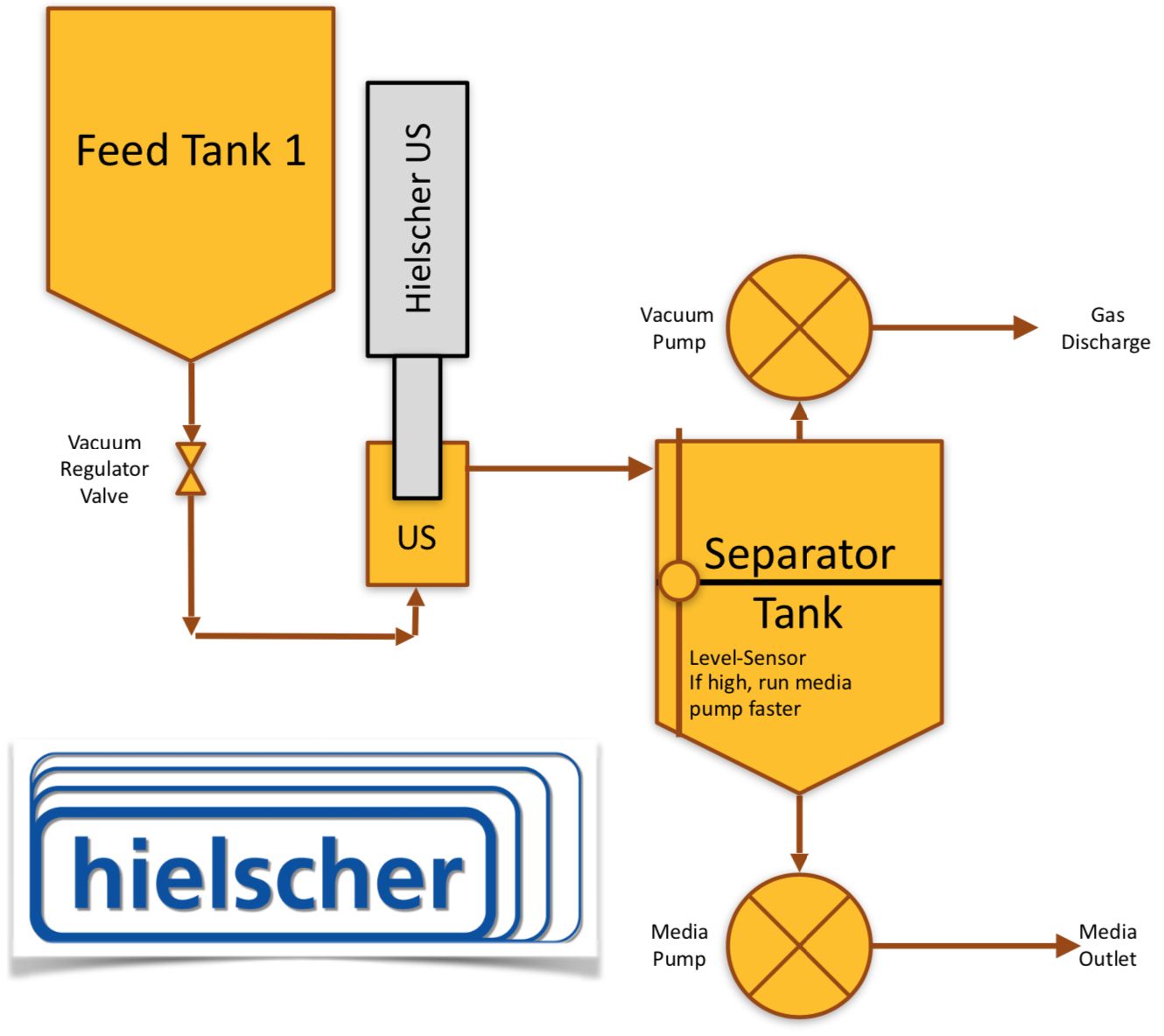
Ultrasonic degassing setup
- high efficiency
- state-of-the-art technology
- reliability & robustness
- adjustable, precise process control
- batch & inline
- for any volume
- intelligent software
- smart features (e.g., programmable, data protocoling, remote control)
- easy and safe to operate
- low maintenance
- CIP (clean-in-place)
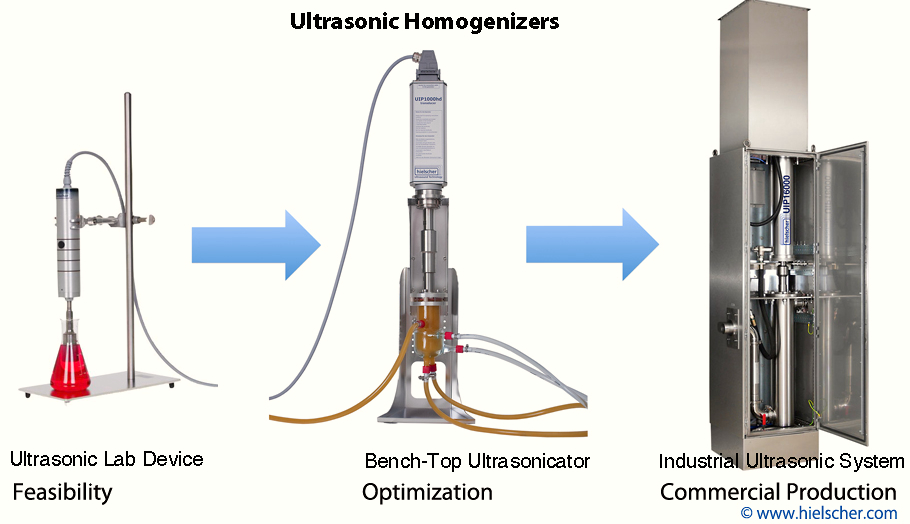
Hielscher Ultrasonics manufactures high-performance ultrasonic homogenizers from lab to industrial size.