Sonocatalysis – Ultrasonically Assisted Catalysis
Sonocatalysis, or ultrasonically assisted catalysis, is a process that significantly enhances chemical reaction rates and catalyst efficiency by taking advantages of the physical forces of acoustic cavitation. When ultrasound waves propagate through a reaction mixture, they generate microscopic bubbles that grow and collapse with immense energy. This implosive collapse creates localized “hotspots” characterized by extreme temperatures and pressures, alongside intense micro-jetting and turbulence. These effects are particularly transformative in heterogeneous catalysis, where they drastically improve mass transfer across phase boundaries, strip away passivating oxide layers, and prevent the fouling of catalyst surfaces. The result is a highly active reaction environment that lowers activation energy, accelerates conversion rates, and ensures the long-term stability and reusability of the catalyst.
What is Sonocatalysis? How Ultrasound Enhances Catalytic Reactions
Traditional catalysis accelerates chemical reactions by lowering activation energy, but heterogeneous systems often face inherent limitations like slow diffusion rates and surface fouling. Sonocatalysis – ultrasonically assisted catalysis – overcomes these barriers by integrating high-intensity acoustic energy directly into the reaction environment.
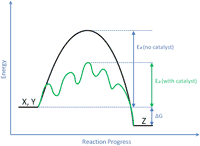 As ultrasound waves propagate through a liquid medium, they generate microscopic cavitation bubbles that grow and violently collapse. This implosive collapse creates extreme localized conditions that continuously refresh the catalyst surface, dramatically improving mass transfer, reaction kinetics, and overall process efficiency. The result is faster conversion rates, reduced catalyst loading, enhanced selectivity, and a more sustainable chemical synthesis pathway.
The diagram above illustrates the effect of a catalyst in a chemical reaction X+Y to produce Z. The catalyst provides an alternative pathway (green) with a lower activation Energy Ea.

Sonochemical setup: sonicator UP400St with flow cell reactor FC22K
Key Mechanisms: How Ultrasonic Waves Boost Catalytic Efficiency
Acoustic wavelengths in liquids (typically 110 mm down to 0.15 mm for frequencies between 20 kHz and 1 MHz) are significantly larger than molecular dimensions. Consequently, ultrasound does not directly interact with chemical bonds. Instead, its catalytic power is delivered through acoustic cavitation – the formation, growth, and asymmetric collapse of microbubbles in liquid media. This phenomenon requires at least one liquid phase and allows precise control over reaction intensity through amplitude, pressure, and sonication time adjustments.
Ultrasonic Dispersion & Emulsification
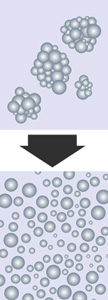 Heterogeneous reactions are inherently limited to the phase boundary where the catalyst and reagents coexist. Maximizing this interfacial area is critical for reaction speed. Ultrasonication excels at breaking down solid catalysts and liquid reagents into sub-micron or nano-scale dispersions and emulsions. By drastically reducing droplet and particle size, sonication exponentially increases the available surface area for molecular interaction. The graphic to the left shows the correlation between particle size and surface area. For many systems, a brief initial sonication generates a stable, high-surface-area mixture that sustains rapid reaction kinetics throughout the batch. Inline ultrasonic reactors are particularly effective for continuous processing, handling even highly viscous or concentrated slurries.
Enhanced Mass Transfer & Boundary Layer Disruption
 In conventional reactors, reaction products often accumulate at the catalyst surface, creating a stagnant diffusion layer that blocks fresh reactants. Ultrasonic cavitation generates intense micro-jets, acoustic streaming, and localized turbulence that continuously disrupt this boundary layer. This constant “scrubbing” effect ensures rapid transport of reactants to the active sites and swift removal of products, effectively eliminating diffusion limitations. For extended reactions, periodic or recirculating sonication maintains peak mass transfer efficiency and prevents reaction slowdowns over time.
Energy Input via Acoustic Cavitation
Cavitation provides a highly efficient, non-thermal (bulk) method of energy delivery concentrated at the molecular level. During bubble collapse, localized hotspots reach temperatures exceeding 5,000 K and pressures above 1,000 atm, with heating/cooling rates surpassing 10⁹ K/s. These extreme conditions can break molecular bonds, generate free radicals, and lower the overall activation energy required for the reaction. As pioneering researcher Kenneth Suslick noted, cavitation transforms diffuse acoustic energy into a highly reactive chemical force, enabling pathways that are inefficient or impossible under conventional mechanical stirring.
Surface Activation & Continuous Catalyst Cleaning
 Solid catalysts frequently suffer from fouling–accumulation of byproducts, carbon deposits, or passivating oxide layers that block active sites. Ultrasonic cleaning leverages cavitational shear forces and shockwaves (up to 1,000 atm) to physically remove these deactivating layers without harsh chemicals. This in-situ cleaning maintains consistent catalytic activity, extends catalyst lifespan, and simplifies recycling. Additionally, the mechanical impact of collapsing bubbles can etch particle surfaces, exposing fresh, highly reactive crystalline planes and improving overall catalytic turnover.
Proven Applications & Case Studies in Sonocatalysis
Sonocatalysis has transitioned from laboratory research to validated industrial processes across multiple high-value sectors. Key applications include:
- Biodiesel Production (Transesterification): Ultrasonic assistance reduces reaction times from hours to minutes, enables lower catalyst concentrations, and improves FAME yields while simplifying downstream purification.
Explore the advantages of ultrasonic biodiesel transesterification! - Advanced Oxidation (Sono-Fenton Process): Enhanced hydroxyl radical generation accelerates the degradation of recalcitrant organic pollutants in wastewater, reducing chemical consumption and sludge production.
Discover how sonication improves Fenton reaction! - Nanomaterial & Catalyst Synthesis: Rapid nucleation and controlled particle growth yield uniform, high-surface-area catalysts with improved thermal stability and mechanical strength.
- Green Chemistry & Fine Chemicals: Cleaner reaction pathways, lower energy consumption, and reduced solvent waste make sonocatalysis ideal for pharmaceutical intermediates and specialty chemicals.
Industrial Sonocatalysis Equipment & Linear Scalability
Hielscher manufactures process-optimized ultrasonic processors designed specifically for demanding catalytic applications. Our systems deliver consistent, repeatable cavitation across all production scales, backed by rigorous acoustic engineering and real-time process monitoring.
- Laboratory & R&D: The UP400St (400 W) provides flexible batch and inline testing, ideal for screening reaction conditions and catalyst formulations.
- Pilot & Process Development: The >UIP1000hdT (1,000 W) bridges lab and production, offering modular flow cells and adjustable parameters for precise scale-up studies.
- Industrial Production: Our full-industrial UIP10000hdT (10 kW) and UIP16000hdT (16 kW) processors handle continuous high-volume processing. Multiple units can be networked in parallel clusters to achieve virtually unlimited throughput, while maintaining uniform acoustic intensity.
Scalability in sonocatalysis is achieved through power density optimization (Watts/Liter) rather than simple geometric scaling. Our engineering team provides comprehensive process support–from initial feasibility studies and acoustic modeling to full deployment and operator training–ensuring your catalytic process operates at peak efficiency.

Ultrasonically agitated reactor with the ultrasonicator UP200St for intensified catalytic reactions
Literature / References
- Suslick, Kenneth; Skrabalak, Sara (2008): Sonocatalysis. In: Handbook of Heterogeneous Catalysis; Wiley-VCH 2008.Pages 1350-1357.
- Suslick, Kenneth S.; Hyeon, Taeghwan; Fang, Mingming; Cichowlas, Andrzej A. (1995): Sonochemical synthesis of nanostructured catalysts. Materials Science and Engineering: A. Proceedings of the Symposium on Engineering of Nanostructured Materials. ScienceDirect 204 (1–2): 186–192.
- Naeem, Marwa; Al-Sakkari, Eslam; Boffito, D; Rene, Eldon; Gadalla, Mamdouh; Ashour, Fatma (2023): Single-stage waste oil conversion into biodiesel via sonication over bio-based bifunctional catalyst: Optimization, preliminary techno-economic and environmental analysis. Fuel, 2023.
- Aharon Gedanken (2003): Sonochemistry and its application to nanochemistry. Current Science Vol. 85, No. 12 (25 December 2003), pp. 1720-1722.

Plot of hydrogen peroxide formation as a function of time under electrochemical conditions (squares), and under sono-electrochemical conditions with low-power ultrasound (diamonds) and high-power ultrasound (triangles).
Graphic and study: González-García et al., 2007