Ultrasonic topic: "What is Sonochemistry?"
Sonochemistry is the application of ultrasound to chemical reactions and processes. SOnication is used to intensify chemical reactions such as synthesis and catalysis. When intense ultrasound waves are couples into liquids, the phenomenon of acoustic cavitation occurs. Ultrasonic cavitation improves mass transfer between reactants, speeds up the reaction and/or allows to change the chemicals pathway.
Learn more about Hielscher ultrasonic laboratory and industrial devices and how they are used in manifold sonochemical processes!

Found 63 hits. Showing results 37 - 48.

Ultrasonic Marine Fuel Desulphurization
Marine fuels are affected by new regulations, which require a sulphur content of 0.5%m/m or less. Ultrasound-assisted oxidative desulfurization (UAOD) is an established method that accelerates the oxidation reaction and is an economical and safe process. UAOD processes can be…
https://www.hielscher.com/ultrasonic-marine-fuel-desulphurization.htm
Ultrasonic Phosphor Recovery from Sewage Sludge
The worldwide demand for phosphor is increasing, whilst the supply of natural phosphorus resources are getting scarce. Sewage sludge and sewage sludge ash are rich in phosphorus and can be therefore used as source to reclaim phosphorus. The ultrasonic wet-chemical…
https://www.hielscher.com/ultrasonic-phosphor-recovery-from-sewage-sludge.htm
Ultrasonically Polyhydroxylated C60 (Fullerenol)
Water-soluble polyhydroxylated C60 fullerene, called fullerenol or fullerol, is a strong free radical scavenger and is therefore used as an antioxidant in supplements and pharmaceuticals. Ultrasonic hydroxylation is a rapid and simple one-step reaction, which is used to produce water-soluble…
https://www.hielscher.com/ultrasonic-polyhydroxylated-c60-fullerenol.htm
Sonication in Multi-Neck Flasks
Sonication is widely used for chemical and biochemical reactions. Hielscher supplies standardized ground joint adapters to insert the ultrasonic sonotrode into reaction vessels such as round-bottom flasks, multi-neck flasks and other lab glass ware. For a sophisticated setup of an…
https://www.hielscher.com/sonication-in-multi-neck-flasks.htm
Ultrasonically Intensified Fixed Bed Reactors
Sonication can improve catalytic reactions in fixed-bed reactors mainly by intensifying mass transfer around and inside the packed catalyst bed. Additionally, sonication removes passivation and fouling layers from the catalyst surface thereby continuously regenerating the catalyst. How Sonication Improves Fixed-Bed…
https://www.hielscher.com/ultrasonically-intensified-fixed-bed-reactors.htm
Ultrasonic Preparation of Reinforced Rubber
Reinforced rubbers show higher tensile strength, elongation, abrasion resistance and better aging stability. Fillers such as carbon black (e.g. CNTs, MWNTs), graphene, or silica must be homogeneously dispersed in the matrix to provide the desired material properties. Power ultrasonics gives…
https://www.hielscher.com/ultrasonic-preparation-of-reinforced-rubber.htm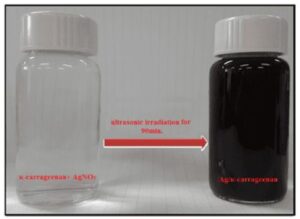
Green Sonochemical Route to Silver Nanoparticles
Silver nanoparticles (AgNPs) are frequently utilized nanomaterials due to their anti-microbial properties, optical properties and high electrical conductivity. The sonochemical route using kappa carrageenan is a simple, convenient and environmental-friendly synthesis method for the preparation of silver nano particles. κ-carrageenan…
https://www.hielscher.com/green-sonochemical-route-to-silver-nanoparticles.htm
Ultrasonic Spray Pyrolysis
Ultrasonic Spray Pyrolysis (USP) is one of the important techniques to synthesize nano materials and to coat substrates with thin film coatings. Ultrasonic spraying and atomization allows for full process control resulting in homogeneous high-quality output. Ultrasonic spray pyrolysis excels…
https://www.hielscher.com/ultrasonic-spray-pyrolysis.htm
Ultrasonic Production of Nano-Structured Cellulose
Nanocellulose, a remarkable high-performance additive, has gained prominence for its versatile applications as a rheology modifier, reinforcing agent, and key component in various advanced materials. These nano-structured fibrils, derived from any cellulose-containing source, can be efficiently isolated through high-power ultrasonic…
https://www.hielscher.com/ultrasonic-production-of-nano-structured-cellulose.htm
Ultrasonic Preparation of Metal-Organic Frameworks (MOFs)
Metal-Organic Frameworks are compounds formed from metal ions and organic molecules so that a one-, two, or three-dimensional hybrid material is created. These hybrid structures can be porous or non-porous and offer manifold functionalities. The sonochemical synthesis of MOFs is…
https://www.hielscher.com/ultrasonic-preparation-of-metal-organic-frameworks-mofs.htm
Ultrasonic Crystallization and Precipitation
Ultrasound initiates and promotes the nucleation and crystallization of organic molecules. Having control over this process is vital to make sure the final product is of high quality. The advantages of using sonication for crystallization and making solids from liquids…
https://www.hielscher.com/ultrasonic-crystallization-and-precipitation.htm
Ultrasonic Synthesis of Fluorescent Nanoparticles
Artificially synthesized fluorescent nanoparticles and quantum dots have emerged as transformative materials with manifold applications spanning electrooptics, optical data storage, biochemical analysis, and advanced medical diagnostics. Traditional synthesis methods often struggle to achieve consistent particle size, colloidal stability, and high…
https://www.hielscher.com/ultrasonic-synthesis-of-fluorescent-nano-particles.htm