Ultrasonic topic: "What is Sonochemistry?"
Sonochemistry is the application of ultrasound to chemical reactions and processes. SOnication is used to intensify chemical reactions such as synthesis and catalysis. When intense ultrasound waves are couples into liquids, the phenomenon of acoustic cavitation occurs. Ultrasonic cavitation improves mass transfer between reactants, speeds up the reaction and/or allows to change the chemicals pathway.
Learn more about Hielscher ultrasonic laboratory and industrial devices and how they are used in manifold sonochemical processes!

Found 63 hits. Showing results 49 - 60.

Sonochemistry: Application Notes
Sonochemistry is the effect of ultrasonic cavitation on chemical systems. Due to the extreme conditions that occur in the cavitational "hot spot", power ultrasound is an very effective method to improve reaction outcome (higher yield, better quality), conversion and duration…
https://www.hielscher.com/sonochemistry-application-notes.htm
Mixing H2S Scavengers for Phase-Transfer-Reaction
Hydrogen sulfide (H2S) is a colorless gas that occurs in crude oil and natural gas. H2S is poisonous, corrosive, flammable and explosive. It can be removed from oil and gas by scavengers, hydrodesulfurization, activated carbon filtration or reaction with iron…
https://www.hielscher.com/mixing-h2s-scavengers-for-phase-transfer-reaction.htm
Sonochemical Synthesis of Latex
Ultrasound induces and promotes the chemical reaction for the polymerization of latex. By sonochemical forces, the latex synthesis occurs faster and more efficient. Even the handling of the chemical reaction becomes easier. How Sonication Improves the Synthesis of Latex Ultrasound…
https://www.hielscher.com/sonochemical-synthesis-of-latex.htm
Ultrasonication Accelerates the Suzuki Coupling Reaction
The Suzuki Cross-Coupling (also known as Suzuki-Miyaura Coupling) is an organic reaction with the aim to synthesize biphenyl derivatives, vinyl aromates (e.g. styrenes), poly-olefins, as well as alkyl bromides. The reaction base materials are an aryl- or vinyl-boronic acid with…
https://www.hielscher.com/ultrasonication-accelerates-the-suzuki-coupling-reaction.htm
Ultrasonically Assisted Fermentation for Bioethanol Production
Ultrasonically-assisted fermentation can enhance bioethanol production by promoting the breakdown of complex carbohydrates into simpler sugars, making them more readily available for yeast to convert into ethanol. Simultaneously, sonication also improves the efficiency of yeast cell wall permeability, allowing for…
https://www.hielscher.com/ultrasonically-assisted-fermentation-for-bioethanol-production.htm
Sonochemical Effects on Sol-Gel Processes
Ultrafine nano-sized particles and spherical shaped particles, thin film coatings, fibers, porous and dense materials, as well extremely porous aerogels and xerogels are highly potential additives for the development and production of high performance materials. Advanced materials, including e.g. ceramics,…
https://www.hielscher.com/sonochemical-effects-on-sol-gel-processes.htm
Ultrasonically Induced and Enhanced Phase Transfer Catalysis
High power ultrasound is well-known for its contribution to various chemical reactions. This is the so-called sonochemistry. Heterogeneous reactions – and especially phase transfer reactions – are highly potential application fields for power ultrasound. Due to the mechanical and sonochemical…
https://www.hielscher.com/ultrasonically-induced-and-enhanced-phase-transfer-catalysis.htm
Ultrasonically Assisted Oxidative Desulfurization (UAODS)
Sulfur-containing compounds in crude oil, petroleum, diesel and other fuel oils include sulfides, thiols, thiophenes, substituted benzo- and dibenzothiophenes (BTs and DBTs), benzonaphthothiophene (BNT), and many more complex molecules, in which the condensed thiophenes are the most common forms. Hielscher…
https://www.hielscher.com/oil_desulfurization_01.htm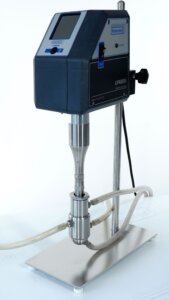
Sonocatalysis – Ultrasonically Assisted Catalysis
Sonocatalysis, or ultrasonically assisted catalysis, is a process that significantly enhances chemical reaction rates and catalyst efficiency by taking advantages of the physical forces of acoustic cavitation. When ultrasound waves propagate through a reaction mixture, they generate microscopic bubbles that…
https://www.hielscher.com/sonocatalysis_catalysis.htm
Sonochemical Reactions and Synthesis
Sonochemistry is the application of ultrasound to chemical reactions and processes. The mechanism causing sonochemical effects in liquids is the phenomenon of acoustic cavitation. Hielscher ultrasonic laboratory and industrial devices are used in a wide range of sonochemical processes. Ultrasonic…
https://www.hielscher.com/sonochem_01.htm
Ultrasonic Processing for Liquids, Slurries, and Chemical Reactions
Ultrasonication is a mechanical processing method which creates acoustic cavitation and highly intense physical forces. Therefore, ultrasonics is used for numerous applications such as mixing, homogenization, milling, dispersion, emulsification, extraction, degassing, and sono-chemical reactions. Find your application in the table…
https://www.hielscher.com/technolo.htm
Ultrasonicators and Probes for Liquid Processing
Hielscher Ultrasonics offers a complete range of high-performance sonicators - from compact lab devices to robust industrial systems. Engineered for precision and reliability, our ultrasonic processors deliver reproducible results for sample preparation, particle size reduction, extraction, and chemical processing. Hielscher…
https://www.hielscher.com/products.htm