Ultrasonic topic: "Ultrasonic Nanomaterial Processing"
High-performance sonication is a well-established technique for particle size reduction in nano-sized dispersions and emulsions. Besides the fine-size distribution of particles, ultrasonic processors are used to synthesise nano-structured materials such as nanodiamonds or to precipitate nanoparticles (e.g. magnetite (Fe3O4)).
Hielscher’s ultrasonic processors are available from lab to industrial size and can be used for batch and continuous inline sonication. Learn how sonication can improve your nano-material processing!

Found 54 hits. Showing results 37 - 48.

Ultrasonic Preparation of Reinforced Rubber
Reinforced rubbers show higher tensile strength, elongation, abrasion resistance and better aging stability. Fillers such as carbon black (e.g. CNTs, MWNTs), graphene, or silica must be homogeneously dispersed in the matrix to provide the desired material properties. Power ultrasonics gives…
https://www.hielscher.com/ultrasonic-preparation-of-reinforced-rubber.htm
Ultrasonic Production of Stable Nanoemulsions
Nanoemulsions - also known as miniemulsions or submicron emulsions - are used in a wide range of applications in chemistry, paints, coatings, cosmetics, pharmaceuticals and food. Ultrasonicators are known as a highly efficient and reliable technique for the production of…
https://www.hielscher.com/ultrasonic-production-of-stable-nanoemulsions.htm
Ultrasonic Dispersing of Activated Charcoal
Activated charcoal and active carbons are widely used in cosmetic, medical and industrial products. For best results, active charcoal must be uniformly dispersed: The smaller the particle size, the larger the particle surface, the better the activity. Ultrasonic dispersion gives…
https://www.hielscher.com/ultrasonic-dispersing-of-activated-charcoal.htm
Ultrasonic High-Shear Batch Mixers for Lab & Production Scale
Wetting, hydration, homogenization, grinding, dispersion, emulsification and dissolving are common applications for Hielscher's ultrasonic high-shear batch mixers. Ultrasonic batch mixing is carried out at high speed with reliable, reproducible results for outstanding process results at lab, bench-top and full commercial…
https://www.hielscher.com/ultrasonic-high-speed-batch-mixers.htm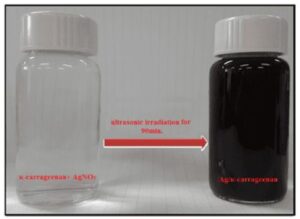
Green Sonochemical Route to Silver Nanoparticles
Silver nanoparticles (AgNPs) are frequently utilized nanomaterials due to their anti-microbial properties, optical properties and high electrical conductivity. The sonochemical route using kappa carrageenan is a simple, convenient and environmental-friendly synthesis method for the preparation of silver nano particles. κ-carrageenan…
https://www.hielscher.com/green-sonochemical-route-to-silver-nanoparticles.htm
GDmini2 – Ultrasonic Inline Micro-Reactor
The GDmini2 is an ultrasonic micro-reactor for the indirect, temperature-controlled sonication of liquid media. Applications include: Homogenization, emulsification, particle synthesis, solvent extraction, cell lysis and fragmentation. The GDmini2 is an ultrasonic homogenizer in the shape of a straight glass tube.…
https://www.hielscher.com/gdmini2-ultrasonic-inline-micro-reactor.htm
Ultrasonic Synthesis of Fluorescent Nanoparticles
Artificially synthesized fluorescent nanoparticles and quantum dots have emerged as transformative materials with manifold applications spanning electrooptics, optical data storage, biochemical analysis, and advanced medical diagnostics. Traditional synthesis methods often struggle to achieve consistent particle size, colloidal stability, and high…
https://www.hielscher.com/ultrasonic-synthesis-of-fluorescent-nano-particles.htm
Sonofragmentation – The Effect of Power Ultrasound on Particle Breakage
Sonofragmentation describes the breakage of particles into nano-sized fragments by high power ultrasound. In contrast to the common ultrasonic deagglomeration and milling - where particles are mainly grinded and separated by inter-particle collision - , sono-fragementation is distinguished by the…
https://www.hielscher.com/sonofragmentation-the-effect-of-power-ultrasound-on-particle-breakage.htm
Ultrasonic Treatment of Nanoparticles for Pharmaceuticals
Probe-type sonicators play a crucial role in pharmaceutical research and manufacturing by providing a powerful and controlled means of achieving particle size reduction, cell disruption, and homogenization. Sonicators utilize ultrasonic waves to generate cavitation, resulting in the formation and collapse…
https://www.hielscher.com/ultrasonic-treatment-of-nanoparticles-for-pharmaceuticals.htm
Sonicators for Liquid Processing in Lab and Production
As the leading manufacturer of sonicators of all sizes, Hielscher Ultrasonics specializes in high-performance ultrasonic homogenizers designed for lab, bench-top, and production-level applications. Whether your goal is mixing, dispersing, particle size reduction, extraction, or facilitating chemical reactions, we have the…
https://www.hielscher.com/
Ultrasonic Synthesis of Nanodiamonds
Due to its intense cavitational force, power ultrasound is a promising technique to produce micron- and nano-sized diamonds from graphite. Micro- and nano-crystalline diamonds can be synthesized sonicating a suspension of graphite in organic liquid at atmospheric pressure and room…
https://www.hielscher.com/ultrasonic-synthesis-of-nanodiamonds.htm
Sonochemical Effects on Sol-Gel Processes
Ultrafine nano-sized particles and spherical shaped particles, thin film coatings, fibers, porous and dense materials, as well extremely porous aerogels and xerogels are highly potential additives for the development and production of high performance materials. Advanced materials, including e.g. ceramics,…
https://www.hielscher.com/sonochemical-effects-on-sol-gel-processes.htm