Scale-Up Agrochemical Formulation with Industrial Sonicators
Agrochemical formulation requires dispersing, dissolving, emulsifying, and homogenizing compounds. Sonication is an effective method for creating high-quality chemical suspensions. It allows for the high-speed production of high-load formulations and facilitates the preparation of active ingredients like nanoparticles and polymers for highly functional agrochemicals.
Ultrasonic Manufacturing of Agricultural Chemicals
 The production of agrochemicals – including fertilizers (e.g., nitrogen- and phosphorus-based compounds) and crop protection agents (e.g., herbicides, insecticides, fungicides, and rodenticides) – requires precise dispersion, dissolution, and emulsification of their components. Power ultrasound addresses these processing needs by generating cavitation-induced high shear forces, which ensure consistent mixing, homogenization, and blending throughout formulation.
From stable suspensions to nano-dispersions, ultrasonic processing delivers superior consistency and higher throughput. Let our engineers analyze your current workflow and recommend a scalable solution to reduce energy consumption and improve product effectiveness.
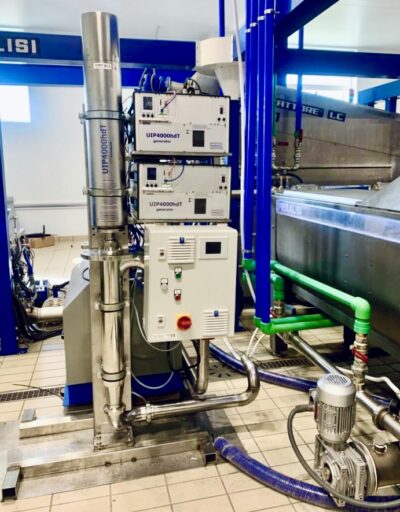
Industrial sonicator UIP4000hdT with flow cells for continuous inline processing of agrochemicals
Improve Crop Protection Products and Fertilizers with Sonication
How Crop Protection Products Benefit from Ultrasonics
- Suspension Concentrates (SCs): Milling active ingredients to sub-micron sizes to prevent settling and maximize field efficacy.
- Emulsifiable Concentrates (ECs): Producing stable, fine-mist oil-in-water emulsions to prevent phase separation.
- Wettable Powders: Deagglomerating dry powders to ensure rapid and complete wetting upon contact with water.
- Encapsulated Formulations: Uniformly dispersing polymer coatings to create controlled-release and UV-protective barriers.
How Fertilizers Benefit from Ultrasonics
- Liquid Fertilizers: Ensuring micronutrients don’t settle out (stabilizing suspensions).
- NPK Solutions: Preventing crystallization in high-concentration liquid fertilizers.
- Coated Urea: Improving the dispersion of polymers used in slow-release fertilizers.
The quality and effectiveness of agrochemicals is highly depending on the concentration, size and shape of active substances and additives as well as their interaction. This means that the dispersion, emulsion or suspension of the additives and active substances influences the expression of the desired features of a fertilizer or pesticide substantially. To produce high quality specialty chemicals such as agrochemicals, the liquid or solid particles must reliably processed: Ultrasonic particle size reduction, dispersion, emulsion and homogenization results in stable formulations and finally in high-quality chemical product.
Hielscher’s range of ultrasonic dispersers and homogenizers offers the suitable “work-horse” for your application!
Improved Agrochemical Formulations – Higher Efficiency
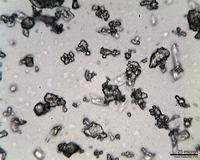 Agrochemical formulations typically combine one or more active ingredients with specialized additives to deliver the desired field performance. Depending on the application, these products are engineered as dispersions, emulsions, suspensions, microemulsions, or controlled-release systems. Achieving long-term stability requires precise control over the interaction forces between particles and droplets–a critical factor that directly impacts shelf life, efficacy, and regulatory compliance.
Ultrasonic processing addresses these formulation challenges by generating intense, localized shear forces through acoustic cavitation.
This technology reliably:
- Disperses solid powders uniformly into the liquid phase
- Emulsifies oils and waxes into stable, fine-mist mixtures
- Mills particles to precise sub-micron or nano-scale dimensions
- Accelerates the dissolution of salts and electrolytes
- Blends final formulations into highly homogeneous products
Beyond mechanical processing, power ultrasound actively supports advanced chemical transformations. It enhances reaction kinetics and enables specialized processes such as chemical synthesis, sonochemical catalysis, phase-transfer catalysis (PTC), polymerization, and the controlled synthesis or surface functionalization of nanoparticles. This versatility makes ultrasonic processing a valuable asset for both routine formulation workflows and next-generation agrochemical development.
Agrochemical ingredients processed with sonication include:
- Wettable Powders (WP)
- Water Dispersible Granules (WDG)
- Dry Flowables (DF)
- Flowables or Suspension Concentrates (SC)
- Emulsifiable Concentrates (EC)
- Soluble Liquid Concentrates (SLC)
- Water Soluble Granules (WSG)
Advantages of Ultrasonic AgroChemical Processing:
- High quality products
- Reliable ultrasonication
- Precisely controllable process conditions
- From R&D to production with Hielscher’s lab homogenizers, bench-top devices and industrial systems
- Fine chemicals manufacturing from kg to multi-ton batches
- Batch and inline processing
- Easy and safe operation
- Green, environmental-friendly technique
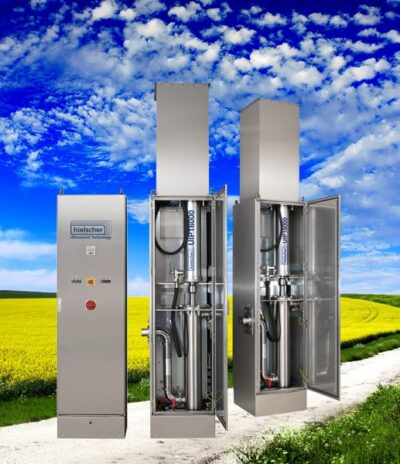
Industrial inline sonicator UIP16000hdT (16kW ultrasound power) for agrochemical production
Ingredients and Components in Agrochemicals
Agrochemical formulations are composed of various components. The most important ingredients include the active substances (such as chlorinated hydrocarbons e.g. DDT, 2,4-D, 2,4,5-T), organophosphates e.g. parathion and malathion, carbamates e.g carbaryl and carbofuran, triazine e.g. atrazine and simazine), polymers, nano particles, electrolytes (e.g. salts of glyphosate, fomesafen, glufosinate, paraquat), surfactant liquid crystals, intermediates (e.g. 2,2-Dimethoxypropane), gel systems, carriers (e.g. hydrocarbon fluids), anionic & non-ionic surfactants, adjuvants, oils, stabilizers and emulsifiers. These components must be reliably processed to formulate an effective agricultural product that protects plants and crop from harmful pest, pathogens and desease.
Hielscher Ultrasonics’ homogenizers are established as reliable industrial mixing equipment to produce high quality chemicals.
FAQ – Ultrasonic Mixing Technology for Agrochemical Production
What agrochemical products can be processed with ultrasonic technology?
Ultrasonic processing is used across a wide range of agrochemical products, including:
- Fertilizers – micronutrient dispersions, liquid fertilizers, and NPK formulations
- Pesticides – emulsifiable concentrates (EC), wettable powders (WP), suspension concentrates (SC)
- Herbicides, Insecticides, and Fungicides – active ingredient dispersion and formulation
- Seed Treatments – uniform coating and encapsulation
- Nanoparticle & Polymer Formulations – controlled synthesis and size reduction
Can Hielscher ultrasonic processors handle high-viscosity agrochemical formulations?
Yes. Hielscher ultrasonic processors are available in multiple configurations, including batch, inline, and multi-stage systems, designed to handle formulations of varying viscosities. For high-viscosity agrochemical products, specialized flow-through cells and high-amplitude sonotrodes ensure efficient energy transfer and uniform processing.
Is ultrasonic processing suitable for large-scale agrochemical production?
Absolutely. Hielscher provides industrial ultrasonic systems ranging from 100W to 16,000W per unit, with modular multi-unit configurations capable of processing liters to thousands of liters per hour. Many manufacturers use ultrasonic probes in inline flow-through mode, where the formulation is continuously sonicated through custom reactor vessels, enabling seamless scale-up from pilot to full production.
How do I choose the right ultrasonic processor for my agrochemical formulation?
The ideal ultrasonic processor depends on your formulation type, desired particle size, production volume, and processing mode (batch vs. inline). Our technical team can help you select the right equipment through:
- Free sample testing – bring your formulation to our application center for hands-on testing
- Process consultation – we’ll recommend optimal amplitude, energy input, and flow rate settings
- Custom reactor design – tailored flow cells and sonotrodes for your specific application
What are Agrochemical NPK Solutions?
NPK fertilizer supplies plants with three essential macronutrients–nitrogen (N), phosphorus (P), and potassium (K) – that drive vegetative growth, root development, and metabolic function. These fertilizers are typically manufactured in two forms: compound fertilizers, where nutrients are chemically bonded into uniform crystalline structures (e.g., monoammonium phosphate or potassium nitrate), and blended fertilizers, which are physical mixtures of granular or powdered components. Blended products offer flexible, customizable nutrient ratios but are prone to particle segregation during storage and transport, while compound formulations ensure consistent distribution but require precise chemical synthesis. In liquid or suspension-based NPK applications, advanced dispersion and mixing techniques – such as ultrasonic processing – can prevent crystallization, stabilize micronutrient suspensions, accelerate dissolution, and improve long-term formulation stability.
Literature/References
- Nenciu, F.; Fatu, V.; Arsenoaia, V.; Persu, C.; Voicea, I.; Vladut, N.-V.; Matache, M.G.; Gageanu, I.; Marin, E.; Biris, S.-S.; et al. (2023): Bioactive Compounds Extraction Using a Hybrid Ultrasound and High-Pressure Technology for Sustainable Farming Systems. Agriculture 2023, 13, 899.
- Pimentel, David (2002): Encyclopedia of Pest Management. CRC Press 2002.
- Tadros, Tharwat (2013): Agrochemical Formulations. in: Encyclopedia of Colloid and Interface Science. Springer 2013. 3-80.

Industrial Sonicators for Agrochemical Processing
Ultrasonic Processing in Agrochemical Production:
- Dispersing
- Synthesis of nano particles
- Emulsification
- Dissolving
- Wettening & Hydration
- Particle functionalization
- Humic Acid Extraction
- Polymerization
- Sonochemical Synthesis
- Phase transfer catalysis (PTC)