Ultrasonic topic: "flow cell"
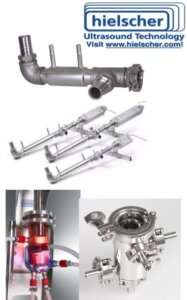
A flow cell or flow reactor is an accessory, which makes it possible to process material, e.g. by sonication, in a continuous inline process. Ultrasonic processes can be run as batch process or in continuous flow mode using an ultrasonic flow cell. The advantages of an ultrasonic in-line process using a flow cell reactor are the more uniform processing of the medium, the application of pressure, which is an important parameter, and the convenient, efficient sonication of large volumes.
A pump feeds the raw material into the ultrasonic flow cell reactor, where ultrasonic power is highly can be focused and concentrated on a small volume. This results in a more uniform processing and higher product quality. A back pressure valve can be used to increase the pressure in the flow cell. This intensifies the acoustic cavitation, resulting in higher hydraulic shear and pressure and temperature differentials due to a more violent implosion of the cavitation bubbles.
Hielscher Ultrasonics offers manifold flow cell and reactor types with varying sizes and geometries. Used in combination with Hielscher high-performance ultrasonic processors, the right configuration of sonotrode and flow cell allow for optimal process conditions and superior sonication output.
Read more about ultrasonic flow cell reactors and their use in lab, pilot and industrial applications!
Found 37 hits. Showing results 13 - 24.

High Shear Mixing with Ultrasonics
High shear mixers apply high shear forces into liquids and slurries in order to provide the uniform dispersing, blending, and emulsification of two or more liquid-solid or liquid-liquid phases. Ultrasonication generates high shear forces via acoustic cavitation, which occurs when…
https://www.hielscher.com/high-shear-mixing-with-ultrasonics.htm
Ultrasonic Disintegration: Wetting, Dissolving, Dispersing
Ultrasonic integrators are widely used to wet, disperse or dissolve particles and powders into liquids. High-performance ultrasonicators create intense shear forces, which break and shatter aggregates, agglomerates and primary particles to microscopic or nano size. The uniform particle processing in…
https://www.hielscher.com/disintegration-wetting-dissolving-dispersing.htm
Ultrasonic Disintegrators
Cell disintegration is a common task in biotechnology and in many applications that involve processing cells and intracellular material. Ultrasonic cell disintegrators are efficient and reliable, when it comes to breaking cell wall or membranes of plant cells, mammalian tissue,…
https://www.hielscher.com/ultrasonic-disintegrators.htm
Improved Remdesivir Solubility by Sonication
Remdesivir (GS-5734) is an anti-viral drug, which is under research for treating the Ebola virus disease and COVID-19, which is caused by the Sars-CoV-2 coronavirus. Remdesivir is pharmaceutical solution, which is administered intravenously. Whilst short ultrasonic dissolving alone enhances the…
https://www.hielscher.com/improved-remdesivir-solubility-by-sonication.htm
Ultrasonic Collagen Extraction from Jellyfish
Jellyfish collagen is a high-quality collagen, which is unique but exhibits similar properties to type I, II, III and type V collagen. Ultrasonic extraction is a purely mechanical technique, that increases yield, accelerates the process and produces high molecular weight…
https://www.hielscher.com/ultrasonic-collagen-extraction-from-jellyfish.htm
Ultrasonic Nano-Emulsification for Microencapsulation before Spray-Drying
In order to microencapsulate active ingredients via spray-drying, a fine-sized stable micro- or nanoemulsion must be prepared. Ultrasonic emulsification is a facile and reliable technique to produce stable micro- and nano-emulsions As alternative surfactant, biopolymers such gum arabi or WPI…
https://www.hielscher.com/ultrasonic-nano-emulsification-for-microencapsulation-before-spray-drying.htm
Ultrasonic Milling of Thermoelectrical Nano-Powders
Research has shown that ultrasonic milling can be successfully used for fabrication of thermoelectric nanoparticles and has the potential to manipulate the surfaces of the particles. Ultrasonically milled particles (e.g. Bi2Te3-based alloy) showed a significant size reduction and fabricated nano-particles…
https://www.hielscher.com/ultrasonic-milling-of-thermoelectrical-nano-powders.htm
Ultrasonic Extraction of Spirulina Pigments
Ultrasonic extraction has been proven to be highly efficient for the isolation of superior quality extracts of microalgae. Spirulina pigments such as phycocyanin are known as superfood, which contribute to health benefits due to their high content of antioxidants, vitamins…
https://www.hielscher.com/ultrasonic-extraction-of-spirulina-pigments.htm
UIP4000hdT – 4kW High Performance Ultrasonics
The UIP4000hdT delivers up to 4kW ultrasound power and is a reliable production machine even under demanding conditions. It is designed for industrial processes with a higher energy demand and large volumes. The UIP4000hdT is a robust and powerful ultrasonic…
https://www.hielscher.com/uip4000hdt-4kw-high-performance-ultrasonics.htm
Ultrasonic Steeping of E-Liquids
Ultrasonic steeping enhances the flavour of e-liquids / e-juices significantly. The ultrasonic steeping treatment offers two major benefits: First, ultrasonic steeping gives a unique flavour profile, which is characterized by a full, round and smooth taste. Secondly, with an industrial…
https://www.hielscher.com/ultrasonic-steeping-of-e-liquids.htm
Ultrasonic Production of Conductive Inks on Large Scale
Uniformly dispersed nanoparticles such as silver, graphene or CNTs with an precisely tailored particle size are crucial for production highly conductive inks. Powerful ultrasonic dispersers allow to synthesize, deagglomerate and distribute metallic (e.g. Ag), carbon-based (e.g. CNTs, graphene) nanoparticles as…
https://www.hielscher.com/ultrasonic-production-of-conductive-inks-on-large-scale.htm
Ultrasonic Dispersion of Polishing Agents (CMP)
Non-uniform particle size and inhomogeneous particle size distribution causes severe damages to the polished surface during a CMP process. Ultrasonic dispersion is a superior technique to disperse and deagglomerate nano-sized polishing particles. The uniform dispersion achieved by sonication results in…
https://www.hielscher.com/ultrasonic-dispersion-of-polishing-agents-cmp.htm