Ultrasonic topic: "What is Ultrasonication?"
What is ultrasonication? This powerful technique uses high-frequency sound waves to generate intense shear forces and cavitation in liquids. Also known as the ultrasonication method, it allows scientists, engineers, and manufacturers to break down particles, mix immiscible substances, and enhance chemical reactions.
When you ultrasonicate a mixture, you create microscopic bubbles that collapse with enough energy to disrupt cell walls, emulsify oils, and dissolve materials. People in food processing, pharmaceuticals, and materials science often rely on ultra sonication to improve extraction yields, accelerate reactions, and ensure a uniform product. Researchers find that effectively ultrasonicating solutions opens the door to countless new applications.
Whether you handle delicate compounds or want to intensify industrial processes, you can choose ultra-sonication to achieve faster and more efficient results. The ultrasonication approach ensures minimal thermal damage and boosts both reproducibility and scalability. Manufacturers use this technology to produce fine dispersions in paints and coatings, while biologists apply it to break open cells for DNA extraction. Because you can control amplitude, time, and temperature precisely, you get a custom-tailored process that meets your specific production or research goals. This level of control reduces waste, saves energy, and streamlines workflows without sacrificing product integrity.
Hielscher delivers ultrasonication for professionals who aim to maximize their processing potential. Robust ultrasonicators combine high power with intuitive software, which allows you to monitor and adjust ultrasonic parameters in real time. You gain a reliable setup that operates continuously while maintaining precise output, even under demanding conditions. Hielscher devices let you ultrasonicate small research samples or tackle larger production volumes without compromising performance. You can trust Hielscher devices to deliver consistent, high-quality ultrasonication results because they feature user-friendly interfaces, durable components, and efficient designs that optimize the entire ultra-sonication process.
Read more below about ultrasonication, methods and multiple applications!

Found 49 hits. Showing results 37 - 48.

Ultrasonically Assisted Fermentation for Bioethanol Production
Ultrasonically-assisted fermentation can enhance bioethanol production by promoting the breakdown of complex carbohydrates into simpler sugars, making them more readily available for yeast to convert into ethanol. Simultaneously, sonication also improves the efficiency of yeast cell wall permeability, allowing for…
https://www.hielscher.com/ultrasonically-assisted-fermentation-for-bioethanol-production.htm
Enhancing Efficiency of Bioenergy Production with Power Ultrasound
The application of high-intensity ultrasound (sonication) to renewable energy production represents a significant advancement in process efficiency. By leveraging acoustic cavitation, ultrasonic technology enhances mass transfer, disrupts cell structures, and accelerates chemical reactions across various biofuel production pathways, including biodiesel,…
https://www.hielscher.com/renewable_fuels_01.htm
Ultrasonic Waste and Sludge Treatment
Biogas is generated from sources, such as municipal organic waste, sewage sludge, muck or manure. Ultrasonication improves the digestibility of such organic material leading to more biogas and less residual sludge. Biogas is a byproduct of the decomposition of organic…
https://www.hielscher.com/sludge01.htm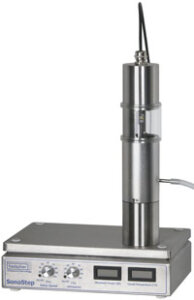
SonoStep – Sample Preparation in a Single-Step
The SonoStep combines ultrasonication, stirring and pumping of samples in a compact design. It is easy to operate and can be used to deliver sonicated samples to analytic devices, e.g. for particle size measurement. Ultrasonication helps to disperse agglomerated particles…
https://www.hielscher.com/sonostep_sample_preparation.htm
Ultrasonic Processing for Liquids, Slurries, and Chemical Reactions
Ultrasonication is a mechanical processing method which creates acoustic cavitation and highly intense physical forces. Therefore, ultrasonics is used for numerous applications such as mixing, homogenization, milling, dispersion, emulsification, extraction, degassing, and sono-chemical reactions. Find your application in the table…
https://www.hielscher.com/technolo.htm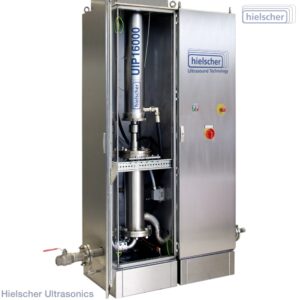
Ultrasonic Wet-Milling: Fine Particles, Precisely Engineered
Hielscher sonicators are efficient milling equipment for high-efficiency particle size reduction, nano-dispersion, and emulsification through controlled, high-intensity ultrasonic cavitation. Engineered for both research and industrial scale, these systems reliably break down agglomerates, refine powders, and create homogeneous suspensions across pharmaceuticals,…
https://www.hielscher.com/mill_01.htm
Ultrasonic Mixing For High-Performance Concrete
The use of micro- and nanosilica or nanotubes leads to improvements in the compressive strength of high-performance concrete. Ultrasonication is an effective means for the mixing, wetting and dispersing of nanomaterials in cement or concrete. Micro silica is widely…
https://www.hielscher.com/nano_cement_concrete_01.htm
UIP1000-Exd – 1.0kW ATEX Ultrasonic Mixer
The UIP1000-Exd (20 kHz, 1000 W) is a safety-certified ultrasonic processor engineered specifically for handling flammable liquids and solvents in hazardous environments. Fully ATEX-compliant, it delivers controlled, high-intensity cavitation for critical formulation tasks–including emulsification of immiscible phases, uniform particle dispersion,…
https://www.hielscher.com/i1000exd_atex_p.htm
Ultrasonic Degassing and Defoaming of Liquids
Degassing and defoaming of liquids using ultrasonic is a very effective process. Ultrasonication removes small suspended gas-bubbles from the liquid and reduces the level of dissolved gas below the natural equilibrium level. The degassing and defoaming of liquids is required…
https://www.hielscher.com/degassing_01.htm
Frequently Asked Questions on Ultrasonics
Below you will find answers to the most common questions regarding ultrasonication. If you do not find an answer to your question, please do not hesitate to ask us. We will be glad to assist you. Can I sonicate solvents?…
https://www.hielscher.com/glossary.htm
Ultrasonic Homogenizers for Lab, Pilot and Industrial Processing
Ultrasonic homogenizers are powerful tools to mix and homogenize solid-liquid and liquid-liquid suspensions. Ultrasonic homogenization is a mechanical process to reduce particles in a liquid so that they become uniformly small and evenly distributed. Hielscher offers powerful ultrasonic homogenizers for…
https://www.hielscher.com/homogenize_01.htm
UP50H – Compact Lab Homogenizer
The ultrasonic processor UP50H is typically used for the sonication of small lab samples. This homogenizer allows for the handheld or stand-mounted emulsification, dispersing, dissolving or cell disruption. The ultrasonic processor UP50H (50 watts, 30kHz) is the smallest model of…
https://www.hielscher.com/50h_p.htm