Chemical Reactors Enhanced by Sonication – Types, Designs and Mechanisms
Chemical reactors are the core of industrial chemistry, materials synthesis, fine chemical production, pharmaceutical manufacturing and environmental processing. As industries seek faster, cleaner and more energy-efficient processes, sonication, also known as ultrasonic processing, has become an increasingly relevant method for reactor intensification. Ultrasonic reactor technology is reshaping chemical processing by improving mixing, mass transfer, reaction kinetics and heterogeneous catalysis in batch and continuous reactor systems.
How Sonication Improves Chemical Reactors
By introducing high-power ultrasound into a chemical reactor, engineers can generate ultrasonic oscillatory flow mixing and acoustic cavitation inside the reaction medium. These mechanisms improve contact between reactants, accelerate mass transfer and can enhance reaction rates, selectivity and yield. Sonication is especially effective in solid-liquid systems, such as heterogeneous catalysis, and liquid-liquid systems, such as emulsification, extraction and biphasic reactions. It is used less frequently in gas-liquid mixtures because acoustic cavitation is generated less efficiently in liquids with high gas contents.
In modern sonochemical reactor design, fluids are agitated by ultrasonic oscillation and cavitation, typically using amplitudes in the range of 10 to 200 µm. This enables powerful microscopic mixing effects that are difficult to achieve with conventional mechanical agitation alone.
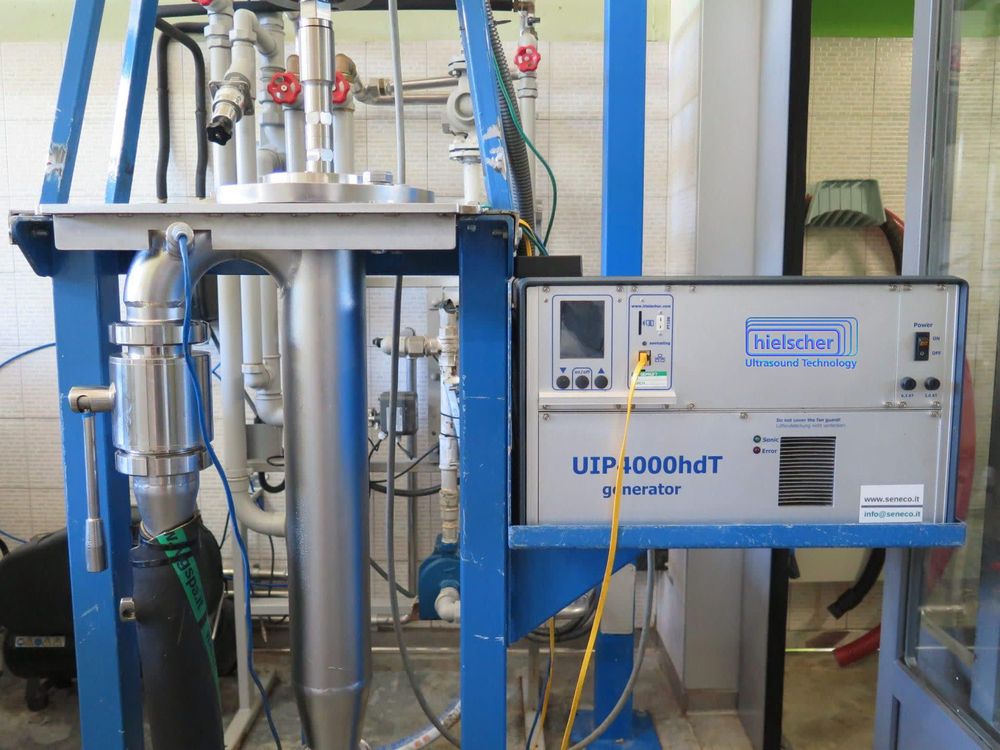
Inline sonicator UIP4000hdT with flow cell for intensified chemical reactions
Why Sonication Intensifies Chemical Reactors
The industrial relevance of sonication lies in its ability to influence chemical and physical transport phenomena at the micro- and meso-scale. Unlike conventional stirring, ultrasound does not merely move bulk liquid. It generates pressure waves, oscillatory motion, cavitation bubbles and localized high-energy zones.
When acoustic cavitation bubbles form, grow and collapse, they create intense micro-environments. These events can produce:
- high local shear forces
- microjets near solid surfaces
- shock waves
- rapid micro-mixing
- enhanced particle dispersion
- improved interfacial contact
- accelerated mass and heat transfer
- surface cleaning and catalyst activation effects
These phenomena make sonication highly valuable for process intensification, particularly when reactions are limited by diffusion, poor phase contact, catalyst fouling or insufficient mixing.
Sonication in Batch Reactors
Batch reactors are widely used in laboratories, pilot plants and specialty chemical production. They are flexible, easy to operate and suitable for reaction screening, small-volume synthesis and high-value products.
When sonication is applied to batch reactors, it can significantly improve mixing and reaction uniformity. Ultrasonic probes, flow cells or externally mounted transducers can introduce acoustic energy directly into the reaction medium.
In batch systems, sonication is particularly useful for:
- heterogeneous catalysis
- nanoparticle synthesis
- crystallization control
- emulsification
- extraction
- polymerization
- dissolution and dispersion of solids
For solid-liquid reactions, ultrasound can prevent particle agglomeration and improve access to catalytic or reactive surfaces. In liquid-liquid systems, sonication can create fine emulsions and increase the interfacial area between immiscible phases, which often leads to faster reaction rates.
Flow-Through Reactors for Continuous Sonochemical Processing
Flow-through reactors are among the most important designs for industrial sonication. Instead of treating a fixed volume of liquid, the reaction mixture continuously passes through an ultrasonic reactor chamber.
This design is highly attractive for scale-up because it allows engineers to control residence time, flow rate, temperature, pressure and ultrasonic energy input more precisely. Flow-through sonochemical reactors are often used when consistent product quality and continuous operation are required.
The main advantages of sonicated flow-through reactors include:
- continuous production capability
- improved process reproducibility
- better temperature control
- controlled residence time distribution
- easier integration into industrial process lines
- scalable reactor architecture
In these systems, ultrasonic oscillatory flow mixing can enhance radial and axial mixing, reduce concentration gradients and improve the interaction of reactants. This is particularly valuable in processes where reaction performance depends on fast phase contact or rapid dispersion.
Ultrasonic Flow-Cell Insert MultiPhaseCavitator
 The MultiPhaseCavitator Insert-MPC48 is a specialized insert for Hielscher ultrasonic flow cell reactors designed to intensify liquid/liquid and liquid/gas processes directly in the ultrasonic cavitation zone. By injecting a second liquid phase or gas phase through 48 fine cannulas into the primary liquid stream, the MultiPhaseCavitator creates very small droplets or gas bubbles with a high specific interfacial area. This makes it especially efficient for ultrasonic emulsification, where immiscible phases are dispersed into fine emulsions, and for catalytic gas reactions, where the injected gas phase is rapidly dispersed and brought into intimate contact with the liquid phase, dissolved reactants, or suspended catalysts. The resulting cavitational shear, micro-mixing, and enhanced mass transfer can improve reaction kinetics, phase-boundary contact, and process efficiency in continuous or batch flow-through operation.

Sonicator UIP2000hdT with chemical batch reactor
Chemical Reactor Designs and the Benefits of Sonication
| Reactor Type | Typical Application | Main Sonication Effects | Technical Relevance |
|---|---|---|---|
| Slurry Reactors | Heterogeneous catalysis with suspended solid catalyst particles in a liquid phase; used in hydrogenation, oxidation, biomass conversion, Fischer-Tropsch-type processes, photocatalysis and wastewater treatment. | Sonication improves catalyst dispersion, particle deagglomeration, boundary layer reduction, surface renewal, liquid-solid mass transfer, catalyst surface cleaning and fouling reduction. | Particularly relevant because many slurry-phase catalytic reactions are limited by how efficiently reactants reach active sites. Acoustic cavitation enhances contact at the catalyst-liquid interface and can improve reaction kinetics. |
| Continuously Stirred Tank Reactors (CSTRs) | Continuous liquid-phase reactions, emulsification, catalytic reactions, precipitation, crystallization, polymer reactions and solid-liquid suspensions. | Ultrasound enhances micro-mixing, particle suspension, emulsification, dispersion and local energy input. It can be combined with mechanical stirring to improve both macro-mixing and micro-mixing. | Sonicated CSTRs are useful when conventional impellers cannot fully eliminate dead zones, poor dispersion or local mass-transfer limitations. Ultrasound supports more uniform reaction conditions and improved process intensification. |
| Fixed Bed Reactors | Stationary catalyst beds used in hydrogenation, oxidation, environmental catalysis, petrochemical processing and liquid-phase heterogeneous catalysis. | Sonication can improve catalyst wetting, liquid movement through the bed, boundary layer reduction, surface cleaning, fouling mitigation and mass transfer to catalytic sites. | Fixed bed performance is often limited by channeling, poor wetting, diffusion resistance and deposit formation. Ultrasonic process intensification can improve catalyst utilization and reaction uniformity. |
| Fluidized Bed Reactors | Dynamic beds of suspended particles used in catalysis, particle processing, coating, polymerization, drying and solid-liquid reactions. | Ultrasonic excitation can improve particle dispersion, reduce agglomeration, enhance fluid-solid contact, stabilize suspensions and improve catalyst surface accessibility. | Sonication is especially effective in liquid-solid fluidized beds, where cavitation can be generated efficiently. In gas-rich systems, cavitation is less effective, making ultrasound more suitable for liquid-based reactor applications. |
| Membrane Reactors | Integrated reaction-separation systems used for selective product removal, reactant dosing, catalytic membrane processes and filtration-assisted reactions. | Ultrasound can reduce membrane fouling, improve permeate flux, enhance surface cleaning, reduce concentration polarization and improve mixing near the membrane interface. | Sonication links reaction engineering with separation science. It is especially valuable where fouling, mass-transfer resistance or weak reaction-separation coupling limits membrane reactor performance. |
Mechanisms of Ultrasonic Reactor Intensification
The advantages of sonication in chemical reactors are based on several interacting mechanisms.
- Acoustic cavitation is the most important mechanism. It involves the formation, growth and collapse of microscopic bubbles in a liquid exposed to high-intensity ultrasound. Bubble collapse generates localized energy release and strong mechanical forces.
- Acoustic streaming creates steady fluid motion induced by ultrasonic waves. This improves mixing and transport in zones where mechanical stirring may be weak.
- Oscillatory flow mixing occurs when ultrasonic vibration causes rapid back-and-forth movement of the liquid. In reactor systems, amplitudes of approximately 10 to 200 µm can produce highly effective agitation and improved mass transfer.
- Microjetting and shock waves occur near collapsing cavitation bubbles, especially close to solid surfaces. These effects can clean catalyst surfaces, disrupt boundary layers and improve liquid access to active sites.
- Interfacial area enhancement is particularly important in liquid-liquid systems. Ultrasound can create fine droplets and stable dispersions, increasing the area available for reaction or mass transfer.
Together, these mechanisms make sonication a powerful tool for chemical reactor intensification.
Industrial Relevance of Sonochemical Reactor Design
The industrial importance of sonicated reactors extends beyond faster mixing. Sonication provides a way to manipulate reaction environments at scales that conventional equipment cannot easily reach.
In chemical engineering, many reactor limitations arise from transport phenomena rather than intrinsic reaction rates. Reactants may not reach catalytic sites quickly enough. Immiscible liquids may have insufficient contact area. Solids may agglomerate. Membranes may foul. Catalyst surfaces may become blocked.
Sonication addresses these constraints by directly enhancing the physical conditions inside the reactor. This makes it relevant to several research and industrial priorities:
- greener chemical processing
- lower energy and solvent demand
- improved catalyst efficiency
- higher reaction selectivity
- faster process development
- continuous manufacturing
- intensified modular reactor systems
- advanced materials synthesis
- sustainable conversion of biomass and waste streams
For researchers, sonication offers a controlled method to study the relationship between acoustic energy input, cavitation behavior, transport enhancement and chemical performance. For industry, it offers a practical path toward compact, efficient and scalable reactor systems.

Ultrasonic homogenizer UIP2000hdT for chemical reactions in a flow-reactor
Advantages of Sonication in Chemical Reactors
The integration of ultrasound into reactor design offers several operational and scientific advantages:
- faster reaction rates through improved mass transfer
- better mixing in multiphase systems
- enhanced dispersion of solids and droplets
- improved catalyst utilization
- reduced diffusion limitations
- cleaner catalyst and membrane surfaces
- improved process reproducibility in flow systems
- potential reduction in temperature, pressure or reaction time
- compatibility with batch and continuous operation
- strong relevance for heterogeneous catalysis and biphasic reactions
These benefits make ultrasonic reactor technology especially attractive for fine chemicals, specialty chemicals, catalysis, nanomaterials, green chemistry and process intensification.

Ultrasonic glass flow cell
Intensify Your Chemical Reactor with Hielscher Sonicators!
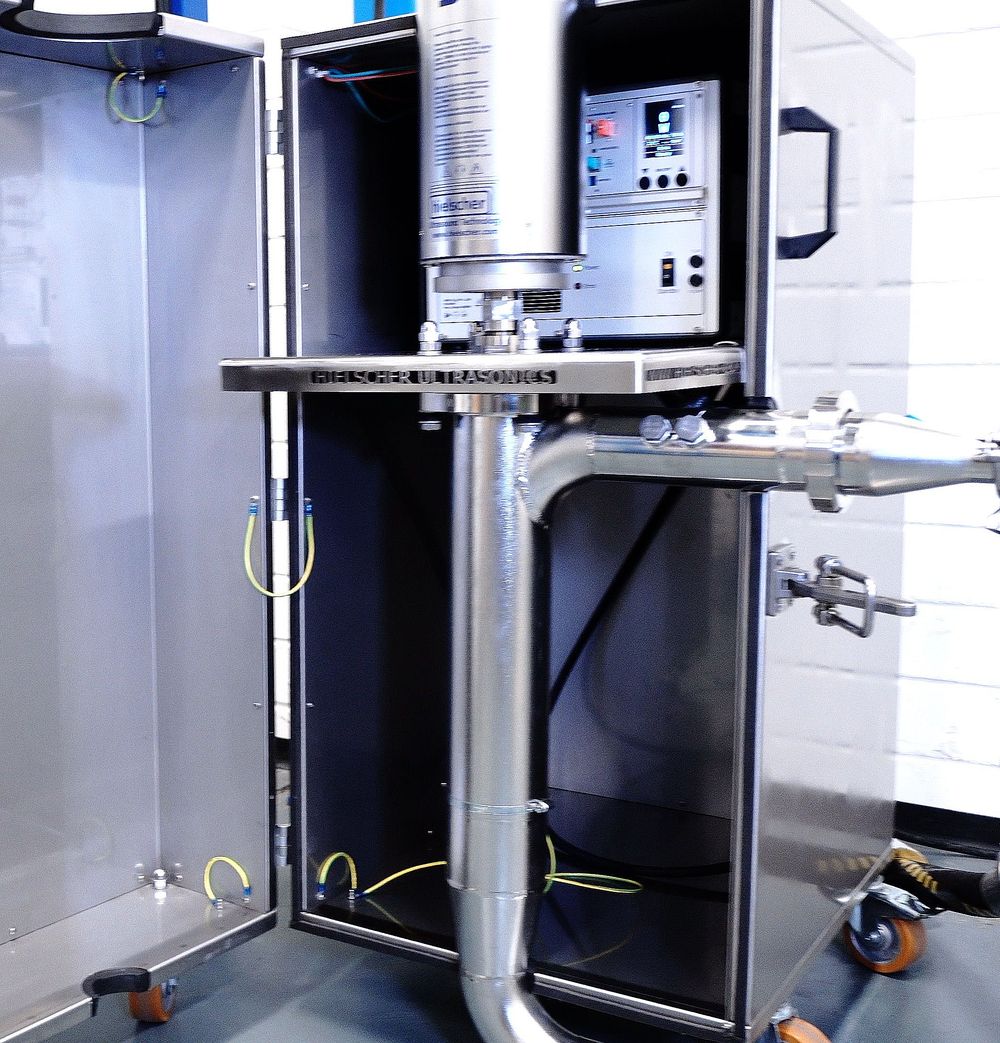 Hielscher sonicators are well suited for customized integration into chemical reactors because they are available as robust, high-power ultrasonic systems with adaptable sonotrodes, flow cells, reactor inserts, and process-specific accessories. Depending on the reaction setup, Hielscher ultrasonic processors can be installed in batch reactors, continuously stirred tank reactors, inline flow reactors, recirculation loops, pressurized systems, and pilot or production-scale plants. This flexibility allows ultrasound to be applied exactly where cavitation is most effective: at the liquid-solid, liquid-liquid, or liquid-gas interface. Hielscher Ultrasonics also offers various types of ultrasonic batch and inline reactors, enabling controlled sonochemical processing, emulsification, dispersion, catalyst activation, surface cleaning, mass-transfer intensification, and reaction acceleration. With precise control of amplitude, power input, temperature, pressure, flow rate, and residence time, Hielscher sonicators can be tailored to the specific requirements of laboratory research, process development, scale-up, and industrial chemical production.
The table below gives you an indication of the approximate processing capacity of our ultrasonicators:
| Batch Volume | Flow Rate | Recommended Devices |
|---|---|---|
| 1 to 500mL | 10 to 200mL/min | UP100H |
| 10 to 2000mL | 20 to 400mL/min | UP200Ht, UP400St |
| 0.1 to 20L | 0.2 to 4L/min | UIP2000hdT |
| 10 to 100L | 2 to 10L/min | UIP4000hdT |
| 15 to 150L | 3 to 15L/min | UIP6000hdT |
| n.a. | 10 to 100L/min | UIP16000hdT |
| n.a. | larger | cluster of UIP16000hdT |
Design, Manufacturing and Consulting – Quality Made in Germany
Hielscher ultrasonicators are well-known for their highest quality and design standards. Robustness and easy operation allow the smooth integration of our ultrasonicators into industrial facilities. Rough conditions and demanding environments are easily handled by Hielscher ultrasonicators.
Hielscher Ultrasonics is an ISO certified company and put special emphasis on high-performance ultrasonicators featuring state-of-the-art technology and user-friendliness. Of course, Hielscher ultrasonicators are CE compliant and meet the requirements of UL, CSA and RoHs.

Ultrasonic homogenizer UIP1500hdT with a flow reactor equipped with cooling jacket to control process temperature during sonication.
Frequently Asked Questions
What are Chemical Reactors?
Chemical reactors are engineered vessels or systems in which chemical reactions are carried out under controlled conditions such as temperature, pressure, mixing, residence time, and reactant concentration. Their purpose is to convert raw materials into desired products with defined yield, selectivity, and process efficiency.
What are the Main Types of Chemical Reactors?
The main types of chemical reactors include batch reactors, continuously stirred tank reactors, plug flow reactors, fixed bed reactors, fluidized bed reactors, slurry reactors, membrane reactors, and photochemical or electrochemical reactors. Each reactor type differs in flow behavior, mixing regime, heat and mass transfer characteristics, and suitability for homogeneous or heterogeneous reactions.
What is the Difference between a Fluidized Bed Reactor and a Fixed Bed Reactor?
In a fixed bed reactor, solid catalyst particles remain stationary while reactants flow through the packed catalyst bed. In a fluidized bed reactor, an upward-flowing fluid suspends and moves the solid particles, creating a dynamic bed with strong mixing, improved heat transfer, and better particle-fluid contact. Fixed beds are simpler and mechanically stable, while fluidized beds provide higher mixing and heat-transfer efficiency but require more complex flow control.
What is a Catalyst Bed?
A catalyst bed is a defined volume of solid catalyst particles arranged inside a reactor. It provides the active surface on which chemical reactions occur. Catalyst beds may be stationary, as in fixed bed reactors, or dynamically suspended, as in fluidized bed reactors. Their performance depends on catalyst activity, particle size, porosity, surface area, flow distribution, heat transfer, and mass transfer.
Literature / References
- Yu, Hang Gao, Jing; Zhong, Qili; Guo, Yahui; Xie, Yunfei; Yao, Weirong; Zhou, Weibiao (2018): Acoustic pressure and temperature distribution in a novel continuous ultrasonic tank reactor: a simulation study. IOP Conference Series: Materials Science and Engineering 2018.
- Francisco J. Navarro-Brull; Andrew R. Teixeira; Jisong Zhang; Roberto Gómez; Klavs F. Jensen (2018): Reduction of Dispersion in Ultrasonically-Enhanced Micropacked Beds. Industrial & Engineering Chemistry Research 57, 1; 2018. 122–128.
- M. Ajmal, S. Rusli, G. Fieg (2016): Modeling and experimental validation of hydrodynamics in an ultrasonic batch reactor. Ultrasonics Sonochemistry, Volume 28, 2016. 218-229.
- L. Castrillón, E. Marañón, Y. Fernández-Nava, P. Ormaechea, G. Quiroga (2013): Thermophilic co-digestion of cattle manure and food waste supplemented with crude glycerin in induced bed reactor (IBR). Bioresource Technology, Volume 136, 2013. 73-77.
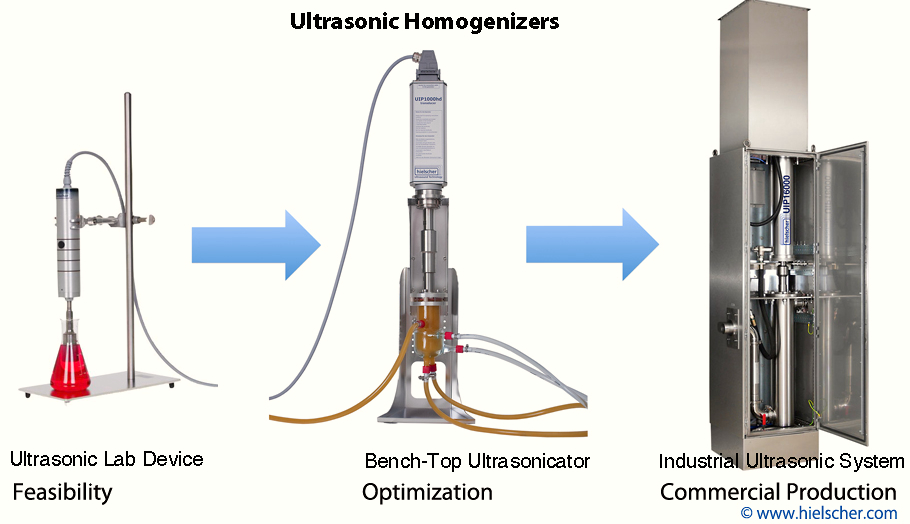
Hielscher Ultrasonics manufactures high-performance ultrasonic homogenizers from lab to industrial size.