Cell Culture-Based Viral Vaccines – Efficient Cell Disruption with Sonication
Hielscher sonicators facilitate cell disruption and solubilization of virus-infected cell cultures (e.g. Vero) for viral harvest in vaccine production. Take advantage of reliable, efficient lysis of cell cultures using high-performance sonication!
Cell Disruption for Viral Harvest in Cell Culture-Based Vaccines
Cell culture-based vaccine production, e.g. in Vero, MDCK, EB66, CHO or PER.C6 cell lines, requires the recovery of the virus from the culture at the end of the infection cycle. Depending on the virus, a large share of the harvested virus is cell-associated, either intracellular or bound to the cell membrane. A complete and gentle harvest therefore depends on efficient cell disruption and solubilization of the cell mass. Ultrasonic lysis is a reliable and long-time established method for the disruption of cells and the subsequent release of viruses, viral proteins, DNA and RNA. Treating virus-infected cell cultures, sonication – the application of high-intensity ultrasound – opens the cells, detaches virus particles from membranes and cell debris and homogenizes the harvest into a pumpable, low-viscosity suspension that can be fed directly to clarification, centrifugation and chromatography.
How Does Sonication Work?
Ultrasonic cell disruption is based on purely mechanical forces. Acoustic cavitation generates intense local shear and microstreaming which break the cell membranes and promote mass transfer between cell interior and the surrounding medium.

Ultrasonic vaccine production system: Industrial sonicator UIP2000hdT with stainless steel reactor
What are the Advantages of Ultreasonic Cell Disruption?
This working mechanism gives sonication a decisive advantage over chemical lysis: no detergents, lysozyme, proteinase K or other lysis reagents are required which may alter the lysate, interfere with downstream purification or have to be removed before further processing. Enzymatic disruption, in contrast, needs long incubation times and often delivers non-reproducible results. Because the intensity of the ultrasonic treatment can be adjusted exactly to the biological sample, over-processing, degradation and yield loss are avoided.
Apply sonication to:
- disrupt and lyse virus-infected cells of adherent and suspension cultures
- release intracellular and membrane-associated virus particles
- solubilize the cell mass and reduce the viscosity of the harvest
- homogenize and deagglomerate cell debris for easier clarification
- disperse virus clusters into a uniform suspension
- inactivate pathogens at defined amplitude, pressure and exposure time
- intensify detergent- or enzyme-based lysis steps where these are required
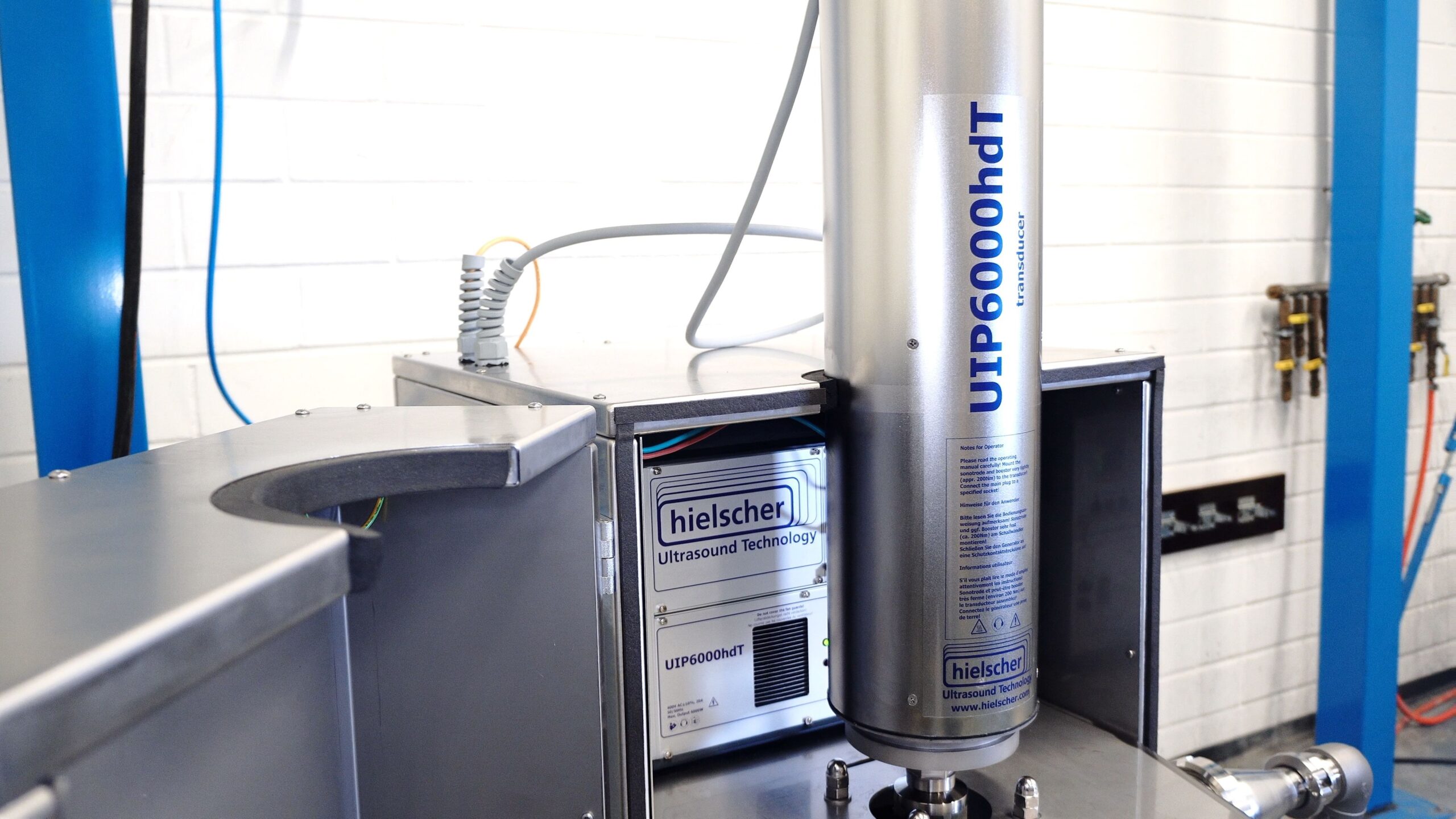
Industrial-scale ultrasonic cell disruption: Sonicator UIP6000hdT with stainless steel flow cell for continuous processing of virus-infected cell cultures.
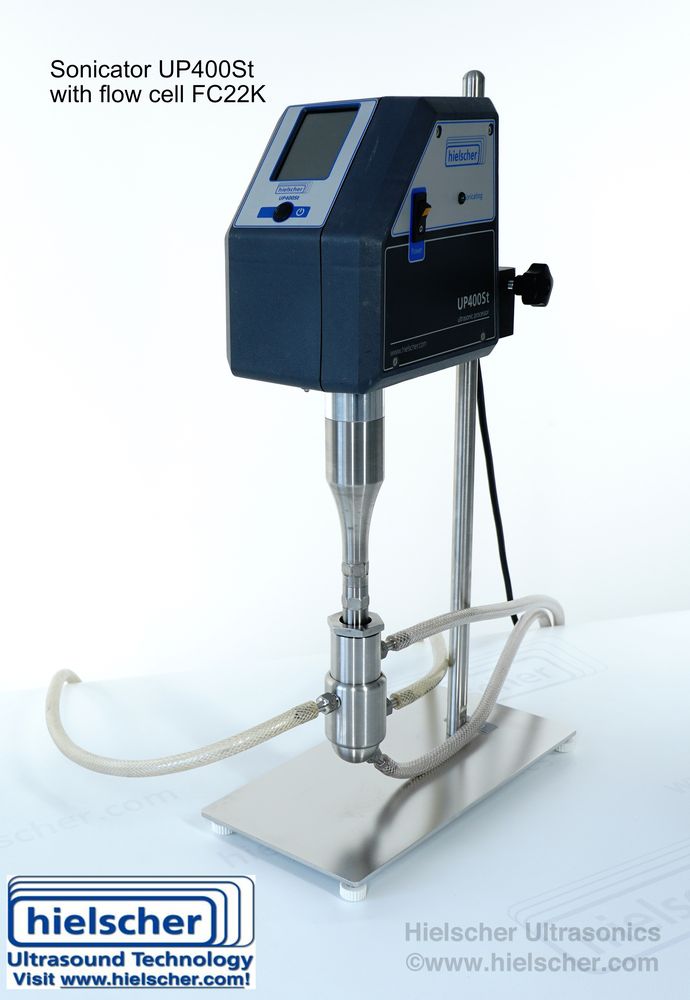
Sonicator UP400St with flow cell FC22K for inline cell disruption
Why Should I Use Sonication for Viral Harvest?
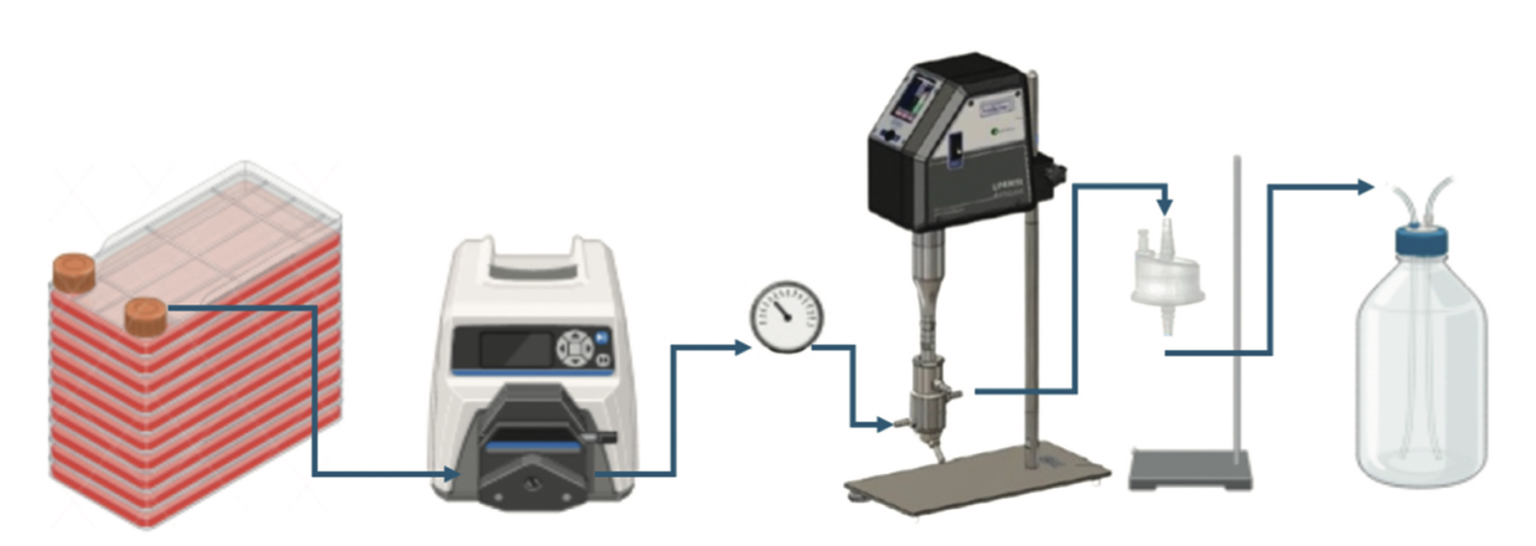
Diagram of inline processing of monovalent rotavirus bulk. Bulk material was aseptically processed directly from the culture vessel (CF-10), transferred via peristaltic pump through a sonicator flow cell to disrupt any remaining cellular debris. The sonicated material was then filter-clarified before being deposited into an intermediate container for stabilization.
Study and image: Langston et al., 2026.
Advantages
- precisely adjustable to the process
- chemical-free, purely mechanical lysis
- clean & hygienic processing, CIP/SIP-compatible flow cells
- highly reproducible with automatic data logging
- linear scale-up from lab to production
- easy & safe operation, browser remote control
- reliable & robust equipment for 24/7 duty
- high energy efficiency, approx. 80–90% from power plug into the liquid
Typical Process Set-Up for Viral Harvest
- Harvest and concentrate. Recover the infected cell culture (harvest broth, cell scrape from fixed-bed or single-use bioreactors, or centrifuged cell pellet resuspended in buffer).
- Condition. Adjust buffer, pH and temperature. Sonication also improves the mixing and dissolution of lysis buffer components if a buffer- or detergent-assisted step is used.
- Ultrasonic disruption. Pass the suspension through a jacketed, temperature-monitored flow cell (recirculation for batch work, single or multi-pass for continuous inline processing). Set amplitude and residence time to the minimum that achieves the target disruption rate, so viral antigens are preserved.
- Optional inactivation. Apply higher amplitude, elevated pressure and longer exposure, or thermo-sonication, for pathogen inactivation in line with the vaccine strategy.
- Downstream. Clarify, centrifuge and/or filter the now low-viscosity, homogeneous lysate, followed by chromatography, concentration and formulation.
After the Harvest: Formulation with the Same Technology
 The same Hielscher platform that disrupts the cells also handles the formulation steps of the vaccine. Ultrasonic dispersion and deagglomeration produce uniform suspensions of antigens, including cell fragments and protein antigens, in polymers or liposomal encapsulations. Aluminum-based adjuvants, such as Alhydrogel™, consist of tiny primary particles that aggregate easily; ultrasonic dispersion gives the homogeneous distribution of antigens and adjuvant that is required for successful integration. Hielscher sonicators are further used to formulate drugs and vaccines into liposomes and nanostructured carriers such as solid-lipid nanoparticles, with precise control over carrier size, improved drug loading and enhanced stability. Degassing of the finished suspension prior to filling into vials or syringes is another standard ultrasonic step.
Get further details here: Ultrasonics for Vaccine Production.
Safe, Clean and Regulated-Manufacturing Ready
- Wetted parts in titanium or stainless steel, autoclavable
- CIP/SIP-compatible flow-cell reactors available
- Antibacterial plastic or stainless steel housings for cleanroom installation
- Automatic, tamper-evident process documentation on SD/USB card
- 24/7 continuous operation, low maintenance, no forced cooling
- No consumable beads, no grinding chambers, no cross-contamination between batches
Design, Manufacturing and Consulting – Quality Made in Germany
Hielscher ultrasonicators are well-known for their highest quality and design standards. Robustness and easy operation allow the smooth integration of our ultrasonicators into industrial facilities. Rough conditions and demanding environments are easily handled by Hielscher ultrasonicators.
Hielscher Ultrasonics is an ISO certified company and put special emphasis on high-performance ultrasonicators featuring state-of-the-art technology and user-friendliness. Of course, Hielscher ultrasonicators are CE compliant and meet the requirements of UL, CSA and RoHs.
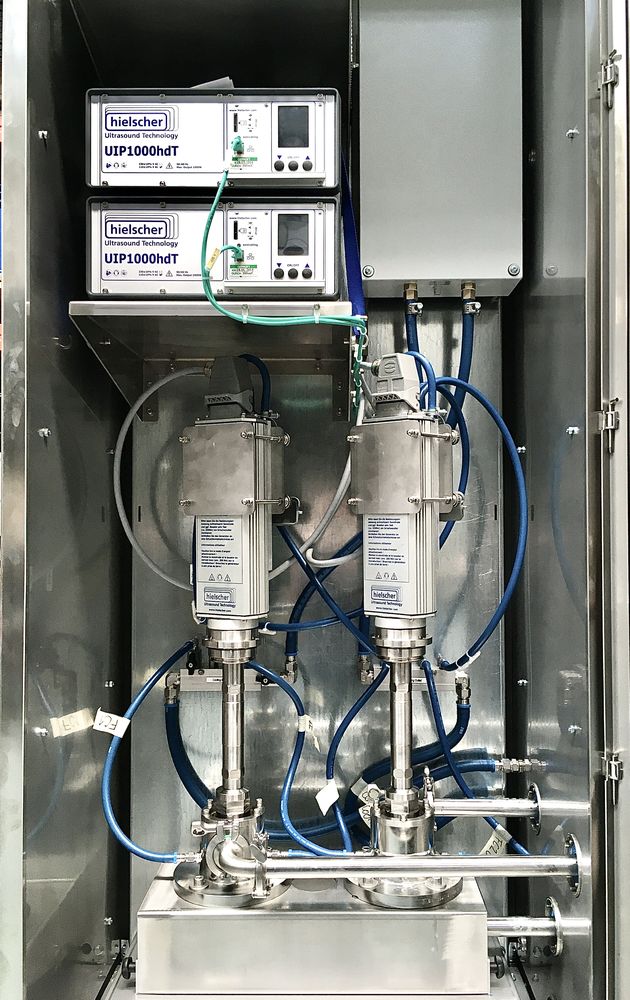
Installation of 2x UIP1000hdT (each 1kW, 20kHz) for the production of pharmaceuticals
Frequently Asked Questions about Ultrasonic Cell Disruption for Viral-Based Vaccine Production
What is ultrasonic cell disruption?
Ultrasonic cell disruption uses high-intensity ultrasound, typically in the range of 20 to 30 kHz, to break open cell membranes and release intracellular material. High-power ultrasound waves create cavitation bubbles in the liquid. When these bubbles collapse, they generate intense local shear forces and microstreaming which mechanically disrupt the cells and promote mass transfer between the cell interior and the surrounding medium. In vaccine production, this is used to lyse virus-infected cell cultures and to release intracellular and membrane-associated virus particles into the harvest.
Why use sonication instead of chemical or enzymatic lysis for viral harvest?
Sonication works with purely mechanical forces. No detergents, lysozyme, proteinase K or other lysis reagents are required which might alter the lysate, interfere with downstream purification or need to be removed before further processing. Chemical reagents typically require time-consuming multi-step preparation to prevent inhibition of subsequent assays and other post-processing steps. Enzymatic disruption requires long incubation times and often delivers non-reproducible results. Ultrasonic lysis also overlaps the steps of resuspension, disruption and extraction into a single continuous operation. Where a detergent- or enzyme-assisted step is required by your process, sonication intensifies it rather than replacing it: cavitation weakens membranes and improves uniform exposure of all cells to the reagent.
How does sonication compare to mechanical homogenization methods?
Probe-type sonicators transfer ultrasonic energy directly and efficiently, because the sonotrode is in direct contact with the sample. Mechanically driven homogenization techniques often result in lower energy transfer efficiency. Ultrasonic processing needs no consumable grinding beads or rotating seals in the product stream, no nozzles or chambers that can clog with viscous cell mass, and no cross-contamination between batches.
Can sonication damage the virus or the antigen?
This is the key optimization task, and it is controllable. By adjusting the parameters of ultrasonic processing, the effects of sonication can be precisely controlled: low amplitude and short sonication have very soft effects, while high amplitudes, elevated pressure and longer sonication duration result in intense processing. Since the intensity can be adjusted exactly to the biological sample, over-processing, degradation and yield loss are avoided. In practice, amplitude, residence time and number of passes are set to the minimum that achieves the target disruption rate, with continuous temperature monitoring and cooling.
Does ultrasonic treatment reduce the viscosity of the harvest?
Yes. Dense, high cell-density harvests are viscous and difficult to pump because of released, unfragmented host-cell DNA. Ultrasonic treatment shears and fragments DNA and RNA, and it solubilizes the cell mass and deagglomerates cell debris. The result is a homogeneous, pumpable suspension that feeds clarification, centrifugation and chromatography more efficiently. DNA and RNA fragmentation by controlled sonication is a well-established laboratory application of the same technology.
Can I run the process in continuous inline mode?
Yes. Hielscher sonicators are designed for 24/7 continuous operation in industrial environments and can be configured with flow cells and reactors for continuous inline sonication, recirculation loops or integration into production skids and processing lines. Single-pass and multi-pass operation are both possible.
How do I scale up from the lab to production?
Linearly, based on measurable energy input. All sonication results obtained with a Hielscher ultrasonic homogenizer can be scaled up linearly to higher throughputs in industrial manufacturing; sonication parameters developed with a bench-top sonicator can be transferred directly to larger Hielscher systems. The scale-up criterion is the specific energy input per volume, together with amplitude, residence time and temperature. Hielscher process consulting includes recommendations for parameter optimization (amplitude, specific energy E/V, residence time, temperature and pressure control) tied to measurable energy input.
Is ultrasonic cell disruption suitable for cleanroom and GMP-style manufacturing?
Hielscher ultrasonicators can be easily installed in cleanroom laboratories and production facilities. The housings are made from antibacterial plastic or stainless steel. All wetted parts, such as sonotrodes and flow cells, are made from titanium or stainless steel and can be autoclaved. Special flow cell reactors meeting advanced CIP (clean-in-place) and SIP (sterilize-in-place) requirements are available. The transducer of the industrial UIP series is IP64 rated and can be installed in demanding environments while the generator is placed remotely. Because Hielscher sonicators convert electrical energy into mechanical oscillation with a very high efficiency of approximately 80–90% from the power plug into the liquid, the transducer can be built into closed housings without louvers, and no forced cooling such as compressed air or water is needed. This also means no cooling medium comes into contact with the process. Automatic process documentation supports traceability and reproducibility in regulated manufacturing.
Can sonication also inactivate the virus for an inactivated vaccine?
Yes. Power ultrasound finds application in the inactivation of pathogens such as bacteria and viruses. With the appropriate dose and intensity of sonication, cells and microbes can be treated in accordance with the process goal, so the same platform serves lysis for harvest and inactivation. The combination of sonication and heat, known as thermo-sonication, offers a faster rate of sterilization with significantly reduced thermal intensity and duration, which is advantageous for preserving heat-sensitive compounds such as proteins and antigens. Ultrasonic inactivation is generally used in combination with established inactivation chemistry, and the full inactivation kinetics must be validated for each specific virus.
Can the same system be used for the formulation steps after harvest?
Yes. The same platform handles antigen dispersion into suspensions, polymers or liposomal encapsulations, the deagglomeration and uniform distribution of antigens and aluminum-based adjuvants such as Alhydrogel™, the formulation of vaccines into liposomes and solid-lipid nanoparticles with precise control over carrier size, and the degassing step prior to filling into vials or syringes.
Literature / References
- Langston J. W.; Carroll M.; Whalen M. M.; Jaw, T. M.; Rojas L. V.; Hertel C. C.; Gote V., Balasundaram W.; Serbzhinzhskiy D.; Kapre S.; Olave, I. A. (2026): Novel non-aqueous rotavirus vaccine: Formulated for thermostability and easy administration. Human Vaccines & Immunotherapeutics, 22(1), 2026.
- Mohsen, M.O., Rothen, D., Balke, I. et al. (2021): Neutralization of MERS coronavirus through a scalable nanoparticle vaccine. npj Vaccines 6, 107 (2021).
- Mohsen M.O., Balke I., Zinkhan S. et al. (2022): A scalable and highly immunogenic virus-like particle-based vaccine against SARS-CoV-2. Allergy Vol 77, Issue 1; 2022. 243–257.
- Brittney Mott; Sanjay Thamake; Jamboor Vishwanatha; Harlan P. Jones (2013): Intranasal delivery of nanoparticle-based vaccine increases protection against S. pneumoniae. J Nanopart Res (2013) 15:1646.
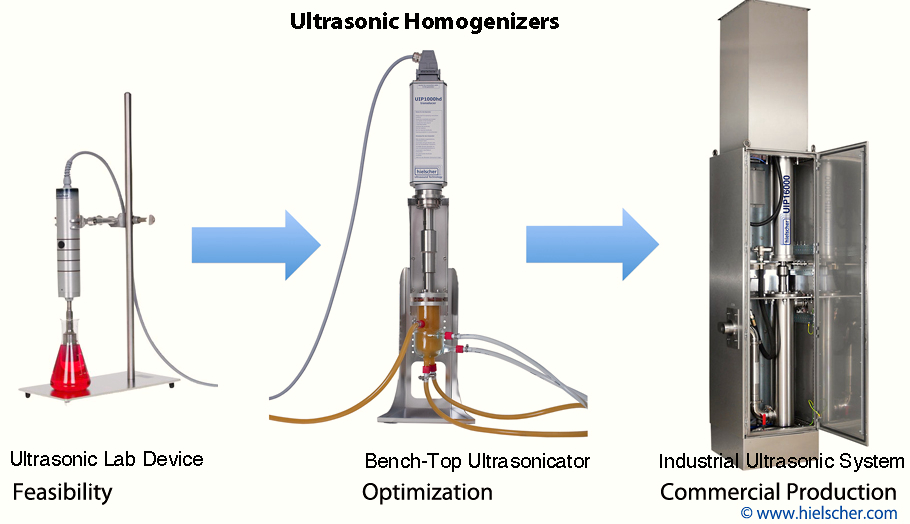
Hielscher Ultrasonics manufactures high-performance ultrasonic homogenizers from lab to industrial size.