Ultrasonically-Assisted Alkaline Hydrolysis for PET Recycling
Alkaline hydrolysis is an effective method for depolymerizing waste polyethylene terephthalate (PET). The process converts PET into terephthalate salts, which can then be acidified to recover high-purity terephthalic acid (TPA) for use in producing new PET and other polyester materials. Power ultrasound, or sonication, enhances mixing and mass transfer and can significantly accelerate PET hydrolysis. Learn how sonication can make PET recycling faster and more efficient.
A Sustainable, Efficient Approach to Depolymerizing Polyethylene Terephthalate Using Ultrasound Energy
 In hydrolysis, PET reacts with water under acidic, neutral, or alkaline conditions to produce terephthalic acid (TPA) and ethylene glycol (EG). Conventional hydrolysis can require high temperatures, elevated pressure, concentrated reagents, or long residence times because the reaction occurs at the interface between a comparatively resistant solid polymer and the liquid phase. Sonication-driven mixing can accelerate this interfacial reaction, improve phase transfer catalysis and achieve improved conversion under milder reaction conditions.
Tell us about your PET feedstock and reaction conditions. Our sonication experts will recommend you the optimal sonicator and reactor configuration for your recycling process.
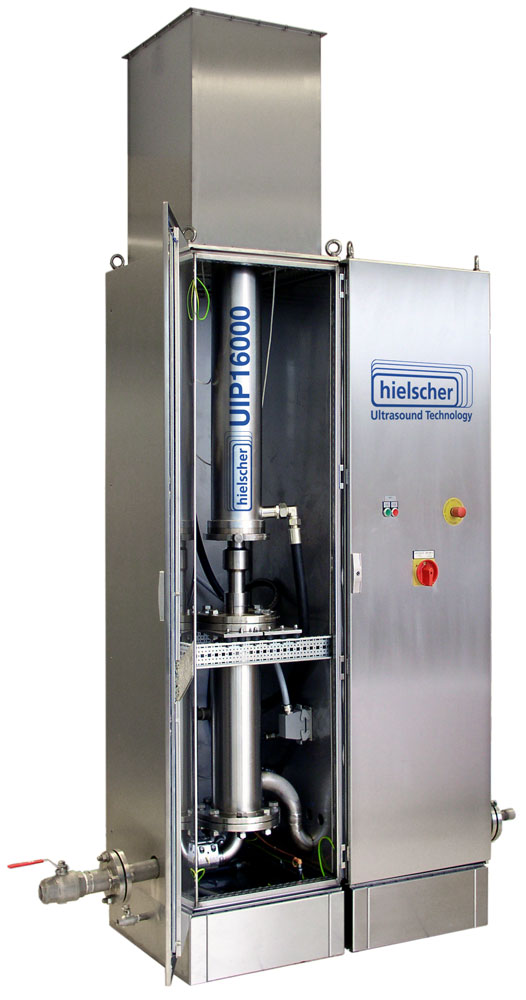
Industrial sonicator UIP1600hdT intensifies the depolymerization of polyethylene terephthalate (PET) for improved recycling
Scientific Results: Sonication improves PET Recycling
Sonication Accelerates Pure Monomer Recovery in Low-Temperature Non-Aqueous Media
The 2017 published study by Bhogle and Pandit demonstrates that the application of 20 kHz ultrasound significantly enhances the alkaline hydrolysis of waste PET, particularly in non-aqueous methanolic media. The researchers found that ultrasound achieved a PET conversion of 69% in 60 minutes at 50°C, compared to only 46% without sonication. This process allows for the recovery of pure terephthalic acid (TA) under milder conditions, offering a novel, solvent-free strategy for treating post-consumer PET waste. The study highlights that ultrasonic micro-mixing increases the collision frequency between PET and alkali molecules, thereby intensifying the reaction rate and making the depolymerization process more economically viable for larger-scale recycling applications.
Sonication Drastically Reduces Reaction Times and Processing Costs
The 2013 published study by Paliwal and Mungray demonstrates that ultrasonic assistance drastically reduces the reaction time required for the alkaline hydrolysis of PET in the presence of a phase transfer catalyst. While the conventional method required over 65 minutes to achieve 100% conversion of PET to terephthalic acid, the ultrasound-assisted process completed the reaction in just 45 minutes. The study confirms that ultrasound does not alter the intrinsic reaction mechanism but significantly enhances the reaction rate through increased cavitation and mass transfer. This efficiency gain is highly relevant to the recycling industry as it lowers processing costs and energy demands, making chemical recycling more competitive with virgin material production.
Sonication Enhances Enzymatic Accessibility Through Surface Modification
The 2016 published study by Pellis and colleagues explores the synergistic effect of ultrasound on enzymatic hydrolysis, showing that sonication increases the surface area of PET by creating micro-roughness and defects. This physical modification enhances the accessibility of enzymes to the polymer chains, significantly improving the efficiency of enzymatic depolymerization. By bridging the gap between chemical and biological recycling methods, this approach offers a greener alternative that operates under milder conditions than traditional alkaline hydrolysis, potentially reducing energy consumption while maintaining high monomer recovery rates for the circular economy.
Read more about the synergetic application of ultrasonication and the enzyme cutinase in PET recycling!
Linear Scale-up and Straightforward Plant Integration
Hielscher inline sonicators are designed for linear scale-up by maintaining defined parameters – such as amplitude, energy input, pressure, temperature, flow rate, and residence time – while increasing ultrasonic power or operating multiple units in parallel. Compact flow-cell reactors can be installed in a PET-slurry transfer line or recirculation loop, making sonication comparatively simple to retrofit into an existing recycling plant without replacing its main depolymerization vessel or downstream separation equipment.
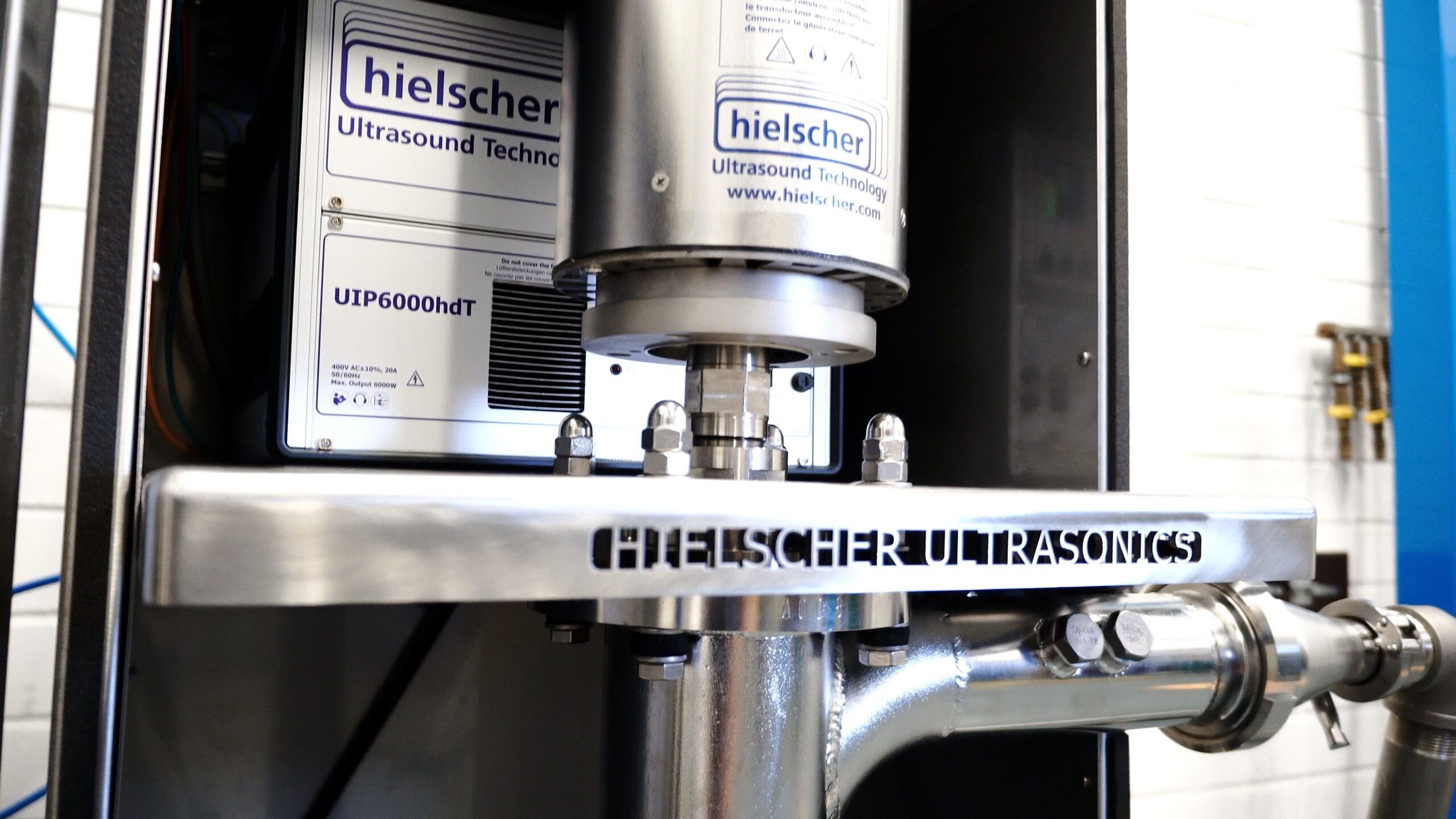
Industrial Sonicator UIP6000hdT with flow cell for inline depolymerization
Industrial Process Configuration
An ultrasound-assisted PET recycling line would typically begin with sorting, washing, and size reduction. PET flakes are mixed with the selected reaction medium and pumped through an ultrasonic flow reactor, either once or repeatedly in a recirculation loop. The treated suspension then enters or returns to the main depolymerization reactor.
For hydrolysis, the downstream train may include removal of unreacted solids, acidification of terephthalate salts, TPA crystallization, washing, and EG recovery. Glycolysis requires separation and purification of BHET and oligomers, while enzymatic processes require enzyme management and recovery of soluble hydrolysis products. Inline instruments can monitor temperature, pressure, flow, and delivered ultrasonic energy, allowing the treatment to be expressed as a reproducible energy dose per unit mass of PET.
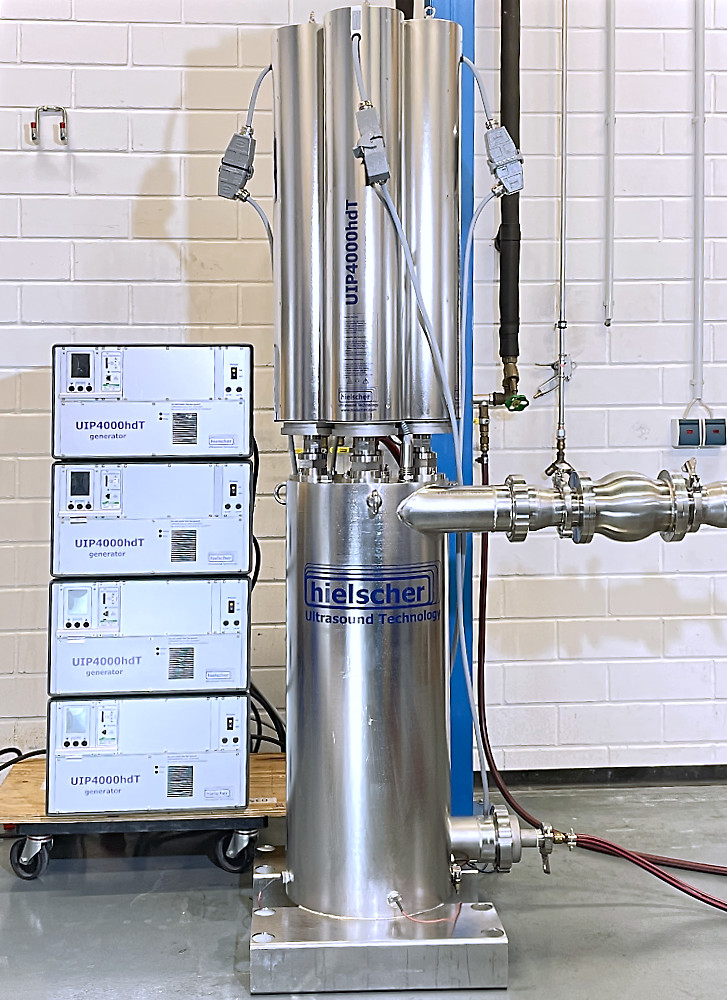
Industrial ultrasonic reactor for inline depolymerization of PET
Frequently Asked Questions About Ultrasonic PET Depolymerization
What is ultrasonic depolymerization of PET?
Ultrasonic PET depolymerization is an ultrasound-assisted recycling process that helps break polyethylene terephthalate into monomers or shorter chemical intermediates. High-power ultrasound intensifies hydrolysis, glycolysis, methanolysis, or enzymatic reactions by improving mixing, mass transfer, and contact between PET particles and the reaction medium.
How does ultrasound improve PET recycling?
Ultrasound creates acoustic cavitation in liquids. The collapse of microscopic bubbles generates shear forces, microjets, shock waves, and intense local mixing. These effects renew the PET surface, disperse particles and catalysts, reduce diffusion barriers, and increase the accessible reaction area, potentially accelerating depolymerization and improving monomer recovery.
Can ultrasound depolymerize PET without chemicals or enzymes?
Ultrasound can fragment particles and cause limited polymer-chain scission under suitable conditions, but it does not normally provide selective and complete PET depolymerization by itself. Its primary industrial role is to intensify an established chemical or enzymatic recycling reaction.
Which PET recycling processes can be assisted by ultrasonication?
Ultrasonication can support alkaline, acidic, or neutral hydrolysis; glycolysis with ethylene glycol; methanolysis; catalytic solvolysis; and enzymatic PET hydrolysis. The appropriate ultrasonic intensity, temperature, pressure, and residence time depend on the chosen reaction and desired products.
What products can be recovered from ultrasonic PET recycling?
Hydrolysis can recover terephthalic acid and ethylene glycol, while glycolysis typically produces bis(2-hydroxyethyl) terephthalate, commonly known as BHET, together with shorter oligomers. Methanolysis produces dimethyl terephthalate and ethylene glycol. After purification, these materials can be used to manufacture new polymers and other chemical products.
Can ultrasound reduce PET depolymerization time or temperature?
Ultrasound can accelerate interfacial reactions and may enable shorter residence times or milder processing conditions. The actual improvement depends on PET particle size, crystallinity, solids concentration, solvent, catalyst, and reactor configuration. Pilot testing is necessary to determine whether reduced time or temperature offsets the additional electrical energy required for sonication.
Is ultrasonic depolymerization suitable for post-consumer PET?
Yes, ultrasound-assisted recycling can process washed and size-reduced post-consumer PET, including bottles, packaging, and potentially polyester-rich textile waste. Feedstock sorting and pretreatment remain important because dyes, multilayer materials, other polymers, additives, and dirt can affect reaction performance and downstream monomer purity.
Can Hielscher inline sonicators be scaled up and retrofitted into existing PET recycling plants?
Hielscher inline sonicators support linear scale-up by transferring defined parameters such as amplitude, energy input, pressure, temperature, flow rate, and residence time from pilot trials to larger processors or parallel sonicator clusters. Their compact flow-cell reactors can be integrated into an existing PET-slurry transfer line or recirculation loop, enabling a comparatively simple retrofit without replacing the plant’s principal depolymerization reactor.
Can ultrasonic PET depolymerization operate continuously?
Yes. A PET slurry can be pumped through an ultrasonic flow-cell reactor in a single pass or circulated repeatedly until the target energy dose or conversion is reached. Continuous inline sonication provides controlled residence time, reproducible treatment, and easier integration with industrial pumps, heat exchangers, reaction vessels, and separation equipment.
Which parameters control ultrasonic PET depolymerization?
Important operating variables include ultrasonic amplitude, specific energy input, pressure, temperature, flow rate, residence time, pulse mode, PET particle size, solids loading, crystallinity, and reactor geometry. Chemical variables–including solvent composition, catalyst concentration, pH, and PET-to-reagent ratio–must be optimized alongside the ultrasonic conditions.
Can ultrasound improve enzymatic PET recycling?
Short, controlled sonication can improve enzyme dispersion, enzyme–substrate contact, PET surface accessibility, and the release of soluble degradation products. Excessive ultrasonic intensity or prolonged exposure may deactivate the enzyme, so pulsed sonication or a brief activation phase is often preferable to continuous treatment. Read more!
Is ultrasonic PET recycling environmentally sustainable?
Ultrasonic processing can improve sustainability when faster reactions, lower temperatures, reduced catalyst consumption, higher monomer yields, or smaller reactors outweigh the electricity used by the sonicator. A complete assessment should also include feedstock pretreatment, solvent and reagent recovery, product purification, wastewater generation, and the carbon intensity of the electricity supply.
How does ultrasonic chemical recycling differ from mechanical PET recycling?
Mechanical recycling washes, melts, and reforms PET while largely preserving the polymer chains. Ultrasonic chemical recycling assists in breaking those chains into monomers or intermediates that can be purified and repolymerized. It may therefore be useful for PET streams that are difficult to recycle mechanically because of color, contamination, degradation, or product-quality requirements.
Literature / References
- Nutan Rajesh Paliwal, Arvind Kumar Mungray (2013): Ultrasound assisted alkaline hydrolysis of poly(ethylene terephthalate) in presence of phase transfer catalyst. Polymer Degradation and Stability, Volume 98, Issue 10, 2013. 2094-2101.
- Bhogle, C. S.; and Pandit, A. B. (2018): Ultrasound-Assisted Alkaline Hydrolysis of Waste Poly(Ethylene Terephthalate) in Aqueous and Non-aqueous Media at Low Temperature. Indian Chemical Engineer, 60(2), 2018. 122–140.
- Alessandro Pellis, Caroline Gamerith, Gagik Ghazaryan, Andreas Ortner, Enrique Herrero Acero, Georg M. Guebitz (2016): Ultrasound-enhanced enzymatic hydrolysis of poly(ethylene terephthalate). Bioresource Technology, Volume 218, 2016. 1298-1302.
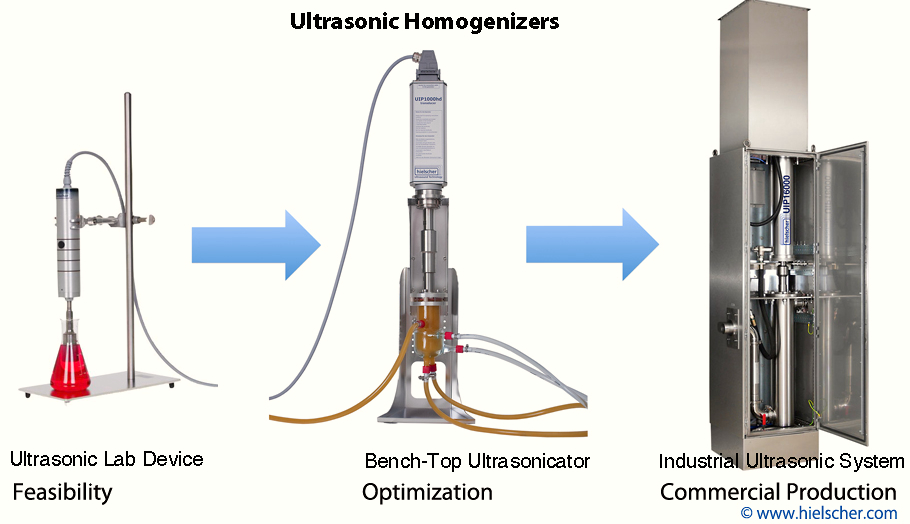
Hielscher Ultrasonics manufactures high-performance ultrasonic homogenizers from lab to industrial size.