Ultrasonic Processing for Liquids, Slurries, and Chemical Reactions
Ultrasonication is a mechanical processing method which creates acoustic cavitation and highly intense physical forces. Therefore, ultrasonics is used for numerous applications such as mixing, homogenization, milling, dispersion, emulsification, extraction, degassing, and sono-chemical reactions.
Find your application in the table below, click the link and jump directly to your process of interest! Learn how sonication improves the process and its efficiency.
| Application | Best for |
|---|---|
| Homogenization | Creating uniform suspensions, emulsions, and liquid mixtures |
| Dispersing and Deagglomeration | Breaking particle agglomerates and distributing solids evenly in liquids |
| Emulsification | Producing stable micro- and nano-emulsions with fine droplet sizes |
| Wet Milling | Micronizing and nano-sizing particles in liquid suspensions |
| Cell Disintegration and Lysis | Cell disruption of mammalian, plant, bacterial, algae and yeast cells as pre-analytical sample preparation step. |
| Extraction | Recovering bioactive compounds, oils, proteins, and natural extracts |
| Sonochemistry | Accelerating chemical reactions and improving process efficiency |
| Biodiesel Production | Intensifying transesterification and reducing reaction times |
| Degassing & Defoaming | Removing dissolved gases and entrained air from liquids |
| Inline Cleaning of Wires and Profiles | Inline cleaning of wires, cables, strips, tubes, and profiles |
| Acoustic Cavitation | Understanding the physical principle behind ultrasonic processing |
Have a specific application or volume in mind?
Contact our application engineers for a free process consultation or request a demo.

The UIP1000hdT is 1000 watts powerful ultrasonicator for homogenization, milling and extraction applications.
Ultrasonic Homogenization
 Ultrasonic homogenizers reduce small particles in a liquid to improve uniformity and dispersion stability. The particles (disperse phase) can be solids or liquid droplets suspended in a liquid phase. Ultrasonic homogenizing is very efficient for the reduction of soft and hard particles. Hielscher manufactures ultrasonicators for the homogenization of any liquid volume and for batch or inline processing. Laboratory ultrasonic devices can be used for volumes from 1.5mL to approx. 4L. Ultrasonic industrial devices can process batches from 0.5 to approx. 2000L or flow rates from 0.1L to 20 cubic meters per hour in process development and in commercial production.
Discover the power of ultrasonic homogenization!
Ultrasonic Dispersing and Deagglomeration
 The dispersion and deagglomeration of solids into liquids is an important application of probe-type ultrasonicators. Ultrasonic / acoustic cavitation generates high shear forces that break particle agglomerates into individual, single dispersed particles. The mixing of powders into liquids is a common step in the formulation of various products, such as paint, varnish, cosmetic products, food and beverages, or polishing media. The individual particles are held together by attraction forces of various physical and chemical nature, including van-der-Waals-forces and liquid surface tension. Ultrasonication overcomes these attraction forces in order to deagglomerate and disperse the particles in liquid media. For the dispersing and deagglomeration of powders in liquids, high intensity ultrasonication is an interesting alternative to high pressure homogenizers, high shear mixers, bead mills or rotor-stator-mixers.
Get in-depth information about ultrasonic dispersing and deagglomeration!
Ultrasonic Emulsification
 A wide range of intermediate and consumer products, such as cosmetics and skin lotions, pharmaceutical ointments, varnishes, paints and lubricants and fuels are based wholly or in part on emulsions. Emulsions are dispersions of two or more immiscible liquid phases. Highly intensive ultrasound supplies enough intense shear to disperse a liquid phase (dispersed phase) in small droplets in a second phase (continuous phase). In the dispersing zone, imploding cavitation bubbles cause intensive shock waves in the surrounding liquid and result in the formation of liquid jets of high liquid velocity (high shear). Ultrasonication can be precisely adapted to the target emulsion size allowing thereby for the reliable production of micro-emulsions and nano-emulsions.
Click here to read more about ultrasonic emulsification!
Ultrasonic Wet Milling and Grinding
Ultrasonication is an efficient means for the wet-milling and micro-grinding of particles. In particular for the manufacturing of superfine-size slurries, ultrasound has many advantages. It is superior to traditional size reduction equipment, such as: colloid mills (e.g. ball mills, bead mills), disc mills or jet mills. Ultrasonication can process high-concentration and high-viscosity slurries – therefore reducing the volume to be processed. Of course, ultrasonic milling is suitable for processing micron-size and nano-size materials, such as ceramics, pigments, barium sulphate, calcium carbonate or metal oxides. Especially when it comes to nano-materials, ultrasonication excels in performance as its highly impactful shear forces create uniformly small nanoparticles.
Read more about ultrasonic wet milling and micro-grinding!

Spray-dried TiO2 before and after ultrasonic milling
Ultrasonic Cell Disintegration and Lysis
 Ultrasonic treatment can disintegrate fibrous, cellulosic material into fine particles and break the walls of the cell structure. This releases more of the intra-cellular material, such as starch or sugar into the liquid. This effect can be used for fermentation, digestion and other conversion processes of organic matter. After milling and grinding, ultrasonication makes more of the intra-cellular material e.g. starch as well as the cell wall debris available to the enzymes that convert starch into sugars. It does also increase the surface area exposed to the enzymes during liquefaction or saccharification. This does typically increase the speed and yield of yeast fermentation and other conversion processes, e.g. to boost the ethanol production from biomass.
Read more about the ultrasonic disintegration of cell structures!
Ultrasonic Extraction of Botanicals
The extraction of bioactive compounds stored in cells and subcellular particles is an widely-used application of high-intensity ultrasound. Ultrasonic extraction is used to isolate secondary metabolites (e.g., polyphenols), polysaccharides, proteins, essential oils and other active ingredients from the cellular matrix of plants and fungi. Suitable for water- and solvent-extraction of organic compounds, sonication improves the yield of botanicals contained within plants or seeds significantly. Ultrasonic extraction is used for the production of pharmaceuticals, nutraceuticals / nutritional supplements, fragrances and biological additives. Ultrasonics is a green extraction technique also used for the extraction of bioactive components in biorefineries, e.g. release valuable compounds from non-utilized by-product streams formed in industrial processes. Ultrasonication is a highly effective technology for botanical extraction at lab and production scale.
Explore the advantages of ultrasonic extraction!

Ultrasonic reactor with 16,000 watts for ultrasonically enhanced liquid processing.
Sonochemical Application of Ultrasonics
Sonochemistry is the application of ultrasound to chemical reactions and processes. The mechanism causing sonochemical effects in liquids is the phenomenon of acoustic cavitation. The sonochemical effects to chemical reactions and processes include increase in reaction speed or output, more efficient energy usage, performance improvement of phase transfer catalysts, activation of metals and solids or increase in the reactivity of reagents or catalysts.
Explore the sonochemical effects of ultrasound!
Ultrasonic Transesterification of (Waste) Oil to Biodiesel
Ultrasonication increases the chemical reaction speed and yield of the transesterification of vegetable oils and animal fats into biodiesel. This allows changing the production from batch processing to continuous flow processing and it reduces investment and operational costs. One of the major advantages of ultrasonic biodiesel manufacturing is the use of waste oils such as spent cooking oils and other poor-quality oil sources. Ultrasonic transesterification can convert even low-quality feedstock into high-quality biodiesel (fatty acid methyl ester / FAME). The manufacturing of biodiesel from vegetable oils or animal fats, involves the base-catalyzed transesterification of fatty acids with methanol or ethanol to give the corresponding methyl esters or ethyl esters. Ultrasonication can achieve a biodiesel yield in excess of 99%. Ultrasound reduces the processing time and the separation time significantly.
Click here to read more about the ultrasonically assisted transesterification of oil into biodiesel!
Ultrasonic Degassing, De-Aeration and Defoaming of Liquids
Degassing of liquids is another important application of probe-type ultrasonicators. Ultrasonic vibrations and cavitation cause the coalescence of dissolved gases in a liquid. As the minute gas bubbles coalesce, they form thereby larger bubbles which float quickly to the top surface of the liquid from there they can be removed. Thus, ultrasonic degassing and deaeration can reduce the level of dissolved gas below the natural equilibrium level.
Click here to read more about the ultrasonic degassing of liquids!
Ultrasonic Wire, Cable and Strip Cleaning
 Ultrasonic cleaning is an environmentally friendly alternative for the cleaning of continuous materials, such as wire and cable, tape or tubes. The effect of the powerful ultrasonic cavitation removes lubrication residues like oil or grease, soaps, stearates or dust from the material surface. Hielscher Ultrasonics offers various ultrasonic systems for the inline cleaning of continuous profiles.
Click here for more information about ultrasonic cleaning of continuous profiles!
Contact Us! / Ask Us!
What makes Sonication a Superior Processing Method?
Sonication, or the use of high frequency sound waves to agitate liquids, is an efficient processing method for a variety of reasons. Here are some reasons why sonication at high-intensity and low-frequency of approx. 20kHz is particularly impactful and advantageous for the processing of liquids and slurries:
- Cavitation: One of the main mechanisms of sonication is the creation and collapse of tiny bubbles, a phenomenon called cavitation. At 20kHz, the sound waves are at just the right frequency to create and collapse bubbles efficiently. The collapse of these bubbles produces high energy shockwaves, which can break down particles and disrupt cells in the liquid being sonicated.
- Oscillation and vibration: Besides the generated acoustic cavitation, the oscillation of the ultrasonic probe creates additional agitation and mixing in the liquid, thereby promoting mass transfer and/or degassing.
- Penetration: Sound waves at 20kHz have a relatively long wavelength, which allows them to penetrate deeply into liquids. Ultrasonic cavitation is a localizes phenomenon appearing in the surrounding of the ultrasonic probe. With increasing distance to the probe, the cavitation intensity is decreasing. However, sonication at 20kHz can efficiently treat larger volumes of liquid, compared to higher frequency sonication which has shorter wavelengths and may be more limited in its penetration depth.
- Low energy consumption: Sonication can be accomplished with relatively low energy consumption compared to other processing methods such as high-pressure homogenization or mechanical stirring. This makes it a more energy-efficient and cost-effective method for processing liquids.
- Linear scalability: Ultrasonic processes can be scaled completely linear to larger or smaller volumes. This makes process adaptations in production reliable as product quality can maintained continuously stable.
- Batch and inline flow: Ultrasonication can be performed as batch or as continuous inline processes. For the sonication of batches, the ultrasonic probe is inserted into the open vessel or closed batch reactor. For the sonication of a continuous flow stream, a ultrasonic flow cell is installed. The liquid medium passes the sonotrode (ultrasonically vibrating rod) in single pass or recirculation and is highly uniform and efficient exposed to the ultrasound waves.
Overall, the intense forces of cavitation, low energy consumption, and process scalability make low-frequency, high-power sonication an efficient method for processing liquids.
Working Principle and Use of Ultrasonic Processing
Ultrasonication is a commercial processing technology, which has been adopted by numerous industries for large scale production. High reliability and scaleablility as well as low maintenance costs and high energy efficiency make ultrasonic processors a good alternative for traditional liquid processing equipment. Ultrasound offers additional exciting opportunities: Cavitation – the basic ultrasonic effect – produces unique results in biological, chemical and physical processes. For instance, ultrasonic dispersion and emulsification easily produces stable nano-sized formulations. Also in the field of botanical extraction, ultrasound is a non-thermal technique to isolate bioactive compounds.

Ultrasonic mixing is based on acoustic cavitation and its hydrodynamic shear forces.
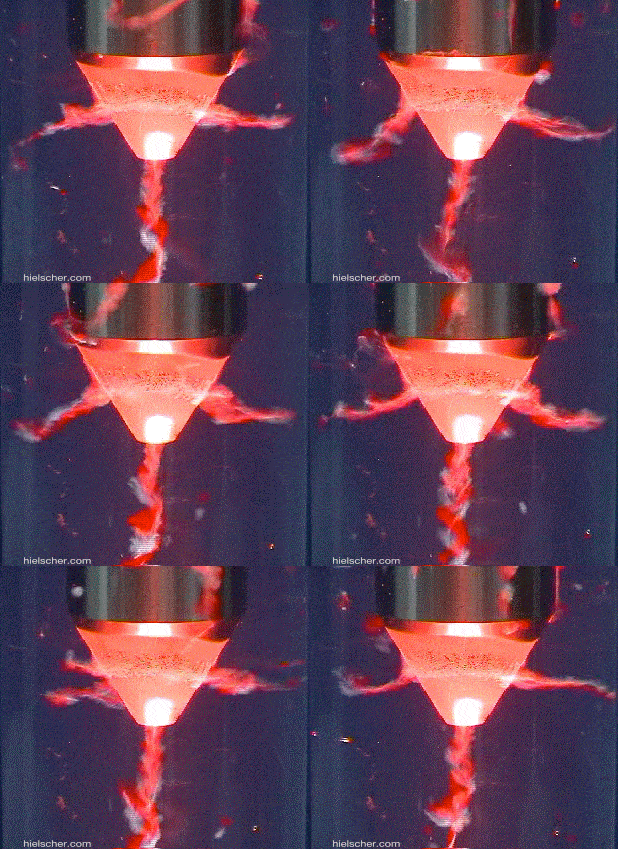 While low-intensity or high-frequency ultrasound is mainly used for analysis, non-destructive testing and imaging, high-intensity ultrasound is used for the processing of liquids and pastes, where intense ultrasound waves are used for mixing, emulsifying, dispersing and deagglomeration, cell disintegration or enzyme deactivation. When sonicating liquids at high intensities, the sound waves propagate through the liquid media. This results in alternating high-pressure (compression) and low-pressure (rarefaction) cycles, with rates depending on the frequency. During the low-pressure cycle, high-intensity ultrasonic waves create small vacuum bubbles or voids in the liquid. When the bubbles attain a volume at which they can no longer absorb energy, they collapse violently during a high-pressure cycle. This phenomenon is termed cavitation. During the implosion very high temperatures (approx. 5,000K) and pressures (approx. 2,000atm) are reached locally. The implosion of the cavitation bubble also results in liquid jets of up to 280 meters per second velocity.
Ultrasonic cavitation in liquids can cause fast and complete degassing; initiate various chemical reactions by generating free chemical ions (radicals); accelerate chemical reactions by facilitating the mixing of reactants; enhance polymerization and depolymerization reactions by dispersing aggregates or by permanently breaking chemical bonds in polymeric chains; increase emulsification rates; improve diffusion rates; produce highly concentrated emulsions or uniform dispersions of micron-size or nano-size materials; assist the extraction of substances such as enzymes from animal, plant, yeast, or bacterial cells; remove viruses from infected tissue; and finally, erode and break down susceptible particles, including micro-organisms. (cf. Kuldiloke 2002)
High-intensity ultrasound produces violent agitation in low-viscosity liquids, which can be used to disperse materials in liquids. (cf. Ensminger, 1988) At liquid/solid or gas/solid interfaces, the asymmetric implosion of cavitation bubbles can cause extreme turbulences that reduce the diffusion boundary layer, increase the convection mass transfer, and considerably accelerate diffusion in systems where ordinary mixing is not possible. (cf. Nyborg, 1965)

Powerful Ultrasonic Cavitation at Hielscher Cascatrode
Frequently Asked Questions about Sonicators for Lab, Bench-top and Industry
Are Hielscher ultrasonic processors designed for heavy-duty industrial applications?
Yes. Hielscher industrial ultrasonic devices are explicitly engineered to operate continuously at high load in heavy-duty industrial environments. With power outputs ranging from 500 watts to 16 kilowatts per unit, they are built to handle the rigorous demands of large-scale production processes that laboratory devices cannot manage.
How durable are Hielscher sonicators in harsh conditions?
Hielscher sonicators are built for outstanding durability. Every single component of the UIP series is meticulously designed and tested for long-term performance. In real-world worldwide installations, these systems routinely withstand outdoor installations, exposure to dusty air, sprayed liquids, and rough handling without compromising functionality.
Can Hielscher equipment be relied upon for continuous, 24/7 operation?
Absolutely. Reliability is a core pillar of Hielscher’s industrial-grade design. Their ultrasonic processors are constructed specifically for continuous operation in demanding environments, ensuring consistent processing quality and minimal downtime for your manufacturing line. This reliability is critical when processing volumes rise and operational costs matter.
What makes Hielscher ultrasonic devices suitable for demanding industrial environments?
Hielscher devices excel in demanding environments because they combine high power, robust construction, and exceptional energy efficiency. Their industrial processors maintain an efficiency of over 85%, which not only reduces electricity costs but also ensures stable mechanical output under heavy loads. This makes them ideal for challenging liquid processing applications like biodiesel production, pigment milling, and nanomaterial formulation.
Do Hielscher industrial sonicators offer long-term longevity?
Yes, longevity is a fundamental design principle for Hielscher. Because every component is rigorously tested for sustained performance, these systems are built to last for years of continuous use. Combined with their high energy conversion efficiency and rugged build quality, Hielscher processors deliver reliable, long-lasting performance even in the most intensive industrial settings.
How does Hielscher ensure equipment reliability when scaling up from lab to production?
Hielscher addresses scalability by offering clusters of industrial units that provide enhanced redundancy and capacity adaptability. By deploying multiple high-power processors (e.g., clusters of 6xUIP10000), facilities can maintain reliable, continuous operation while processing massive volumes (up to 50 cubic meters per hour) without overloading individual components. This modular, heavy-duty approach guarantees both reliability and process consistency at scale.
Literature
- Seyed Mohammad Mohsen Modarres-Gheisari, Roghayeh Gavagsaz-Ghoachani, Massoud Malaki, Pedram Safarpour, Majid Zandi (2019): Ultrasonic nano-emulsification – A review. Ultrasonics Sonochemistry Vol. 52, 2019. 88-105.
- Suslick, Kenneth S.; Hyeon, Taeghwan; Fang, Mingming; Cichowlas, Andrzej A. (1995): Sonochemical synthesis of nanostructured catalysts. Materials Science and Engineering: A. Proceedings of the Symposium on Engineering of Nanostructured Materials. ScienceDirect 204 (1–2): 186–192.
- Brad W. Zeiger; Kenneth S. Suslick (2011): Sonofragmentation of Molecular Crystals. J. Am. Chem. Soc. 2011, 133, 37, 14530–14533.
- Petigny L., Périno-Issartier S., Wajsman J., Chemat F. (2013): Batch and Continuous Ultrasound Assisted Extraction of Boldo Leaves (Peumus boldus Mol.). International Journal of Molecular Science 14, 2013. 5750-5764.
- Ensminger, D. E. (1988): Acoustic and electroacoustic methods of dewatering and drying, in: Drying Tech. 6, 473 (1988).
- Kuldiloke, J. (2002): Effect of Ultrasound, Temperature and Pressure Treatments on Enzyme Activity an Quality Indicators of Fruit and Vegetable Juices; Ph.D. Thesis at Technische Universität Berlin (2002).
- Nyborg, W.L. (1965): Acoustic Streaming, Vol. 2B, Academic Press, New York (1965).

Ultrasonic reactor with 4x 2000 watts probes (8kW) for sonochemical processes.

Hielscher Ultrasonics manufactures high-performance ultrasonic homogenizers from lab to industrial size.