Ultrasonic Wet-Milling: Fine Particles, Precisely Engineered
Hielscher sonicators are efficient milling equipment for high-efficiency particle size reduction, nano-dispersion, and emulsification through controlled, high-intensity ultrasonic cavitation. Engineered for both research and industrial scale, these systems reliably break down agglomerates, refine powders, and create homogeneous suspensions across pharmaceuticals, cosmetics, nanomaterials, and specialty chemicals.
From Coarse Powder to Uniform Micro- and Nanoparticles
Hielscher probe-type sonicators deliver powerful, precisely controllable wet-milling and fine grinding – without beads, balls, or other milling media. Produce homogeneous, high-solid slurries with narrow particle size distributions while shortening processing time and reducing energy demand.
By leveraging precise amplitude control and advanced acoustic wave propagation, the sonicators achieve uniform results with minimal thermal impact, preserving sensitive compounds while maximizing throughput and reproducibility. Discover how ultrasonic milling can streamline your formulation workflow and elevate product performance.
Who Should Use Ultrasonic Wet-Milling?
- Manufacturers requiring controlled particle reduction to micron or nanometer size
- Producers of pigments, inks, paints, and high-performance coatings
- Ceramic, mineral, cement, and metal-oxide processors
- Pharmaceutical and cosmetic formulators developing fine suspensions
- Battery, catalyst, and advanced-material manufacturers
- Companies processing highly concentrated or viscous slurries
- Laboratories developing scalable particle-size reduction processes
- Manufacturers seeking a narrow, uniform particle-size distribution
- Operations that want to avoid contamination from milling beads or balls
- Producers aiming to reduce milling time, energy consumption, and cleaning requirements
Tell us about your material, solids loading, and particle-size target. Our sonication expert team will recommend you a sonication setup for improved particle milling.

Industrial 16,000 watts sonicator UIP16000hdT for wet-milling of pigments and nanoparticles
Controlled Particle Size Reduction with Power Ultrasound
Reducing particles to the micron or nanometer range can transform a formulation. Finer particles can improve reactivity, stability, surface area, optical properties, and final-product performance. Yet conventional ball, bead, and media mills may introduce wear particles, require laborious media separation, and struggle to provide consistent treatment at high solids concentrations. Ultrasonic wet-milling offers a clean, controllable alternative.
Hielscher probe-type sonicators transmit high-intensity ultrasound directly into a liquid or slurry. The alternating pressure waves create acoustic cavitation: microscopic bubbles form and collapse with extreme intensity, generating high-speed liquid jets, shock waves, and powerful shear forces. These forces accelerate suspended particles into one another. The resulting inter-particle collisions, fragmentation, and surface erosion reduce agglomerates – and, under sufficiently intense conditions, primary particles – to micro- and nano-size.
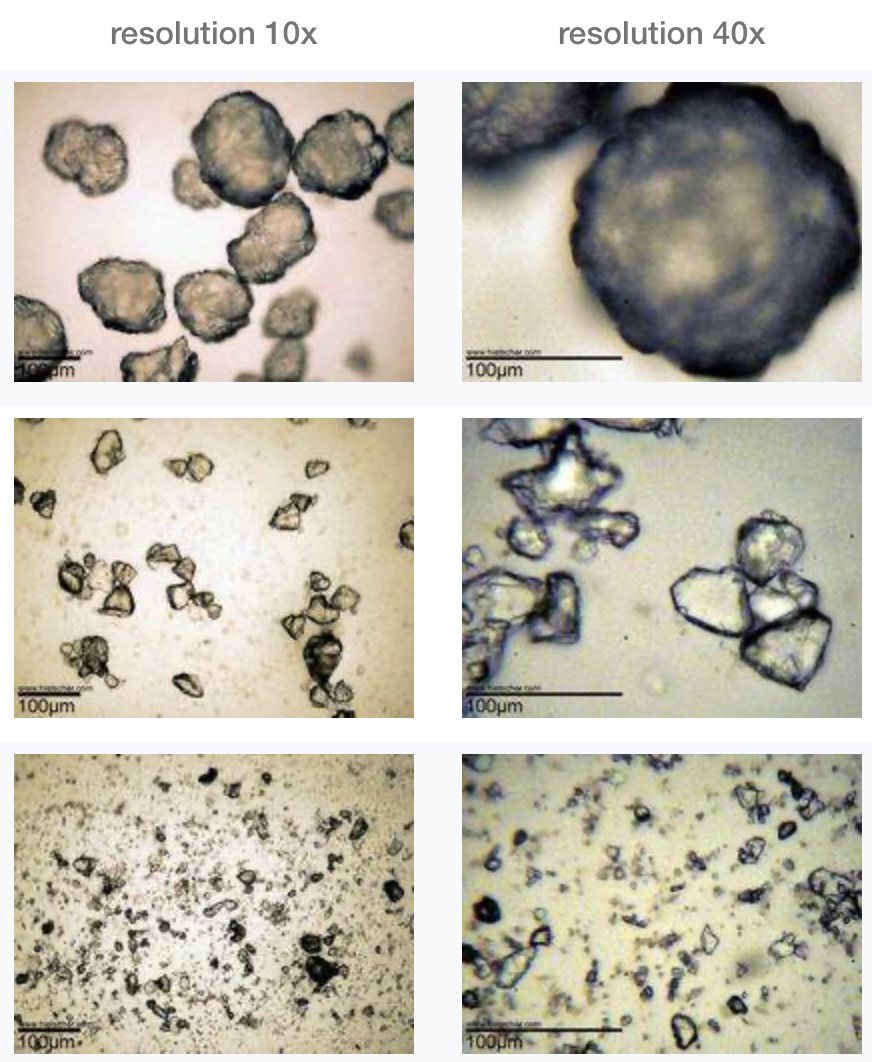
Ultrasonically milled Alumina Trihydrate
AL(OH)3 was supplied by Alcoa World Alumina LLC, Pittsburgh, PA, USA. AL(OH)3 is also known as Aluminum Trihydroxide ATH Series, Bayer Hydrated Alumina, C-30, KB-30, KC-30, KH-30, Hydragyllite or Gibbsite. It has a Mohs’ hardness of 2.5 to 3.5.

Ultrasonic flow-through reactors for industrial inline production of nanoparticle slurries.
Precise, Repeatable and Uniform Particle Size Distribution
Ultrasonic milling is highly adjustable. Operators can control amplitude, energy input, pressure, temperature, residence time, and flow rate to match the material and the target particle size. This makes the process suitable for everything from gentle deagglomeration to intensive fine grinding. Recirculation and inline flow-cell configurations expose the slurry uniformly to the cavitation zone, supporting reproducible results and a narrow, homogeneous particle size distribution.
This level of control is valuable for pigments, inks, coatings, ceramics, metal oxides, minerals, catalysts, pharmaceuticals, and other advanced materials where oversize particles or a broad distribution can compromise quality. Process parameters established in the laboratory can be transferred to pilot and industrial production, enabling systematic development and scale-up.
High-Solid Processing Without Milling Media
Because particle reduction is driven by cavitation and collisions between the particles themselves, no beads, pearls, or grinding balls are required. Eliminating milling media avoids a potential source of contamination and removes the need to purchase, clean, replace, and separate media from the finished slurry. The simple wetted geometry also facilitates cleaning and product changeover.
Hielscher sonicators can process highly concentrated and viscous slurries. A high solids loading means less liquid to handle and, in many cases, less downstream concentration or drying. It can also strengthen the inter-particle milling effect by increasing the frequency of particle collisions. This combination makes ultrasonic milling especially attractive for concentrated masterbatches and production-scale suspensions.
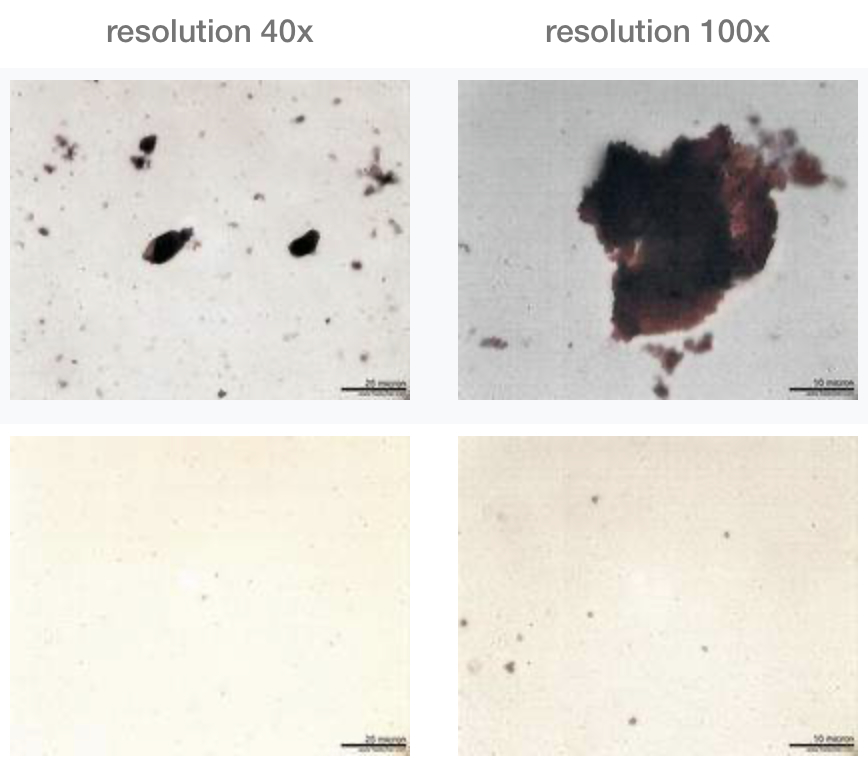
Microscope images showing the progress of ultrasonic milling of oil-based magenta pigments
Examples: Wet-Milling of Nano-Particles with Power Ultrasound
Ultrasonic milling is especially suited to process micron-size and nano-size materials, such as ceramics, alumina trihydrate, barium sulphate, calcium carbonate and metal oxides. The tables below show microscopic images of the milling of alumina trihydrate (from 150 micron down to 10 micron), ceramics (from 30 micron down to 2 micron) and sodium carbonate (from 70 micron down to 3 micron). The microscopic images on this page show you the progress of ultrasonic milling at the examples of dental ceramics, magenta pigments, sodium carbonate and hydrated alumina.
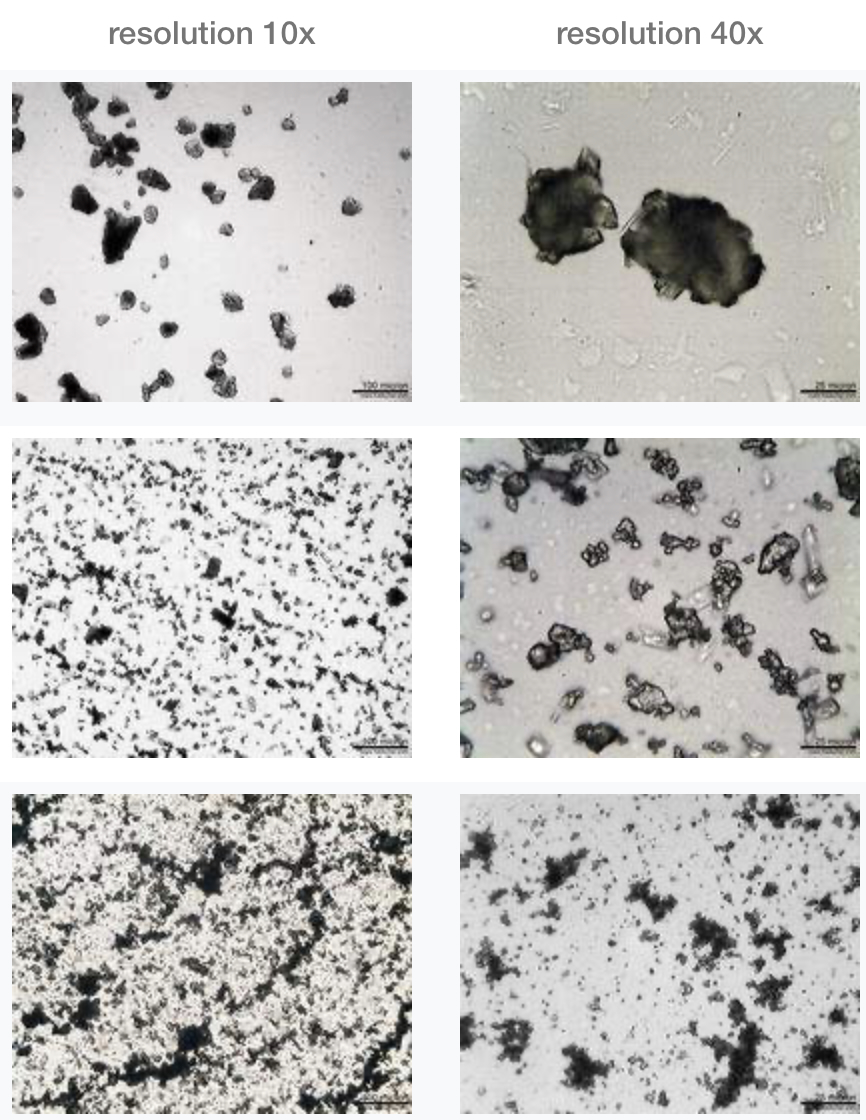
Microscope images showing the progress of ultrasonic milling of Sodium Carbonate (Na2CO3) in isopropanol.

Sonicated chalk paint on the grindometer demonstrates the perfectly uniform deagglomeration and particle size distribution of the pigments

Ultrasonic dispersion ensures an effective particle size reduction and uniform distribution of carbon black pigments in UV ink.
More Output from Every Processing Step
Ultrasonic energy is delivered directly into the slurry, where the particle-size reduction occurs. Rapid cavitational forces can shorten milling cycles, while the efficient conversion of electrical energy into mechanical motion can reduce energy demand compared with conventional milling equipment. Continuous inline processing further supports high throughput, consistent quality, and integration into existing production lines.
For manufacturers seeking smaller particles, tighter distributions, cleaner processing, and efficient scale-up, Hielscher probe-type sonicators turn wet-milling into a precisely engineered process – from laboratory trials to continuous industrial production.
Continuous Operation for High-Throughput
 Ultrasonic homogenizers are very easy to install and to operate. There are two parts only in contact with the material to be milled: the titanium sonotrode and the stainless steel flow cell. Due to the simple design of the ultrasonic flow cell, the units can be cleaned quickly. As Hielscher ultrasonic devices have a very high efficiency in the conversion of electrical into mechanical energy generally less power is needed for the ultrasonic milling than for conventional milling equipment.
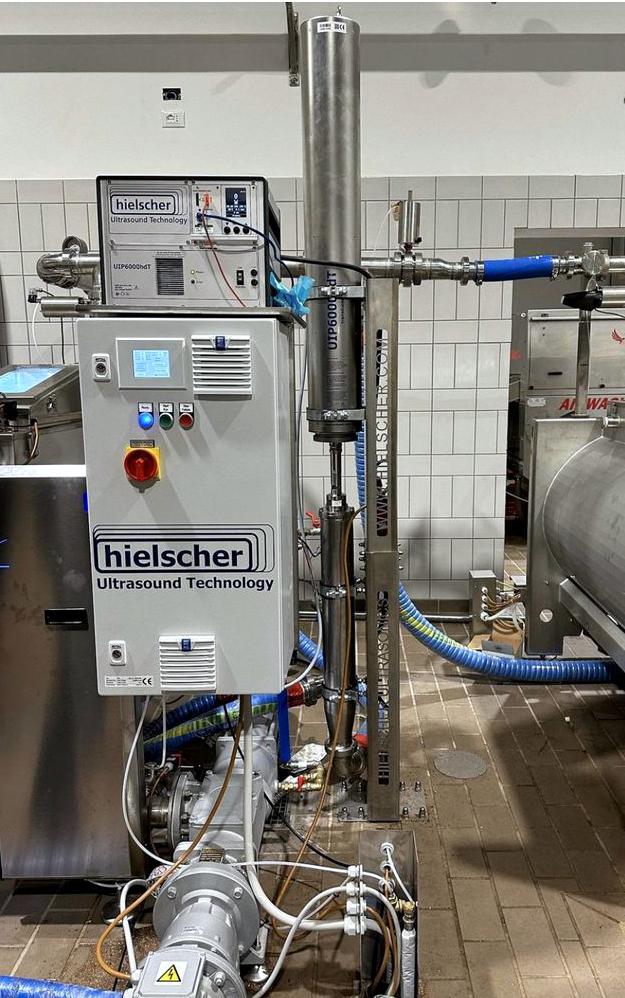 Industrial sonicator UIP6000hdT (6kW) for simultaneous pigment dispersion and microbial sterilization of water-borne paint and coating formulations [/caption]The particle milling effect is based on intense ultrasonic cavitation. When sonicating liquids at high intensities, the sound waves that propagate into the liquid media result in alternating high-pressure (compression) and low-pressure (rarefaction) cycles, with rates depending on the frequency. During the low pressure cycle, high-intensity ultrasonic waves create small vacuum bubbles or voids in the liquid. When the bubbles attain a volume at which they can no longer absorb energy, they collapse violently during a high pressure cycle. This phenomenon is termed cavitation.
The implosion of the cavitation bubbles results in micro-turbulences and micro-jets of up to 1000km/hr. Large particles are subject to surface erosion (via cavitation collapse in the surrounding liquid) or particle size reduction (due to fission through inter-particle collision or the collapse of cavitation bubbles formed on the surface). This leads to sharp acceleration of diffusion, mass-transfer processes and solid phase reactions due to crystallite size and structure changing.
Ultrasonic processors and flow cells for dispersing and for the wet-milling of powders are available for laboratory and production level. The industrial systems can easily be retrofitted to work inline. For the research and for the testing of this process as well as for many sonochemical processes we recommend our laboratory devices or the UIP1000hd.

Nanodiamonds can be efficient and reliably dispersed using Hielscher ultrasonicators.
Frequently Asked Questions about Ultrasonic Wet-Milling
What is ultrasonic wet-milling?
Ultrasonic wet-milling is a particle-size reduction process in which high-power ultrasound is applied to a liquid slurry. Acoustic cavitation generates intense shear forces, shock waves, and inter-particle collisions that break agglomerates and reduce solid particles to micron or nanometer dimensions.
How does a probe-type sonicator reduce particle size?
The ultrasonic probe, or sonotrode, transfers high-intensity ultrasound directly into the slurry. Cavitation bubbles form and collapse, creating high-speed liquid jets that accelerate particles into one another. These collisions cause particle fragmentation, surface erosion, and effective deagglomeration.
Can ultrasonic wet-milling produce nanoparticles?
Yes. Hielscher probe-type sonicators can be used for controlled micronization and nano-sizing. The achievable particle size depends on the material, initial particle size, slurry formulation, solids concentration, processing intensity, temperature, pressure, and sonication time.
Which materials can be processed by ultrasonic milling?
Ultrasonic wet-milling is suitable for pigments, inks, ceramics, metal oxides, minerals, cement, catalysts, battery materials, pharmaceuticals, cosmetics, and advanced nanomaterials. It can process particles suspended in water, solvents, oils, resins, and other compatible liquid media.
Does ultrasonic milling require grinding beads or balls?
No. Ultrasonic particle-size reduction does not require conventional milling media. Cavitation-driven particle collisions provide the grinding effect. Eliminating beads and balls reduces the risk of media-related contamination and removes the need for media separation, cleaning, replacement, and disposal.
Can Hielscher sonicators process high-solid slurries?
Yes. Hielscher ultrasonic processors can handle highly concentrated and viscous suspensions. High solids loading reduces the volume of liquid that must be processed and can intensify inter-particle collisions, making ultrasonic milling attractive for concentrated slurries and masterbatch production.
Does ultrasonic milling produce a narrow particle-size distribution?
Uniform exposure to the ultrasonic cavitation zone supports a narrow and homogeneous particle-size distribution. Recirculation and continuous inline processing help ensure consistent treatment of the entire slurry while reducing the number of oversized or insufficiently processed particles.
Which ultrasonic milling parameters can be controlled?
Important parameters include ultrasonic amplitude, energy input, pressure, temperature, flow rate, residence time, and solids concentration. Precise control allows the process to be adjusted for gentle deagglomeration, intensive fine grinding, or reproducible nano-dispersion.
Is ultrasonic wet-milling energy-efficient?
Ultrasonic energy is transferred directly into the slurry where particle-size reduction occurs. Rapid cavitational forces can shorten processing cycles and reduce energy demand compared with some conventional milling methods. Actual energy consumption depends on the material, target particle size, throughput, and process configuration.
Can ultrasonic milling be operated continuously?
Yes. Hielscher sonicators can be integrated with flow-cell reactors for continuous inline wet-milling. Inline processing enables controlled residence time, consistent product quality, high throughput, and straightforward integration into existing industrial production lines.
Can an ultrasonic milling process be scaled up?
Ultrasonic milling can be developed with a laboratory sonicator and transferred to pilot or industrial equipment using defined process parameters and specific energy input. Hielscher offers probe-type sonicators for small-scale testing, process development, and continuous commercial production.
How do I select the right Hielscher sonicator?
Sonicator selection depends on the material, slurry volume, solids loading, viscosity, starting particle size, required final size, and desired throughput. A milling trial can help determine the optimal amplitude, energy requirement, probe geometry, and batch or inline configuration.
Learn more about the Hielscher process lab for your feasibility tests and process optimization.
Literature / References
- Almir Draganović, Antranik Karamanoukian, Peter Ulriksen, Stefan Larsson (2020): Dispersion of microfine cement grout with ultrasound and conventional laboratory dissolvers. Construction and Building Materials, Volume 251, 2020.
- I. Fasaki, K. Siamos, M. Arin, P. Lommens, I. Van Driessche, S.C. Hopkins, B.A. Glowacki, I. Arabatzis (2012): Ultrasound assisted preparation of stable water-based nanocrystalline TiO2 suspensions for photocatalytic applications of inkjet-printed films. Applied Catalysis A: General, Volumes 411–412, 2012. 60-69.
- Badgujar, N.P.; Bhoge, Y.E.; Deshpande, T.D.; Bhanvase, B.A.; Gogate, P.R.; Sonawane, S.H.; Kulkarni, R.D. (2015): Ultrasound assisted organic pigment dispersion: advantages of ultrasound method over conventional method. Pigment ; Resin Technology, Vol. 44 No. 4, 2015. 214-223.
- Bhagawat, L.I., Patil, V.S., Kale, B.B., Sonawane, S.H., Bhanvase, B.A., Pinjari, D.V. and Ashokkumar, M. (2016): Sonoprocessing of LiFePO4 nanoparticles and nanocomposites for cathode material in lithium ion batteries. Polymer Composites 37, 2026. 1874-1880.
- Anastasia V. Tyurnina, Iakovos Tzanakis, Justin Morton, Jiawei Mi, Kyriakos Porfyrakis, Barbara M. Maciejewska, Nicole Grobert, Dmitry G. Eskin 2020): Ultrasonic exfoliation of graphene in water: A key parameter study. Carbon, Vol. 168, 2020.
- Brad W. Zeiger; Kenneth S. Suslick (2011): Sonofragmentation of Molecular Crystals. J. Am. Chem. Soc. 2011, 133, 37, 14530–14533.
UIP1000hd
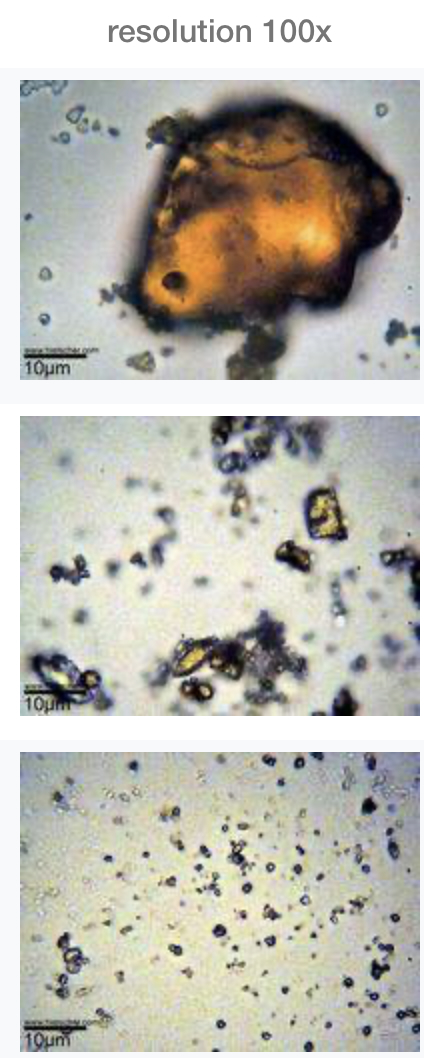
Microscope images showing the progress of ultrasonic milling of dental ceramic