Emulsifying by Ultrasonic Cavitation
A wide range of intermediate and consumer products – such as cosmetics, skin lotions, pharmaceutical ointments, varnishes, paints, lubricants, and fuels – are based wholly or in part on emulsions.
Hielscher manufactures the world’s largest industrial ultrasonic liquid processors for the efficient emulsification of large-volume streams in production plants.
How Ultrasonic Emulsification Works
Laboratory Applications: In laboratory settings, the emulsification power of ultrasound has been known and applied for a long time due to the various benefits tied to ultrasonic homogenization and emulsification.
The Technology
Reliable ultrasonic emulsification is based on the use of ultrasonic probes, also known as sonotrodes. The process works as follows:
- Ultrasound Coupling: Via the ultrasonic probe, high-intensity ultrasound is coupled into liquids, creating acoustic cavitation.
- Cavitation Effect: Ultrasonic or acoustic cavitation generates high shear forces, which provide the required energy to disrupt large droplets down to nano-size droplets.
- Emulsion Formation: Two or more liquid phases are mixed into a uniform submicron- or nano-emulsion.
Industrial Scale-Up via Flow-Through Technology: Using ultrasonic flow cells allows for linear scale-up to industrial production of nanoemulsions, processing large volume streams in continuous flow-through.
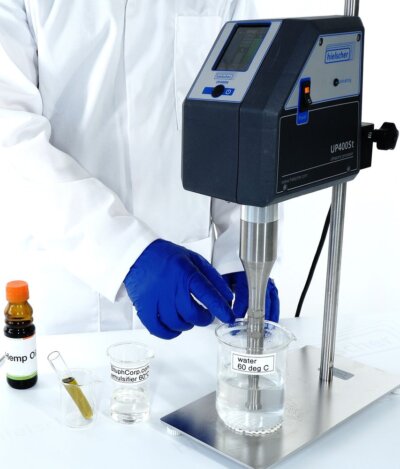
Ultrasonic preparation of a clear nano-emulsion using the UP400ST ultrasonicator.
The Advantages of Ultrasonic Emulsification
Ultrasonic emulsification using a probe-type ultrasonicator offers several advantages over other emulsifying techniques:
- Improved emulsion stability: Ultrasonic emulsification creates smaller droplet sizes and more uniform droplet distribution, resulting in improved emulsion stability and a longer shelf life. Submicron- and nano-sized droplets can be reliably produced using power ultrasound.
- Energy efficiency: Ultrasonic emulsification requires less energy than other emulsification methods, making it a more energy-efficient process.
- Scalability: Ultrasonic emulsification can be easily scaled up or down depending on the required volume, making it a versatile process for both laboratory and industrial applications.
- Time-saving: Ultrasonic emulsification can be a very rapid process, with emulsions forming in seconds to minutes, depending on the liquids, volume and equipment.
- Reduced need for surfactants: Ultrasonic emulsification can reduce the need for surfactants, which are often required to stabilize emulsions. However, with a reduced droplet size, the surface area of the particle is increased and more area must be covered by a surfactant. Ultrasonication is compatible with almost any kind of surfactant including alternative and novel emulsifiers.
- Minimal and controllable heat generation: Ultrasonic emulsification is a non-thermal process and heat generation during processing can be avoided or reduced to a small degree. Thereby, the risk of thermal degradation of sensitive compounds or ingredients is reduced.
The advantages of ultrasonic emulsification using a probe-type ultrasonicator make it an excellent choice for emulsification in a variety of fields, including food and beverage, pharmaceuticals, cosmetics, fine chemicals and fuels.
Read more about ultrasonic mayonnaise emulsification!
Read more about the production of paraffin wax emulsions using sonication!
Read more about Water-in-Diesel Emulsions produced using ultrasonics!
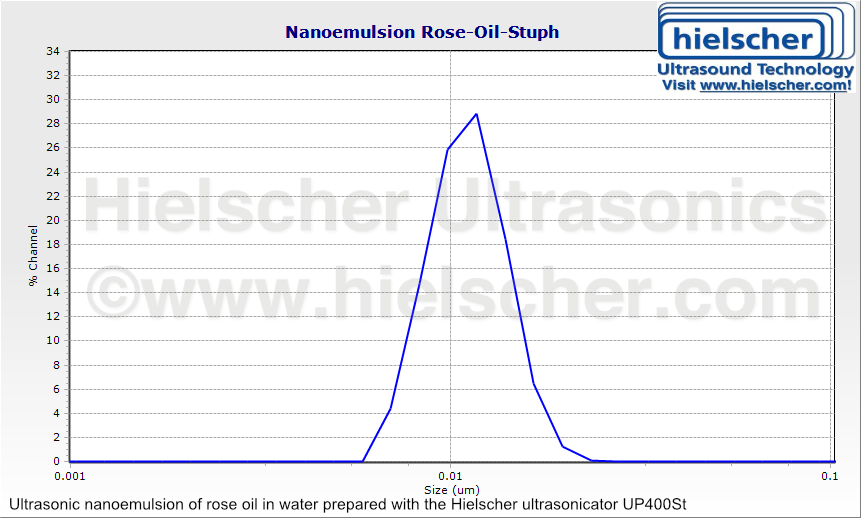
The DLS measurement shows the uniform droplet size distribution of an ultrasonically produced rose oil-in-water emulsion.
 What is an Emulsion?
Emulsions are dispersions of two or more immiscible liquids. Highly intensive ultrasound supplies the power needed to disperse a liquid phase (dispersed phase) in small droplets in a second phase (continuous phase). In the dispersing zone, imploding cavitation bubbles cause intensive shock waves in the surrounding liquid and result in the formation of liquid jets of high liquid velocity.
Learn about ultrasonication for better emulsions.
Nano-Emulsions – The Power Application for Sonicators
Nanoemulsions are emulsions with droplets that are typically less than 100 nanometers in size. Nanoemulsions offer several advantages over conventional emulsions, including unique functional properties, higher stability, transparency, etc.
Ultrasonication outcompetes traditional emulsification technologies especially when it comes to the formation of nanoemulsions. This is due to the highly efficient and energy-intense working principle of ultrasound.
The video below shows the emulsification process of oil (yellow) into water (red) by using the UP400S lab ultrasonicator.
Working Principle of Ultrasonic Emulsification
 Acoustic Cavitation: The Driving Force Behind Ultrasonic Emulsification and Nano-Emulsification
Ultrasonic emulsification relies on the powerful effects of acoustic cavitation, a phenomenon that occurs when high-intensity ultrasound waves pass through a liquid. During this process, microscopic bubbles form, grow, and then collapse violently. The implosive collapse of these bubbles generates extreme localized conditions, including intense pressure and temperature gradients, high shear forces, shock waves, and liquid micro-jets. These forces effectively break down large particles, droplets, and agglomerates into much smaller structures.
The image on the left illustrates acoustic cavitation generated by the UIP1000hdT ultrasonic processor (1000 W) operating in a liquid-filled glass column.
How Acoustic Cavitation Improves Emulsification
In both emulsification and nano-emulsification, cavitation intensity is a key factor in determining droplet size. As cavitation bubbles collapse, the resulting shear forces fragment larger droplets into increasingly smaller ones. At the same time, the localized pressure and temperature changes promote the formation of new droplets while helping to stabilize the emulsion.
This combination of droplet disruption and stabilization enables ultrasonic technology to produce highly uniform emulsions with exceptionally fine droplet size distributions.
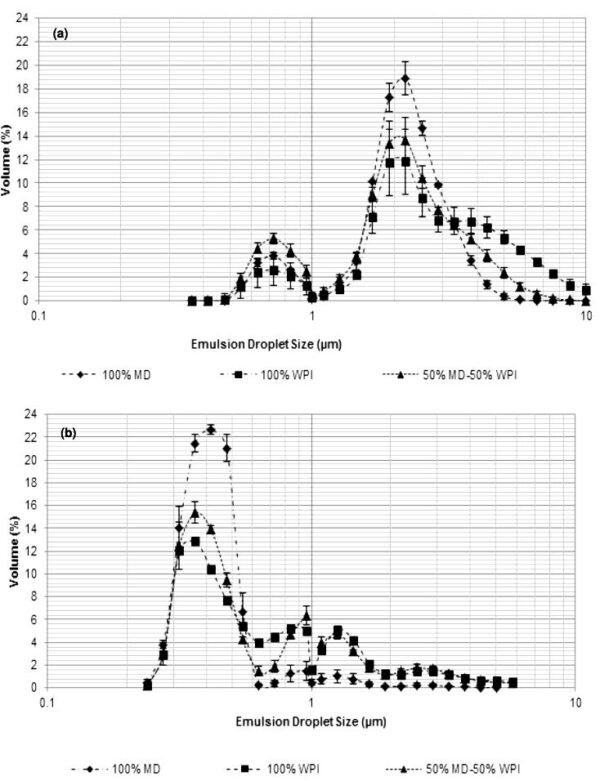
Droplet size distribution of water-olive oil emulsions prepared by (a) classic homogenization method (b) ultrasonic homogenization (using the UP400S) method with MD, WPI and their mixture, having 40% dry matter with 9% oil (w/w) content. Ultrasonic emulsification results in significantly smaller droplets, less creaming and a better overall emulsion stability.
(study and graphs: Zungur et al., 2015)
Ultrasonic Probes for Efficient Emulsification
 Hielscher offers a broad range of probe-type ultrasonicators and accessories for the efficient emulsification and dispersing of liquids in batch and flow-through mode.
Systems consisting of several ultrasonic processors of up to 16,000 watts each, provide the capacity needed to translate this lab application into an efficient production method to obtain finely dispersed emulsions in continuous flow or in a batch – achieving results comparable to that of today’s best high-pressure homogenizers available, such as the new orifice valve. In addition to this high efficiency in the continuous emulsification, Hielscher ultrasonic devices require very low maintenance and are very easy to operate and to clean. The ultrasound does actually support the cleaning and rinsing. The ultrasonic power is adjustable and can be adapted to particular products and emulsification requirements. Special flow cell reactors meeting the advanced CIP (clean-in-place) and SIP (sterilize-in-place) requirements are available, too.

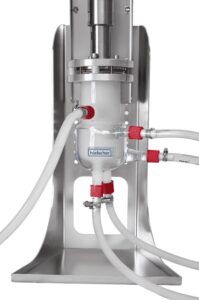
The MultiSonoReactor MSR-4 is an industrial inline homogenization reactor suitable for (nano-)emulsification processes with high throughputs.
| Batch Volume | Flow Rate | Recommended Devices |
|---|---|---|
| 0.5 to 1.5mL | n.a. | VialTweeter | 1 to 500mL | 10 to 200mL/min | UP100H |
| 10 to 2000mL | 20 to 400mL/min | UP200Ht, UP400St |
| 0.1 to 20L | 0.2 to 4L/min | UIP2000hdT |
| 10 to 100L | 2 to 10L/min | UIP4000hdT |
| 15 to 150L | 3 to 15L/min | UIP6000hdT |
| n.a. | 10 to 100L/min | UIP16000 |
| n.a. | larger | cluster of UIP16000 |
Contact Us! / Ask Us!
MultiPhaseCavitator (MPC48)
The MultiPhaseCavitator is a powerful accessory compatible with Hielscher ultrasonic flow cell reactors: Using the insert MPC48, the dispersed phase is injected via 48 cannulas as thin liquid strands into the ultrasonic hot zone, where the dispersed phase and the continuous phase are mixed as minute droplets into a nanoemulsion.
Discover how the MultiPhaseCavitator improves emulsification!

Hielscher Ultrasonics manufactures high-performance ultrasonic homogenizers for mixing applications, dispersion, emulsification and extraction on lab, pilot and industrial scale.
Literature / References
- Ahmed Taha, Eman Ahmed, Amr Ismaiel, Muthupandian Ashokkumar, Xiaoyun Xu, Siyi Pan, Hao Hu (2020): Ultrasonic emulsification: An overview on the preparation of different emulsifiers-stabilized emulsions. Trends in Food Science & Technology Vol. 105, 2020. 363-377.
- Seyed Mohammad Mohsen Modarres-Gheisari, Roghayeh Gavagsaz-Ghoachani, Massoud Malaki, Pedram Safarpour, Majid Zandi (2019): Ultrasonic nano-emulsification – A review. Ultrasonics Sonochemistry Vol. 52, 2019. 88-105.
- Behrend, O., Schubert, H. (2000): Influence of continuous phase viscosity on emulsification by ultrasound, in: Ultrasonics Sonochemistry 7 (2000) 77-85.
- Salla Puupponen, Ari Seppälä, Olli Vartia, Kari Saari, Tapio Ala-Nissilä (2015): Preparation of paraffin and fatty acid phase changing nanoemulsions for heat transfer. Thermochimica Acta, Volume 601, 2015. 33-38.
- F. Joseph Schork; Yingwu Luo; Wilfred Smulders; James P. Russum; Alessandro Butté; Kevin Fontenot (2005): Miniemulsion Polymerization. Adv Polym Sci (2005) 175: 129–255.
- The Advantages of Ultrasonic Emulsification – Hielscher Ultrasonics
Facts Worth Knowing
Definition of the Term “Emulsion”
An emulsion is a mixture of two or more immiscible liquids, such as oil and water.
Emulsions can be either oil-in-water (where oil droplets are dispersed in water) or water-in-oil (where water droplets are dispersed in oil). Emulsions are used in a variety of applications, including food products (such as salad dressings and mayonnaise), cosmetics (such as lotions and creams), and pharmaceuticals (such as vaccines).
An emulsifier works by reducing the surface tension between the two immiscible substances (such as oil and water) in an emulsion. This reduces the tendency of the two substances to separate and allows them to form a stable mixture.
How is an Emulsion made Stable?
An emulsion is made stable by preventing the dispersed phase (droplets of one liquid) from coalescing and separating from the continuous phase (the surrounding liquid). Several key points must be considered to achieve stability in emulsions:
- Emulsifiers (Surfactants):
– Role: Emulsifiers are molecules that have both hydrophilic (water-attracting) and hydrophobic (water-repelling) ends.
– Action: They reduce the surface tension between the two immiscible liquids and form a protective layer around the droplets, preventing them from coalescing.
– Examples: Lecithin, polysorbates, and sodium stearoyl lactylate. - Mechanical Methods:
High-Performance Mixing: Using high-shear mixers or homogenizers to break the droplets into smaller sizes, increasing the surface area and enhancing stability. Probe-type sonicators are an excellent and very reliable method using sonomechanical shear forces. These ultrasonic shear forces break large droplets into minute droplets and blending the immiscible phases into a stable emulsion. - Viscosity Modifiers:
Thickeners: Increasing the viscosity of the continuous phase can slow down the movement of droplets, reducing the likelihood of coalescence.
– Examples: Xanthan gum, guar gum, and carboxymethyl cellulose. - Stabilizing Agents:
– Polymers: Polymers can provide steric stabilization by forming a thick layer around droplets.
– Examples: Pectin, gelatin, and certain proteins. - Electrostatic Stabilization:
– Charge: Some emulsifiers impart an electrical charge to the surface of droplets, causing them to repel each other and thus reducing coalescence.
– Examples: Sodium caseinate and soy lecithin. - Temperature Control:
– Cooling: Lowering the temperature can increase the viscosity of the continuous phase and reduce the kinetic energy of the droplets, preventing coalescence.
– Avoiding Phase Separation: Ensuring the temperature remains within a range that prevents the components from separating. - Additives:
– Antioxidants: Preventing oxidation can help maintain the integrity of the emulsifier and other components.
– Chelating Agents: Binding metal ions that might otherwise destabilize the emulsion.
Applying the right technique of emulsification, emulsions can be made stable, ensuring that the mixture remains homogeneous and retains its desired properties over time.
Stabilizing Emulsifiers
In general, emulsions require stabilization using an emulsifying agent or surfactant. Emulsifiers are amphiphilic – they attract both water and fatty substances. This means they have hydrophilic (water-loving) and hydrophobic (oil-loving) properties, which allows them to interact with both the oil and water phases of the emulsion. The hydrophilic part of the emulsifier molecule attaches to the water molecules, while the hydrophobic part attaches to the oil molecules.
By surrounding the oil droplets with emulsifier molecules, the emulsifier creates a protective layer around the droplets that prevents them from coming into contact with each other and coalescing (joining together) to form larger droplets. This helps to keep the emulsion stable and prevents separation.
As coalescence of the droplets after disruption influences the final droplet size distribution, efficiently stabilizing emulsifiers are used to maintain the final droplet size distribution at a level that is equal to the distribution immediately after the droplet disruption in the ultrasonic dispersing zone. Stabilizers actually lead to improved droplet disruption at constant energy density.
Examples of commonly used emulsifiers include lecithin (which is found in egg yolks and soybeans), mono- and diglycerides, polysorbate 80, and sodium stearoyl lactylate.

Miniemulsions, which can be efficiently created by ultrasonication, enhance chemical reactions. Macroemulsion polymerization (a) versus miniemulsion polymerization (b) [Schork et al. 2005: 136]

Hielscher Ultrasonics manufactures high-performance ultrasonic homogenizers from lab to industrial size.