Yeast Cell Lysis in Microplates Using High-Intensity Sonication
Microbiologists and life science researchers working with Saccharomyces cerevisiae, Pichia pastoris / Komagataella phaffii, and other yeast systems know the challenge: yeast cells are robust, reproducible lysis can be difficult, and manual sample disruption quickly becomes a bottleneck when many strains, clones, culture conditions, or expression constructs must be screened.
High-Throughput Yeast Lysis for Microbiology, Molecular Biology and Protein Analytics
Hielscher microplate sonicators such as the UIP400MTP (400 W) and UIP550MTP (550 W) provide a high-throughput solution for mechanical yeast cell lysis directly in microplates. Instead of processing samples one by one with a probe, entire microplates can be sonicated under uniform conditions. This makes ultrasonic yeast lysis faster, more reproducible, and easier to integrate into modern microbiology, protein expression, enzyme screening, and omics workflows.
Whether you need to release recombinant proteins from P. pastoris, prepare yeast lysates for enzyme assays, disrupt S. cerevisiae for protein analysis, or screen dozens of yeast clones in parallel, Hielscher microplate sonicators deliver powerful cavitation-based cell disruption with precise process control.
Need reproducible lysis of S. cerevisiae, P. pastoris, or other yeast strains in microplates? Tell us your plate format, sample volume, cell density, and target analyte. We will help you define suitable sonication parameters for your UIP400MTP or UIP550MTP workflow.

Hielscher Multi-Well Plate Sonicator for yeast lysis – sample preparation at high-throughput
Why Yeast Cells Require Efficient Mechanical Lysis
Yeast cells are more difficult to lyse than many bacterial or mammalian cells because they are protected by a rigid cell wall composed mainly of polysaccharides, glucans, mannoproteins, and chitin. This cell wall provides mechanical stability, but it also limits the release of intracellular proteins, nucleic acids, metabolites, and enzymes.
Conventional yeast lysis methods include bead beating, enzymatic digestion, freeze-thaw cycles, chemical lysis, and probe-type sonication. These methods can be effective, but they also have limitations. Bead beating can introduce debris and heating, enzymatic digestion can add cost and variability, and single-sample probe sonication is time-consuming when large sample numbers must be processed.
High-intensity, focused ultrasonic cavitation overcomes these limitations by applying intense mechanical shear forces, pressure fluctuations, and microstreaming to the yeast suspension. The result is rapid disruption of cell walls and membranes, improved intracellular release, and highly reproducible sample preparation in plate format.
Microplate Sonication for Parallel Yeast Sample Preparation
The Hielscher UIP400MTP and UIP550MTP are designed for uniform sonication of microplates, multiwell plates, PCR plates, and suitable sample racks. Unlike probe sonication, the samples do not need to be treated individually. The complete plate is exposed to controlled ultrasonic energy, making the workflow highly suitable for parallel sample processing.
This is particularly useful for:
- Screening S. cerevisiae mutants or expression strains
- Lysis of P. pastoris / K. phaffii clones after recombinant protein expression
- Preparation of yeast lysates for enzyme assays
- Protein extraction for SDS-PAGE, Western blot, ELISA, LC-MS/MS, or activity testing
- Release of intracellular metabolites for metabolomics
- DNA and RNA sample preparation after suitable downstream purification
- High-throughput optimization of lysis buffers, additives, and extraction conditions
How Ultrasonic Cavitation Disrupts Yeast Cells
During sonication, focused high-power ultrasound generates alternating compression and rarefaction cycles in the liquid sample. At sufficient intensity, these pressure fluctuations create acoustic cavitation. Cavitation bubbles form, oscillate, and collapse, producing localized shear forces, microjets, turbulence, and strong pressure gradients.
In yeast suspensions, these mechanical effects weaken and rupture the cell wall and cell membrane. Intracellular proteins, enzymes, nucleic acids, and metabolites are released into the lysis buffer. Since the process is mechanical, it can be used with many different buffer systems and can be combined with protease inhibitors, reducing agents, detergents, salts, or mild enzymatic pre-treatment.
General Protocol: Yeast Cell Lysis in Microplates
The following protocol provides a practical starting point for yeast lysis using the Hielscher UIP400MTP or UIP550MTP microplate sonicator. Parameters should be optimized according to yeast strain, cell density, target molecule, buffer composition, plate type, and downstream assay.
1. Harvest and Wash Yeast Cells
Grow Saccharomyces, Pichia, Hansenula, Debaryomyces, or another yeast strain under the desired culture conditions. Harvest the cells by centrifugation and remove the culture medium. Wash the pellet with cold distilled water, PBS, or the selected lysis buffer to remove residual medium components that may interfere with downstream analysis.
For protein extraction, keep samples cold and work quickly. If proteases are a concern, pre-cool all buffers and consumables.
2. Resuspend the Cell Pellet
Resuspend the yeast pellet in a suitable cold lysis buffer. For efficient protein release, high cell density is often advantageous. As a starting point, use approximately 10–20% w/v wet cell pellet or a dense suspension corresponding to OD600 > 10, depending on the assay.
A typical yeast protein lysis buffer may contain:
- buffer system such as Tris-HCl, phosphate buffer, or HEPES
- salt such as NaCl or KCl
- protease inhibitor cocktail
- optional reducing agent such as DTT or β-mercaptoethanol
- optional detergent such as Triton X-100, NP-40, SDS, or CHAPS, depending on downstream compatibility
- optional phosphatase inhibitors for phosphorylation studies
For difficult yeast strains or very gentle protein extraction, a short pre-treatment with Zymolyase, Lyticase, or another cell-wall-digesting enzyme can be used before sonication. This enzymatic pre-treatment is optional but may improve lysis efficiency or reduce the required ultrasonic intensity.
3. Transfer Samples into a Suitable Microplate
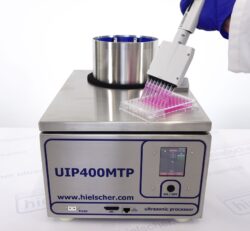 Dispense the yeast suspension into a sonication-compatible microplate. Round-bottom plates are often preferred because they improve sample collection and reduce dead zones. Use equal sample volumes across wells to improve reproducibility.
Seal the plate with a suitable sealing mat or film to prevent evaporation, aerosol formation, and cross-contamination. Ensure that the seal is compatible with the selected temperature and sonication conditions.
Typical working volumes depend on the plate format and application. Common formats include 96-well plates, deep-well plates, PCR plates, or suitable tube racks.
4. Set Up Cooling
Yeast lysis requires high ultrasonic intensity, and mechanical disruption generates heat. Temperature control is therefore critical, especially for protein, enzyme, RNA, or phosphorylation analysis.
Use an appropriate cooling strategy, such as:
- pre-chilled lysis buffer
- pre-cooled microplates
- cooling pauses between sonication intervals
- external cooling of the sonication platform, where applicable
The goal is to keep the sample cold enough to prevent protein denaturation, enzyme inactivation, RNA degradation, and heat-induced sample variability.
5. Sonicate the Yeast Suspension
Place the sealed plate into the Hielscher UIP400MTP or UIP550MTP microplate sonicator and select a pulsed sonication program. Pulsing is recommended because it allows mechanical disruption during ON phases and heat dissipation during OFF phases.
As a starting point for yeast cell lysis:
| Parameter | Recommended Starting Range | Purpose |
|---|---|---|
| Amplitude | 60–100% | High cavitation intensity for robust yeast cells |
| Pulse Mode | 10–30 sec ON / 30–60 sec OFF | Efficient lysis with controlled heat build-up |
| Cumulative ON-Time | 5–15 min | Adjust according to strain, density, and target molecule |
| Temperature | Keep samples cold | Protect proteins, enzymes, RNA, and metabolites |
| Plate Sealing | Recommended | Prevents evaporation, aerosol formation, and cross-contamination |
For highly resistant yeast suspensions, dense P. pastoris biomass, or difficult recombinant protein extraction, increase the cumulative ON-time stepwise. For heat-sensitive proteins or enzyme assays, use shorter pulses, longer cooling pauses, and lower starting amplitude.
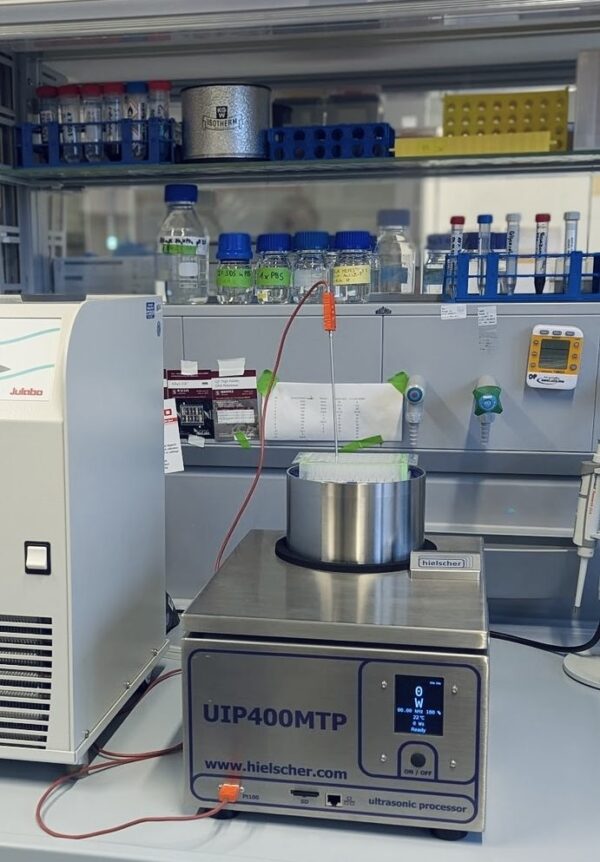
High-throughput yeast lysis in multiwell plates with the UIP400MTP
6. Clarify the Lysate
After sonication, centrifuge the microplate or transfer samples to tubes for centrifugation. Remove cell debris by centrifugation at a suitable speed and temperature. Collect the supernatant for downstream analysis.
Depending on the application, the lysate can be used for:
- protein quantification
- enzyme activity assays
- SDS-PAGE and Western blotting
- ELISA and immunoassays
- LC-MS/MS proteomics
- metabolite analysis
- DNA or RNA purification
7. Optimize and Document the Method
For reproducible yeast lysis, document all relevant parameters, including strain, culture condition, OD600, wet cell mass, buffer composition, plate type, sample volume, amplitude, pulse cycle, cumulative ON-time, cooling method, and final sample temperature.
If the Hielscher sonicator is equipped with automatic data recording, the process data can be used for documentation, method development, scale-up, and quality control.
Optimization Tips for Yeast Lysis
For maximum protein release, use dense yeast suspensions, high ultrasonic intensity, and sufficient cumulative ON-time. For sensitive proteins, reduce the amplitude, extend cooling pauses, and keep the plate cold throughout the run.
If lysis is incomplete, increase the sonication time stepwise, test enzymatic pre-treatment, reduce sample viscosity, or optimize the buffer. If proteins degrade or lose activity, improve cooling, shorten ON intervals, add inhibitors, and verify that the detergent system is compatible with the target protein.
Because yeast strains differ substantially in cell wall structure, growth phase, expression system, and biomass density, a short optimization matrix is recommended. For example, test three amplitudes, two pulse cycles, and two total ON-times, then evaluate lysis efficiency and protein integrity.
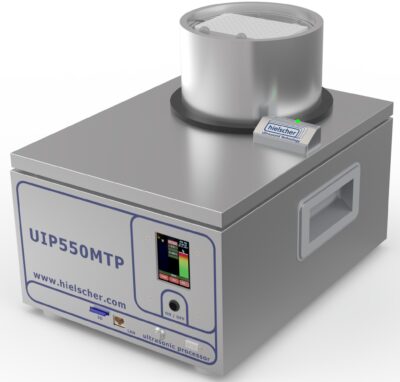
Whether you process a few assay plates or run high-throughput yeast screening, Hielscher can help you select the right microplate sonicator and develop a robust lysis protocol. Contact us with your yeast strain, workflow, and throughput requirements!
Advantages of Hielscher Microplate Sonicators for Yeast Lysis
Hielscher microplate sonicators are ideal for laboratories that need reproducible lysis across many samples. They eliminate the slow one-sample-at-a-time handling of probe sonication and reduce variability caused by manual probe positioning, immersion depth, and sample-to-sample handling differences.
Key advantages include:
- High-throughput processing: Sonicate many yeast samples in parallel in microplates or compatible sample racks.
- Reproducible conditions: Same sonication conditions across all wells for uniform, comparable lysis results.
- No probe cross-contamination: Samples remain sealed during sonication, reducing carryover and cleaning steps.
- Suitable for robust cells: High-intensity ultrasound supports the disruption of yeast cell walls.
- Efficient workflow: Ideal for screening strains, clones, expression conditions, and lysis buffers.
- Efficient workflow: Programmable settings, automated data logging and suitable for lab automation.
Applications in Yeast Biotechnology and Life Science Research
Ultrasonic yeast lysis in microplates supports many research and screening workflows. In recombinant protein expression, P. pastoris and S. cerevisiae clones can be lysed in parallel to compare expression levels or enzyme activity. In systems biology and omics, standardized lysis improves comparability across conditions. In microbiology, sonication supports rapid preparation of lysates from multiple strains, media conditions, or stress treatments.
Typical application areas include:
- yeast protein extraction
- recombinant protein screening
- enzyme activity screening
- clone selection after transformation
- fermentation optimization
- proteomics sample preparation
- metabolomics sample preparation
- cell wall disruption studies
- high-throughput microbiology assays
Reliable Yeast Lysis Starts with Controlled Sonication
Yeast lysis can be difficult when sample numbers increase, but Hielscher microplate sonicators make the process faster, cleaner, and more reproducible. The UIP400MTP and UIP550MTP allow researchers to process complete plates under defined ultrasonic conditions, improving throughput while reducing manual handling.
For microbiologists, molecular biologists, protein scientists, and biotech laboratories, microplate sonication is a powerful tool to release intracellular yeast components efficiently and reproducibly.
Frequently Asked Questions about Yeast Cell Lysis by Microplate Sonication
Can yeast cells be lysed by sonication?
Yes. Yeast cells such as Saccharomyces cerevisiaeand Pichia pastoris can be lysed by high-intensity sonication. Ultrasonic cavitation generates strong mechanical shear forces that disrupt the yeast cell wall and membrane, releasing proteins, enzymes, nucleic acids, and metabolites.
Why are yeast cells harder to lyse than bacterial cells?
Yeast cells have a thick and mechanically resistant cell wall composed mainly of glucans, mannoproteins, and chitin. This rigid structure makes yeast more difficult to disrupt than many bacterial or mammalian cells. Therefore, yeast lysis usually requires higher intensity, longer processing, or optional enzymatic pre-treatment.
Which Hielscher sonicators are suitable for yeast lysis in microplates?
The Hielscher UIP400MTP and UIP550MTP are suitable for high-throughput yeast lysis in microplates. The UIP400MTP is ideal for routine parallel sample preparation, while the UIP550MTP provides higher ultrasonic power for demanding lysis tasks, dense suspensions, and robust yeast strains.
Can Pichia pastoris be lysed in a microplate sonicator?
Yes. Pichia pastoris, also known as Komagataella phaffii, can be lysed using high-intensity microplate sonication. Since P. pastoris can form dense biomass and has a robust cell wall, optimization of amplitude, pulse cycle, cooling, and total sonication time is recommended.
What are typical sonication parameters for yeast lysis?
A useful starting range is 50–80% amplitude, pulsed operation such as 10–30 seconds ON and 30–60 seconds OFF, and 5–15 minutes cumulative ON-time. The exact parameters depend on yeast strain, cell density, sample volume, plate type, buffer, and target molecule.
Why should yeast lysis be performed with pulse mode?
Pulse mode reduces heat accumulation during sonication. During the ON phase, ultrasonic cavitation disrupts the cells. During the OFF phase, the sample can cool. This is important because excessive heat can denature proteins, reduce enzyme activity, degrade RNA, and compromise reproducibility.
Is enzymatic pre-treatment required before sonicating yeast cells?
Enzymatic pre-treatment is not always required, but it can improve lysis efficiency. Enzymes such as Zymolyase or Lyticase partially digest the yeast cell wall and can reduce the ultrasonic intensity or time needed for complete lysis. This may be useful for sensitive proteins or difficult strains.
How can overheating be prevented during yeast sonication?
Use pre-chilled buffers, pulse mode, cooling pauses, and a cooled plate setup. Keep the microplate sealed and monitor temperature where possible. For sensitive proteins, use shorter ON intervals, longer OFF intervals, and process samples under cold conditions.
Can microplate sonication replace bead beating for yeast lysis?
In many workflows, yes. Microplate sonication can replace bead beating when clean, reproducible, and parallel lysis is required. It avoids bead handling, reduces consumable complexity, and simplifies automation. However, each application should be validated by comparing lysis yield, protein integrity, and assay performance.
Is microplate sonication suitable for protein extraction from yeast?
Yes. Microplate sonication is well suited for protein extraction from yeast, especially when many clones or culture conditions must be compared. Protease inhibitors, cold buffers, and controlled pulse settings help preserve protein quality.
Can the same method be used for DNA, RNA, and protein extraction?
The same basic sonication principle can be used, but the buffer and process conditions should be adapted to the target molecule. Protein workflows require protease inhibition and temperature control. RNA workflows require RNase-free handling and strong cooling. DNA workflows may require different lysis and purification conditions depending on whether intact genomic DNA or fragmented DNA is desired.
What plate type should be used for yeast lysis?
Use a sonication-compatible microplate or deep-well plate with suitable sealing. Round-bottom plates are often useful for suspension handling. The plate should withstand the selected sonication conditions, sample temperature, and centrifugation steps.
How do I know if yeast lysis is complete?
Lysis efficiency can be checked by microscopy, protein yield, enzyme activity, viscosity reduction, SDS-PAGE analysis, DNA/RNA yield, or comparison with a known lysis method. For method development, evaluate both yield and quality of the released target molecule.
UIP400MTP or UIP550MTP: Which Microplate Sonicator Should You Choose?
The UIP400MTP is a powerful microplate sonicator for routine high-throughput sample preparation, including yeast lysis, protein extraction, DNA shearing, biofilm detachment, and assay preparation. It is suitable for laboratories that need reproducible sonication in standard plate formats.
The UIP550MTP provides higher ultrasonic power and is recommended when more demanding applications require stronger acoustic intensity, shorter processing times, higher sample loads, or more robust disruption conditions. For yeast lysis, the UIP550MTP is particularly useful for dense biomass, difficult strains, larger working volumes, and high-throughput expression screening.
Can yeast lysis by microplate sonication be automated?
Yes. Microplate-based sonication is well suited for automated laboratory workflows because samples remain in plate format. This supports integration with pipetting systems, plate handling, centrifugation, assay preparation, and high-throughput screening workflows.
Literature / References
- FactSheet UIP400MTP Multi-well Plate Sonicator – Non-Contact Sonicator – Hielscher Ultrasonics
- FactSheet UIP550MTP Multi-well Plate Sonicator – Non-Contact Sonicator – Hielscher Ultrasonics
- Lauren E. Cruchley-Fuge, Martin R. Jones, Ossama Edbali, Gavin R. Lloyd, Ralf J. M. Weber, Andrew D. Southam, Mark R. Viant (2024): Automated extraction of adherent cell lines from 24-well and 96-well plates for multi-omics analysis using the Hielscher UIP400MTP sonicator and Beckman Coulter i7 liquid handling workstation. Metabomeeting 2024, University of Liverpool, 26-28th November 2024.
- Cosenza-Contreras M, Seredynska A, Vogele D, Pinter N, Brombacher E, Cueto RF, Dinh TJ, Bernhard P, Rogg M, Liu J, Willems P, Stael S, Huesgen PF, Kuehn EW, Kreutz C, Schell C, Schilling O. (2024): TermineR: Extracting information on endogenous proteolytic processing from shotgun proteomics data. Proteomics 2024.
