Assay Miniaturization Enabled by High-Throughput Sonication
Assay miniaturization is a defining trend in modern life science research. As laboratories seek to process larger sample numbers while reducing reagent consumption and experimental costs, smaller reaction volumes and microplate-based workflows are increasingly replacing traditional tube-based assays. This shift toward assay miniaturization enables researchers to accelerate assay development, shorten experimental cycles, and generate more robust datasets through higher sample density.
Challenges in Assay Miniaturization
Miniaturized assays also introduce technical challenges. Working with small sample volumes in high-density microplates requires highly consistent sample preparation across all wells. Variations in processing conditions can quickly lead to inconsistent results, particularly in workflows involving cell disruption, nucleic acid extraction, protein isolation, or nanoparticle dispersion. Ensuring uniform treatment of all samples therefore becomes critical for maintaining data reliability and experimental reproducibility.

Overcome Challenges in Assay Miniaturization with the UIP400MTP
 The Microplate Sonicator UIP400MTP addresses these challenges by enabling high-throughput sonication directly in standard multi-well plates. Instead of processing samples individually, the system applies ultrasonic energy simultaneously across the entire microplate. This approach ensures uniform sonication conditions for every well while dramatically increasing processing speed. As a result, researchers can integrate ultrasonic sample preparation seamlessly into modern high-throughput workflows.
Ultrasonic processing has long been a proven technique in life science laboratories. Ultrasound efficiently disrupts cell membranes, fragments DNA, extracts intracellular biomolecules, and disperses particles. Yet conventional sonication methods often require probe-based systems or tube-by-tube processing, which can limit throughput when working with large sample numbers. By contrast, the UIP400MTP allows laboratories to process entire microplates at once, eliminating the need for repetitive individual sample handling and enabling truly scalable workflows.
The Advantages of the Microplate Sonicator UIP400MTP
A central advantage of the UIP400MTP is its ability to deliver uniform ultrasonic energy distribution across all wells of the microplate. Consistent sonication conditions are essential for maintaining reproducibility in high-throughput assays, especially when comparing hundreds of samples within a single experiment. By treating all wells simultaneously under identical parameters, the UIP400MTP ensures that each sample undergoes the same processing conditions.
This capability supports a broad range of life science applications that rely on controlled ultrasonic processing. Researchers use high-throughput sonication for tasks such as:
- cell lysis and cell solubilization for molecular analysis
- DNA and RNA extraction from biological samples
- DNA fragmentation for genomic workflows
- protein extraction for proteomics and biochemical studies
- next-generation sequencing (NGS) library preparation
- nanoparticle dispersion in nanobiotechnology research
- detachment of cells or biofilms from surfaces
Because ultrasonic treatment is applied uniformly across the plate, experimental variability is minimized and downstream analytical workflows benefit from greater reliability.
Another important aspect of assay miniaturization is the increasing adoption of laboratory automation and robotic workstations. Automated liquid handling systems and integrated robotic platforms allow laboratories to process large numbers of samples with minimal manual intervention. To support these environments, laboratory equipment must be designed for seamless integration into automated systems.

The UIP400MTP ensures reliable sample preparation and a facile integration with existing lab workflows
The UIP400MTP is not an ultrasonic bath. It'a a high intensity cup horn for focused sonication. This powerful non-contact sonicator delivers a uniform sonication across all wells of your standard well-plate. You have precise control over amplitude, power, and pulsing. A built-in timer and temperature probe ensures consistent results. The UIP400MTP plate sonicator cools samples with water bath (external chiller optional).
The UIP400MTP is not an ultrasonic bath. It'a a high intensity cup horn for focused sonication. This powerful non-contact sonicator delivers a uniform sonication across all wells of your standard well-plate. You have precise control over amplitude, power, and pulsing. A built-in timer and temperature probe ensures consistent results. The UIP400MTP plate sonicator cools samples with water bath (external chiller optional).
Integration into Automated Lab Workstations
The UIP400MTP was engineered with this requirement in mind. Its clean structural design, compact footprint, and highly robust device housing allow it to be easily incorporated into automated laboratory workstations. The system can be integrated into robotic workflows alongside automated liquid handlers, microplate readers, and other high-throughput analytical instruments. This compatibility makes it particularly suitable for laboratories performing automated cell assays, genomic workflows, or screening experiments where reproducibility and scalability are critical. Read more about the integration of the UIP400MTP into automated liquid handling systems!
| Sonicator: Key Advantages for Robotic Automation | Why It Matters |
| Standard plate support | Works with SBS formats robots already handle. |
| High throughput | Parallel sonication reduces cycle times. |
| Remote control & logging | Enables unattended operation and traceability. |
| Non-contact sonication | Lower contamination risk and better plate sealing. |
| Temperature control | Maintains sample integrity in automated runs. |
| Scalable across well formats | Fits evolving automation throughput needs. |
Compatibility with Lab Software
 In addition to mechanical integration, the UIP400MTP supports digital connectivity for automated control and data exchange. Modern laboratory environments increasingly rely on networked instruments that can be remotely controlled, monitored, and integrated into laboratory information systems. The microplate sonicator therefore provides several well-documented open interfaces that facilitate communication with automation platforms and control software.
Key communication and integration features include:
- remote control via XML and JSON-based communication protocols
- compatibility with ModBUS for industrial and laboratory automation systems
- SYSLOG support for event logging and system monitoring
These open-standard interfaces allow laboratories to incorporate the UIP400MTP into complex automated workflows and digital laboratory infrastructures. As a result, researchers can implement fully automated processes where microplate sonication becomes an integrated step within a larger experimental pipeline.

High-throughput PCR assays with the 96-well plate sonicator UIP400MTP
Advanced Life Science and Research with the Assay Sonicator
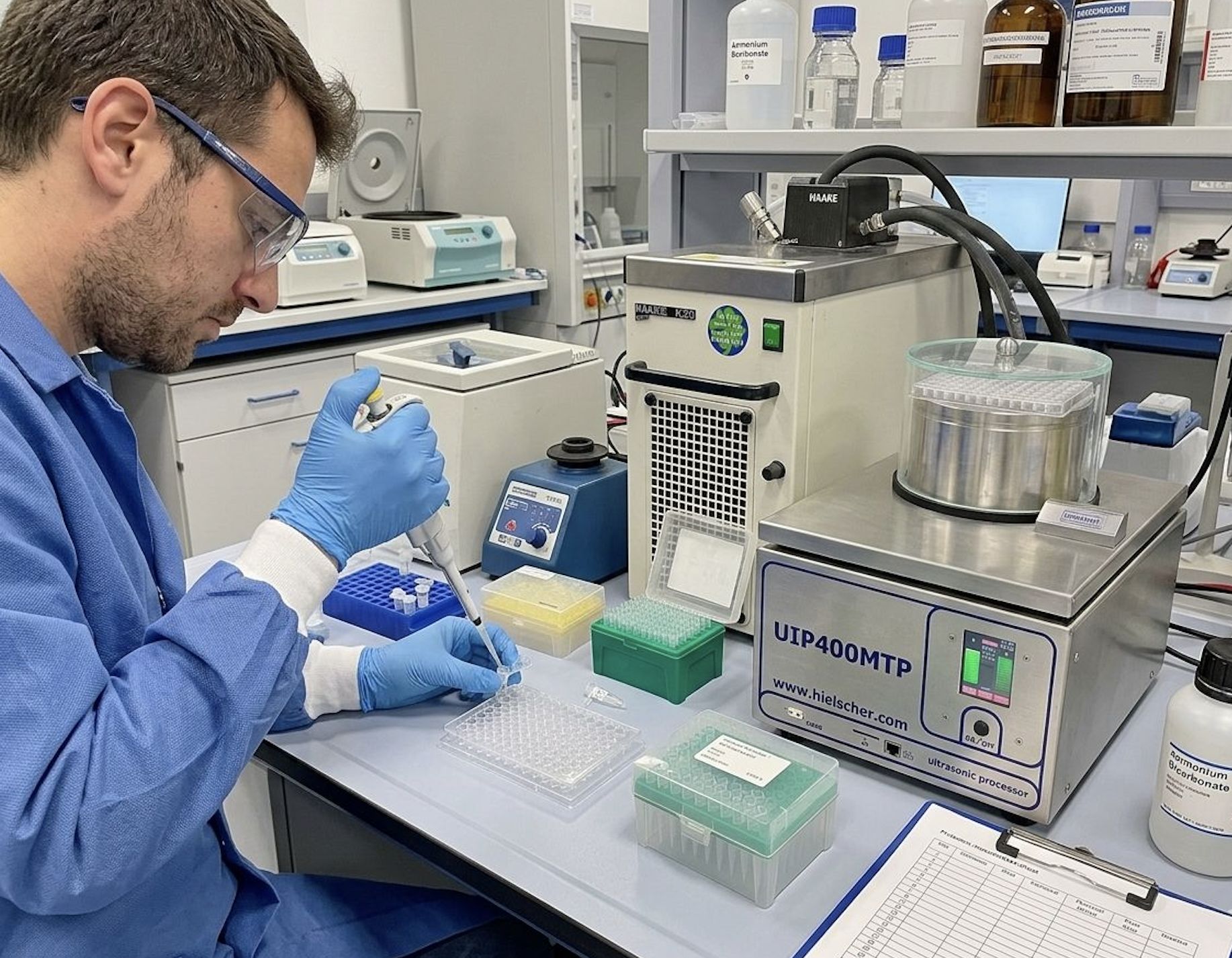 As life science research continues to move toward higher throughput, smaller reaction volumes, and automated workflows, technologies that support assay miniaturization are becoming increasingly important. Reliable sample preparation remains a key factor in ensuring experimental success, particularly when hundreds or thousands of samples must be processed under identical conditions.
By enabling high-throughput sonication with uniform energy distribution across entire microplates, the UIP400MTP provides researchers with a powerful tool for scalable and reproducible sample preparation. Its automation-ready design, digital connectivity, and compatibility with standard microplates make it an ideal solution for laboratories seeking to streamline assay development while maintaining scientific rigor.
In this way, the UIP400MTP Microplate Sonicator helps simplify one of the central challenges of modern laboratory workflows: achieving consistent, high-quality sample preparation in increasingly miniaturized and automated experimental environments.

High-throughput assays sonication with the 96-well plate sonicator UIP400MTP
Literature / References
- FactSheet UIP400MTP Multi-well Plate Sonicator – Non-Contact Sonicator – Hielscher Ultrasonics
- Lauren E. Cruchley-Fuge, Martin R. Jones, Ossama Edbali, Gavin R. Lloyd, Ralf J. M. Weber, Andrew D. Southam, Mark R. Viant (2024): Automated extraction of adherent cell lines from 24-well and 96-well plates for multi-omics analysis using the Hielscher UIP400MTP sonicator and Beckman Coulter i7 liquid handling workstation. Metabomeeting 2024, University of Liverpool, 26-28th November 2024.
- De Oliveira A, Cataneli Pereira V, Pinheiro L, Moraes Riboli DF, Benini Martins K, Ribeiro de Souza da Cunha MDL (2016): Antimicrobial Resistance Profile of Planktonic and Biofilm Cells of Staphylococcus aureus and Coagulase-Negative Staphylococci. International Journal of Molecular Sciences 17(9):1423; 2016.
- Martins KB, Ferreira AM, Pereira VC, Pinheiro L, Oliveira A, Cunha MLRS (2019): In vitro Effects of Antimicrobial Agents on Planktonic and Biofilm Forms of Staphylococcus saprophyticus Isolated From Patients With Urinary Tract Infections. Frontiers in Microbiology 2019.
- Dreyer J., Ricci G., van den Berg J., Bhardwaj V., Funk J., Armstrong C., van Batenburg V., Sine C., VanInsberghe M.A., Marsman R., Mandemaker I.K., di Sanzo S., Costantini J., Manzo S.G., Biran A., Burny C., Völker-Albert M., Groth A., Spencer S.L., van Oudenaarden A., Mattiroli F. (2024): Acute multi-level response to defective de novo chromatin assembly in S-phase. Molecular Cell 2024.
- Mochizuki, Chika; Taketomi, Yoshitaka; Irie, Atsushi; Kano, Kuniyuki; Nagasaki, Yuki; Miki, Yoshimi; Ono, Takashi; Nishito, Yasumasa; Nakajima, Takahiro; Tomabechi, Yuri; Hanada, Kazuharu; Shirouzu, Mikako; Watanabe, Takashi; Hata, Kousuke; Izumi, Yoshihiro; Bamba, Takeshi; Chun, Jerold; Kudo, Kai; Kotani, Ai; Murakami, Makoto (2024): Secreted phospholipase PLA2G12A-driven lysophospholipid signaling via lipolytic modification of extracellular vesicles facilitates pathogenic Th17 differentiation. BioRxiv 2024.
- Cosenza-Contreras M, Seredynska A, Vogele D, Pinter N, Brombacher E, Cueto RF, Dinh TJ, Bernhard P, Rogg M, Liu J, Willems P, Stael S, Huesgen PF, Kuehn EW, Kreutz C, Schell C, Schilling O. (2024): TermineR: Extracting information on endogenous proteolytic processing from shotgun proteomics data. Proteomics. 2024.
Frequently Asked Questions
What is an Assay?
An assay is an analytical procedure used to qualitatively detect or quantitatively measure the presence, concentration, activity, or functional effect of a biological molecule, cell population, or biochemical process within a sample. Assays are fundamental tools in life sciences, biochemistry, and pharmaceutical research, enabling scientists to study molecular interactions, enzyme activity, gene expression, cell viability, and many other biological parameters under controlled experimental conditions.
What are the most Common Assays?
The most common assays in life science research include enzyme-linked immunosorbent assays (ELISA) for detecting proteins or antibodies, polymerase chain reaction (PCR) and quantitative PCR (qPCR) assays for nucleic acid detection and quantification, cell viability assays such as MTT or resazurin assays, reporter gene assays used to study gene regulation, and enzyme activity assays that measure catalytic reactions. In addition, assays for DNA/RNA extraction, protein quantification (e.g., Bradford or BCA assays), and high-throughput screening assays are widely used in biotechnology and pharmaceutical development.
What are the 4 Types of Assays?
Assays are often categorized into four major types based on the analytical principle used.
- Biochemical assays measure the activity or concentration of biomolecules such as enzymes, proteins, or metabolites in a controlled reaction environment.
- Cell-based assays evaluate biological processes within living cells, such as cell proliferation, cytotoxicity, signaling pathways, or gene expression.
- Immunoassays use antigen–antibody interactions to detect specific proteins or biomarkers with high specificity.
- Binding assays analyze the interaction between molecules, for example ligand–receptor binding or protein–protein interactions, which is particularly important in drug discovery and pharmacological studies.
What is the Difference between an Assay and a Test?
The difference between an assay and a test lies mainly in their scientific scope and context. An assay is typically a standardized analytical procedure designed to measure a specific biological or chemical parameter with defined methodology, often used in research, drug development, and quality control. A test is a broader term that refers to any evaluation or examination performed to determine the presence, condition, or performance of something. In scientific and clinical contexts, many diagnostic tests are based on assays, but the term “test” may also refer to non-analytical evaluations or simplified diagnostic procedures.
Is the UIP400MTP microplate sonicator suitable for high-throughput sample preparation?
Yes, the UIP400MTP is a focused, non-contact sonicator streamlining workflows in microplates. Handling any 6-, 12-, 24-, 48-, 96-, and 384-well plates, the UIP400MTP easily facilitates sample preparation at mid-throughput and high-throughput.
Read more about mid-throughput and high-throughput sample preparation using a focused, non-contact sonicator!

Hielscher Ultrasonics manufactures high-performance ultrasonic homogenizers from lab to industrial size.