Integrating the UIP400MTP Microplate Sonicator into Lab Automation
The Hielscher UIP400MTP multi-well plate sonicator is engineered specifically for high-throughput, uniform ultrasonic processing of microtiter plates, addressing a critical need in automated sample preparation workflows spanning genomics, proteomics, diagnostics, and drug discovery. Its design, interface capabilities, and operational characteristics make it highly suitable for seamless incorporation into modern automated liquid handling systems – including liquid handlers and robotic workcells from platforms such as Tecan, Hamilton, and Beckman Coulter.
What the UIP400MTP Is and Why It Matters for Automation
 The UIP400MTP is a 400 W, 20 kHz high-performance multi-well plate sonicator capable of delivering precise, uniform ultrasonic energy across all wells of standard multi-well plates (e.g., 6-, 12-, 24-, 48-, 96-, 384-well formats). This uniformity supports reproducible sample processing necessary for downstream assays and analytics.
Unlike traditional probe sonicators, the UIP400MTP’s non-contact sonication chamber sonicates plates indirectly through the plate bottom, eliminating the need to immerse probes into samples and reducing cross-contamination risk. Its compatibility with standard laboratory plates (no proprietary consumables) further simplifies integration into automation workflows that rely on standard SBS formats.

UIP400MTP focused sonicator – suitable for integration in automated liquid handling systems
Integration with Automated Liquid Handlers: Key Enablers
- Standard Plate Compatibility
The UIP400MTP accepts all standard multi-well plate formats, including PCR and microtiter plates, enabling workflows without specialized consumable constraints. This directly aligns with automation decks that handle SBS-standard plates.
Why this matters: Robots from Tecan, Hamilton, and Beckman move plates from deck positions, stackers, incubators, and readers – and the more standardized the plate, the easier it is to incorporate additional process steps like sonication without changing plate geometry or handling logic. - Non-Contact, Parallel Processing
Because the UIP400MTP processes all samples in a plate simultaneously and without physical contact probes, the sonication step becomes a discrete, repeatable batch operation that fits naturally into automated sequences such as:→ Plate unloaded from stacker
→ Pipetting of sample into wells
→ Move to UIP400MTP sonication station
→ Remote trigger sonication run
→ Return plate to robotic deck
→ Proceed to downstream steps (analysis, detection, etc.)This batch nature enhances throughput and reduces variability across wells and plates.
- Remote Operation and Protocoling
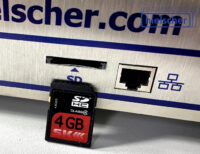 The UIP400MTP includes browser remote control and built-in SD-card logging functionality. Users can configure, start, and monitor sonication runs in an automated workcell without direct physical intervention, and output machine-readable protocol files (CSV) for traceability and compliance.
Automation Implication:
Robotic controllers (or middleware systems) can:- Programmatically trigger sonication via browser API or scheduled script,
- Monitor progress (e.g., elapsed time, temperature),
- Capture sonication metadata for integration into LIMS or ELN,
- Use logged run files for batch records, compliance reporting, and QA/QC.
- Temperature Control Infrastructure
The unit includes ports for an external recirculating chiller and a PT100 temperature sensor to regulate sample temperatures during sonication. This allows automated workflows to maintain sample integrity even for sensitive assays – a common requirement in genomics and proteomics prep.
In automation systems, this integrates well with lab infrastructure that already uses external chillers, incubators, or environmental controls managed by the robot scheduler.

The UIP400MTP is not an ultrasonic bath. It'a a high intensity cup horn for focused sonication. This powerful non-contact sonicator delivers a uniform sonication across all wells of your standard well-plate. You have precise control over amplitude, power, and pulsing. A built-in timer and temperature probe ensures consistent results. The UIP400MTP plate sonicator cools samples with water bath (external chiller optional).
The UIP400MTP is not an ultrasonic bath. It'a a high intensity cup horn for focused sonication. This powerful non-contact sonicator delivers a uniform sonication across all wells of your standard well-plate. You have precise control over amplitude, power, and pulsing. A built-in timer and temperature probe ensures consistent results. The UIP400MTP plate sonicator cools samples with water bath (external chiller optional).

| Integration Dimension | Key Features of the UIP400MTP in Automation | Benefits in Robotic High-Throughput Workflows |
| Plate Compatibility | Supports standard SBS-format microplates (e.g., 6–1536 wells); no proprietary consumables required. Designed for uniform plate sonication. | Seamless integration with liquid handlers and stackers; simplifies deck layout and plate handling logic. |
| Sonication Mode | Non-contact ultrasonic energy transfer through plate bottoms; simultaneous processing of all wells. | Batch processing that increases throughput and uniformity; reduces manual handling and contamination risk. |
| Remote Control & Logging | Browser-based remote operation and built-in SD card data logging for protocol capture and traceability. | Enables unattended runs, automated monitoring, and integration of sonication metadata into LIMS/ELN for compliance. |
| Temperature Management | Interfaces for external chillers and PT100 temperature sensors to maintain sample integrity during runs. | Critical for sensitive assays; supports automation of workflows requiring temperature control without manual intervention. |
| Deck Integration Complexity | Minimal – sonication becomes a discrete plate event triggered remotely; no probe alignment required. The small footprint and very robust design facilitate the integration. | Reduces robot programming complexity and lowers risk of mechanical errors during plate placement. |
| Throughput Model | Parallel processing across an entire plate rather than individual wells. | Shortens per-plate processing time and improves statistical power in screening workflows. |
| Contamination Risk | Non-contact sonication minimizes fluid contact with mechanical parts. | Reduces cleaning validation and cross-contamination concerns in multi-plate automation. |
| Scalability | Compatible with a range of multiwell formats without hardware changes. | Supports scaling from low- to high-density plates within the same automated process. |
Practical Workflow Integration in Automation
In a typical high-throughput robotic workcell (e.g., Tecan Fluent, Hamilton STAR/VANTAGE, Beckman Coulter Biomek), the UIP400MTP can be incorporated as:
- On-Deck Sonication Station
Mounted in a dedicated deck position or peripheral station where:
The robot places loaded plates directly into the UIP400MTP,
Sonication is triggered remotely,
Completed plates are retrieved by the robot and moved to subsequent processing steps (e.g., reagent addition or detection).Advantages:
- Minimal plate manipulation errors,
- Fully part of the automated sequence,
- Reduces operator involvement.
- Side-Car or Peripheral Module
The UIP400MTP can be situated off-deck but connected via robot path planners (stackers or plate stack interfaces).Advantages here include:
- Clear separation of sonication (potential noise/vibration) from the primary deck,
- Easier enclosure for safety and vibration isolation,
- Flexible path planning with stacker systems.

Automation Benefits in Detail
Throughput Gains
Simultaneous sonication across entire plates dramatically shortens processing time per plate compared to sequential probe insertion. For large sample batches, this reduces bottlenecks in workflows like NGS library prep, protein extraction, or metabolomics.
Reproducibility & Uniformity
Engineered to deliver nearly identical energy to all wells, the UIP400MTP significantly improves well-to-well comparability. Uniformity is demonstrable with standardized tests (e.g., aluminium foil erosion and emulsion recognition).
Scalability and Flexibility
The ability to sonicate various multi-well formats using the same instrument means that automated processes can scale from 96 to 1536 wells without changing equipment or handling sequences.
Reduced Consumable Costs
The use of standard lab plates (no proprietary consumables) minimizes operating expenses – a significant advantage when scaling automated systems.
Improved Process Control
With programmable amplitude, duration, and temperature parameters, laboratories can create defined protocols that fit into automated routines, with automated logging for process verification and quality control.
The UIP400MTP supports automated workflows in areas such as:
- High-throughput cell lysis for genomics or proteomics sample prep,
- DNA/RNA fragmentation in NGS workflows,
- Protein extraction for mass spectrometry or immunoassays,
- Assay miniaturization (e.g., PCR or ELISA plate prep),
- Cell detachment or homogenization in microbiology and cell biology workflows.
Integration of the UIP400MTP – from seamless network connectivity to robotic liquid handling
The Hielscher multi-plate sonicator connects easily to lab software and integrates smoothly into automated systems. From digital control to robotic liquid handling, the UIP400MTP fits effortlessly into modern laboratory workflows – helping to streamline processes, improve reproducibility, and enhance assay performance.
Design, Manufacturing and Consulting – Quality Made in Germany
Hielscher ultrasonicators are well-known for their highest quality and design standards. Robustness and easy operation allow the smooth integration of our ultrasonicators into industrial facilities. Rough conditions and demanding environments are easily handled by Hielscher ultrasonicators.
Hielscher Ultrasonics is an ISO certified company and put special emphasis on high-performance ultrasonicators featuring state-of-the-art technology and user-friendliness. Of course, Hielscher ultrasonicators are CE compliant and meet the requirements of UL, CSA and RoHs.
Literature / References
- FactSheet UIP400MTP Multi-well Plate Sonicator – Non-Contact Sonicator – Hielscher Ultrasonics
- Lauren E. Cruchley-Fuge, Martin R. Jones, Ossama Edbali, Gavin R. Lloyd, Ralf J. M. Weber, Andrew D. Southam, Mark R. Viant (2024): Automated extraction of adherent cell lines from 24-well and 96-well plates for multi-omics analysis using the Hielscher UIP400MTP sonicator and Beckman Coulter i7 liquid handling workstation. Metabomeeting 2024, University of Liverpool, 26-28th November 2024.
- Qiyun Liang, Christoph Ratzke (2025): Lysing diverse bacteria with the Hielscher UIP400MTP for DNA sequencing. Protocol Uni Tübingen 2025.
- Dreyer J., Ricci G., van den Berg J., Bhardwaj V., Funk J., Armstrong C., van Batenburg V., Sine C., VanInsberghe M.A., Marsman R., Mandemaker I.K., di Sanzo S., Costantini J., Manzo S.G., Biran A., Burny C., Völker-Albert M., Groth A., Spencer S.L., van Oudenaarden A., Mattiroli F. (2024): Acute multi-level response to defective de novo chromatin assembly in S-phase. Molecular Cell 2024.
- Cosenza-Contreras M, Seredynska A, Vogele D, Pinter N, Brombacher E, Cueto RF, Dinh TJ, Bernhard P, Rogg M, Liu J, Willems P, Stael S, Huesgen PF, Kuehn EW, Kreutz C, Schell C, Schilling O. (2024): TermineR: Extracting information on endogenous proteolytic processing from shotgun proteomics data. Proteomics. 2024.
- Wang Y., Joshu C.E., Curtis S.D., Douville C., Burk V.A., Ru M., Popoli M., Ptak J., Dobbyn L., Silliman N., Coresh J., Boerwinkle E., Prizment A., Bettegowda C., Kinzler K.W., Papadopoulos N., Platz E.A., Vogelstein B. (2025): Detection of cancers three years prior to diagnosis using plasma cell-free DNA. Cancer Discovery 2025 May.
Frequently Asked Questions
What are Automated Liquid Handling Systems?
Automated liquid handling systems are robotic laboratory instruments designed to aspirate, dispense, and transfer precise volumes of liquids without manual pipetting. They are used to automate repetitive laboratory tasks such as sample preparation, reagent addition, dilution, and assay setup. These systems improve reproducibility, throughput, and accuracy while reducing human error and labor. They typically consist of programmable robotic arms, pipetting modules, liquid handling software, and deck positions for labware such as plates, tubes, and reservoirs.
What are Hotels in Liquid Handlers?
Hotels in liquid handlers are storage modules integrated into automated liquid handling platforms that hold stacks of labware such as microplates, tip racks, or reservoirs. They enable automated loading and unloading of consumables during long or high-throughput workflows. Hotels increase operational autonomy by allowing the system to access multiple plates or tip racks sequentially without human intervention.
What are Workcells in Liquid Handling Systems?
Workcells in liquid handling systems are integrated automation environments that combine multiple laboratory instruments around a liquid handling robot to perform complex workflows. A workcell may include devices such as plate readers, incubators, centrifuges, sealers, barcode scanners, and robotic arms that transport labware between instruments. This configuration allows multiple experimental steps to be executed automatically within a coordinated system.
What are the Different Types in Automated Liquid Handling Systems?
Different types of automated liquid handling systems are generally classified based on their pipetting mechanisms and application scale. Common types include tip-based liquid handlers that use disposable pipette tips for high precision and contamination control, acoustic liquid handlers that transfer nanoliter droplets using sound waves without physical contact, and pin tools or fixed-tip systems designed for rapid plate replication and high-throughput screening. Systems may also vary in throughput, ranging from small benchtop liquid handlers for routine laboratory tasks to large integrated platforms for industrial-scale screening and diagnostics.

Hielscher Ultrasonics manufactures high-performance ultrasonic homogenizers from lab to industrial size.