Ultrasonic Sieve Shaker for Improved Sieving – A Case Study
Traditional mechanical sieving of fine powders is frequently hindered by the rapid formation of agglomerates – often caused by starch stickiness – which quickly blind the sieve mesh and drastically reduce separation efficiency. The ultrasonic sieve shaker addresses this critical challenge by employing high-frequency mechanical vibrations to continuously deblind the sieve surface.
The results of the here presented study reveal a dramatic improvement in separation efficiency compared to conventional methods; while traditional sieving yielded less than 55% of the material in the optimal 200–450 μm range, the ultrasonic setup significantly enhanced the recovery of the desired fraction. Most notably, a 10-minute sieving cycle at a 75% ultrasonic amplitude successfully isolated 83.79% of the corn flour within the target size range, proving that ultrasonic deblinding is a highly effective and justified processing method for ensuring precise particle size distribution.
Who Benefits from the Use of an Ultrasonic Sieve Shaker
- Quality Control & Laboratory Research: Scientists and technicians performing particle size analysis gain accurate, reproducible results without the interference of mesh blinding.
- Food Industry & Processors: Industries dealing with starch-based materials like corn, wheat, and rye flour benefit from consistent particle sizing, which is essential for optimizing products such as direct expanded extrudates.
- Manufacturing Operations: Facilities utilizing extrusion or similar processes improve the quality of their final products, as uniform particle sizes ensure better heat transfer and desired textural properties during processing.
Improve your Screening Process!

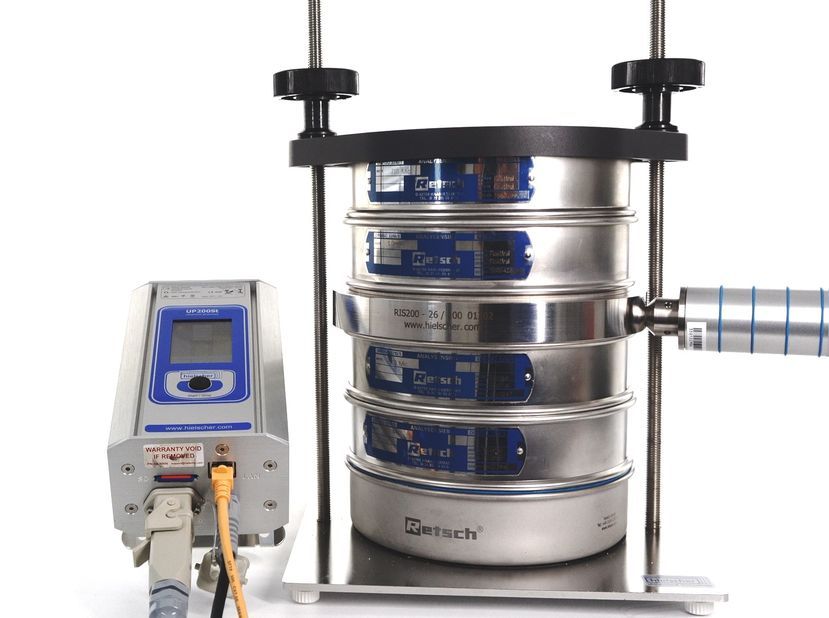
Ultrasonic sieve shaker with sieving tower
Case Study: Ultrasonic Sieve Shaker for Deblinding Screens during Corn Flour Sieving
 The case study by Brnčić and colleagues (2009) evaluates the use of the Hielscher ultrasonic sieve shaker to improve corn flour sieving for the production of direct-expanded extruded foods, including snacks enriched with whey or soy proteins. Particle size is critical in extrusion because it affects ingredient mixing, heat transfer, expansion and final product texture. The researchers therefore aimed to isolate corn flour particles between 200 and 450 μm – the preferred range for this application.
Conventional sieving was tested for 5, 10 and 15 minutes. Because corn flour contains sticky starch, particles collided and formed agglomerates that blocked the sieve, particularly the 450 μm mesh. Blockage began within the first or second minute and became worse with longer processing. Consequently, the proportion of flour in the desired range fell from 55.58% after 5 minutes to 54.11% after 10 minutes and only 49.37% after 15 minutes.
The trials were repeated using an ultrasonic system rated at up to 250 W and operating at 24 kHz. Three ultrasonic amplitudes – 25%, 50% and 75% – were evaluated at each sieving duration. The high-frequency mechanical vibrations passed through the sieve, broke down agglomerates and kept the mesh openings clear.
Ultrasonically-vibrated sieves produced a substantial improvement:
- After 5 minutes, the usable fraction increased with amplitude, reaching 79.57% at 75% amplitude.
- After 10 minutes at 75% amplitude, 83.79% of the flour fell within the target range, compared with 54.11% using conventional sieving – a gain of almost 30 percentage points.
- After 15 minutes at 75% amplitude, the target fraction remained similarly high at 83.4%, compared with just 49.37% without ultrasound.
The two best results exceeded the study’s 75% benchmark for economically viable processing.
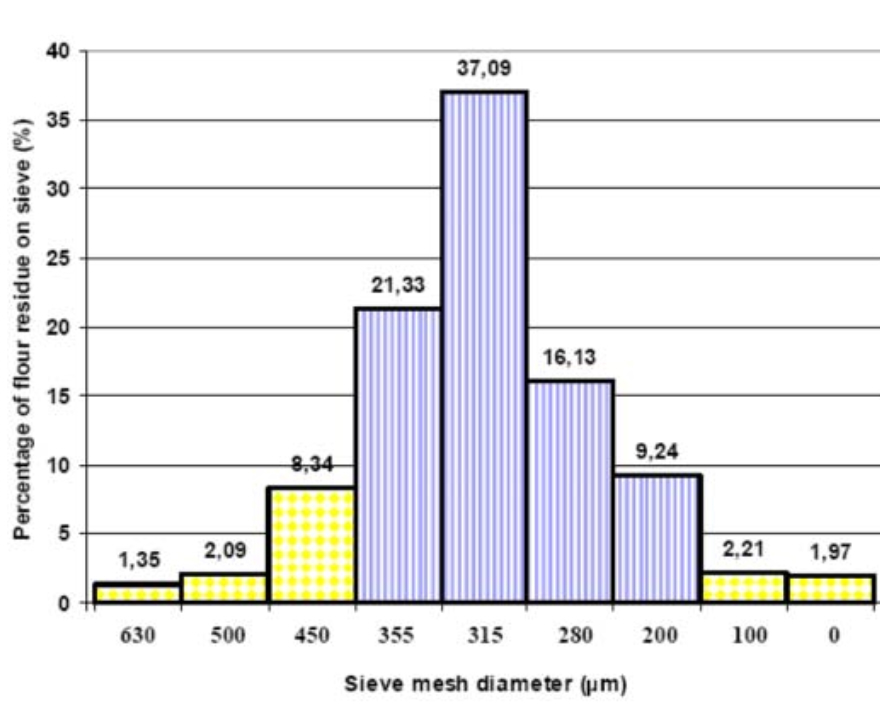
Results of sieving corn flour using the ultrasonic sieve shaker after 10 minutes
Study and graphic: ©Brnčić et al., 2009.
The main advantage of ultrasonic sieving is therefore its ability to prevent sieve blinding while delivering a larger and more consistent yield of correctly sized material. It can also maintain sieving capacity, reduce reliance on manual or mechanical cleaning methods, and limit the associated risks of mesh damage and product contamination.
Overall, the study identifies 10 minutes of sieving at 75% ultrasonic amplitude as the most efficient tested condition. The resulting flour fraction supports more uniform mixing with protein concentrates and should promote more consistent extrusion, expansion and product texture. The method may also be suitable for particle-size separation of other powdered materials.
Why Should I Use an Ultrasonic Sieve Shaker?
- Elimination of Sieve Blinding: Conventional sieving of fine, sticky powders (like corn flour) often leads to rapid mesh blockage due to particle agglomeration caused by starch stickiness. Ultrasonic vibrations continuously break down these agglomerates, keeping the mesh openings clear throughout the process.
- Significant Increase in Yield and Accuracy: By preventing blockage, ultrasonic sieving can drastically improve the recovery of the desired particle fraction. For example, in the case study, the target fraction (200–450 μm) increased from under 55% with traditional sieving to over 83% using ultrasound.
- Optimization of Downstream Processing: Precise particle size distribution is critical for analysis, quality control, and industrial applications.
- Superior Performance with Fine Particles: Traditional methods often fail with fine meshes (e.g., 450 μm or smaller) due to rapid clogging. Ultrasonic deblinding ensures that even the finest meshes remain effective, allowing for high-precision separation of fine powders and suspensions.
- Improved Mesh Durability, Reduced Cleaning: Mechanical deblinding discs or manual intervention can be inefficient and potentially damaging to delicate sieve meshes. Ultrasonic sieve shaker reduce the wear and tear of screen mesh.
- Time and Cost Efficiency: Ultrasonic sieving achieves higher yields in shorter periods compared to extended traditional sieving times that yield lower recovery rates. This efficiency reduces labor costs and increases laboratory throughput.
- Versatility Across Industries: While demonstrated with food materials like corn, wheat, and rye flour, the technology is applicable to various fine powders and particles suspended in liquids, making it valuable for pharmaceutical, chemical, and material science research.
- Improved Reproducibility: By providing a consistent and controlled deblinding mechanism, ultrasonic sieving reduces the variability associated with manual sieving or mechanical tapping, leading to more reliable and repeatable analytical results.
Frequently Asked Questions: Ultrasonic Sieving of Food Materials
What is the main advantage of using an ultrasonic sieve shaker for fine powders like flour?
The primary advantage is the prevention of “sieve blinding” (blockage). Fine powders, especially those high in starch like corn flour, tend to form agglomerates due to stickiness and particle collision. These agglomerates quickly block the sieve mesh, reducing separation efficiency. Ultrasonic sieving uses high-frequency vibrations to break down these agglomerates in real-time, keeping the mesh openings clear and ensuring accurate particle size distribution.
How does the ultrasonic deblinding system work?
The system uses an ultrasonic transducer mounted on an empty ring placed between the bottom sieve and the device base. A power generator converts electrical impulses into a high-energy mechanical signal. This signal penetrates the sieve surface, breaking down agglomerates and “deblinding” the mesh continuously during the sieving process.
Why is precise particle size important for extrusion processing?
Particle size directly impacts the quality of the final product. For direct expanded extrudates, larger particles have less contact area with the extruder barrel, leading to poor heat transfer and uneven processing. Conversely, properly sized particles ensure uniform heating and better textural properties. Generally, a profitability threshold is met when at least 75% of the raw material particles fall within the desirable size range.
How does ultrasonic sieving compare to traditional mechanical sieving?
Traditional sieving without ultrasound often results in rapid sieve blockage. In the study by Brnčić et al. (2009), sieves became completely blinded within the first one to two minutes, with the 450 μm sieve being the most affected. Traditional methods yielded less than 55% of the material in the optimal size range, even after extended sieving times. Ultrasonic sieving significantly improved this, allowing for the recovery of over 83% of the desired fraction.
Are there any operational benefits to using ultrasonic sieving in a laboratory setting?
Yes. Ultrasonic sieve shakers not only accelerate screening workflows significantly, but also enhance sieving efficiency and reduce the wear and tear on delicate sieve meshes.
How does ultrasonic sieving improve the accuracy of particle size analysis compared to traditional methods?
Traditional sieving of fine powders often results in sieve “blinding” or blockage due to the formation of agglomerates, which can skew results. Ultrasonic sieving solves this by using a high-frequency mechanical signal generated by a transducer mounted on the sieve base. This energy penetrates the mesh surface to break down agglomerates in real-time, keeping the mesh clear and ensuring accurate separation
What are the optimal settings for ultrasonic sieving to achieve the best separation results?
Research indicates that both sieving duration and ultrasonic amplitude are critical factors. For materials like corn flour, a sieving duration of 10 minutes combined with an ultrasonic amplitude of 75% was found to be highly effective. This specific setting successfully isolated 83.79% of the material within the desired particle size range (200–450 μm), significantly outperforming traditional sieving methods. (cf. Brnčić et al., 2009)
Why is precise particle size separation important for downstream industrial processes like extrusion?
Particle size directly impacts the quality of the final product. Larger particles have less contact area with the extruder barrel, leading to poor heat transfer and uneven processing. Conversely, properly sized particles ensure uniform heating and better contact with the extruder’s internal components, resulting in superior textural properties in the final extrudate.
Literature / References
- FactSheet Ultrasonic Sieve Shaker UP200TS – Hielscher Ultrasonics
- FactSheet Ultraschall-Siebsystem UP200TS – Hielscher Ultrasonics – deutsch
- Brnčić, Mladen; Ines, Bradač; Tripalo, Branko; Ježek, Damir; Obradović, Valentina; Sven, Karlović; Bosiljkov, Tomislav (2009): Ultrasonically Improved Sieving of Food Materials for Manufacturing of Direct Expanded Extrudates. Agriculturae Conspectus Scientificus (ACS) 74, 2009.
- Xu R., Hong J., Morse C.L., Pike V.W. (2010): Synthesis, structure-affinity relationships, and radiolabeling of selective high-affinity 5-HT4 receptor ligands as prospective imaging probes for positron emission tomography. Journal of Medicinal Chemistry Oct 14;53(19), 2010. 7035-7047.
- An, Y., Kim, K., Lee, YJ. et al. (2026): Binding properties of sulfur to enable solvent-free fabrication of high-performance polymer-free sulfur-carbon positive electrodes. Nature Communications 17, 2360 (2026).
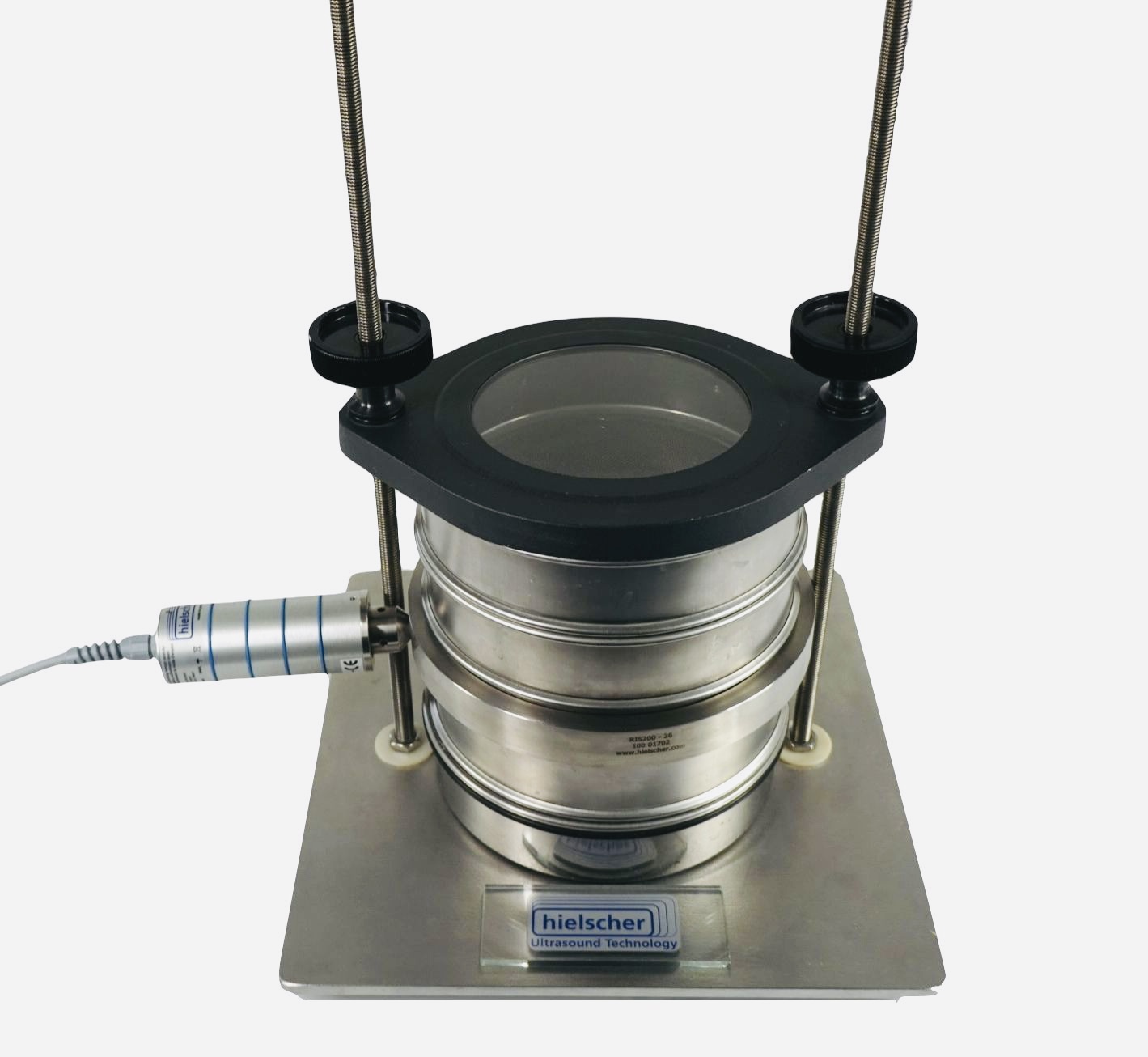
The Hielscher ultrasonic sieve shaker improves screening of dry and wet powders
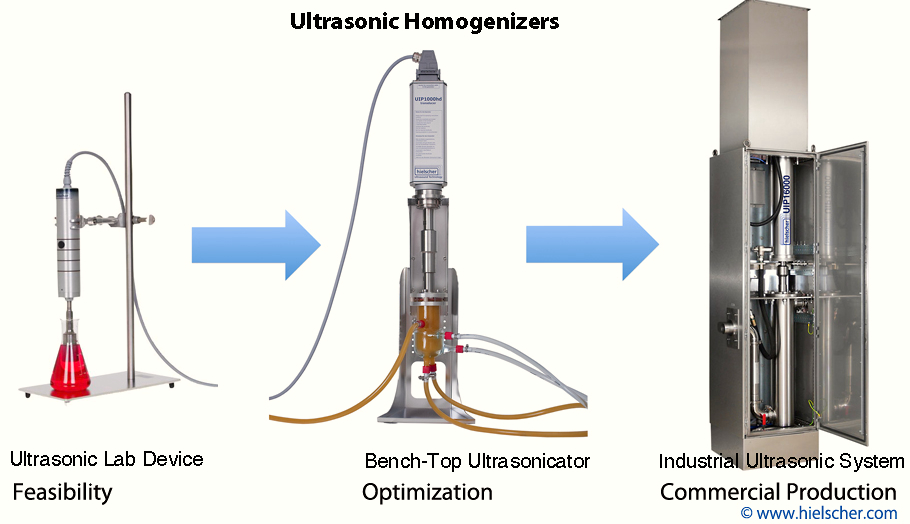
Hielscher Ultrasonics manufactures high-performance ultrasonic homogenizers from lab to industrial size.