Sonicators for ASTM Test and Practice Standards
Hielscher ultrasonicators deliver controlled, repeatable sonication for ASTM methods involving sonic shear, ultrasonic extraction, cavitation erosion, and MBEC biofilm detachment.
Why Sonicator Selection Matters for ASTM Testing
ASTM methods that use ultrasonic energy depend on defined acoustic cavitation and vibration, controlled amplitude, reproducible sample positioning, and consistent temperature management. The wrong ultrasonic device can create insufficient cavitation, uneven treatment, excessive heating, or poor repeatability. Hielscher sonicators are designed for laboratory validation work with digital amplitude control, data recording, broad sonotrode compatibility, and robust continuous operation.
Why Sonicator Selection Matters for ASTM Testing
ASTM methods that use ultrasonic energy depend on defined acoustic cavitation and vibration, controlled amplitude, reproducible sample positioning, and consistent temperature management. The wrong ultrasonic device can create insufficient cavitation, uneven treatment, excessive heating, or poor repeatability. Hielscher sonicators are designed for laboratory validation work with digital amplitude control, data recording, broad sonotrode compatibility, and robust continuous operation.

Ultra-Sonic Shear System UP400St (24kHz, 400W) for ASTM D2603 Sonic Shear Stability Testing
Controlled energy input
Digital ultrasonic generators help keep amplitude, time, pulse settings, and process temperature traceable for method documentation.
Method-specific geometries
Probe sonicators, high-power cavitation systems, and plate sonicators match different ASTM sample formats, from beakers to microtiter plates.
Repeatable sample treatment
Stable sonication conditions improve inter-run comparability for viscosity change, extraction efficiency, cavitation erosion, and biofilm recovery.
At-a-Glance Sonicator Selection Guide
| ASTM Standard | Test Purpose | How Sonication Helps | Recommended Sonicator Model |
|---|---|---|---|
| ASTM D2603 | Sonic shear stability of polymer-containing oils, such as lubricating oils, transmission fluids, tractor fluids, hydraulic fluids, and other polymer-containing oils. | Probe-generated ultrasonic cavitation creates intense, repeatable shear forces. This accelerates mechanical degradation of shear-sensitive viscosity-index improvers and allows laboratories to measure permanent viscosity loss under controlled conditions. | UP400St with S24d22 sonotrode |
| ASTM D5621 | Sonic shear stability of hydraulic fluids containing polymeric viscosity modifiers. | Sonication exposes the hydraulic fluid to defined high-shear acoustic conditions. This helps determine whether polymer additives maintain viscosity or degrade under severe mechanical stress. | UP400St with S24d22 sonotrode |
| ASTM G32 | Cavitation erosion testing of metals, coatings, alloys, ceramics, and other engineering materials exposed to cavitation. | A vibrating ultrasonic sonotrode generates a controlled cavitation field in liquid. The repeated formation and collapse of cavitation bubbles produces measurable erosion, enabling comparison of material resistance to cavitation damage. | UIP1000hdT Alternatives: UIP500hdT or UIP2000hdT |
| ASTM E1979-21 | Ultrasonic extraction of paint, dust, soil, and air samples for lead determination. | Ultrasonic cavitation improves extraction efficiency by disrupting particles, increasing contact between sample and extraction solution, and accelerating release of lead for subsequent analytical determination. | UP200Ht for routine laboratories UP400St for higher intensity or throughput |
| ASTM E2799-22 | Testing disinfectant efficacy against Pseudomonas aeruginosa biofilm using the MBEC assay. | Plate-wide sonication detaches biofilm cells from the 96-peg MBEC lid into the wells for recovery and quantification. Uniform microplate sonication improves comparability across wells and supports high-throughput biofilm testing. | Microplate sonicator UIP400MTP |
Recommended Hielscher Sonicators for ASTM Standards
The following ASTM standards use sonication as a core test step or as a sonication-assisted sample preparation step. Select the model that matches the required sample geometry, power level, and throughput.
ASTM D2603 – Sonic Shear Stability of Polymer-Containing Oils
ASTM D2603 evaluates the shear stability of polymer-containing oils by measuring permanent viscosity loss after irradiation in a sonic oscillator. The test is used for fluids such as lubricating oils, transmission fluids, tractor fluids, and other polymer-modified oils where viscosity-index improvers may degrade under intense shear.
Core sonication function: intense and focused cavitation and shear generated by an ultrasonic probe.
Critical control points: fixed test time, defined probe geometry, sample temperature control, and reproducible immersion depth.
Typical result: viscosity before and after sonication to quantify permanent viscosity loss.
Recommended sonicator: Hielscher UP400St with S24d22 sonotrode.
The UP400St is the preferred Hielscher configuration for ASTM D2603 because it provides 400 W ultrasonic power at 24 kHz, precise amplitude control, integrated temperature monitoring, and compatibility with the S24d22 probe geometry used for sonic shear stability testing.
Learn more about ASTM D2603!
ASTM D5621 – Sonic Shear Stability of Hydraulic Fluids
ASTM D5621 measures the shear stability of hydraulic fluids by determining the final viscosity after ultrasonic irradiation in a sonic oscillator. It is especially relevant for hydraulic fluids containing shear-sensitive or shear-resistant polymer additives.
Core sonication function: accelerated polymer shear through acoustic cavitation.
Critical control points: ultrasonic horn selection, amplitude stability, temperature control, and consistent test duration.
Typical result: final viscosity or viscosity change after standardized sonic treatment.
Recommended sonicator: Hielscher UP400St with S24d22 sonotrode.
The UP400St is also the ideal choice for ASTM D5621. Its 24 kHz probe-type ultrasonic shear setup gives laboratories a compact, digitally controlled platform for repeatable hydraulic-fluid shear testing.
Learn more about ASTM D5621!
ASTM G32 – Cavitation Erosion Using Ultrasonic Vibratory Apparatus
ASTM G32 describes cavitation erosion testing using a vibratory apparatus. A specimen is exposed to high-frequency vibration – generated by a sonicator – in a liquid, producing the formation and collapse of cavities that cause measurable material loss. The method is used to compare cavitation erosion resistance of metals, coatings, and other engineering materials.

Sample Worksheet for Cavitation Erosion Testing
Core sonication function: controlled cavitation field generated by a vibrating sonotrode.
Critical control points: amplitude, specimen geometry, gap distance, liquid temperature, exposure time, and specimen mass loss measurement.
Typical result: erosion rate, cumulative mass loss, or comparative cavitation resistance.
Recommended sonicator: Hielscher UIP1000hdT.
The UIP1000hdT is an excellent Hielscher choice for ASTM G32 because its 1000 W, 20 kHz probe-type design provides the high, stable amplitude required for reproducible cavitation erosion studies. For lower or higher power requirements, Hielscher UIP500hdT and UIP2000hdT configurations are suitable alternatives.
Learn more about ASTM G32!
Get insight into the procedure of a cavitation erosion test!

UIP1000hdT (1000W, 20kHz) Cavitation Erosion Test Setup
ASTM E1979-21 – Ultrasonic Extraction of Paint, Dust, Soil, and Air Samples for Lead Determination
 ASTM E1979-21 is an ultrasonic extraction practice for preparing environmental samples prior to analytical lead determination. It applies to matrices such as dry paint films, settled dust, soil, and air particulates from lead abatement, renovation, occupational hygiene, and environmental monitoring contexts.
Core sonication function: ultrasonic extraction to make lead available for subsequent analytical measurement.
Critical control points: extraction vessel, sonication time, temperature, acid matrix, and consistent energy transfer.
Typical result: extracted lead concentration determined by a downstream laboratory analytical method.
Recommended sonicator: Hielscher UP200Ht or UP400St.
For routine ASTM E1979 sample preparation, the UP200Ht is a strong laboratory choice for small to medium extraction volumes. The UP400St is recommended when higher intensity, larger sample throughput, or broader sonotrode flexibility is required.
Learn more about ASTM E1979-21!
ASTM E2799-22 – Testing Disinfectant Efficacy Against Pseudomonas aeruginosa Biofilm Using the MBEC Assay
ASTM E2799-22 specifies operational parameters for growing, treating, neutralizing, and recovering Pseudomonas aeruginosa biofilm in a high-throughput MBEC assay format. Biofilm grows on a 96-peg lid that corresponds to a 96-well receiver plate. After disinfectant exposure, sonication is used as a biofilm detachment and recovery step.
Core sonication function: simultaneous, reproducible detachment of biofilm from a 96-peg MBEC lid into microplate wells.
Critical control points: uniform ultrasonic energy across the entire plate, controlled exposure time, low cross-contamination risk, and cell recovery without excessive destructive energy.
Typical result: quantitative recovery of viable biofilm cells after disinfectant treatment.
Recommended sonicator: Hielscher UIP400MTP.
 The UIP400MTP is ideal for ASTM E2799-22 because it is built for microtiter plates rather than single-vessel probe treatment. It delivers uniform ultrasound across the full plate, enabling simultaneous treatment of all wells and reproducible detachment of biofilms from MBEC peg lids. This makes it better suited than a handheld probe for high-throughput biofilm workflows, where consistent plate-wide energy distribution and sample-to-sample comparability are essential.
Read more about the UIP400MTP and the MBEC assay!
Learn more about ASTM E2799-22!
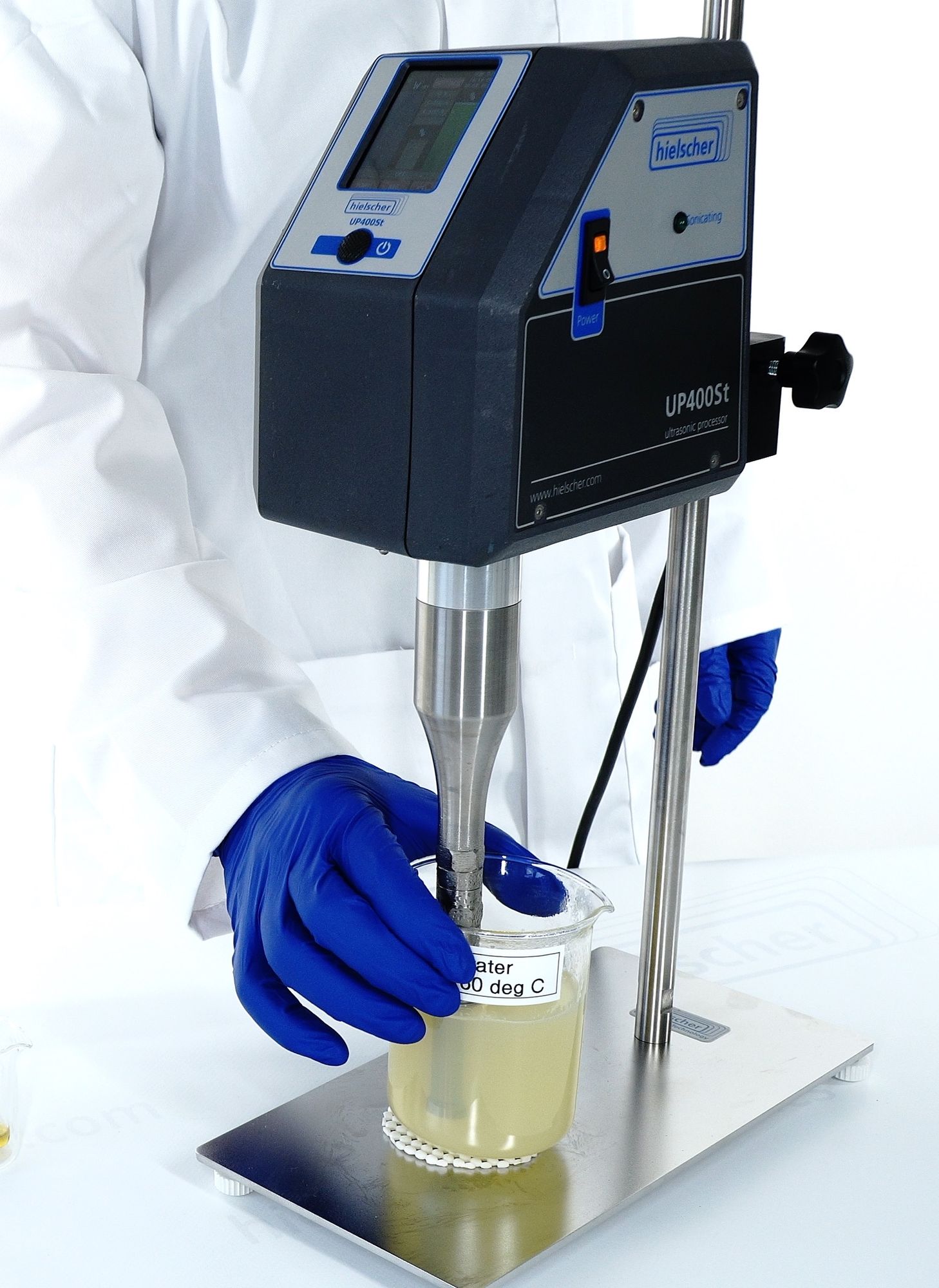
UP400St for sonic shear stability testing of hydraulic fluids
Always follow the official ASTM standard, the current revision in your laboratory quality system, and any validated internal SOP. Hielscher can help configure sonotrodes, fixtures, vessels, and accessories to match the required method geometry.
ASTM standards are controlled documents. This page summarizes sonication-related test applications and equipment selection guidance; it does not replace the official ASTM method text.
Design, Manufacturing and Consulting – Quality Made in Germany
Hielscher ultrasonicators are well-known for their highest quality and design standards. Robustness and easy operation allow the smooth integration of our ultrasonicators into industrial facilities. Rough conditions and demanding environments are easily handled by Hielscher ultrasonicators.
Hielscher Ultrasonics is an ISO certified company and put special emphasis on high-performance ultrasonicators featuring state-of-the-art technology and user-friendliness. Of course, Hielscher ultrasonicators are CE compliant and meet the requirements of UL, CSA and RoHs.
Frequently Asked Questions
What stands ASTM for?
ASTM originally stood for American Society for Testing and Materials. Today, the organization is officially called ASTM International, and it develops voluntary technical standards for materials, products, systems, and services.
What are the types of ASTM?
ASTM standards are commonly classified into several document types: test methods, specifications, practices, guides, classifications, and terminology standards. In scientific and industrial use, ASTM standards mainly define how to test, specify, classify, or describe materials and products.
What is the difference between ASTM, ISO, and DIN?
ASTM is a standards-development organization with strong origins in materials testing and product performance standards. ISO is an international standards organization that develops global standards through national member bodies. DIN is Germany’s national standards body and represents German interests in European and international standardization.
Is ASTM the same as ANSI?
No, ASTM develops and publishes technical standards, while ANSI coordinates the U.S. voluntary standards system and accredits standards developers. ASTM standards may be used in ANSI-related systems, but ASTM and ANSI are different organizations.

Hielscher Ultrasonics manufactures high-performance ultrasonic homogenizers for mixing applications, dispersion, emulsification and extraction on lab, pilot and industrial scale.
Literature / References
- ASTM D5621-20, Standard Test Method for Sonic Shear Stability of Hydraulic Fluids, ASTM International, West Conshohocken, PA, 2020.
- ASTM D2603-20, Standard Test Method for Sonic Shear Stability of Polymer-Containing Oils, ASTM International, West Conshohocken, PA, 2020.
- ASTM E2799-22 Standard Test Method for Testing Disinfectant Efficacy against Pseudomonas aeruginosa Biofilm using the MBEC Assay
- ASTM E1979-21 Standard Practice for Ultrasonic Extraction of Paint, Dust, Soil, and Air Samples for Subsequent Determination of Lead
- ASTM32 Standard Test Method for Cavitation Erosion Using Vibratory Apparatus
- Spencer Court, Ilaria Corni, Nicola Symonds (2018): Cavitation Erosion Performance of Steel, Ceramics, Carbide, and Victrex PEEK Materials. Materials Performance and Characterization 1 May 2018; 7 (5): 1093–1106.
- Bolewski, Łukasz; Szkodo, Marek; Kmieć, Mateusz (2017): Cavitation erosion degradation of Belzona® coatings. Advances in Materials Science. 17, 2017.
- Kmieć, Mateusz; Karpiński, Bartłomiej; Szkodo, Marek (2016): Cavitation Erosion of P110 Steel in Different Drilling Muds. Advances in Materials Science. 16, 2016.
- Müller, Saskia; Fischper, Maurice; Mottyll, Stephan; Skoda, Romuald; Hussong, Jeanette (2014): Analysis of the cavitating flow induced by an ultrasonic horn – Experimental investigation on the influence of actuation phase, amplitude and geometrical boundary conditions. EPJ Web of Conferences 67, 2014.
- Michael, Paul; Cheekolu, Mercy; Panwar, Pawan; Devlin, Mark; Davidson, Rob; Johnson, Duval; Martini, Ashlie (2018): Temporary and Permanent Viscosity Loss Correlated to Hydraulic System Performance. Tribology Transactions 61, 2018.
- high efficiency
- state-of-the-art technology
- reliability & robustness
- adjustable, precise process control
- batch & inline
- for any volume
- intelligent software
- smart features (e.g., programmable, data protocoling, remote control)
- easy and safe to operate
- low maintenance
- CIP (clean-in-place)
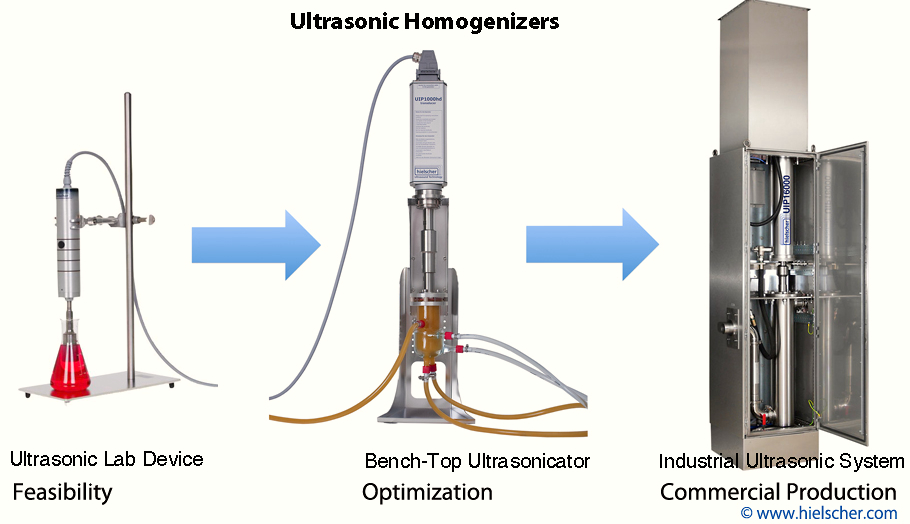
Hielscher Ultrasonics manufactures high-performance ultrasonic homogenizers from lab to industrial size.