Ultrasonic Treatment for Aerobic Waste Activated Sludge Digestion
High-power ultrasonication disintegrates waste activated sludge (WAS) before or during aerobic digestion. Acoustic cavitation breaks sludge flocs, disrupts extracellular polymeric substances and opens microbial cells. This makes previously protected organic matter more accessible to the aerobic digester.
For an aerobic process, the objective is not increased biogas production. Methane enhancement is relevant to anaerobic digestion. In an aerobic digester, the relevant performance indicators are volatile-solids destruction, oxygen consumption, digestion time, residual dry solids, dewaterability and total operating cost.
Hielscher industrial sonicators integrate into a pumped WAS line or a digester recirculation loop. Ultrasonic flow-cell reactors concentrate the treatment on a defined sludge flow and allow the process to be monitored by power, flow, solids concentration, pressure and temperature. The result is a compact retrofit that can add ultrasonic sludge disintegration without replacing the existing aerobic digester.

Hielscher industrial ultrasonic inline flow-skid for processing thickened WAS
Why Waste Activated Sludge Is Difficult to Digest
Waste activated sludge is the excess biological solids removed from an activated-sludge wastewater treatment process. It contains microorganisms, extracellular polymeric substances (EPS), captured organic material and inert solids.
In the secondary clarifier, settled activated sludge is divided into two streams:
- Return activated sludge (RAS) is returned to the aeration basin to maintain the required biomass concentration.
- Waste activated sludge (WAS) is removed from the liquid-treatment process and sent to thickening, stabilization, digestion or dewatering.
WAS contains a high proportion of microbial cell material. Much of its biodegradable organic content is enclosed by cell walls or bound inside compact sludge flocs. This physical protection slows natural cell lysis and hydrolysis.
During aerobic digestion, oxygen is supplied while little new food is available. The microorganisms enter endogenous respiration and consume stored material, dead cells and other biodegradable sludge components. The purpose is to stabilize the sludge, reduce odor potential and lower the amount of volatile solids that must be dewatered and disposed of.
The digestion rate is often limited by access to the substrate. A digester may have active microorganisms and sufficient residence time, but the organic matter inside intact cells and dense flocs remains difficult to reach.
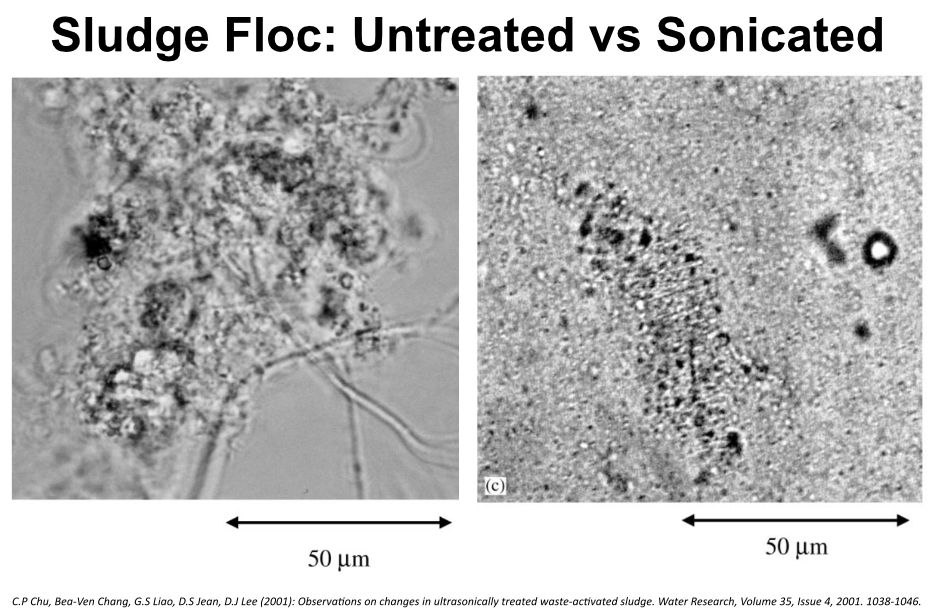
Comparison of untreated flocs with sonicated sludge: Sonication reduces flocs significantly.
Study and images: ©Chu et al. 2001
How Ultrasonic Cavitation Opens WAS for Aerobic Digestion
Hielscher industrial sonicators operate at 20kHz and generate intense acoustic cavitation in liquid and slurry streams. Cavitation bubbles form, grow and collapse within the sludge. Their collapse creates powerful local shear forces that act directly on flocs, EPS and microbial cells.
Ultrasonic treatment produces three important changes in WAS:
Floc Disintegration
Cavitation breaks up sludge aggregates and exposes surfaces that were previously enclosed by extracellular polymeric substances (EPS). The treated sludge contains smaller particles and a larger accessible surface area.
EPS and Cell Disruption
Ultrasonic-aided disintegration increases the aerobic biodegradability of municipal waste activated sludge by breaking down tough sludge flocs and releasing trapped organic matter. Ultrasonic cavitation disrupts cell membranes and cell walls. Proteins and carbohydrates as well as other intracellular compounds move into the liquid phase.
Increased Bioavailability
Aerobic microorganisms can consume soluble and finely divided organic material more readily than intact microbial cells and compact flocs. Ultrasonication therefore performs part of the lysis and hydrolysis work mechanically before the biological oxidation step.
Sonication targets the thick protective matrix of sewage sludge to make microbial digestion much faster and more efficient. This is commonly observed as an increase in soluble chemical oxygen demand (SCOD).

Industrial ultrasonic flow reactor for improved WAS digestion
Benefits of Sonication in Aerobic Digestion Plants
The response depends on the sludge and the ultrasonic dose. When sonication increases aerobic biodegradability, a wastewater treatment plant may obtain:
- More volatile-solids destruction at the existing digestion time
- Comparable sludge stabilization at a shorter residence time
- Lower residual dry-solids production
- Additional effective capacity from an existing aerobic digester
- Reduced biosolids hauling and disposal
- Improved process stability during periods of high solids loading
- Better control of filamentous organisms through floc and cell disruption
Inline Hielscher Sonicators for a Facile Retrofit
At full scale, it is generally more efficient to sonicate a concentrated sludge flow than the entire volume of the aerobic digester. Hielscher ultrasonic flow-cell reactors support two practical configurations.
WAS Feed-Line Pretreatment
The ultrasonic system is installed after WAS thickening and before the aerobic digester:
Thickened WAS -> feed pump -> Hielscher ultrasonic flow cell -> aerobic digester
This arrangement treats a defined dry-solids mass flow and provides a clear basis for controlling the specific ultrasonic energy input.
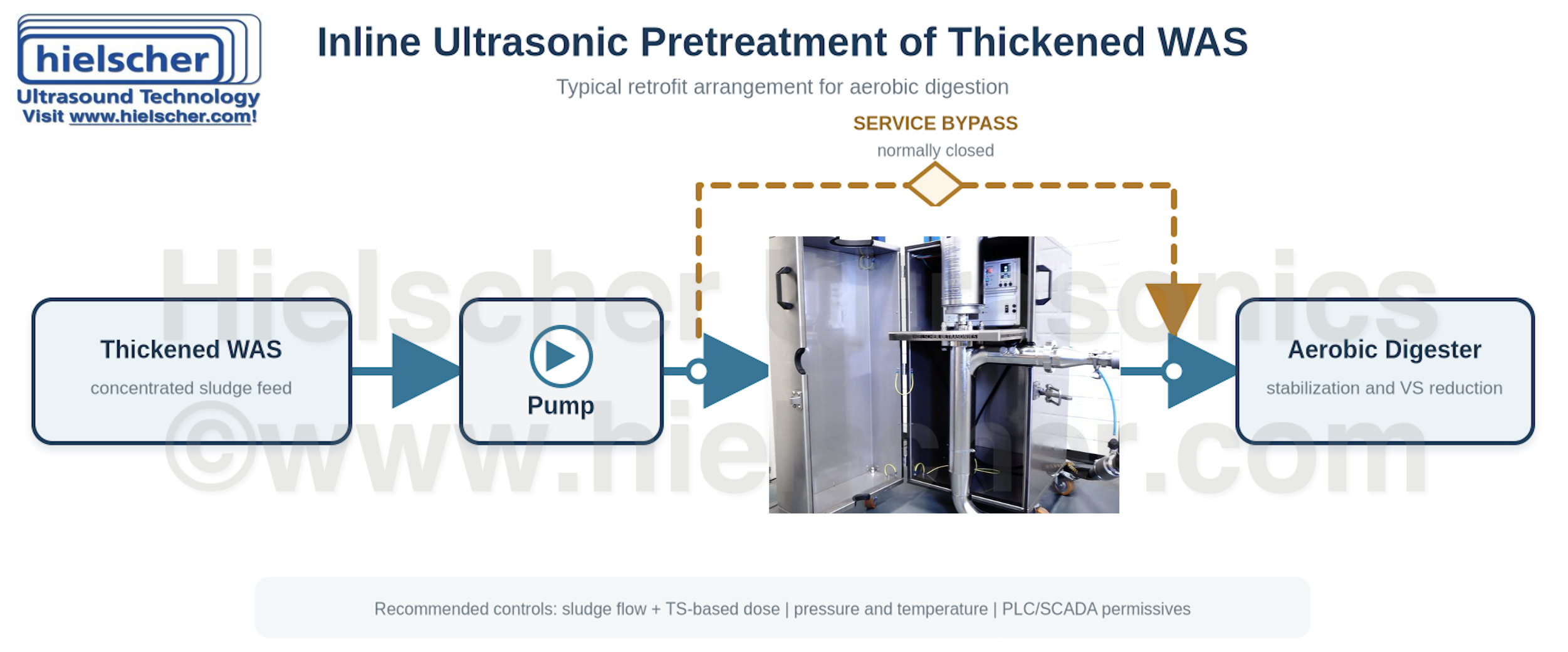
Flow chart: Thickened WAS -> feed pump -> Hielscher industrial inline sonicator UIP6000hdT -> aerobic digester
Digester Recirculation or Sidestream Treatment
A controlled fraction of sludge is pumped from the digester or sludge line through the sonicator and returned to the process. This configuration is useful when the existing feed line is difficult to modify or when only a selected fraction of the sludge should be treated.
Both arrangements can be installed as compact skids with a pump, ultrasonic flow cell, isolation valves, service bypass, pressure and temperature measurement, sampling points and process controls. The existing digester vessel remains unchanged.
This makes ultrasonic treatment particularly suitable for retrofitting existing wastewater treatment plants. The ultrasonic skid can be installed in a pumped line, operated independently and bypassed during inspection or maintenance.
Improve Aerobic Sludge Disintegration with Power Ultrasound!
Hielscher industrial sonicators provide a compact and scalable method for integrating high-power ultrasound into an existing WAS treatment line. Inline flow-cell processing concentrates the ultrasonic energy on the sludge stream, supports reproducible dose control and can be engineered for reliable 24/7 heavy-duty operation.
Design, Manufacturing and Consulting – Quality Made in Germany
Hielscher ultrasonicators are well-known for their highest quality and design standards. Robustness and easy operation allow the smooth integration of our ultrasonicators into industrial facilities. Rough conditions and demanding environments are easily handled by Hielscher ultrasonicators.
Hielscher Ultrasonics is an ISO certified company and put special emphasis on high-performance ultrasonicators featuring state-of-the-art technology and user-friendliness. Of course, Hielscher ultrasonicators are CE compliant and meet the requirements of UL, CSA and RoHs.

Hielscher Ultrasonics manufactures high-performance ultrasonic homogenizers for mixing applications, dispersion, emulsification and extraction on lab, pilot and industrial scale.
Frequently Asked Questions
Does ultrasonic treatment produce more biogas in an aerobic digester?
No. Increased methane or biogas yield is an anaerobic-digestion benefit. For aerobic digestion, ultrasonic treatment should be evaluated by VS destruction, oxygen consumption, digestion time, residual dry solids, dewaterability and total cost.
Where is the ultrasonic system installed?
The system is generally installed inline after WAS thickening and before the aerobic digester. It can also operate in a controlled sidestream or digester recirculation loop. A service bypass allows sludge transfer to continue during maintenance.
Why use a 20kHz industrial sonicator?
Low-frequency, high-power ultrasound generates intense cavitation and mechanical shear. This is effective for breaking sludge flocs, disrupting EPS and opening microbial cells in liquid-solid streams.
Can a Hielscher sonicator operate continuously?
Yes. Hielscher industrial hdT sonicator line are designed for continuous heavy-duty operation and known for their durability. Flow-cell reactors enable controlled inline or recirculation processing, while automatic data logging supports process monitoring and reproducibility.
What data are needed to size an ultrasonic sludge system?
The main inputs are WAS flow, TS and VS concentration, sludge viscosity, target specific energy, required treatment effect, operating hours and available pressure. Pilot testing is recommended to determine the useful dose before full-scale sizing.
Does sonication improve sludge dewatering?
The result depends on sludge characteristics and dose. Moderate treatment may improve the solids process, while excessive disintegration can generate fine particles and soluble polymers that impair capture or cake solids. Dewatering trials are therefore an essential part of process optimization.
What say scientific studies about ultrasonic WAS digestion?
Laboratory studies support the use of ultrasound to increase the accessibility and aerobic biodegradability of WAS.
In a study of combined alkaline and ultrasonic pretreatment before aerobic digestion, organic-matter degradation at the same digestion time was reported as 38.0% for untreated sludge and 42.5% for ultrasonically pretreated sludge. Combined alkaline and ultrasonic pretreatment increased degradation to 50.7%. The result demonstrates that ultrasound alone can improve aerobic degradation, while also showing that the attainable improvement depends on the pretreatment strategy and sludge characteristics. (cf. Jin et al., 2009)
Another investigation of municipal WAS reported increased sludge solubilization and aerobic biodegradability after ultrasonic-aided bacterial disintegration. The pretreated sludge showed a higher biodegradation or decay rate than the untreated control. (cf. Kavitha et al. 2016)
Does sonication support other sludge processes?
Yes. Sonication supports several sludge-treatment processes by disrupting flocs, EPS and microbial cells:
Anaerobic digestion/Biogas production: accelerates hydrolysis, increases soluble COD and can improve VS destruction and methane yield.
Phosphorus recovery: releases cell-bound and organic phosphorus into the liquid phase, improving availability for subsequent struvite or vivianite precipitation; ultrasound can also intensify phosphorus leaching from sludge ash.
Literature / References
- Jin Y., Li H., Mahar R.B., Wang Z., Nie Y. (2009): Combined alkaline and ultrasonic pretreatment of sludge before aerobic digestion. Journal of Environmental Science 2009;21(3):279-284.
- Kavitha S., Jessin Brindha G.M., Sally Gloriana A., Rajashankar K., Yeom I.T., Rajesh Banu J. (2016): Enhancement of aerobic biodegradability potential of municipal waste activated sludge by ultrasonic aided bacterial disintegration. Bioresource Technology 2016 Jan;200:161-169.
- C. M. Braguglia, G. Mininni, A. Gianico (2008): Is sonication effective to improve biogas production and solids reduction in excess sludge digestion? Water Science Technology 1 March 2008; 57 (4): 479–483.
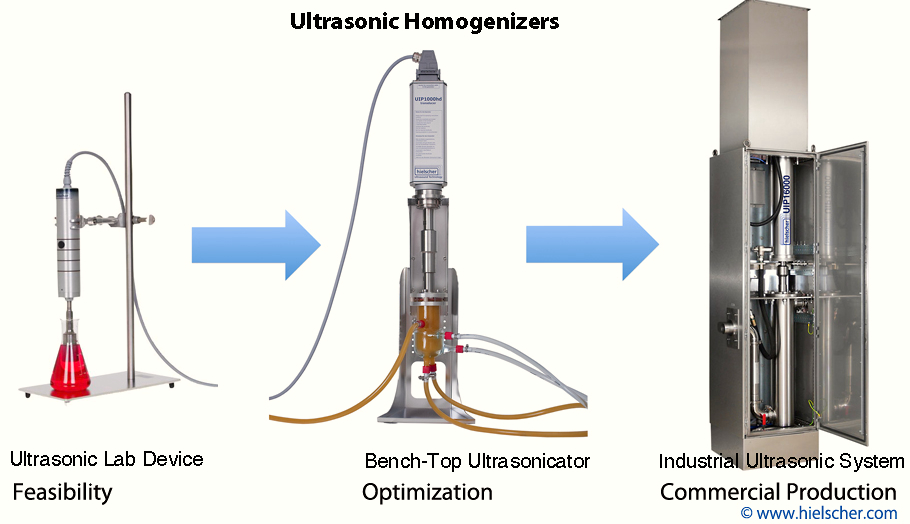
Hielscher Ultrasonics manufactures high-performance ultrasonic homogenizers from lab to industrial size.