Ultrasonic topic: "Common applications of Ultrasonic Dispersers"
Ultrasonic dispersers are a reliable tool to disperse and deagglomerate micron- and nano-sized particles into uniform suspensions. Besides the common dispersing application, ultrasonic dispersers (also known as probe-type ultrasonicators) are used for manifold other processes in lab and industry.
The application fields of ultrasonic dispersers include liquid-solid mixtures, emulsification, extraction, disintegration and cell lysis, sonochemical reactions and many more.
Common applications of ultrasonic dispersers are the production of stable nano-emulsions and -suspensions; sample preparation e.g. soil samples to identify the presence of polycyclic aromatic hydrocarbons (PAHs); degassing and deaeration of samples; as well as the functionalization, activation and cleaning of particle surfaces (e.g. catalysts).
Read more about ultrasonic dispersers and the manifold applications, where sonication can facilitate your process!

Found 46 hits. Showing results 1 - 12.
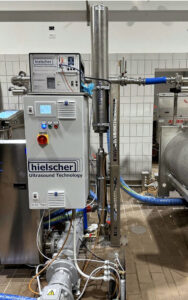
Biocide-free Sterilization and Dispersion of Water-Based Coatings
Water-based coatings are widely used because they support low-VOC formulations, safer handling, and more sustainable production. At the same time, their water content makes them highly susceptible to microbial contamination. Bacteria, yeasts, and molds can enter the product through raw…
https://www.hielscher.com/biocide-free-sterilization-and-dispersion-of-water-based-coatings.htm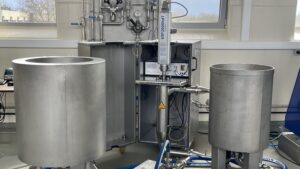
Ultrasound Advances Phase-Change Materials for Energy Storage
, Kathrin HielscherResearchers are increasingly using high-power ultrasonic processing (sonication) to improve the performance of phase-change materials (PCMs) used in thermal energy storage. By generating intense cavitation and micro-mixing, ultrasound enables the production of stable PCM dispersions, nano-enhanced PCMs, and nanoencapsulated materials with superior heat transfer and long-term stability. Studies show that sonication produces more homogeneous mixtures and smaller particle aggregates compared to conventional mixing methods, leading to more reliable thermal behavior and improved energy storage performance.
Advanced ultrasonic processors, such as those developed by Hielscher Ultrasonics, provide precise control over cavitation intensity and processing parameters, making them powerful tools for PCM research and scalable industrial production. The technology is already being used to disperse nanoparticles, create paraffin wax emulsions, and fabricate micro- and nano-encapsulated PCMs, helping researchers develop next-generation materials for building climate control, renewable energy storage, electronics cooling, and battery thermal management.

How Ultrasonic Dispersion Improves Wet End Performance and Cuts Costs
, Kathrin HielscherPapermakers are discovering that better chemistry doesn’t always mean more chemistry. A growing number of mills are turning to ultrasonic dispersion to improve how wet end additives are mixed and activated before they ever reach the stock. By using high-power ultrasound to break up agglomerates and homogenize chemical streams in-line, mills can improve retention, formation, and process stability while reducing chemical consumption and energy use. With linear scalability and industrial-grade sonicator systems from Hielscher Ultrasonics, ultrasonic dispersion is moving from the lab into full-scale paper production as a practical, cost-effective wet end upgrade.
https://www.hielscher.com/how-ultrasonic-dispersion-improves-wet-end-performance-and-cuts-costs.htm
Ultrasonic Immersion Homogenizers
Ultrasonic immersion homogenizers are particularly valued in modern process engineering because they combine mechanical simplicity with extreme process effectiveness. By introducing ultrasonic energy directly into the liquid phase, probe-type sonicators eliminate intermediate transmission losses that are common in indirect systems.…
https://www.hielscher.com/ultrasonic-immersion-homogenizers.htm
Nail Polish Production – Find the Ideal Mixing Tool!
Being one of the most advanced mixing techniques, sonication has significantly improved the production process of nail polishes, also known as nail varnishes or enamels. As a beauty product, nail polish comes in a wide variety of colors and finishes,…
https://www.hielscher.com/nail-polish-production.htm
Cement Particle Deagglomeration using Power Ultrasonics
Probe-type sonicators are frequently used for the deagglomeration of cement particles. This method eliminates the need for grinding media, simplifies the process by making filtration and intensive cleaning unnecessary, and provides efficient particle size reduction. Additionally, sonication reduces the reliance…
https://www.hielscher.com/cement-particle-deagglomeration-using-power-ultrasonics.htm
Colorant Manufacturing using High-Performance Dispersers
The production of colorants and pigment suspensions requires reliable dispersion and mixing. Ultrasonic homogenizers are highly efficient when it comes to the production of liquid and paste-like masterbatches and colorant suspensions. Available at any industrial production scale, ultrasonic dispersers improve…
https://www.hielscher.com/colorant-manufacturing-using-high-performance-dispersers.htm
Dispersion of Carbon Nanotubes in 3D-Printable Inks
A uniform dispersion of CNTs in 3D-printable inks can enhance the properties of ink and enable new applications in various fields. Probe-type ultrasonication is a highly reliable dispersing technique to produce stable nanosuspensions of CNTs in polymers. Efficient and Stable…
https://www.hielscher.com/dispersion-of-carbon-nanotubes-in-3d-printable-inks.htm
Nanocomposite Hydrogel Synthesis using Ultrasonication
Nanocomposite hydrogels or nanogels are multi-functional 3D structures with high efficacies as drug carriers and controlled-release drug delivery systems. Ultrasonication promotes the dispersion of nano-sized, polymeric hydrogel particles as well as the subsequent inclusion/incorporation of nanoparticles into these polymer structures.…
https://www.hielscher.com/nanocomposite-hydrogel-synthesis-using-ultrasonication.htm
Lubricants with Nanoparticle-Improved Functionalities
Lubricating oils can greatly benefit from nano-additives, which help to reduce friction and wear. It is however crucial, that nano-additives such as nanoparticles, graphene monolayers or core-shell nanospheres are uniformly and single-dispersed in the lubricant. Ultrasonic dispersion has been proven…
https://www.hielscher.com/lubricants-with-nanoparticle-improved-functionalities.htm
How to Mix Varnishes with Nanofillers
Varnish production requires powerful mixing equipment that can handle nano-particles and pigments, which must be uniformly dispersed into the formulation. Ultrasonic homogenizers are highly efficient and reliable dispersing technique which provide a homogeneous distribution of the nanoparticles into polymers. Varnish…
https://www.hielscher.com/how-to-mix-varnishes-with-nanofillers.htm
Homogenizers – Working Principle, Use and Scale-Up
Homogenizers are a type of mixers, which apply mechanical forces to blend, emulsify, disperse, and dissolve liquid-liquid and solid-liquid systems. Depending on the homogenizer model rotational shear, nozzles or high-power ultrasound are used to create the required forces to disintegrate…
https://www.hielscher.com/homogenizers-working-principle-use-and-scale-up.htm