Efficient Hydrogen Production with Ultrasonics
Hydrogen is an alternative fuel that is preferable due to its environmental-friendliness and zero carbon dioxide emission. However, conventional hydrogen generation is not efficient for economical mass production. The ultrasonically promoted electrolysis of water and alkaline water solutions results in higher hydrogen yields, reaction rate and conversion speed. Ultrasonically assisted electrolysis makes hydrogen production economical and energy efficient.
Ultrasonically promoted electrochemical reactions such as electrolysis and electrocoagulation show improved reaction speed, rate and yields.
Accelerate Hydrogen Production with the Power of Ultrasound and Electrochemistry
Combine the efficiency of ultrasonic cavitation with the precision of electrochemical reactions to achieve higher hydrogen yields and lower energy consumption. Hielscher advanced sono-electrochemical systems enhance mass transfer, improve catalyst activity, and optimize electrode surfaces for consistent, high-performance H₂ generation.
Key Benefits:
- Enhanced Mass Transfer: Ultrasonic waves reduce diffusion layer thickness, ensuring efficient reactant delivery to electrodes.
- Improved Catalyst Stability: Sonication prevents nanoparticle agglomeration, maintaining high catalytic activity over time.
- Energy Efficiency: Optimize energy input by leveraging cavitation-induced micro-mixing and surface cleaning.
Ensure consistent, high-intensity cavitation with reliable ultrasonic processors designed for continuous 24/7 H₂ production. Get detailed information about our high-power ultrasonic solutions and talk to our sonication experts!

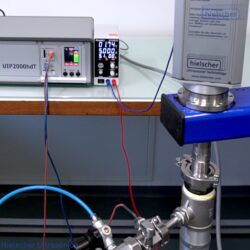
2x ultrasonic processors of the model UIP2000hdT with probes, that act as electrodes, i.e. cathode and anode. The ultrasound vibration and cavitation promotes electrochemical hydrogen production.
Efficient Hydrogen Generation with Sonication
Electrolysis of water and aqueous solutions for the purpose of hydrogen generation is a promising process for the production of clean energy. The electrolysis of water is an electrochemical process where electricity is applied to split water into two gases, namely hydrogen (H₂) and oxygen (O₂). In order to cleave the H – O – H bonds by electrolysis, an electrical current is run through the water.
For the electrolytic reaction, a direct electric currency is applied to initiate an other-wise non-spontaneous reaction. Electrolysis can generate hydrogen of high purity in a simple, environmental-friendly, green process with a zero CO₂ emission as O₂ is the only by-product.
Regarding electrolysis of water, the splitting of water into oxygen and hydrogen is achieved by passing an electric current through the water.
In pure water at the negatively charged cathode, a reduction reaction takes place where electrons (e−) from the cathode are donated to hydrogen cations so that hydrogen gas forms. At the positively charged anode, an oxidation reaction takes place, which generates oxygen gas whilst giving electrons to the anode. This means, water reacts at the anode to form oxygen and positively charged hydrogen ions (protons). Thereby the following equation of energy balance is completed:
2H+ (aq) + 2e– → H₂ (g) (reduction at the cathode)
2H2O (l) → O2 (g) + 4H+ (aq) + 4e– (oxidation at the anode)
Overall reaction: 2H₂O (l) → 2H₂ (g) + O₂ (g)
Often, alkaline water is used for the electrolysis in order to produce hydrogen. Alkali salts are soluble hydroxides of alkali metals and alkaline earth metals, of which common examples are: Sodium hydroxide (NaOH, also known as caustic soda) and potassium hydroxide (KOH, also known as caustic potash). For eletcrolysis, mainly concentrations of 20% to 40% caustic solution are used.

Sono-electrochemical production of hydrogen at an ultrasonic cathode.
Ultrasonic Synthesis of Hydrogen
When hydrogen gas is produced in an electrolytic reaction, the hydrogen is synthesized right at the decomposition potential. The surface of electrodes is the area, where hydrogen formation occurs on molecular stage during the electrochemical reaction. The hydrogen molecules nucleate at electrode surface, so that subsequently hydrogen gas bubbles are present around the cathode. Using ultrasonic electrodes improves activity impedances and concentration impedance and accelerates the rising of hydrogen bubbles during water electrolysis. Several studies demonstrated that ultrasonic hydrogen production increases hydrogen yields efficiently.
- Higher hydrogen yields
- Improved energy efficiency
➡️ Apply sonication for:
- Increased mass transfer
- Accelerated reduction of accumulated impedance
- Reduced ohmic voltage drop
- Reduced reaction overpotential
- Reduced decomposition potential
- Degassing of water / aqueous solution
- Cleaning of electrode catalysts
Ultrasonic Effects on Electrolysis
Ultrasonically excited electrolysis is also known as sono-electrolysis. Various ultrasonic factors of sonomechanical and sonochemical nature influence and promote electrochemical reactions.
- Ultrasound waves create bubbles
- Bubbles collapse
- Extreme heat splits water molecules
The electrolysis-influencing factors are results of ultrasound-induced cavitation and vibration and include acoustic streaming, micro-turbulences, microjets, shock waves as well as sonochemical effects. Ultrasonic / acoustic cavitation occurs, when high-intensity ultrasound waves are coupled into liquid. The phenomenon of cavitation is characterized by the growth and collapse of so-called cavitation bubbles. The bubble implosion is marked by super-intense, locally occuring forces. These forces include intense local heating of up to 5000K, high pressures of up to 1000 atm, and enormous heating and cooling rates (>100k/sec) and they provoke a unique interaction between matter and energy. For instance, those cavitational forces impact hydrogen bondings in water and facilitate splitting of water clusters which subsequently results in a reduced energy consumption for the electrolysis.
Ultrasonic Impact on the Electrodes
- Removing deposits from the electrode surface
- Activation of the electrode surface
- Transport of electrolytes towards and away from electrodes
Ultrasonic Cleaning and Activation of Electrode Surfaces
Mass transfer is one of the crucial factors influencing reaction rate, speed, and yield. During electrolytic reactions, the reaction product, e.g. precipitates, accumulate around as well as directly on the electrode surfaces and decelerate the electrolytic conversion of fresh solution to the electrode. Ultrasonically promoted electrolytic processes show an increased mass transfer in the bulk solution and near the surfaces. Ultrasonic vibration and cavitation removes passivation layers from the electrode surfaces and keep them thereby permanently fully efficient. Furthermore, sonification is known to enhance reaction pathways by sonochemical effects.
Lower Ohmic Voltage Drop, Reaction Overpotential, and Decomposition Potential
The voltage required for electrolysis to occur is known as decomposition potential. Ultrasound can lower the necessary decomposition potential in electrolysis processes.
Ultrasonic Electrolysis Cell
 For water electrolysis, ultrasonic energy input, electrode gap, and electrolyte concentration are key factors that impact the water electrolysis and its efficiency.
For an alkaline electrolysis, an electrolysis cell with an aqueous caustic solution of usually 20%–40% KOH or NaOH is used. Electric energy is applied to two electrodes.
Electrode catalysts can be used to accelerate the reaction speed. For instance, Pt electrodes are favourable as reaction occurs more easily.
Scientific research articles report 10%-25% energy saving using the ultrasonically-promoted electrolysis of water.
Ultrasonic Electrolyzers for Hydrogen Production at Pilot and Industrial Scale
Hielscher Ultrasonics’ industrial ultrasonic processors are built for the 24/7/365 operation under full load and in heavy duty processes.
By supplying robust ultrasonic systems, special designed sonotrodes (probes), which function as electrode and ultrasound wave transmitter at the same time, and electrolysis reactors, Hielscher Ultrasonics caters the specific requirements for electrolytic hydrogen production. All digital industrial ultrasonicators of the UIP series (UIP500hdT (500 watts), UIP1000hdT (1kW), UIP1500hdT (1.5kW), UIP2000hdT (2kW), and UIP4000hdT (4kW)) are high-performance ultrasonic units for electrolysis applications.

Ultrasonic probe of the UIP2000hdT functions as anode. The applied ultrasonic waves intensify the electrolytic synthesis of hydrogen.
The table below gives you an overview about our sonicators and sono-electrodes for electro-chemical H₂ generation – from research lab to production:
| Sonicator | Ultrasound Power | Volume |
|---|---|---|
| VialTweeter | 200W | Falcon Tube |
| UP100H | 100W | 10 to 200mL/min |
| UP400St | 400W | 20 to 400mL/min |
| UIP2000hdT | 2000W | 0.2 to 4L/min |
Optimize Your Hydrogen Yield with Sonication!

Sonoelectrochemical cell for improved H2 synthesis
FAQ – Sono-Electrochemical Hydrogen Production
What is Hydrogen?
Hydrogen is the chemical element with the symbol H and atomic number 1. With a standard atomic weight of 1.008, hydrogen is the lightest element in the periodic table. Hydrogen is the most abundant chemical substance in the universe, constituting roughly 75% of all baryonic mass. H₂ is a gas which forms when two hydrogen atoms bond together and become a hydrogen molecule. H₂ is also called molecular hydrogen and is a diatomic, homonuclear molecule. It consists of two protons and two electrons. Having a neutral charge, molecular hydrogen is stable and thereby the most common form of hydrogen.
When hydrogen is produced on industrial scale, steam reforming natural gas is the most widely used production form. An alternative method is the electrolysis of water. Most hydrogen is produced near the site of its latter use, e.g., near fossil fuel processing facilities (e.g., hydrocracking) and ammonia-based fertilizer producers.
What is Sono-Electrochemical Synthesis of Hydrogen?
Sono-electrochemical synthesis is a hybrid technique that combines ultrasonic cavitation with electrochemical water splitting. By applying high-frequency sound waves – i.e. ultrasound – to an electrochemical reactor, the process enhances mass transfer, cleans electrode surfaces, and improves the overall efficiency of hydrogen generation compared to traditional electrolysis.
How does Ultrasound Improve Hydrogen Yield in Electrolysis?
Ultrasound improves hydrogen generation primarily through acoustic cavitation. The formation and collapse of microscopic bubbles create intense micro-turbulence that reduces the thickness of the diffusion layer at the electrode surface. This ensures a faster supply of reactants to the catalyst and helps remove hydrogen gas bubbles more efficiently, preventing “gas shielding” and allowing for higher current densities.
What are the advantages of using an industrial sonicator for hydrogen synthesis?
Using high-intensity ultrasonic processors like the UIP2000hdT of the Hielscher industrial-grade UIP series offers several advantages:
- Enhanced Catalyst Activity: Sonication prevents nanoparticle agglomeration, keeping catalysts (like Pt, TiO₂, or Ni) highly active.
- Electrode Cleaning: Ultrasound continuously cleans electrode surfaces, reducing polarization and extending the lifespan of the reactor components.
- Scalability: These systems are designed for continuous 24/7 operation, making them suitable for both laboratory research and industrial-scale hydrogen production.
What is the Role of Cavitation in Sono-Electrochemical Reactions?
Acoustic cavitation is the core mechanism in sono-electrochemistry. When ultrasonic waves pass through a liquid, they create alternating high-pressure and low-pressure cycles. During the low-pressure cycle, tiny vacuum bubbles form and grow; during the high-pressure cycle, they collapse implosively. This collapse generates localized extreme temperatures and pressures, which can facilitate chemical reactions and significantly improve the contact between electrodes and the electrolyte.
Can Sono-Electrochemistry be Used with Renewable Energy Sources?
Yes. Sono-electrochemical systems can be integrated with renewable energy sources such as solar or wind power. The ability of ultrasonic processors to operate efficiently at varying power levels makes them an excellent match for intermittent energy supplies, potentially lowering the carbon footprint of green hydrogen production.
How does Sono-Electrochemical Hydrogen Production Compare to Traditional Steam Methane Reforming?
Unlike steam methane reforming (SMR), which relies on fossil fuels and releases significant CO₂, sono-electrochemical synthesis typically uses water as the feedstock. While SMR is currently more established, sono-electrochemistry offers a cleaner, “green” alternative that can be powered by renewable electricity, making it a key technology for a sustainable hydrogen economy.
Literature / References
- Sherif S. Rashwan, Ibrahim Dincer, Atef Mohany, Bruno G. Pollet (2019): The Sono-Hydro-Gen process (Ultrasound induced hydrogen production): Challenges and opportunities. International Journal of Hydrogen Energy, Volume 44, Issue 29, 2019, 14500-14526.
- Islam Md H., Burheim Odne S., Pollet Bruno G. (2019): Sonochemical and sonoelectrochemical production of hydrogen. Ultrasonics Sonochemistry 51, 2019. 533–555.
- Bruno G. Pollet; Faranak Foroughi; Alaa Y. Faid; David R. Emberson; Md.H. Islam (2020): Does power ultrasound (26 kHz) affect the hydrogen evolution reaction (HER) on Pt polycrystalline electrode in a mild acidic electrolyte? Ultrasonics Sonochemistry Vol. 69, December 2020.
- José González-García, Ludovic Drouin, Craig E. Banks, Biljana Šljukić, Richard G. Compton (2007): At point of use sono-electrochemical generation of hydrogen peroxide for chemical synthesis: The green oxidation of benzonitrile to benzamide. Ultrasonics Sonochemistry, Volume 14, Issue 2, 2007. 113-116.
- Cherepanov, Pavel; Melnyk, Inga; Skorb, Ekaterina V.; Fratzl, P.; Zolotoyabko, E.; Dubrovinskaia, Natalia; Dubrovinsky, Leonid Avadhut, Yamini S.; Senker, Jürgen; Leppert, Linn; Kümmel, Stephan; Andreeva, Daria V. (2015): The use of ultrasonic cavitation for near-surface structuring of robust and low-cost AlNi catalysts for hydrogen production. Green Chemistry Issue 5, 2015. 745-2749.