Dissolving Cannabinoids in Alcoholic Beverages with Ultrasonic Nanoemulsification
Produce clear, stable CBD, THC, CBG and full-spectrum cannabis beverages with scalable ultrasonic nano-emulsification. Cannabinoids are oil-soluble compounds and can cause haze, ringing, sedimentation, poor taste and inconsistent dosing when they are not properly dispersed in alcoholic or low-alcohol beverage systems. Hielscher Ultrasonics’ high-performance ultrasonic emulsifiers create fine cannabinoid nanoemulsions for transparent appearance, long-term physical stability and reproducible active distribution.
From recipe development to continuous inline production, Hielscher sonicators help beverage manufacturers control droplet size, emulsifier use, temperature, residence time and throughput. Use Hielscher ultrasonic emulsification systems for CBD spirits, THC-infused cocktails, cannabis seltzers, bitters, aperitifs, alcohol-free cannabis drinks and functional beverage formulations.

Produce nano-emulsified beverages with the Sonicator UP400St
Why Cannabinoids Are Difficult to Formulate in Beverages

Cannabinoids dissolve well in very high-proof alcohol. However, 190-proof alcohol, with approximately 92.4% ethanol by weight, is not suitable for most consumer beverages because of its strong physiological effect, harsh taste and limited formulation flexibility. Most commercial cannabis beverages, including spirits, RTD cocktails, seltzers and low-ABV products, require lower alcohol levels, a pleasant flavour profile and a stable appearance.
To formulate cannabis extracts such as CBD, THC, CBG and full-spectrum hemp or cannabis extracts into beverage products, the cannabinoid-containing oil phase must be reduced to very small droplets and stabilized with a compatible food-grade emulsifier. Ultrasonic nanoemulsification creates intense high-shear forces that disperse the oil phase into the alcoholic or aqueous-alcoholic beverage matrix. This produces clear or finely dispersed cannabinoid beverages with improved stability, consistent active distribution and attractive optical appearance.
Ultrasonic Nanoemulsification for Clear CBD and THC Drinks
Hielscher ultrasonic processors generate acoustic cavitation in liquids. The resulting high shear, microstreaming and pressure fluctuations break cannabinoid-containing oil phases into nano-sized droplets and distribute them uniformly throughout the beverage. When combined with a suitable food-grade emulsifier, ultrasound helps create transparent or translucent nanoemulsions for cannabis-infused alcoholic and non-alcoholic beverages.
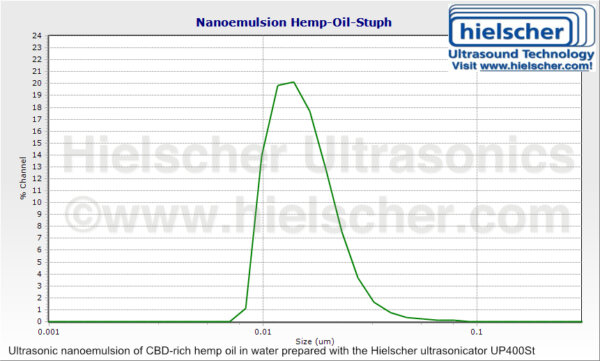
Narrow distribution curve of hemp oil-in-water nanoemulsion prepared with the ultrasonicator UP400St.
- Efficient and rapid high-shear homogenization
- Clear or transparent beverage appearance
- Fine droplet size for improved dispersion stability
- Reproducible active distribution for consistent dosing
- Suitable for CBD, THC, CBG and full-spectrum extracts
- Compatible with various food-grade emulsifier systems
- Scalable from laboratory formulation to industrial inline production
- Easy operation with precise process control
Process Workflow for Beverage Technicians
The following workflow helps beverage R&D teams and production technicians develop stable cannabinoid beverage formulations and transfer them from the laboratory to inline production.
| Process Step | Technician Focus | Purpose |
|---|---|---|
| 1. Define the beverage matrix | ABV, pH, sugar content, carbonation, flavour system, preservatives | Identify compatibility limits before adding cannabinoids |
| 2. Prepare the cannabinoid phase | CBD, THC, CBG, full-spectrum extract, carrier oil, terpene profile | Create a controlled active phase for accurate dosing |
| 3. Select the emulsifier | Food-grade, clean-label, alcohol-compatible, flavour-neutral | Stabilize the nanoemulsion and support beverage clarity |
| 4. Pre-mix | Coarse emulsion, controlled addition sequence, no air intake | Prepare the formulation for efficient sonication |
| 5. Sonicate | Amplitude, power input, flow rate, residence time, temperature | Reduce droplet size and homogenize the cannabinoid phase |
| 6. Quality control | Droplet size, turbidity, active distribution, phase stability | Confirm that the beverage meets specification |
| 7. Shelf-life testing | Heat/cold cycles, light exposure, storage time, carbonation stability | Validate stability under realistic market conditions |
| 8. Scale-up | Batch, recirculation or continuous inline operation | Transfer the formulation to commercial production |
Key Formulation Parameters for Stable Cannabinoid Beverages
Successful cannabinoid beverage production depends on the interaction of extract quality, emulsifier chemistry, alcohol content and ultrasonic process parameters. During recipe development, beverage technicians should document the following variables:
- Droplet size: Smaller droplets support clarity, physical stability and uniform cannabinoid distribution.
- Emulsifier concentration: The emulsifier must be sufficient to stabilize the oil-water or oil-alcohol interface without causing off-flavour or excessive foaming.
- Alcohol content: High-proof ethanol dissolves cannabinoids more easily, while low-ABV beverages usually require stronger emulsification and stabilisation.
- Temperature: Ultrasonic energy input can raise liquid temperature. Cooling or inline heat exchange may be required for flavour-sensitive formulations.
- Residence time and flow rate: Inline sonication allows precise control over the energy input per volume.
- Number of passes: Recirculation or multiple passes can reduce droplet size further when necessary.
- Beverage matrix: Sugar, acids, carbonation, colours, flavours and preservatives can influence clarity and long-term emulsion stability.
Tipps to Improve Your Cannabinoid Beverage Nanoemulsions
| Problem | Likely Cause | Suggested Adjustment |
|---|---|---|
| Haze or cloudiness | Droplets too large; incompatible emulsifier; overloaded oil phase | Increase ultrasonic intensity, optimize emulsifier ratio or reduce cannabinoid load |
| Ring formation | Oil phase not fully stabilized | Improve emulsifier selection, increase pre-mixing quality or apply an additional sonication pass |
| Sedimentation | Extract impurities, waxes or unstable dispersion | Use a cleaner extract, improve filtration and optimize sonication conditions |
| Bitter or cannabis-heavy taste | Extract profile, terpene load or high THC/full-spectrum concentration | Use flavour masking, lower the dose per serving or select a cleaner extract |
| Foaming during processing | Surfactant system, air intake or pump conditions | Reduce air entrainment, optimize flow-cell filling and adjust pump speed |
| Heat rise | High energy input or insufficient cooling | Use inline cooling, reduce recirculation time or control residence time |
| Inconsistent potency | Poor mixing, phase separation or inadequate sampling | Validate homogeneity, sample at different tank levels and improve inline dispersion |
Nano-Dissolved Cannabinoids for Improved Dispersion and Bioavailability
Cannabinoids are poorly water-soluble and naturally hydrophobic. In beverages, this creates challenges for clarity, stability and consistent dosing. Nanoemulsions, liposomes and solid-lipid carriers are used in pharmaceutical, nutraceutical and functional food applications to improve dispersion and support the availability of lipophilic bioactive compounds.
Ultrasonic nanoemulsification increases the surface area of the cannabinoid-containing phase by reducing the droplets to very small sizes. This improves distribution in the beverage matrix and can support improved dissolution behaviour during consumption. Beverage manufacturers should validate bioavailability, onset claims and dosage claims according to the applicable analytical and regulatory requirements in their target markets.
THC-Infused Spirits and Cannabis RTD Beverages

The formulation of THC-infused beverages is especially demanding. THC has an intense flavour profile, and many beverage brands require a clean, mild taste in addition to stable dispersion and consistent dosing. Ultrasonic nanoemulsification helps disperse THC-containing extracts into spirits, cocktails, seltzers, bitters and other beverage bases. However, flavour quality also depends on extract selection, terpene profile, emulsifier choice, dosage and the beverage’s flavour system.
For THC, CBD and full-spectrum cannabis beverages, producers should verify formulation, dosage, labelling, packaging and distribution requirements in the relevant jurisdiction. Regulations for cannabis, alcohol and combined cannabis-alcohol products can differ significantly by market.
Beverage Applications
- CBD and THC spirits
- vodka, whiskey, rum and gin formulations
- bitters and aperitifs, such as amaro
- RTD cocktails and mixed drinks
- hard seltzers and alcoholic sparkling waters
- beer-based and malt-based beverages
- alcoholic lemonades and sodas
- fruit juices, lemonades and alcohol-free cannabis drinks
- functional beverages with CBD, CBG or full-spectrum extracts
Ultrasonic Flavouring and Botanical Infusion
Ultrasonic extraction can also be applied to produce non-alcoholic and alcoholic cannabis-infused beverages with additional botanical flavour compounds. For example, sonication can be used to infuse a cannabis beverage with herbs, spices, citrus peels, bitters botanicals or other flavouring ingredients. This can enhance the sensory profile and support the development of differentiated beverage products.
Ultrasonic High-Shear Processors for Dissolving and Emulsification
Hielscher Ultrasonics offers a broad product range of high-performance ultrasonicators for nanoemulsifying cannabinoids into alcoholic and non-alcoholic beverages. Cannabis-infused drinks, aperitifs, spirits and cocktails can be formulated by mixing phytocannabinoids such as CBD, THC, CBG or full-spectrum cannabis extracts into drinkable liquids.
Hielscher industrial ultrasonic processors can deliver very high amplitudes. Amplitudes of up to 200µm can be continuously operated in 24/7 production. For even higher amplitudes, customized ultrasonic sonotrodes are available.
Which Hielscher Ultrasonicator Fits Your Beverage Process?
The right ultrasonic system depends on batch size, target flow rate, viscosity, alcohol content, required droplet size and production schedule. Start with laboratory trials to confirm formulation stability, then scale to pilot or industrial inline processing using the same ultrasonic process principle.
| Production Stage | Batch Volume | Flow Rate | Recommended Devices |
|---|---|---|---|
| Laboratory formulation | 1 to 500mL | 10 to 200mL/min | UP100H |
| Recipe development and small batches | 10 to 2000mL | 20 to 400mL/min | UP200Ht, UP400St |
| Pilot trials and craft production | 0.1 to 20L | 0.2 to 4L/min | UIP2000hdT |
| Industrial inline production | 10 to 100L | 2 to 10L/min | UIP4000hdT |
| High-volume continuous production | n.a. | 10 to 100L/min | UIP16000hdT |
| Very large production lines | n.a. | larger | Cluster of UIP16000hdT |
FAQ: Cannabinoid Nanoemulsions in Alcoholic Beverages
Why are cannabinoids difficult to dissolve in alcoholic beverages?
Cannabinoids such as CBD, THC, CBG and full-spectrum cannabis extracts are hydrophobic, which means they do not dissolve well in water-based beverage systems. High-proof ethanol can dissolve cannabinoids more easily, but most consumer beverages have much lower alcohol levels. In low-ABV drinks, cocktails, seltzers and ready-to-drink beverages, cannabinoids must be finely emulsified to remain evenly distributed and visually stable.
How does ultrasound help dissolve cannabinoids in beverages?
Ultrasonic processors generate intense cavitation forces in liquids. These forces break cannabinoid-containing oil phases into very small droplets and distribute them uniformly into the beverage matrix. With a suitable food-grade emulsifier, ultrasonic nanoemulsification can produce clear or finely dispersed cannabinoid beverages with improved physical stability.
Can ultrasonic emulsification be used for CBD and THC beverages?
Yes. Ultrasonic emulsification can be used for CBD, THC, CBG and full-spectrum cannabis extracts. The process is suitable for beverage manufacturers developing cannabis-infused spirits, RTD cocktails, hard seltzers, bitters, aperitifs, alcohol-free cannabis drinks and other functional beverage products. Producers must verify that their formulation, cannabinoid content, labelling and sales channels comply with applicable local regulations.
What makes a cannabinoid beverage clear and stable?
Clarity and stability depend on droplet size, emulsifier selection, cannabinoid concentration, alcohol content, sugar content, pH, temperature and storage conditions. Ultrasonic nanoemulsification helps reduce droplet size and improve distribution, which can reduce haze, creaming, sedimentation and phase separation.
Which emulsifiers can be used for cannabinoid beverage nanoemulsions?
Cannabinoid beverage formulations normally require food-grade emulsifiers or stabilizers that are compatible with the beverage matrix and regulatory requirements. The best emulsifier depends on the cannabinoid extract, desired flavour profile, alcohol content, label requirements and clarity target. Hielscher ultrasonic systems can be tested with different emulsifier systems during formulation development.
Does ultrasonic processing change the taste of cannabis beverages?
Ultrasonic processing improves dispersion, but it does not automatically remove the characteristic taste of cannabis extracts. Flavour quality depends on the extract, terpene profile, emulsifier, dosage and beverage base. For THC and full-spectrum extracts, flavour masking or careful flavour pairing may be required.
Is ultrasonic nanoemulsification suitable for industrial beverage production?
Yes. Hielscher supplies ultrasonic systems from laboratory scale to pilot and industrial inline production. Beverage manufacturers can start with small formulation trials, optimize process parameters and scale the same ultrasonic process to continuous production with flow cells and industrial ultrasonic processors.
What process parameters should beverage technicians control?
Important parameters include amplitude, ultrasonic power input, flow rate, residence time, temperature, pressure, emulsifier concentration, cannabinoid concentration and number of passes. For quality control, beverage technicians should monitor droplet size, turbidity, phase stability, cannabinoid distribution, taste and shelf-life performance.
Can ultrasonic systems be integrated into an existing beverage line?
Yes. Industrial ultrasonic processors can be configured for inline processing and integrated with pumps, tanks, heat exchangers, flow cells and existing beverage production equipment. Inline sonication is especially useful for controlled scale-up, reproducible quality and continuous manufacturing.
How do I choose the right Hielscher ultrasonicator for cannabinoid beverages?
The right system depends on batch size, target flow rate, viscosity, alcohol content, required droplet size and production schedule. Small ultrasonicators are suitable for laboratory formulation and feasibility tests, while industrial Hielscher systems are used for pilot trials, craft production and continuous inline manufacturing.
Literature / References
- Huestis, Marilyn A. (2007): Human Cannabinoid Pharmacokinetics. Chem Biodivers. 2007 August; 4(8): 1770–1804.
- Seyed Mohammad Mohsen Modarres-Gheisari, Roghayeh Gavagsaz-Ghoachani, Massoud Malaki, Pedram Safarpour, Majid Zandi (2019): Ultrasonic nano-emulsification – A review. Ultrasonics Sonochemistry Vol. 52, 2019. 88-105.

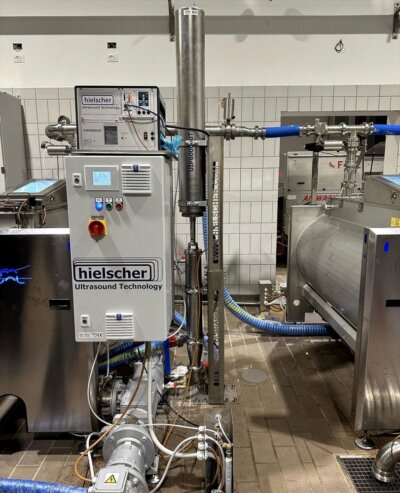
UIP4000hdT, a powerful 4000-watt industrial sonicator, for inline production of nano-infused and nanoemulsified cannabis beverages.

High-performance ultrasonics: Hielscher’s product range covers the full spectrum from compact laboratory ultrasonicators and bench-top units to full industrial ultrasonic systems.