Ultrasonic Cell Disaggregation of Bacterial Samples
Bacterial samples rarely arrive as true single-cell suspensions. Cultures grow in chains and flocs, environmental isolates form aggregates bound by extracellular polymeric substances, and centrifuged pellets often resist resuspension despite thorough vortexing. Viable counts, optical density, flow cytometry and microbiome profiling all assume that one particle equals one cell. Ultrasonic cell disaggregation resolves that conflict: short, controlled sonication bursts separate aggregates into single cells without lysing them.
Why Cell Aggregation Compromises Your Results
Aggregation is a biological feature, not a preparation error. Staphylococcus, Streptococcus, Lactobacillus, Actinomyces and many environmental species grow in chains, clusters or biofilm fragments, and extracellular DNA and polysaccharides glue cells together in pellets and swab eluates. The analytical consequences are systematic:
- Colony counts are underestimated, because one clump produces one colony regardless of how many cells it contains.
- Optical density and particle counters report aggregates instead of cells, biasing growth curves.
- Flow cytometry and cell sorting miscount clumped events and exclude them from analysis.
- DNA and protein extractions represent only the cells on the aggregate surface, skewing microbiome and omics data.
Conventional remedies are slow, incomplete, or chemically altering. Vigorous pipeting and vortexing leave micro-aggregates behind. Enzymatic or chelator-based dispersion modifies the cell surface you may intend to analyse. Mechanical disaggregation by controlled cavitation acts within seconds and requires no additives.
One aggregate equals one colony – and one wrong result. See how ultrasonic disaggregation produces true single-cell suspensions without lysis, aerosols or probe handling. Request more information!

Multi-Tube Sonicator VialTweeter for the non-contact sample preparation: Disaggregate cell clumps in sealed tubes
How Sonication Disaggregates Cells Without Lysing Them
 Ultrasonic cell disaggregation exploits a difference in mechanical strength. Bacterial aggregates are held together by relatively weak intercellular bonds and an extracellular matrix, while an intact cell envelope withstands substantially higher shear. As calibrated ultrasound enters the suspension, acoustic cavitation generates microstreaming, pressure pulses and shear forces that act first at the aggregate interfaces. Clumps, chains and biofilm fragments are sheared apart (deagglomeration) before the energy level at which membranes rupture (lysis) is reached.
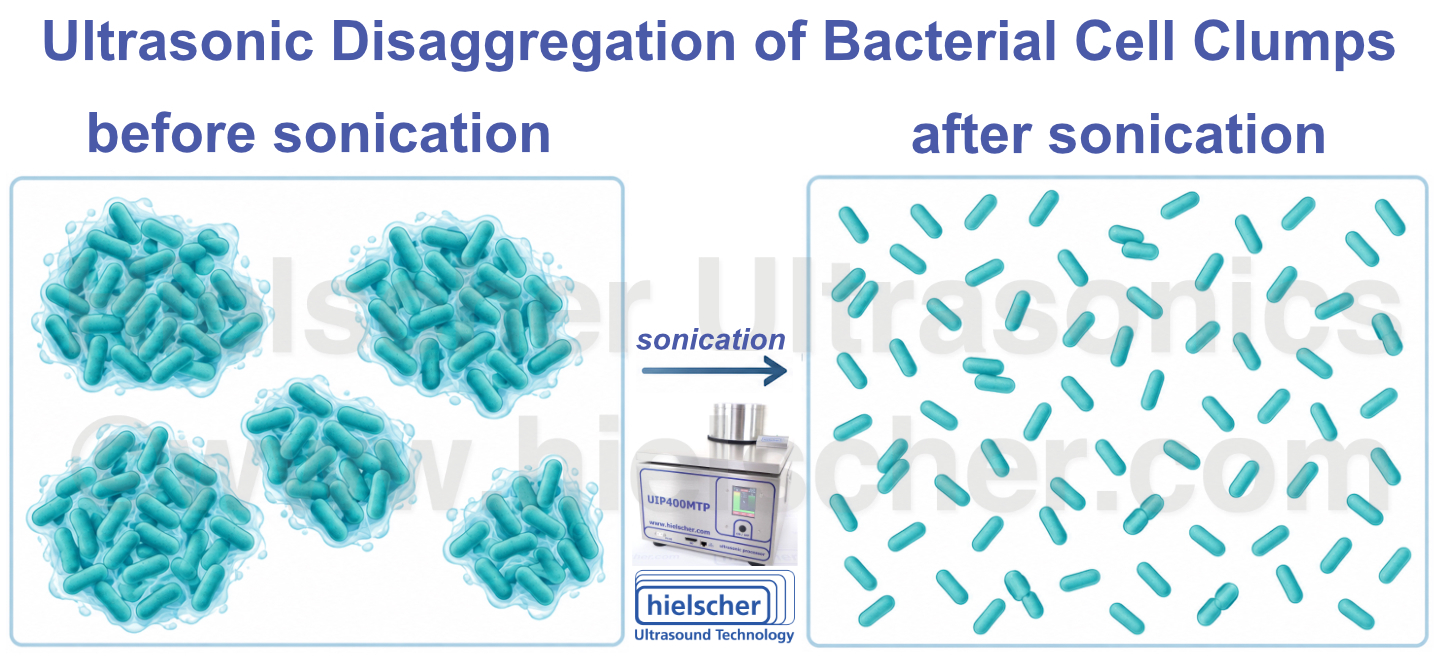
Ultrasonic Disaggregation of Bacterial Cell Clumps
Disaggregation or Lysis – How Sonication Parameters Matter
The practical consequence is that disaggregation and lysis are the same instrument operated at different parameters. At moderate amplitude, short pulsed cycles and controlled temperature you obtain a viable single-cell suspension. Raising amplitude, exposure time or sample temperature shifts the process toward complete cell disruption for intracellular targets. Hielscher generators let you set amplitude, power, pulse and energy input precisely and save the method, so the disaggregation step is reproducible across samples, operators and runs.
Efficient Non-Contact Sonication
Bath sonication cannot match this control. Ultrasonic cleaning baths and tanks provide only low ultrasonic energy, which results in incomplete preparation, and cavitation occurs unevenly, so each tube is treated according to its position in the bath. The VialTweeter transmits intense, focused ultrasonic forces directly through the vessel wall into up to 10 sealed samples at the same time. Treatments that require long, variable exposure in a bath are completed in a standardized pulse pattern.
Hielscher non-contact sonicators apply intense, focused ultrasound through the walls of closed vials. The VialTweeter processes up to 10 vials simultaneously at identical intensity, with no probe in the sample, no cross-contamination and no aerosol release. Where throughput demands it, the UIP400MTP and UIP550MTP microplate sonicators extend the same controlled energy transfer to multi-well plates.

The VialTweeter sonicates up to 10 smaller vials and up to 5 larger test tubes simultaneously.
Advantages of Non-Contact Ultrasonic Disaggregation
- Zero cross-contamination: Because the vials remain permanently closed and no probe is immersed in the sample, cross-contamination and sample loss are completely avoided. There is nothing to sterilize between samples, and one run cannot affect the next.
- Aerosol protection: Open probe sonication generates infectious aerosols and contaminates instrument surfaces. Sealed-vial sonication contains the sample inside its own tube, which matters when handling pathogenic bacteria such as Mycobacterium tuberculosis and other BSL-2 or BSL-3 agents.
- No tip erosion: Titanium probes can shed a small amount of micro-particles into the sample during operation. Those particles shift optical density and particle counts downstream. Indirect sonication through the vessel wall eliminates this source of solids entirely.
- Uniform throughput: The VialTweeter delivers the same ultrasound intensity to each of up to 10 vials, so sonication results are even and reproducible. Position effects that plague baths and single-sample probing disappear, and your baselines stay comparable across replicates.
- Sample integrity: The tubes stay closed throughout processing, so the sample cannot be contaminated, spoiled or volatilized. Small volumes work without dilution, including precious clinical pellets that cannot afford an extra transfer step.
- Process control: Amplitude is adjustable from 20 to 100%, pulse mode from 0 to 100%, and the systems support temperature monitoring so thermosensitive strains and proteins stay below damaging thresholds.
Typical Applications
- Microbiome and gut-content analysis: dispersing Lactobacillus, Bifidobacterium and faecal samples before plating or sequencing, so counts are not depressed by clumps.
- Food and water microbiology: disaggregating flocs in swabs, rinses and enrichment broths for accurate colony and viability determination.
- Biofilm research: recovering cells from carriers and surfaces as single-cell suspensions, without enzymatic treatment that would strip surface proteins.
- Clinical diagnostics: resuspending sputum, pus and swab eluates under containment conditions.
- Cell culture: separating clumped mammalian, insect and CHO aggregates prior to counting and passaging.
- Whole-workflow preparation: the same instrument that disaggregates at low amplitude performs full cell disruption at higher settings, so lysis, protein extraction and DNA fragmentation follow without tube transfers.

Multi-well plate Sonicator UIP400MTP for high-throughput deagglomeration of cell clumps
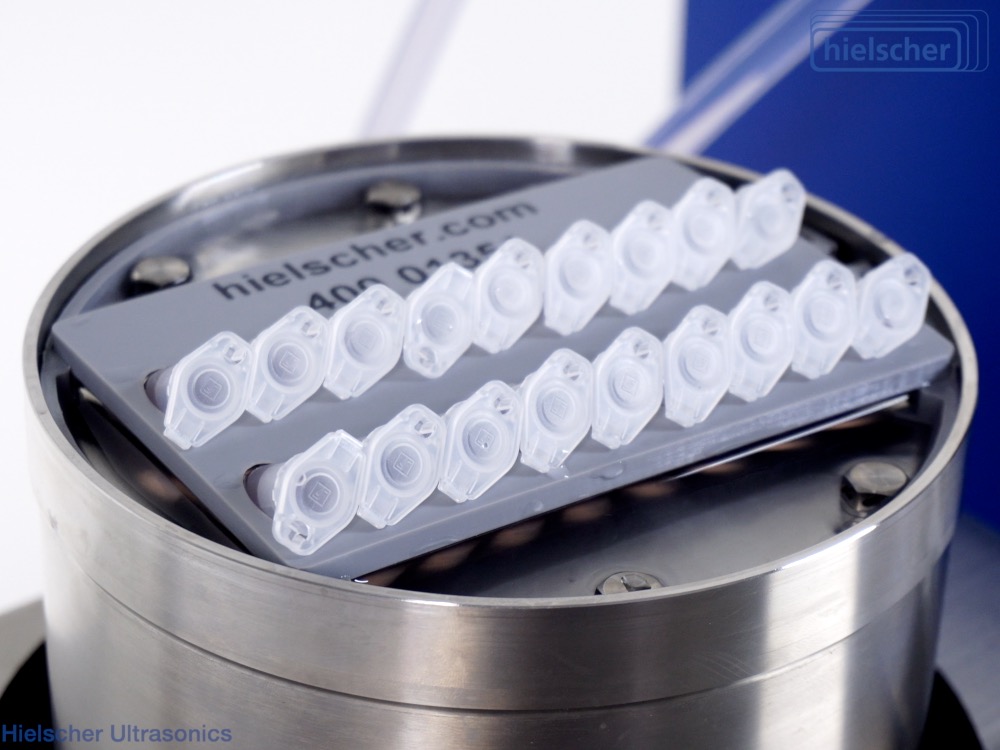
Not only for multi-well plates, the microplate sonicator models UIP400MTP and UIP550MTP process tube racks, too.
Find the Right Sonicator for Your Disaggregation Workflow
VialTweeter Multi-Tube Sonicator
 The method of choice for sterile, sealed-vial disaggregation. Driven by the 200-watt UP200St processor at 26 kHz with automatic tuning, the VialTweeter transmits ultrasound indirectly through the walls of up to 10 closed vials at the same time, at up to 10 W per tube, for even and reproducible results with no cross-contamination and no sample loss. The titanium VialTweeter sonotrode is autoclavable, and amplitude and pulse are adjustable and saveable, which is the control range a deagglomeration protocol needs. The standard 10-position sonotrode accepts auto-sampler vials, micro-centrifuge tubes and Eppendorf or Nunc tubes of 1 to 5 mL. The VialPress clamping device handles up to 5 larger vessels of up to 20 mm diameter.
 Dedicated single-tube VialTweeter models are available for Falcon tubes and for single vials customized to vessel size. Disassemble the block sonotrode and the UP200St core unit works as a conventional probe sonicator for direct treatment of small to mid-size samples.
Microplate Sonicators
 Scale-Up to high-throughput sample prep with multi-well plate sonication: For plate-based workflows, the microplate sonicators UIP400MTP and UIP550MTP extend non-contact, uniform sonication from ten tubes to an entire plate.
The 400-watt UIP400MTP treats standard microtiter and multi-well plates, including 96-well formats, with precise amplitude, power and pulsing control plus timer, temperature probe and water-bath cooling. Biofilm dislodging and bacterial culture processing are established applications of the UIP400MTP microplate sonicator.
The 550-watt UIP550MTP is the more powerful option – ideal for more demanding applications.
Both non-contact sonication systems reliably process 6-, 12-, 24-, 48-, 96- and 384-well plates as well as tube racks and Petri dishes. Hielscher microplate sonicators work with any standard plate, avoiding expensive proprietary consumables. With programmable temperature limits, sonication pauses automatically at the maximum sample temperature and resume after cooling, protecting viability in repeated cycles. Smart and reliable high-throughput sample preparation for repeatable results.
The table below gives you an overview of the approximate processing capacity of our lab sample sonicators used in life science, genomics, proteomics and diagnostics:
| Recommended Devices | Batch Volume | Flow Rate |
|---|---|---|
| VialTweeter Multi-Tube Sonicator | 0.5 to 1.5mL vials | n.a. |
| UIP400MTP Multi-Well Plate Sonicator (440 watts) | multi-well / microtiter plates | n.a. |
| UIP550MTP Multi-Well Plate Sonicator (550 watts) | multi-well / microtiter plates | n.a. |
| Ultrasonic CupHorn | CupHorn for vials or beaker | n.a. |
| UP100H 100 watts probe-type sonicator | 1 to 500mL | 10 to 200mL/min |
| UP200Ht, UP200St 200 watts probe-type sonicator models | 10 to 1000mL | 20 to 200mL/min |
| UP400St 400 watts probe-type sonicator | 10 to 2000mL | 20 to 400mL/min |
| GDmini2 | sterile ultrasonic micro-flow reactor | n.a. |
| Ultrasonic Sieve Shaker | n.a. | n.a. |
Frequently Asked Questions about Ultrasonic Cell Disaggregation
What is the difference between cell disaggregation and cell lysis?
Disaggregation, also called deagglomeration, separates clumped cells into a single-cell suspension while the cells remain intact and viable. Lysis ruptures the cell envelope and releases intracellular content. Both are driven by cavitation shear, and the difference is energy input. With optimized amplitude, pulse and temperature settings, sonication achieves disaggregation below the lysis threshold.
Why are ultrasonic baths not suitable for standardized disaggregation?
Baths provide only low ultrasonic energy, which leads to incomplete preparation, and cavitation develops very unevenly across the tank, so each sample receives a different treatment depending on its position. Microbiological counts and comparative studies depend on comparability. Non-contact sonicators such as the Multi-Tube Sonicator VialTweeter as well as the microplate sonicator models UIP400MTP and UIP550MTP process all vessels under adjusted ultrasonic conditions, which improves reproducibility across replicates.
Can sonication damage the cells?
Yes, if parameters are not controlled. Excessive sonication or uncontrolled heating can damage cells, and released DNA makes samples viscous and promotes re-aggregation. That is why the process should be developed deliberately: moderate amplitude, pulsed cycles, cooling and temperature-limited instruments keep the treatment on the disaggregation side of the curve.
All Hielscher digital sonicators offer precisely controllable parameter, pluggable temperature sensors, programmable settings and automated data logging for reliable sample preparation.
Does the sample need to be transferred to another vessel?
No. Vials and plates are processed in their original, closed containers. Indirect sonication avoids both transfer losses and the carryover associated with probe handling.
Which vial formats can the VialTweeter process?
The standard 10-position sonotrode accepts auto-sampler vials, micro-centrifuge tubes and Eppendorf or Nunc tubes of 1 to 5 mL. The VialPress accessory accommodates up to 5 larger vessels of up to 20 mm diameter. Dedicated Single-Tube VialTweeter models are available for Falcon tubes and for customized single-vial or larger formats.
Can I disaggregate and lyse with one instrument?
Yes. The same setup that deaggregates at moderate amplitude performs complete cell disruption at higher amplitude and longer exposure, so single-cell suspension and downstream extraction can run consecutively without changing platforms.
Is sonication used in MBEC assays?
Sonication is an established and largely standard component. In the peg-lid MBEC assay, after biofilms are grown on polystyrene pegs and exposed to antibiotic, the pegs are transferred to fresh medium and subjected to vortexing plus sonication to dislodge and deaggregate adherent biofilm cells into a planktonic suspension before serial dilution and viable counts (MBEC is read as the lowest concentration reducing recovered counts by ≥3 log10 relative to untreated biofilm). Sonication improves dispersion quality significantly: incomplete release of embedded cells from the EPS matrix underestimates eradication and inflates MBEC values. The targeted sonication of peg-holder wells across the assay plates with the microplate sonicator UIP400MTP overcomes the traditional weaknesses of bath sonication – namely uneven energy distribution, heating and aerosol/cross-contamination risk.
Learn how the contactless Microplate Sonicator UIP400MTP facilitate MBEC assays!
Is sonication used in MIC assays?
Sonication is applied at different MIC-adjacent workflows to improve the efficiency and reproducibility:
- mycobacteriology, where sputum and other viscous specimens are routinely decontaminated and homogenized, sometimes with sonication, before susceptibility testing, and clump-forming mycobacterial inocula benefit from brief dispersion for accurate MICs;
- aggregate-prone organisms (e.g., streptococci, staphylococci in pellets) where micro-aggregates distort inoculum density; and
- combined diagnostics such as implant sonication fluid culture followed by susceptibility testing in prosthetic joint infection (a MBEC-like, not classic MIC, application).
Literature / References
- FactSheet VialTweeter – Sonicator for Simultaneous Sample Preparation
- FactSheet UIP400MTP Plate-Sonicator for High-Throughput Sample Preparation – English version – Hielscher Ultrasonics
- FactSheet UIP550MTP Plate-Sonicator for High-Throughput Sample Preparation – English version – Hielscher Ultrasonics
- Bahnan W, Happonen L, Khakzad H, Kumra Ahnlide V, de Neergaard T, Wrighton S, André O, Bratanis E, Tang D, Hellmark T, Björck L, Shannon O, Malmström L, Malmström J, Nordenfelt P. (2023): A human monoclonal antibody bivalently binding two different epitopes in streptococcal M protein mediates immune function. EMBO Mol Med. 2023 Feb 8;15(2):e16208.
- Wrighton S., Ahnlide V.K., André O., Bahnan W., Nordenfelt P. (2023): Group A streptococci induce stronger M protein-fibronectin interaction when specific human antibodies are bound. Frontiers in Microbiology 14:1069789.
- De Oliveira A, Cataneli Pereira V, Pinheiro L, Moraes Riboli DF, Benini Martins K, Ribeiro de Souza da Cunha MDL (2016): Antimicrobial Resistance Profile of Planktonic and Biofilm Cells of Staphylococcus aureus and Coagulase-Negative Staphylococci. International Journal of Molecular Sciences 17(9):1423; 2016.
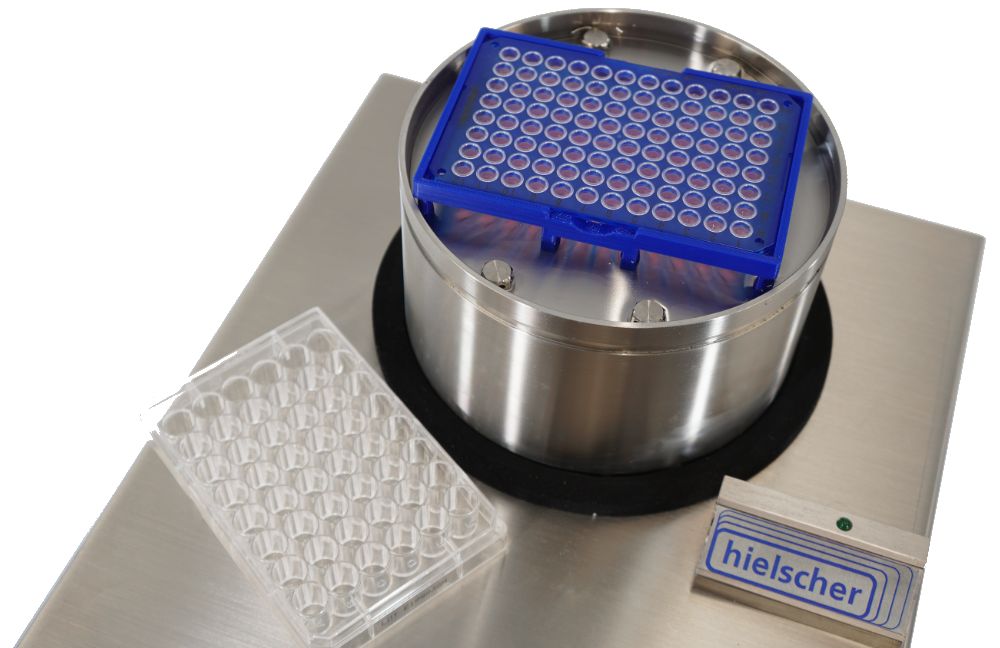
Choose your own plate! The microplate sonicator UIP550MTP disaggregates bacterial samples in any standard multi-well plate.

Hielscher Multi-Sample Sonicator models UIP400MTP for microplates, VialTweeter and CupHorn: high-speed and high-throughput sample preparation