Valorizing Food Processing Side Streams with Ultrasonic Extraction
Food processing side streams – such as onion and cabbage trimmings, orange peels, and protein-rich residues like brewer’s spent grain – are often discarded as waste or downgraded to low-value animal feed. Yet these by-products remain rich sources of valuable bioactive compounds, including proteins, dietary fibers, phenolic antioxidants, and natural pigments.
Recovering these high-value ingredients requires gentle processing methods that preserve their functional and nutritional properties. Once extracted and refined, these compounds can be incorporated into a wide range of food and beverage applications, particularly in the growing plant-based food sector.
Ultrasonic extraction offers an efficient, non-thermal, and environmentally friendly solution for recovering valuable compounds from food waste and biomass. By using high-intensity ultrasound, manufacturers can maximize extraction yields while maintaining the integrity and functionality of sensitive bioactive ingredients.
Efficient Biorefineries Through Ultrasonic Process Intensification
Ultrasonication is a proven process-intensification technology that enhances the efficiency, sustainability, and profitability of modern biorefineries. By integrating high-power ultrasound into biomass processing operations, manufacturers can significantly improve extraction performance, accelerate chemical and biochemical reactions, and optimize mixing, homogenization, and dispersion processes.
Compared to conventional processing methods, ultrasonic treatment delivers:
- Higher extraction yields
- Faster reaction and processing times
- Improved conversion rates
- Reduced energy consumption
- Enhanced product quality and purity
- Lower operating costs
As a result, ultrasonic process intensification plays a key role in transforming biomass into high-value products more efficiently and sustainably.
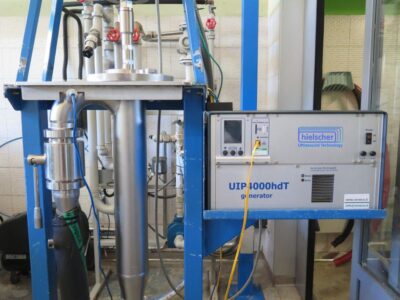
Sonicator UIP4000hdT for the efficient extraction of value compounds (e.g. proteins, polyphenols, pectins, lipids) from bio-waste.
What Is a Biorefinery?
A biorefinery is an integrated processing facility that converts renewable biomass into a range of valuable products, including food ingredients, animal feed, chemicals, biofuels, energy, and specialty materials.
Typical feedstocks include:
- Agricultural residues and crop waste
- Food processing by-products
- Industrial organic waste streams
- Forestry residues
- Municipal bio-waste
Like a petroleum refinery, which separates crude oil into multiple products, a biorefinery fractionates biomass into key intermediates–such as carbohydrates, proteins, lipids, and fibers – which are then further processed into value-added products.
A defining characteristic of modern biorefineries is the valorization of waste streams. Through innovative technologies, materials previously considered waste are converted into commercially valuable resources, supporting circular economy principles and reducing environmental impact.
Ultrasonically Intensified Biorefineries
The integration of ultrasonic technology can significantly improve the performance of numerous biorefinery processes, including:
- Extraction of bioactive compounds
- Biomass disintegration and cell disruption
- Anaerobic digestion
- Hydrolysis
- Fermentation support
- Transesterification of waste vegetable oils to biodiesel
- Emulsification and homogenization
- Particle size reduction and dispersion
Ultrasonic process intensification enables biorefineries to achieve higher productivity while reducing processing time and energy requirements. In addition, ultrasound-assisted processes often improve product purity and preserve the quality of heat-sensitive compounds.
By enhancing mass transfer, accelerating reaction kinetics, and increasing biomass accessibility, ultrasonication contributes to more sustainable and economically viable biorefinery operations. As demand for circular production systems and resource-efficient technologies continues to grow, ultrasound is becoming an increasingly important tool for maximizing the value of biomass and food processing side streams.
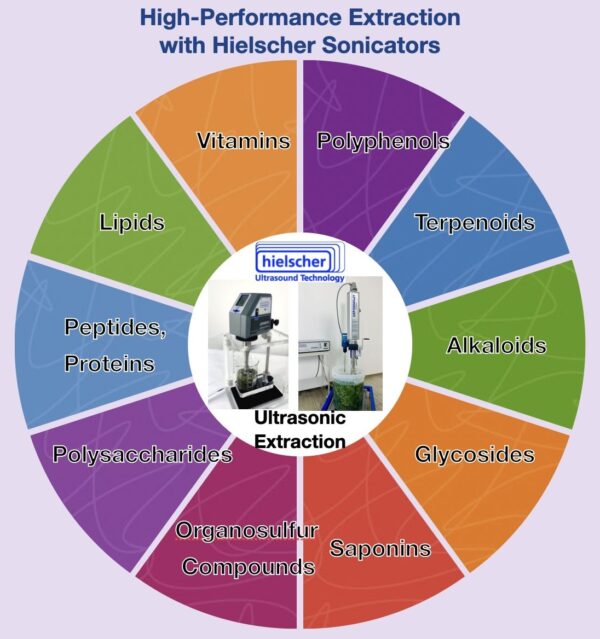
What Products Benefit from Sonication in Biorefineries?
High-performance ultrasonics is a process intensifying technique applied to multiple industries. Ultrasonication is used to process liquids and slurries in order to mix and homogenise, promote mass transfer, extract compounds and/or to initiate chemical reactions.
Common applications of ultrasonication in biorefineries are:
- extraction of valuable compounds from biomass (e.g. proteins, pectins, starches etc.)
- bioethanol production
- biodiesel synthesis from spent vegetable oils and animal fats
- biodiesel from algae oil
- lignocellulose treatment
- starch modification
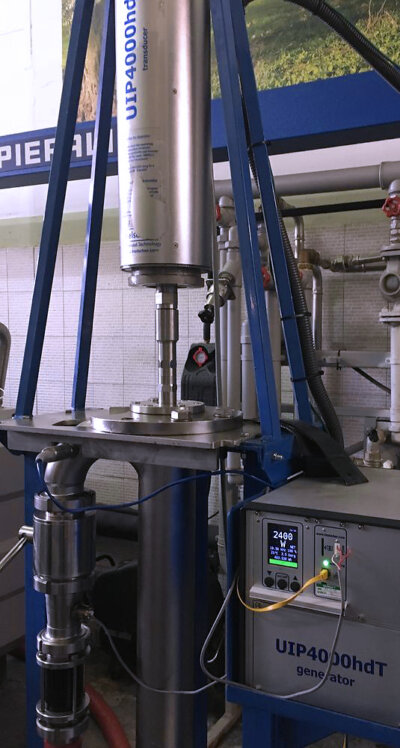
Ultrasonic extractor UIP4000hdT for continuous extraction of proteins, lipids and phyto-nutrients from bio-waste.

Protein extraction form duckweed: SEM images of duckweed samples: The upper row shows the intact cells of duckweed control samples
The lower row shows duckweed samples extracted using the sonicator UP400ST. The cells show clear mechanical breakdown due to sonication.
Study and images: ©2023 Inguanez et. al.
High-Performance Ultrasonic Processors for Biorefineries
 Hielscher Ultrasonics designs and manufactures high-performance ultrasonic processors for biorefinery applications worldwide. Our industrial ultrasonic reactors enhance extraction, biomass disintegration, homogenization, mixing, dispersion, degassing, and sonochemical reactions, helping operators achieve higher yields, faster processing, and improved conversion rates.
From laboratory feasibility studies to pilot-scale optimization and full-scale industrial production, Hielscher provides scalable ultrasonic solutions for every stage of process development. Established applications such as ultrasonic extraction, cell disruption, mass transfer enhancement, and biomass valorization can be rapidly implemented and scaled with predictable results.
Hielscher offers ultrasonic processors ranging from compact laboratory units to industrial systems processing multiple tons of biomass per hour. With the UIP16000hdT (16kW), the world’s most powerful ultrasonic processor, and scalable clustering options, virtually any production capacity can be achieved. All industrial systems are engineered for continuous 24/7 operation under demanding production conditions.
Ultrasonic Reactors and Probes for Any Production Scale
Hielscher’s product portfolio includes:
- Laboratory ultrasonicators for process development and feasibility testing
- Bench-top and pilot systems for scale-up studies
- Industrial ultrasonic processors for large-scale biomass processing
- Inline flow-cell reactors for continuous production
This broad product range ensures the ideal ultrasonic solution for your process, throughput requirements, and production goals.
Maximum Process Control for Consistent Results

Precise process control is essential for efficient biomass conversion and extraction. Hielscher ultrasonic processors allow accurate adjustment and monitoring of all critical sonication parameters, including amplitude, power, temperature, pressure, and energy input.
Amplitude is one of the most important factors affecting ultrasonic process efficiency. Hielscher systems provide precise amplitude control and can operate continuously at amplitudes of up to 200 µm under industrial conditions. Sonotrodes and booster horns allow further optimization for specific applications.
Integrated digital controls and browser-based monitoring enable real-time process management, ensuring reproducible results, maximum extraction efficiency, and reliable scale-up from laboratory to industrial production.
Built for Continuous Industrial Operation
Hielscher ultrasonic processors are engineered for heavy-duty industrial environments. Robust design, high-quality components, and proven reliability enable continuous 24/7 operation under full load.
Key benefits include:
- High extraction yields and improved biomass utilization
- Fast and reliable scale-up from lab to production
- Continuous inline processing capability
- Low maintenance requirements
- Remote monitoring and process data recording
- Industrial-grade reliability for round-the-clock operation
German Engineering and Manufacturing Excellence
As a family-owned company based near Berlin, Germany, Hielscher Ultrasonics has been developing and manufacturing industrial ultrasonic equipment for decades. Every ultrasonic processor is designed, built, and tested in Germany to ensure maximum performance, reliability, and long service life.
Beyond equipment supply, Hielscher supports customers with application expertise, process optimization, scale-up assistance, technical training, and ongoing engineering support – helping biorefineries achieve efficient, profitable, and sustainable biomass processing.
The table below gives you an indication of the approximate processing capacity of our ultrasonicators:
| Batch Volume | Flow Rate | Recommended Devices |
|---|---|---|
| 10 to 2000mL | 20 to 400mL/min | UP200Ht, UP400St |
| 0.1 to 20L | 0.2 to 4L/min | UIP2000hdT |
| 10 to 100L | 2 to 10L/min | UIP4000hdT |
| n.a. | 10 to 100L/min | UIP16000 |
| n.a. | larger | cluster of UIP16000 |
Contact Us! / Ask Us!
Frequently Asked Questions
What is the Biorefinery Concept?
The biorefinery concept is the sustainable conversion of biomass into a spectrum of valuable products, including food ingredients, feed, chemicals, materials, biofuels, and energy. Similar to a petroleum refinery, a biorefinery fractionates and processes raw materials into multiple products, maximizing resource efficiency and minimizing waste.
What is an Example of a Biorefinery?
A food waste biorefinery is a common example. It processes agricultural residues, fruit peels, brewer’s spent grain, or other food processing by-products to recover valuable compounds such as proteins, dietary fibers, antioxidants, and bioactive molecules, while converting the remaining biomass into bioenergy or biofertilizers.
What Materials are Processed in a Biorefinery?
Biorefineries process renewable biomass, including agricultural residues, food processing side streams, forestry waste, energy crops, algae, animal by-products, and organic municipal waste. These feedstocks contain carbohydrates, proteins, lipids, fibers, and other compounds that can be converted into value-added products.
What is the Difference between a Refinery and a Biorefinery?
A conventional refinery uses fossil-based raw materials such as crude oil to produce fuels and petrochemicals, whereas a biorefinery uses renewable biomass as its feedstock. Biorefineries are designed to support a circular and sustainable economy by converting biological resources and waste streams into renewable fuels, chemicals, materials, and energy.

Hielscher Ultrasonics manufactures high-performance ultrasonic homogenizers for mixing applications, dispersion, emulsification and extraction on lab, pilot and industrial scale.
Literature / References
- García, A., González Alriols, M., Wukovits, W. et al. (2014): Assessment of biorefinery process intensification by ultrasound technology. Clean Techn Environ Policy 16, 1403–1410 (2014).
- Velmuruga, Rajendran; Muthukumar, Karuppan (2011): Utilization of sugarcane bagasse for bioethanol production: Sono-assisted acid hydrolysis approach. Bioresource Technology Vol. 102, Issue 14; 2011. 7119-7123.
- Lukavski, T.; Šarčević, I.; Vukoje Bezjak, M. (2026): Influence of Solvent and Ultrasound-Assisted Extraction on the UV Spectral Profiles of Extracts from Agro-Waste. Science 2026, 8, 96.
- Marina Fernández-Delgado, Esther del Amo-Mateos, Mónica Coca, Juan Carlos López-Linares, M. Teresa García-Cubero, Susana Lucas (2023): Enhancement of industrial pectin production from sugar beet pulp by the integration of surfactants in ultrasound-assisted extraction followed by diafiltration/ultrafiltration. Industrial Crops and Products, Volume 194, 2023.