Sono-Electrowinning for Industrial Metal Extraction
As global demand for copper, nickel, cobalt, zinc, silver, gold, rare metals, and battery-relevant materials continues to rise, metal producers are under pressure to recover more value from ores, concentrates, tailings, recycled streams, and low-grade feedstocks. In hydrometallurgy, one of the most established routes for metal recovery is electrowinning, also known as electroextraction: dissolved metal ions are recovered from a leach solution by applying an electrical current, which reduces the ions and deposits the metal onto a cathode.
Sono-Electrowinning for Improved Hydrometallurgical Metal Recovery
Sono-electrowinning advances this principle by combining electrowinning with high-intensity ultrasound. The result is a sonoelectrochemical process in which acoustic cavitation, microstreaming, and electrochemical reduction act together. Instead of relying only on electrical potential and conventional electrolyte circulation, sono-electrowinning introduces intense local mixing directly at or near the electrode interface, where metal deposition actually occurs. Ultrasound is widely reported to enhance mass transport, disturb the diffusion layer, clean electrode surfaces, remove gas bubbles, and support higher electrochemical rates.

Electro-Sonication Using the Sonotrode and the reactor wall as electrodes.

Sono-electro-probes: 2 ultrasonic transducers agitate anode and cathode, respectively. The sono-electrodes or sono-electro-probes act simultaneously as electrodes and ultrasonic probes for improved electrowinning.
From Ore to Cathode: How Sono-Electrodeposition Works
Industrial electrowinning usually begins with leaching. In this upstream step, the target metal is dissolved from an ore, concentrate, process residue, slag, black mass, electronic waste, or other metallurgical feedstock into an aqueous solution. Depending on the metal and ore chemistry, the leachant may be acidic, alkaline, chloride-based, sulfate-based, cyanide-based, ammoniacal, organic-acid-based, or otherwise chemically tailored to dissolve the valuable metal phase.
After leaching, the pregnant leach solution is commonly clarified, purified, and adjusted for pH, conductivity, temperature, metal concentration, and impurity profile. In the electrowinning cell, this metal-bearing electrolyte flows between an anode and a cathode. When a controlled current is applied, dissolved metal ions migrate and are reduced at the cathode surface, where they form a solid metallic deposit. In sono-electrowinning, ultrasound is introduced into this electrochemical environment so that acoustic energy intensifies the transport of ions and the renewal of the electrode boundary layer.
In simple terms, the process sequence is as follows:
- Leaching: Valuable metals are dissolved from ore or secondary raw material into solution.
- Solution conditioning: The leach liquor is purified or adjusted to improve selectivity and deposition behavior.
- Sono-electrochemical deposition: Ultrasound and electrical current act simultaneously in the electrowinning cell.
- Cathode recovery: Metal deposits are harvested as sheets, powder, sponge, foil, or other deposit forms depending on the process design.
- Electrolyte recirculation: The depleted electrolyte can be regenerated, recycled, or returned to the hydrometallurgical circuit.

Inline sono-electrochemical setup
Why Sonication Improves Electrowinning
 The main bottleneck in many electrowinning systems is not only the electrical reaction itself. It is the supply of fresh metal ions to the cathode surface, the removal of reaction products and gas bubbles, and the maintenance of an active, clean, homogeneous electrode interface. Ultrasound directly addresses these limitations.
When high-power ultrasound enters the electrolyte, it creates acoustic cavitation: microscopic bubbles form, oscillate, and collapse. These collapses generate microjets, shock waves, and intense local shear. In liquid-phase processing, this can produce localized mixing, micro-mixing, dispersion, deagglomeration, and accelerated interfacial transport.
Hielscher ultrasonic and sono-electro-technology is positioned around controlled acoustic cavitation for liquid processing, where ultrasonic waves generate cavitation fields that produce shear, shock waves, microjets, and reproducible energy transfer into fluids, suspensions, and slurries.
In electrowinning, these effects are especially valuable because the electrochemical reaction happens at a surface. Ultrasound can reduce concentration gradients near the electrode, compress or disrupt the diffusion layer, and bring fresh metal ions continuously to the cathode. Recent work on ultrasound-enhanced electrochemical mass transport describes current enhancement through diffusion-layer compression driven by acoustic streaming, while research on ultrasound-assisted electrodeposition reports improved ion transport through cavitation, microflow, and acoustic pressure effects.
The Synergy: Sonication Plus Electrochemistry
The advantage of sono-electrowinning is not merely that ultrasound “stirs” the solution. Hielscher Sono-Electro-Probes combine ultrasonic probes and electrodes that simultaneously introduces high-intensity ultrasound and electrical current into an electrochemical system. Hereby, the key is the synergetic coupling of two energy fields: electrical energy drives the metal-ion reduction reaction, while acoustic energy improves the physical and interfacial conditions under which that reaction takes place.
This synergy can create several industrially relevant benefits:
- Higher mass transfer: Sonication improves the supply of dissolved metal ions to the cathode surface, reducing local depletion.
- Cleaner electrode surfaces: Cavitation and acoustic streaming help remove passivating films, loosely attached particles, gas bubbles, and reaction products.
- Improved current efficiency potential: A more active electrode interface can reduce losses associated with concentration polarization and surface blockage, although the final efficiency depends on electrolyte chemistry and operating parameters.
- More uniform deposition: Ultrasound-assisted electrodeposition has been associated with smoother, denser, more uniform deposits and finer grain structures.
- Faster electrodeposition kinetics: Enhanced mass transfer and surface activation can allow higher deposition rates under optimized conditions.
- Reduced diffusion limitations: By disturbing the boundary layer at the electrode, ultrasound can support more consistent deposition even when metal concentrations are relatively low.
- Better handling of complex electrolytes: Ultrasonic agitation can support the processing of suspensions, fine particles, and difficult leach liquors by improving dispersion and reducing localized stagnation.
This makes sono-electrowinning particularly attractive for hydrometallurgical circuits where conventional electrowinning is limited by slow kinetics, poor deposit morphology, concentration polarization, electrode fouling, gas bubble coverage, or low metal-ion concentration.
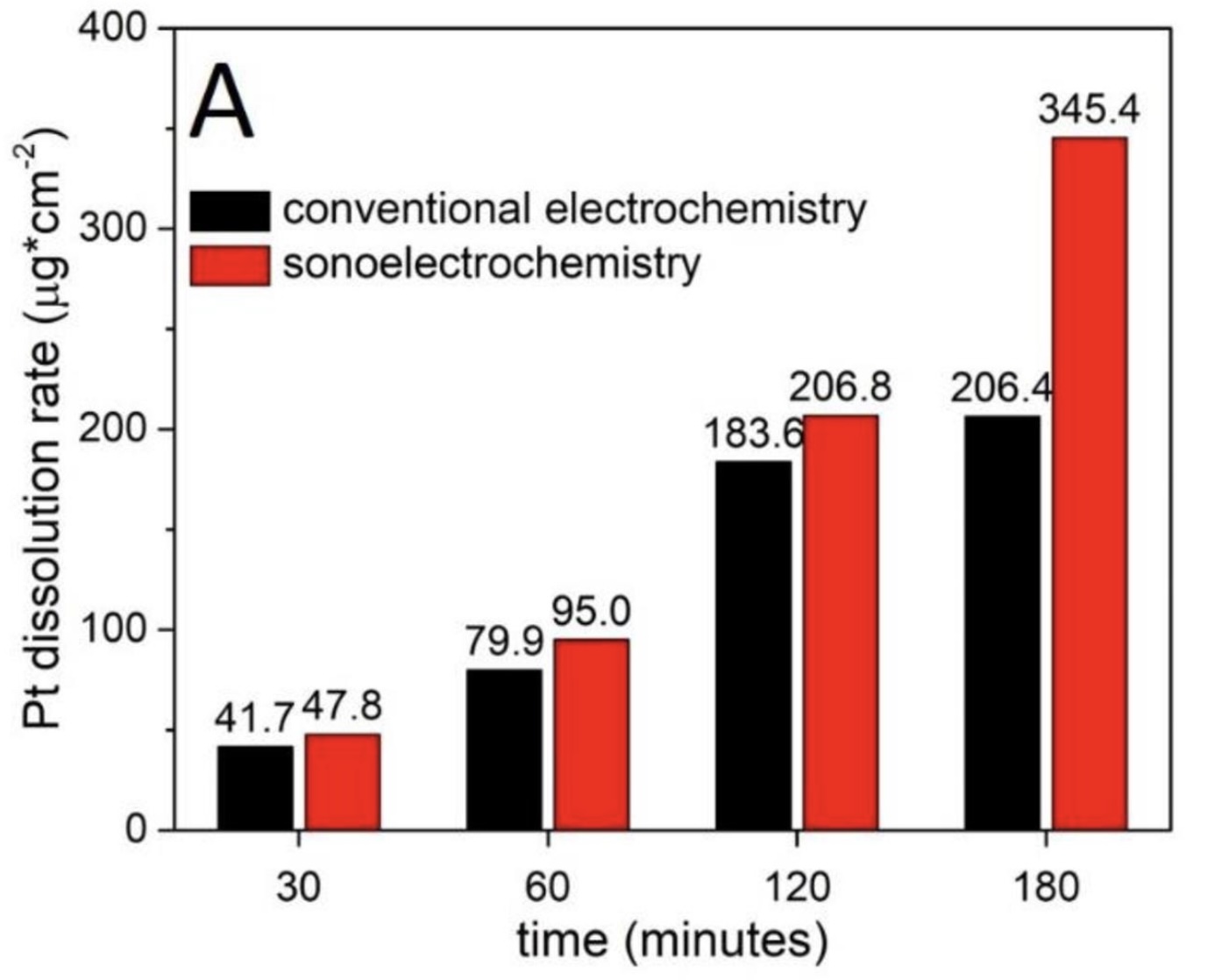
Conventional vs sonoelectrochemical dissolution rates of Pt electrodes.
Study and graphs: ©Vasile et al., 2021
Industrial Benefits for Metal Extraction
For industrial extraction of metals, the value of sono-electrowinning lies in process intensification. More metal can potentially be recovered in a shorter time, with improved deposit morphology and more stable cell operation, provided the sonication power, electrode geometry, electrolyte composition, and current density are properly matched.
In practical terms, sono-electrowinning supports:
- Recovery from low-grade leach liquors: Better mass transfer can help maintain deposition when dissolved metal concentrations are not ideal.
- Improved cathode quality: Smoother and more uniform deposits can simplify downstream stripping, melting, refining, or powder handling.
- Lower fouling tendency: Continuous surface renewal can reduce the impact of passivation and unwanted surface films.
- More compact process design: Faster kinetics may allow smaller cells or higher throughput, depending on the process chemistry.
- Enhanced recovery from secondary resources: Battery black mass, electronic waste, catalysts, slags, and industrial residues often generate complex leach solutions where intensified mass transfer is valuable.
- Better process controllability: Modern ultrasonic systems can be integrated into batch or continuous inline setups and tuned via amplitude, residence time, flow rate, temperature, and energy input.
Hielscher sono-electro-systems are unique: The sono-electrode acts simultaneously as ultrasonic probe and electrode. The sono-electro-setups are designed around scalable liquid processing from laboratory testing to pilot operation and industrial inline production. High power ultrasound, 24/7 continuous-operation capability, industrial-grade robustness and low maintenance make Hielscher sono-electro-systems ideal for industrial sono-electrowinning.
Linear scale-up through controlled parameters such as amplitude, energy input, flow rate, temperature, and residence time facilitate the increase in production capacities significantly.
Sono-Electrowinning in the Leaching–Electrowinning Chain
In a conventional hydrometallurgical plant, electrowinning is often positioned after leaching, solid-liquid separation, purification, and sometimes solvent extraction or ion exchange. Sono-electrowinning can be integrated into this downstream recovery step to intensify the conversion of dissolved metal ions into solid metal.
A typical process pathway may look like this:
- Crushed ore, concentrate, tailings, or secondary raw material is leached to dissolve the target metal.
- Insoluble gangue, residual solids, and unwanted phases are removed or reduced.
- The pregnant leach solution is chemically adjusted for selective electrowinning.
- The electrolyte is fed into an electrowinning cell equipped with sono-electrodes and circulation.
- Sonication improves ion transport and electrode-surface renewal while the applied current plates the metal onto the cathode.
- The metal product is harvested, and the electrolyte is recycled or sent to further treatment.
This combination is especially interesting where the metal extraction industry needs to process more challenging resources. Many future feedstocks contain lower metal grades, more impurities, finer particles, mixed chemistries, or variable composition. Sono-electrowinning offers a route to make the electrochemical recovery step more robust by improving the interaction between the electrolyte and the electrode surface.

The ultrasonic probe functions as electrode. The ultrasound waves promote electrochemical reactions resulting in improved efficiency, higher yields and faster conversion rates.
Sonoelectrochemistry improves electrodeposition processes significantly.
Sono-Electrochemical Metal Recovery: Higher Yields at Lower Process Costs
Electrowinning is already a cornerstone of hydrometallurgy because it can recover metals from aqueous solutions as high-value solid products. Sono-electrowinning improves conventional electroextraction by improving recovery efficiency, current efficiency, and energy consumption.
The synergistic effects of power ultrasound and electrowinning address the physical limitations of the electrochemical interface and supports more intensive, controlled, and potentially more efficient metal recovery. For mining, recycling, and metallurgical operations, the technology helps bridging the gap between increasingly complex feedstocks and the need for cleaner, more selective, higher-throughput extraction routes.
Sono-Electrowinning as a Process-Intensification Tool
The future of metal extraction will depend on recovering more metal from more difficult resources. High-grade ores are declining in many regions, while demand for copper, nickel, cobalt, lithium-related metals, precious metals, and rare elements is increasing. At the same time, industry is expanding its focus from primary ores to secondary resources such as spent batteries, electronic scrap, catalysts, industrial residues, and process waters.
Sono-electrowinning offers a compelling process-intensification strategy for this landscape. By combining the selectivity of electrochemical metal recovery with the interfacial power of ultrasonic cavitation, it can improve mass transfer, electrode activity, deposit morphology, and process robustness. For industrial operators, this means a stronger route from leached metal ions to recoverable metal product.
In short, sono-electrowinning turns the cathode surface into a more dynamic reaction zone. Sonication keeps the electrochemical interface active; electrochemistry converts dissolved ions into metal; and together they create a powerful platform for modern hydrometallurgical extraction.
High-Performance Sono-Electro-Probes and SonoElectroReactors
Hielscher Ultrasonics is your long-time experienced partner for high-performance ultrasonic systems. We manufacture and distribute state-of-the-art ultrasonic probes and reactors, which are used worldwide for heavy-duty applications in demanding environments. For sonoelectrochemistry, Hielscher has developed special ultrasonic probes, which can act as cathode and/or anode, as well as ultrasonic reactor cells suitable for electrochemical reactions. Ultrasonic electrodes and cells are available for galvanic / voltaic as well as electrolytic systems.
Contact us now and tell us about your electrochemical process requirements! We will recommend you the most suitable ultrasonic electrodes and reactor setup!
Contact Us! / Ask Us!

Hielscher Ultrasonics manufactures high-performance ultrasonic homogenizers for mixing applications, dispersion, emulsification and extraction on lab, pilot and industrial scale.
Frequently Asked Questions
What is Electrowinning?
Electrowinning is an electrochemical metal-recovery process in which dissolved metal ions are reduced from an aqueous electrolyte and deposited as solid metal onto a cathode. The metal-bearing solution is typically produced by leaching ores, concentrates, residues, or recycled materials, after which an applied electric current drives the selective recovery of the target metal.
What is a Sono-Electro-Probe?
A Sono-Electro-Probe is a combined ultrasonic probe and electrode that simultaneously introduces high-intensity ultrasound and electrical current into an electrochemical system. As a sono-electrode, it creates acoustic cavitation and microstreaming at or near the electrode surface, which improves mass transfer, disrupts diffusion layers, removes gas bubbles or passivating films, and thereby intensifies electrochemical reactions such as electrodeposition, electrowinning, electrooxidation, and electroreduction.
What are Applications of Sonoelectrochemistry?
Sonoelectrochemistry can be applied to various processes and in different industries. Very common applications of sonoelectrochemistry include the following:
- Nanoparticle synthesis (electrosynthesis)
- Hydrogen synthesis
- Electrocoagulation
- Wastewater treatment
- Ohmic Heating
- Breaking emulsions
- Electroplating / Electrodeposition
Literature / References
- Eugeniu Vasile, Adrian Ciocanea, Viorel Ionescu, Ioan Lepadatu, Cornelia Diac, Serban N. Stamatin (2021): Making precious metals cheap: A sonoelectrochemical – Hydrodynamic cavitation method to recycle platinum group metals from spent automotive catalysts. Ultrasonics Sonochemistry, Volume 72, 2021.
- Sherif S. Rashwan, Ibrahim Dincer, Atef Mohany, Bruno G. Pollet (2019): The Sono-Hydro-Gen process (Ultrasound induced hydrogen production): Challenges and opportunities. International Journal of Hydrogen Energy, Volume 44, Issue 29, 2019, 14500-14526.
- Yurdal K.; Karahan İ.H. (2017): A Cyclic Voltammetry Study on Electrodeposition of Cu-Zn Alloy Films: Effect of Ultrasonication Time. Acta Physica Polonica Vol 132, 2017. 1087-1090.
- Mason, T.; Sáez Bernal, V. (2012): An Introduction to Sonoelectrochemistry In: Power Ultrasound in Electrochemistry: From Versatile Laboratory Tool to Engineering Solution, First Edition. Edited by Bruno G. Pollet. 2012 John Wiley & Sons, Ltd.
- Haas, I.: Gedanken A. (2008): Synthesis of metallic magnesium nanoparticles by sonoelectrochemistry. Chemical Communications 15(15), 2008. 1795-1798.
- Ashassi-Sorkhabi, H.; Bagheri R. (2014): Sonoelectrochemical and Electrochemical Synthesis of Polypyrrole Films on St-12 Steel and Their Corrosion and Morphological Studies. Advances in Polymer Technology Vol. 33, Issue 3; 2014.
- Sono-Electrochemical Synthesis Improves Efficiency in Chemical Manufacturing

Ultrasonic UIP2000hdT (2000 watts, 20kHz) as Cathode and/or Anode in a Tank