Power Ultrasound for Water-in-Diesel Emulsions
The use of water-in-fuel emulsions is a rapidly expanding due to tightened environmental regulations and the tougher competition in the transportation market. The ultrasonic emulsification technology enables for a more efficient use of fuels, such as heavy fuels or diesel, by mixing water into the base fuel. Ultrasonically emulsified water-fuels provide a more complete combustion and a more economic fuel consumption, whilst burning the fuels with fewer emissions!
Water-in-Fuel Emulsion
 The combustion of fuels generates hazardous gasses, such as nitrous oxides (NOx), hydrocarbons (HC), carbon monoxide (CO), carbon dioxide (CO2) as well as particulate matter (PM), soot and smoke, which are harmful to human health and environment. The emission of those pollutants can be significantly reduced by adding water to the fuel.
The addition of 5 – 25% water to the fuel, such as heavy fuel oil or diesel, can reduce the emisson of hazardous pollutants drastically. The injected water reduces the local adiabatic combustion temperature. Studies have proven that thereby the emission of NOx can be lowered by up to 40%, CO2 by 5% – 15% and PM by up to 90%. Black smoke from diesel combustion can be completely eliminated as the fuel is burned completely.
At the same time, the fuel consumption can be reduced by approx. 5%. Save the environment and save fuel!
Emulsifiable fuels include liquid hydrocarbons, crude, heavy fuels (HFO), naphtha, kerosene, diesel, heating oils, biodiesel and vegetable oils.

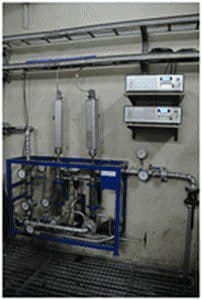
Two sonicators of the model UIP1000hdT (each 1000 watts) for the inline emulsification of stable aqua-fuels
Environmental & Economic Benefits:
- lower NOx emissions
- lower soot emissions
- reduced fuel consumption
- more complete combustion
- lower peak combustion temperatures
- less fouling in the boiler

Primary and secondary atomisation in spray flame of emulsified fuel.
Ultrasonic Water-in-Fuel Emulsions
 Power ultrasound is a well known and proven technology to create fine-size emulsions with droplets in the micron and nano range. The ultrasonic emulsification technology is based on cavitational shear forces. By ultrasonic cavitation, the water and fuel droplets are minimized to nano size and are blended together so that a fine-size (nano-/ mini-)emulsion is produced. For the ultrasonic inline emulsification, the separate fuel and water streams can be precisely adjusted so that a constant ratio of water and fuel is ensured.
The ultrasonic homogenizers can be installed directly before the injection pump so that the homogeneous water-fuel emulsion can be injected immediately into the engine and the storage of the fuel emulsion is avoided. When the water-fuel emulsion is injected into the combustion chamber, the water droplets evaporate due to the high temperatures rapidly as the boiling point of water is much lower as of the fuel. During the vaporization process, the water droplets burst in a micro-explosive way and disrupt the fuel into smaller droplets. Thereby, the water-fuel is atomized in the combustion chamber so that fuel and air in the combustion chamber are better mixed and the fuel can be burned completely. The very small droplets offer a very high particle surface resulting in a large low-tension water-oil interface, which improves the atomization further. This increases the combustion efficiency, finally resulting in a significant fuel cost reduction, which exceeds the costs for the emulsification.
The ultrasonic blending technology is an inline process, which can be easily retrofitted at existing engines. The engine itself requires no modifications.

Hielscher UIP6000hdT cluster consisting of up to 12x sonicators. This setup allows to compose a 72kW powerful inline sonication system for high-performance inline processing.
Ultrasound-Driven Emulsion Technology
The ultrasonic emulsification technology is based on cavitation and high shear mixing. High intense ultrasound waves are coupled into the liquid medium (fuel-water mixture) and create droplet sizes in the nano range and allow to produce two-phase water-in-oil emulsions and three-phase oil-in-water-in-oil emulsions.
Installations on:
- CHP – combined heat and power units
- diesel generators
- power stations
- marine vessels
- diesel locomotives
- retrofittable to all diesel engines
- on-board technology: seaworthiness

Ultrasonic nano-emulsification produces stable emulsions
Heavy-Duty Ultrasound Equipment
 Hielscher supplies heavy duty industrial ultrasonic equipment which can handle high fuel streams – even at high viscosities. Hielscher ultrasonic homogenizers are built for 24/7 operation under rough conditions. Our systems are operator-friendly and compact, do not have any moving parts, are easy to install and operate and barely require maintenance.
The ultrasonic emulsion-fuel production can be securely controlled via browser control, whilst the two separate feeding streams of water and fuel allow for an accurate dosage of the water-fuel ratio and the regulation / adaption of the fuel mixture during operation in accordance to the current engine load / speed.

Design, Manufacturing and Consulting – Quality Made in Germany
Hielscher ultrasonicators are well-known for their highest quality and design standards. Robustness and easy operation allow the smooth integration of our ultrasonicators into industrial facilities. Rough conditions and demanding environments are easily handled by Hielscher ultrasonicators.
Hielscher Ultrasonics is an ISO certified company and put special emphasis on high-performance ultrasonicators featuring state-of-the-art technology and user-friendliness. Of course, Hielscher ultrasonicators are CE compliant and meet the requirements of UL, CSA and RoHs.

Ultrasonic production of emulsion fuels on-board at marine vessels
Facts Worth Knowing
What are Aqua-Fuels?
Aqua-fuels is a term that is alternatively used for emulsified fuels (so-called emulsion-fuels). Those type of fuels are emulsions composed of water and a liquid combustible, such as oil, fuel, gas or diesel. Emulsions are a particular mixture of two or more immiscible liquids comprising a continuous and a dispersed phase. Ultrasonic emulsification is a powerful and reliable technique to emulsify water and oil (fuel, crude, diesel etc.) by creating nano-sized droplets. Sonication is thereby an innovative technology for cleaner and more effective combustion of fuels.
How can Ship Fuels be made Greener?
Ship fuels can be made greener by reducing sulfur and particulate emissions, increasing the share of renewable and low-carbon fuels such as biofuels, and evaluating fuels on a life-cycle greenhouse-gas basis from production to onboard use. In practice, greener ship fuels are achieved through cleaner fuel formulations, blending fossil marine fuels with sustainable bio-components, and adopting alternative marine fuels that lower well-to-wake emissions and improve overall sustainability performance.
Read more about ultrasonic blending of biodiesel-marine diesel fuels!
Literature / References
- Al-Iwayzy, Saddam H.; Yusaf, Talal; Al-Juboori, Raed A. (2014): Biofuels from the Fresh Water Microalgae Chlorella vulgaris (FWM-CV) for Diesel Engines. Energies 7/2014. 1829-1851.
- Khan, Mohammed Yahaya; Karim, Z. A. Abdul; Hagos, Ftwi Yohaness; Aziz, A. Rashid A.; Tan, Isa M. (2014): Current Trends in Water-in-Diesel Emulsion as a Fuel. The Scientific World Journal 2014.
- Scarpete, Dan (2013): Diesel-Water Emulsion, an Alterantive Fuel to Reduce Diesel Engine Emissions. Machines, Technologies, Materials 7/2013. 13-16.
- high efficiency
- state-of-the-art technology
- reliability & robustness
- adjustable, precise process control
- batch & inline
- for any volume
- intelligent software
- smart features (e.g., programmable, data protocoling, remote control)
- easy and safe to operate
- low maintenance
- CIP (clean-in-place)
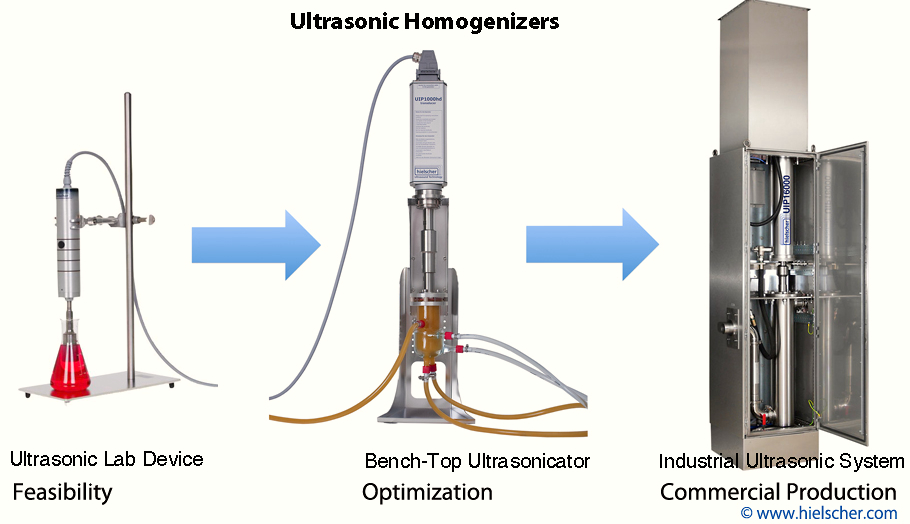
Hielscher Ultrasonics manufactures high-performance ultrasonic homogenizers from lab to industrial size.