Peptide Synthesis Scale-Up: Ultrasonic Strategies for Batch + Continuous Flow
Sonication-assisted peptide synthesis combines established peptide chemistry with high-frequency mechanical energy to accelerate reaction and transport processes. Acoustic cavitation – the formation and collapse of microscopic bubbles – produces intense local mixing, microjets and shear forces. In peptide synthesis, these effects improve reagent transport, resin wetting, dissolution and the disruption of aggregates. Low frequency ultrasound therefore acts primarily as a process-intensification tool: it does not replace coupling chemistry, but can make coupling, deprotection, washing, cleavage and work-up substantially faster and more efficient.
The Challenge of Up-Scaling Peptide Production
Scaling peptide production from the laboratory to manufacturing is challenging because small inefficiencies accumulate over many coupling and deprotection cycles, reducing yield and increasing difficult-to-remove impurities. Larger reactors also introduce limitations in mixing, heat transfer, resin swelling and reagent transport, while solvent consumption, purification demands and production costs rise sharply. A successful scale-up must therefore preserve reaction uniformity and product quality while delivering reproducible throughput, efficient resource use and precise control of all critical process parameters.

Pharma-batch with sonicator UIP2000hdT for improved peptide synthesis
Sonication-Assisted Peptide Synthesis Strategies
Ultrasonic Solid-Phase Peptide Synthesis
Fmoc solid-phase peptide synthesis (SPPS) is the most extensively studied ultrasonic strategy. Sonication enhances penetration of deprotection and coupling reagents into swollen polymer beads while reducing stagnant boundary layers around the resin. It can also disrupt on-resin aggregation, an important cause of incomplete conversion in hydrophobic and other “difficult” sequences.
Experimental studies have demonstrated ultrasound-assisted synthesis of biologically active peptides containing as many as 44 residues, with lower material consumption and shorter reaction times without an observed increase in the principal side reactions under the reported conditions. (cf. Merlino et al., 2019)
Another study reported four- to fourteen-fold reductions in assembly time for selected peptides; a 25-mer rich in hydrophobic residues was assembled in 347 minutes. (cf. Silva et al., 2021)
Ultrasound can be introduced during:
- Resin swelling and reagent exchange
- Fmoc or Boc deprotection
- Amino-acid activation and coupling
- Intermediate washing
- On-resin cyclization
- Cleavage of the completed peptide from the support
Liquid-Phase and Tag-Assisted Synthesis
Ultrasound can also intensify conventional liquid-phase peptide synthesis by accelerating dissolution, reagent dispersion and mass transfer in heterogeneous or viscous mixtures. Its benefit is generally greatest when the process is mixing- or transport-limited; a completely homogeneous reaction controlled only by intrinsic chemical kinetics may show a smaller improvement.
In tag-assisted peptide synthesis, the growing peptide is attached to a soluble or precipitable organic anchor. Reactions proceed in solution, after which the tagged intermediate is recovered by precipitation or filtration. Sonication can accelerate coupling, deprotection, cyclization and tag cleavage while maintaining poorly soluble intermediates in a dispersed state.
| Technique | How sonication promotes it | Importance and limitations |
|---|---|---|
| Fmoc solid-phase peptide synthesis | Sonication accelerates piperidine penetration and removal of Fmoc products; improves transport of activated amino acids into swollen resin; disrupts on-resin aggregation | Strongest evidence and usually the largest benefit |
| Boc solid-phase synthesis | Sonication improves acid penetration, reagent exchange, coupling and washing similarly to Fmoc chemistry | Acid containment and heating require care |
| Solution/liquid-phase synthesis | Sonication improves dissolution of protected amino acids, disperses precipitates and increases contact in biphasic or slurry reactions | Benefit is smaller when the reaction is already homogeneous and chemically rate-limited |
| Soluble-tag or precipitation-based synthesis | Sonication keeps tagged intermediates dispersed during coupling and can improve dissolution before filtration or precipitation | Useful for poorly soluble or bulk preparations; ultrasound mainly assists handling and mass transfer |
| Flow or continuous synthesis | Sonication helps maintain resin–liquid contact and suppress local stagnant regions or aggregation | Scale-up with flow cell design for uniform ultrasound exposure |
| Fragment ligation and cyclization | Sonication can solubilize hydrophobic fragments, break aggregates and improve intermolecular contact | It does not intrinsically accelerate every native chemical ligation or macrocyclization; excessive dilution or intermolecular aggregation may remain dominant |
| Enzymatic peptide synthesis | At appropriate intensity, sonication can modify enzyme dynamics and improve substrate transfer, especially with immobilized enzymes or biphasic media | Highly enzyme-dependent; excessive power causes unfolding or inactivation |
| Ribosomal/recombinant synthesis | No direct effect on translation | Sonication is used mainly for post-expression cell disruption |
Ultrasonic Sclae-up: Batch, Recirculation and Continuous-Flow Processing
Hielscher sonicators can be seamlessly integrated into your specific peptide synthesis production setup.
Three reactor configurations are relevant to scale-up:
- Batch sonication is simple and flexible but becomes harder to control of optimum homogeneous sonication as vessel volume increases.
- Recirculation processing pumps the reactor contents repeatedly through an ultrasonic flow cell, providing more uniform treatment while retaining batch flexibility.
- Continuous flow passes the reaction stream through one or more controlled sonication zones. Residence time, flow rate and energy input can be specified accurately, making this the preferred architecture for high-throughput, reproducible production.
For resin-based processes, the flow path, pump and valves must accommodate the bead size without attrition or blockage. An alternative is to retain the resin in a stirred reactor and circulate only the liquid phase through the ultrasonic cell.
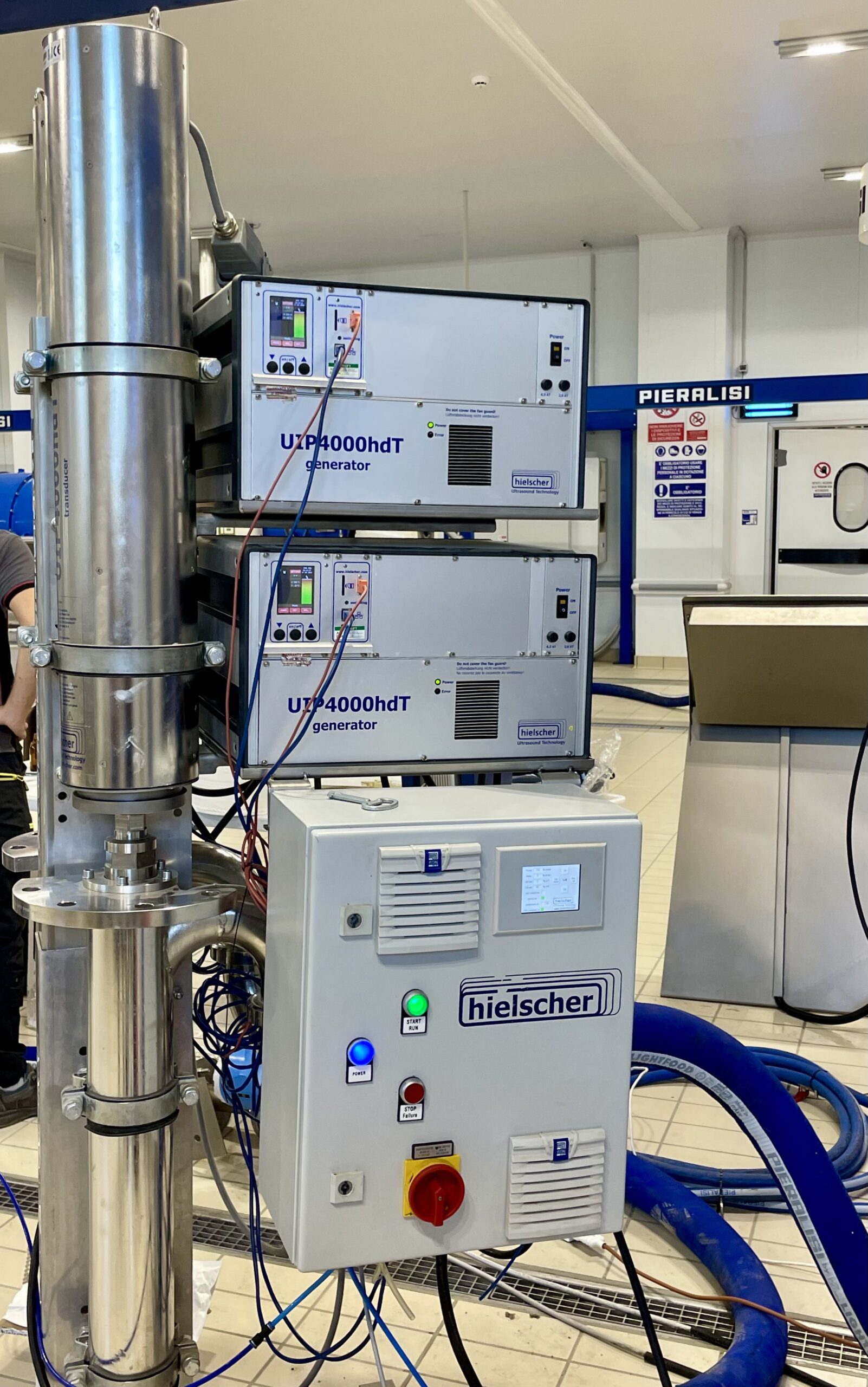
2x industrial sonicator models UIP4000hdT connected to a stainless-steel flow-cell reactor for peptide production.
Frequently Asked Questions about Scaling-Up Ultrasonic Peptide Synthesis
What is ultrasonic peptide synthesis?
Ultrasonic peptide synthesis uses high-intensity sound waves to improve mixing, mass transfer and reaction kinetics during peptide assembly. Acoustic cavitation helps reagents penetrate swollen resin, disperses aggregates and accelerates coupling, deprotection, washing and cleavage steps.
How does ultrasound improve solid-phase peptide synthesis?
In ultrasound-assisted solid-phase peptide synthesis (US-SPPS), sonication improves contact between the resin-bound peptide and dissolved reagents. This can shorten reaction cycles, promote more complete coupling and reduce sequence deletions, particularly when synthesizing hydrophobic, aggregation-prone or otherwise difficult peptides.
Can sonication increase peptide yield and purity?
Sonication can improve conversion, crude yield and purity by promoting uniform reagent distribution and reducing incomplete coupling. The result depends on the peptide sequence, resin, solvent, coupling chemistry and ultrasonic parameters, so each process should be optimized and analytically validated.
Which peptide-synthesis steps can be sonicated?
Ultrasound can assist resin swelling, Fmoc or Boc deprotection, amino-acid coupling, washing, fragment condensation, cyclization and cleavage from the solid support. It can also improve dissolution and mass transfer in liquid-phase and tag-assisted peptide synthesis.
Discover ultrasonic peptide synthesis – for solid-phase peptide synthesis and – liquid-phase TAGGING synthesis!
Is ultrasonic peptide synthesis suitable for difficult sequences?
Yes. Ultrasound is especially useful for hydrophobic and aggregation-prone sequences because cavitation and microstreaming help disrupt on-resin aggregation and improve reagent access to reactive sites. Difficult couplings may still require optimized reagents, repeat coupling or adjusted reaction conditions.
Can ultrasonic peptide synthesis be scaled up?
Ultrasonic peptide synthesis can be transferred from laboratory trials to batch, recirculation or continuous-flow production. Scale-up is achieved by maintaining critical parameters such as amplitude, specific energy, temperature and residence time while increasing ultrasonic power, sonotrode area or the number of processing modules.
What does linear scalability mean in ultrasonication?
Linear scalability means that throughput can increase approximately in proportion to installed ultrasonic power when the required energy per volume and other process conditions remain constant. For example, doubling the effective ultrasonic power can approximately double the flow rate, provided reactor geometry, temperature and product-quality targets are preserved.
Why are Hielscher sonicators suitable for peptide-production scale-up?
Hielscher sonicators cover laboratory, pilot and industrial power ranges using consistent, controllable operating parameters. Their adjustable amplitude, automatic data logging, temperature and pressure monitoring, flow-cell compatibility and modular configurations support reproducible process transfer and reliable production.
Can Hielscher sonicators operate in continuous peptide production?
Yes. Hielscher industrial sonicators can be integrated into recirculation loops and continuous inline flow-cell reactors. These configurations provide controlled residence time and energy input while reducing batch-to-batch variation. Industrial systems are designed for continuous 24/7 operation under demanding production conditions.
Are ultrasonic baths or probe sonicators better for peptide synthesis?
Ultrasonic baths might be convenient for initial screening and simultaneous treatment of small closed vessels. Probe-type sonicators deliver ultrasound directly into the medium, offering higher intensity, better parameter control and greater scalability. Consequently, probes and flow cells are generally preferred for pilot and industrial production.
How is temperature controlled during ultrasonic peptide synthesis?
Because sonication introduces energy into the reaction mixture, effective cooling is essential. Hielscher sonicators are available with jacketed vessels, external heat exchangers, temperature-controlled recirculation and pulsed sonication so that overheating is efficiently prevented. Pluggable temperature sensors and programmable temperature limits allow for reliable temperature monitoring and recording throughout development and production.
How do I select a Hielscher sonicator for peptide synthesis?
Selection depends on batch volume, desired flow rate, solvent, viscosity, solids or resin concentration, required specific energy and production schedule. Laboratory testing establishes the effective process window, after which a Hielscher sonicator, sonotrode and flow-cell configuration can be sized for the intended throughput.
Literature / References
- Merlino, F., Tomassi, S., Yousif, A. M., Messere, A., Marinelli, L., Grieco, P., Novellino, E., Cosconati, S., Di Maro, S. (2019): Boosting Fmoc Solid-Phase Peptide Synthesis by Ultrasonication. Organic Letters, 21(16), 2019. 6378–6382.
- M. Ramya, Veeranjaneyulu Avula, S. Nandeesh, B. Kirankumar, G. Nagendra (2025): TAG assisted and ultrasonication mediated total synthesis of lipobactin. Results in Chemistry, Volume 18, 2025, 102842.
- Silva, R., Franco Machado, J., Gonçalves, K., Lucas, F. M., Batista, S., Melo, R., Morais, T. S., & Correia, J. (2021): Ultrasonication Improves Solid Phase Synthesis of Peptides Specific for Fibroblast Growth Factor Receptor and for the Protein-Protein Interface RANK-TRAF6. Molecules (Basel, Switzerland), 26(23), 7349.
- Raheem, Shvan J; Schmidt, Benjamin W; Solomon, Viswas Raja; Salih, Akam K; Price, Eric W (2020): Ultrasonic-Assisted Solid-Phase Peptide Synthesis of DOTA-TATE and DOTA-linker-TATE Derivatives as a Simple and Low-Cost Method for the Facile Synthesis of Chelator-Peptide Conjugates. ACS Bioconjugate Chemistry, 2020.
- Salvatore Mottola, Alessandra Del Bene, Vincenzo Mazzarella, Roberto Cutolo, Ida Boccino, Francesco Merlino, Sandro Cosconati, Salvatore Di Maro, Anna Messere (2015): Sustainable Ultrasound-Assisted Solid-Phase peptide synthesis (SUS-SPPS): Less Waste, more efficiency. Ultrasonics Sonochemistry, Volume 114, 2025.
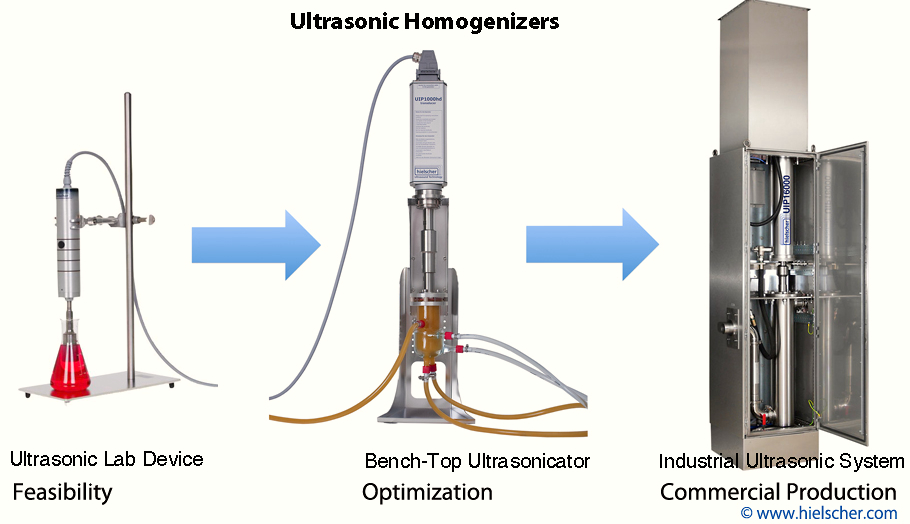
Hielscher Ultrasonics manufactures high-performance ultrasonic homogenizers from lab to industrial size.