Ultrasonic topic: "Chemical synthesis can be significantly improved by sonication"
Chemical synthesis is a chemical reaction with the aim of converting one or more reactants into one or multiple products.
Intense ultrasound waves can be applied to improve chemical reactions (i.e. synthesis and catalysis) – a field known as sonochemistry. The effect of ultrasound on chemical reactions are based on the generation of acoustic cavitation in liquids. Sonication introduces energy into the chemical mixture, produces locally extreme conditions due to cavitation and promotes mass transfer. Thereby, it can greatly enhance chemical reactions such as synthesis (sono-synthesis) and catalysis (sono-catalysis). Ultrasonic energy can induce and accelerate reactions, increase the conversion rate as well as establish alternative synthetic pathways. As a result of that, ultrasound can make synthesis reactions more efficient, faster and environmental-friendlier.
Ultrasonically-assisted synthesis reactions such as the sono-synthesis of hydroxyapatite, silver nanoparticles, Mn3O4nanoparticles and a large variety of core-shell particles have been extensively studied and successfully scaled to industrial sized production.

Found 27 hits. Showing results 25 - 27.
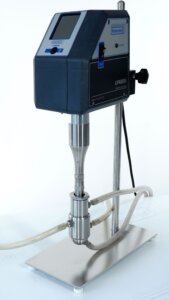
Sonocatalysis – Ultrasonically Assisted Catalysis
Sonocatalysis, or ultrasonically assisted catalysis, is a process that significantly enhances chemical reaction rates and catalyst efficiency by taking advantages of the physical forces of acoustic cavitation. When ultrasound waves propagate through a reaction mixture, they generate microscopic bubbles that…
https://www.hielscher.com/sonocatalysis_catalysis.htm
Sonochemical Reactions and Synthesis
Sonochemistry is the application of ultrasound to chemical reactions and processes. The mechanism causing sonochemical effects in liquids is the phenomenon of acoustic cavitation. Hielscher ultrasonic laboratory and industrial devices are used in a wide range of sonochemical processes. Ultrasonic…
https://www.hielscher.com/sonochem_01.htm
Industry-Specific Ultrasonic Solutions
Hielscher ultrasonic devices are used in many industries, such as renewable fuels & biomass, food & beverage, paint & ink, coatings, wire and cable, or chemical processing. Algae Growth and Algae Oil Extraction Hielscher ultrasonic devices are applied to continuous…
https://www.hielscher.com/industries.htm