Ultrasonic topic: "Ultrasonically improved mass transfer"
Mass transfer is the net movement of mass from one location, usually meaning stream, phase, fraction or component, to another. Mass transfer occurs in many processes, such as solid-liquid and liquid-liquid extraction, catalysis, precipitation, dehydration and many other chemical and biological reactions. Naturally occurring mass transfer can be often very slow and time-consuming, so that mass transfer intensification by mechanical means is applied to accelerate reactions and processes. Efficiency of mass transfer is dependant on the effects on external or internal mass transfer resistance. External mass transfer improvement can be achieved by decreasing the boundary layer thickness. Internal mass transfer improvements are caused by sonication, where ultrasonic waves cause changing pressure fields and micro-mixing within the product.
Power ultrasound is an effective method to create shear forces, turbulences and micro-mixing in liquids and slurries. Acoustic cavitation is used to induce and accelerate chemical reactions due to improved mass transfer between reactants, to break cells and extract intracellular material improving the release of extracts by improving the mass transfer between cell interior and solvent, to improve diffusion coefficients and decrease the boundary layer of diffusion for dewatering and drying processes and many more applications.
Learn more about ultrasonic process intensification due to increased mass transfer!

Found 26 hits. Showing results 25 - 26.
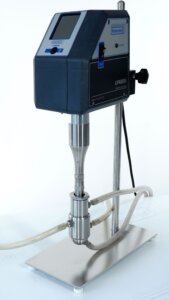
Sonocatalysis – Ultrasonically Assisted Catalysis
Sonocatalysis, or ultrasonically assisted catalysis, is a process that significantly enhances chemical reaction rates and catalyst efficiency by taking advantages of the physical forces of acoustic cavitation. When ultrasound waves propagate through a reaction mixture, they generate microscopic bubbles that…
https://www.hielscher.com/sonocatalysis_catalysis.htm
Ultrasonic Extraction and Preservation
Ultrasonic extraction and preservation utilizes using power ultrasound for the disintegration of cell structures (lysis). Breaking cells with ultrasonics results in highly efficient extraction of intra-cellular compounds as well as microbial inactivation. Due to numerous advantages, ultrasonication is widely used…
https://www.hielscher.com/extraction_01.htm