Ultrasonic topic: "Ultrasonic Deagglomeration"
Deagglomeration describes the process of breaking up or dispersing particles which have agglomerated, aggregated, or formed clusters. Interparticle forces can be classified into two groups: Adhesive forces such as van der Waals, electrostatic and magnetic attraction, mechanical interlocking and chemical bonds require no material bridge between the particles. Solid bridges, capillary bonding forces and immobile
liquid bridges are based on the formation of solid connections between particles.
Ultrasonic deagglomeration and dispersing is a powerful method to break particle agglomerates and aggregates into individual particles and results in uniformly dispersed suspensions. An important application field of ultrasonic dispersers is the dispersion of nanoparticles such as carbon nanotubes, silica, alumina, titanium dioxide or magnetite.
Acoustic cavitation, the working principle behind ultrasonic deagglomeration and milling, creates intense hydraulic shear forces, which overcome the interparticle bondings and promote deagglomeration of agglomerated particles to mono-dispersed nanoparticles.
Read more about ultrasonic dispersing, deagglomeration and wet-milling of nano-particles!

Found 30 hits. Showing results 25 - 30.

Ultrasonic Synthesis of Nanodiamonds
Due to its intense cavitational force, power ultrasound is a promising technique to produce micron- and nano-sized diamonds from graphite. Micro- and nano-crystalline diamonds can be synthesized sonicating a suspension of graphite in organic liquid at atmospheric pressure and room…
https://www.hielscher.com/ultrasonic-synthesis-of-nanodiamonds.htm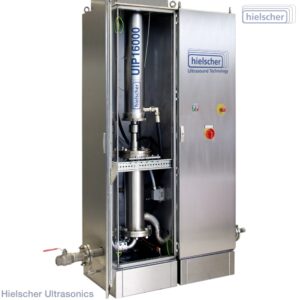
Ultrasonic Wet-Milling: Fine Particles, Precisely Engineered
Hielscher sonicators are efficient milling equipment for high-efficiency particle size reduction, nano-dispersion, and emulsification through controlled, high-intensity ultrasonic cavitation. Engineered for both research and industrial scale, these systems reliably break down agglomerates, refine powders, and create homogeneous suspensions across pharmaceuticals,…
https://www.hielscher.com/mill_01.htm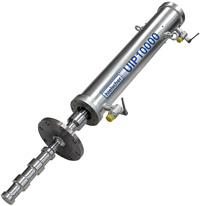
UIP10000 – High Power Ultrasonic Clusters
With its 10,000 watts, the UIP10000 is the second largest ultrasonic processor. It is designed to work in clusters of four or more units, for large volume processing, such as homogenizing, dispersing and deagglomeration. Ultrasonic applications can be scaled up…
https://www.hielscher.com/i10000_p.htm
Ultrasound in Coating Formulation
Various components, such as pigments, fillers, chemical additives, crosslinkers and rheology modifiers go into coating and paint formulations. Ultrasound is an effective means for the dispersion and emulsifying, deagglomeration and milling of such components in coatings. Ultrasound is used in…
https://www.hielscher.com/coatings_01.htm
Ultrasonic Dispersing and Deagglomeration
The dispersing and deagglomeration of solids into liquids is an important application of power ultrasound and probe-type sonicators. Ultrasonic cavitation generates extraordinarily high shear that breaks particle agglomerates into single dispersed particles. Due to its locally focused high shear forces,…
https://www.hielscher.com/disperse.htm
UP400S – Powerful Sonication of Larger Samples
400 Watts ultrasonic power - The UP400S (400W, 24kHz) is a powerful and reliable ultrasonic device for the sonication of larger samples in the lab. Typical application include: Homogenization, deagglomeration, lysis and cell disintegration, protein extraction and the emulsification of…
https://www.hielscher.com/400s_p.htm