Chamomile Extraction – Higher Yields, Better Quality with Sonication
Produce high-quality chamomile extracts faster, more efficiently and with reproducible potency. Hielscher ultrasonic extractors intensify the extraction of chamomile bioactives such as apigenin, flavonoids, phenolic compounds, polysaccharides and essential oil constituents. Whether you manufacture herbal teas, functional beverages, tinctures, dietary supplements, cosmetic actives or botanical ingredients, sonication helps you achieve higher yields, shorter extraction times and consistent extract quality.
Ultrasonic Chamomile Extraction for Food, Supplements and Cosmetics
Using high-intensity ultrasound, Hielscher sonicators create acoustic cavitation in the solvent–plant slurry. This disrupts chamomile flower tissue, improves solvent penetration and accelerates mass transfer. The result is a mild, non-thermal extraction process that can be precisely controlled and scaled from laboratory testing to continuous industrial production.
- Higher extract yield: Efficient release of flavonoids, phenolics, aroma compounds and other chamomile actives.
- Shorter processing time: Replace long maceration with fast ultrasonic extraction.
- Food-, supplement- and cosmetic-grade solvents: Water, ethanol, aqueous ethanol, glycerine, oils and other suitable solvents.
- Excellent process control: Adjustable amplitude, temperature, pressure, energy input, flow rate and residence time.
- Reliable scale-up: From small R&D batches to pilot trials and industrial inline extraction.
Tell us your raw material, solvent, batch size or target throughput. We will recommend the most suitable Hielscher sonicator and process setup for your chamomile extraction.
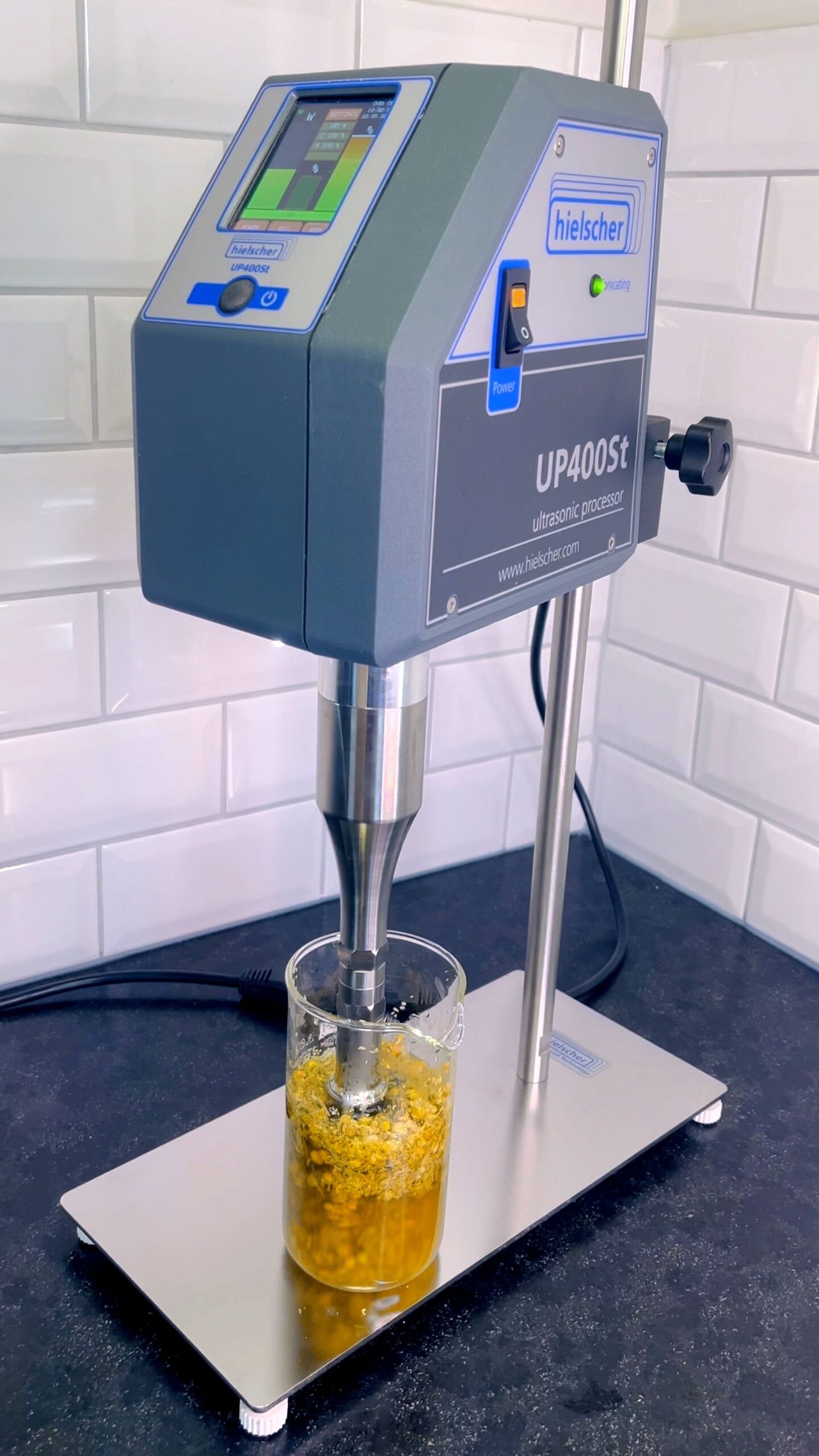
Sonicator UP400St extracting bioactive compounds from chamomile
Why Sonication Improves Chamomile Extraction
In conventional botanical extraction, the solvent must slowly diffuse into the plant particles, dissolve the target compounds and diffuse back out into the bulk liquid. This process can take hours or days and often requires elevated temperatures or large solvent volumes. Sonication intensifies every step of this extraction mechanism.
During ultrasonic extraction, cavitation physically disrupts the botanical structure and reduces the diffusion boundary layer around plant particles. The solvent penetrates faster into the chamomile flower material, while dissolved bioactives are transported rapidly into the surrounding liquid. This makes sonication especially valuable for producers who need high extraction efficiency, short batch times and consistent extract quality.
Key advantages of ultrasonic chamomile extraction include:
- Higher extraction yields: More complete release of flavonoids, phenolics, essential oil constituents and other plant actives.
- Shorter processing times: Extraction that may otherwise require long maceration can often be completed much faster.
- Mild, non-thermal processing: Reduced heat exposure helps preserve delicate aroma compounds and temperature-sensitive phytochemicals.
- Lower solvent demand: Improved mass transfer can reduce the required solvent volume or extraction cycles.
- Reproducible quality: Amplitude, energy input, temperature, pressure, flow rate and residence time can be controlled.
- Scalable production: Hielscher sonicators can be used from R&D to pilot testing and continuous inline manufacturing.
As a process-intensifying technology for releasing bioactive compounds from botanicals, ultrasonic extraction is broadly used in food, nutritional supplements and pharmaceutical applications.
Choosing the Right Solvent for Chamomile Extraction
Chamomile contains both polar and non-polar compounds. Therefore, the ideal solvent depends on the target extract profile and final product application. Sonication can be used with water, ethanol, aqueous ethanol, glycerine, vegetable oils and other food- or cosmetic-grade solvents. Ultrasonication is compatible with a wide range of botanical materials and solvents, including water, ethanol, glycerine and vegetable oils.
Aqueous Ethanol: Broad-Spectrum Chamomile Extraction
For many commercial chamomile extracts, aqueous ethanol is the most versatile solvent system. For hydro-ethanolic extracts, a water–ethanol mixture is used to dissolve a broad range of polar and moderately lipophilic chamomile constituents. Water supports the extraction of hydrophilic compounds such as certain phenolic acids, polysaccharides and flavonoid glycosides, while ethanol improves the solubility of less polar compounds, including apigenin aglycone and many aroma-related constituents.
Apigenin is widely recognized as a poorly water-soluble flavonoid, while ethanol–water mixtures are frequently investigated as more suitable food- and pharma-compatible solvent systems for apigenin handling and recovery.
For food, supplement and cosmetic producers, aqueous ethanol offers several advantages:
- Broad phytochemical spectrum
- Food-grade and widely accepted solvent system
- Efficient extraction of flavonoids and phenolics
- Adjustable polarity by changing the ethanol/water ratio
- Easy downstream removal or concentration by evaporation
With sonication, aqueous ethanol becomes even more effective. Ultrasonic cavitation increases solvent penetration into the chamomile particles and accelerates dissolution of target molecules. This allows processors to optimize ethanol concentration, extraction time and temperature for a specific target: a mild chamomile flavor extract, a standardized apigenin-rich extract or a broad-spectrum botanical active for cosmetics.
Water: Clean-Label Chamomile Extracts for Beverages and Foods
 Water is the most natural solvent for chamomile extraction and is widely used for teas, infusions, beverages and clean-label food products. Water is especially suitable for extracting hydrophilic components, including certain flavonoid glycosides, phenolic acids, polysaccharides and water-soluble flavor compounds. However, water alone is less efficient for poorly water-soluble compounds such as apigenin aglycone and many lipophilic essential oil constituents.
Sonication significantly improves aqueous chamomile extraction. By breaking up the flower tissue and enhancing mass transfer, ultrasound helps water extract bioactives more rapidly and more completely than simple steeping. This is highly relevant for beverage manufacturers, tea extract producers and clean-label formulators who want to avoid organic solvents while still increasing extract strength and process efficiency.
Ultrasonic water extraction is particularly attractive when the final product is:
- Ready-to-drink chamomile beverage
- Herbal tea concentrate
- Functional water-based extract
- Alcohol-free supplement extract
- Cosmetic hydrosol-style botanical extract
Because sonication is a mechanical, non-thermal process, it can support high-quality aqueous extraction without relying on excessive heat. This helps preserve chamomile’s delicate floral profile and reduces the risk of cooked or degraded sensory notes.
Ethanol: Potent Botanical Extracts and Tinctures
Ethanol is a strong solvent for many chamomile bioactives and is especially useful when the target extract should contain a higher proportion of less polar flavonoids, phenolics and aroma-active constituents. Ethanol is widely used in botanical tinctures, supplement extracts and cosmetic actives because it is effective, food-compatible and easy to remove during concentration.
Pure ethanol is less polar than water and may not extract the full spectrum of hydrophilic chamomile constituents as effectively as aqueous ethanol. Therefore, many producers use ethanol–water blends instead of absolute ethanol. Still, ethanol-rich extraction can be beneficial when the goal is a concentrated extract with higher levels of apigenin aglycone, essential oil components and lipophilic actives.
Sonication enhances ethanol extraction by reducing extraction time and improving the release of compounds trapped within the flower structure. For supplement producers, this means more efficient production of high-strength tinctures, liquid extracts or dried extract intermediates. For cosmetics manufacturers, ethanol-based ultrasonic extraction can generate potent botanical actives for serums, toners, gels and emulsions.
Oil Extraction: Chamomile Actives for Cosmetic and Topical Formulations
 Vegetable oils such as olive oil, sunflower oil, jojoba oil or MCT oil are excellent carriers for lipophilic chamomile constituents. Oil extraction is especially relevant for natural cosmetics, skin-care oils, balms, massage oils and topical formulations. Lipophilic compounds such as essential oil constituents, bisabolol-related components and other non-polar aroma fractions are well suited to oil-based extraction.
However, oil is not the preferred solvent when the primary target is apigenin or other polar flavonoid derivatives. Apigenin has poor water solubility but is not typically treated as an oil-soluble botanical marker in the same way as terpenes or essential oil components. For apigenin-focused extracts, aqueous ethanol or ethanol-rich solvents are usually more appropriate.
Sonication makes oil-based chamomile extraction more efficient by dispersing plant particles thoroughly in the oil and increasing contact between the solvent and the botanical surface. This can shorten infusion times, increase extract intensity and improve batch-to-batch reproducibility. For cosmetic producers, ultrasonic oil extraction provides a clean, solvent-free route to chamomile-infused oils without long maceration times.
Sonication gives you full flexibility in solvent selection, including water, aqueous ethanol, pure ethanol and other common extraction media. Through mechanical cell disruption, ultrasound releases bioactive compounds rapidly into the liquid, creating potent full-spectrum extracts for pharmaceuticals, food, supplements and cosmetics.
Tell us your raw material, solvent, batch size or target throughput. We will recommend the best Hielscher sonicator and process setup for your chamomile extraction.
Apigenin and Chamomile Bioactives: Solubility Matters
A high-quality chamomile extract starts with a clear understanding of compound polarity. Chamomile is not a single-compound raw material; it is a complex botanical matrix. The solvent must be selected according to the desired active profile.
Apigenin and its derivatives are among the most important chamomile flavonoids. Apigenin aglycone is poorly soluble in water, which is why water alone may not maximize apigenin recovery. Ethanol and aqueous ethanol improve extraction performance for less water-soluble flavonoids, while water contributes to the extraction of more polar glycosides and hydrophilic compounds. Scientific literature describes apigenin as a poorly water-soluble bioflavonoid and reports solubility studies in ethanol, water and ethanol–water systems.
For practical chamomile extraction, this means:
- Water is ideal for mild, clean-label, hydrophilic extracts.
- Aqueous ethanol is the best all-round solvent for broad-spectrum chamomile extracts.
- Ethanol is useful for potent tinctures and flavonoid-rich extracts.
- Vegetable oils are ideal for lipophilic cosmetic extracts and topical formulations.
Sonication does not change the fundamental solubility of a molecule, but it dramatically improves the extraction kinetics. Ultrasound helps the solvent reach the target compounds faster and more completely. This is why ultrasonic extraction is so powerful: it combines the chemistry of the right solvent with the physical intensification of acoustic cavitation.
Hielscher Sonicators: From Lab Tests to Industrial Chamomile Extracts
 A major advantage of Hielscher ultrasonic technology is linear scalability. Producers can start with small laboratory trials to determine the best solvent, particle size, solid loading, amplitude, temperature and extraction time. Once the optimal extraction parameters are defined, the process can be scaled linearly to pilot and industrial production using larger Hielscher ultrasonic processors and flow-cell reactors.
Hielscher offers sonicators for laboratory, bench-top, pilot and industrial processing. The company’s industrial systems are designed for demanding continuous operation, and Hielscher highlights digital operation, process control, automatic data recording, remote control and robust industrial design for its hdT systems.
For commercial chamomile extraction, this means:
- Straightforward feasibility testing
- Reliable parameter optimization
- Batch or continuous inline processing
- Controlled temperature management
- Reproducible extract quality
- Industrial throughput with robust sonication equipment
- Lower scale-up risk from R&D to production
The Hielscher UIP2000hdT, for example, is a 2,000 watts probe-type ultrasonicator for bench-top and industrial liquid processing, with applications including extraction, emulsification, dispersing, homogenization and sonochemical reactions. The Hielscher model UIP16000hdT provides 16,000 watts ultrasonic power for large-volume processing.
Better Chamomile Extracts with Ultrasonic Process Intensification
Chamomile extraction is not only about dissolving plant compounds. It is about producing a consistent, high-value botanical ingredient that meets the requirements of modern food, supplement and cosmetic markets. Sonication gives manufacturers a decisive advantage by combining mild processing with high extraction efficiency.
With the right solvent and the right ultrasonic process parameters, producers can tailor chamomile extracts for specific applications: clean-label water extracts for beverages, broad-spectrum aqueous ethanol extracts for supplements, ethanol-rich tinctures for potent botanicals or oil-based infusions for natural cosmetics. Hielscher sonicators provide the ultrasonic power, process control and scale-up pathway required to turn chamomile into a high-quality commercial extract.
For manufacturers seeking higher yields, better quality and faster processing, ultrasonic chamomile extraction with Hielscher sonicators is the superior extraction technology.
The table below gives you an indication of the approximate processing capacity of our ultrasonicators:
| Batch Volume | Flow Rate | Recommended Devices |
|---|---|---|
| 1 to 500mL | 10 to 200mL/min | UP100H |
| 10 to 2000mL | 20 to 400mL/min | UP200Ht, UP400St |
| 0.1 to 20L | 0.2 to 4L/min | UIP2000hdT |
| 10 to 100L | 2 to 10L/min | UIP4000hdT |
| 15 to 150L | 3 to 15L/min | UIP6000hdT |
| n.a. | 10 to 100L/min | UIP16000hdT |
| n.a. | larger | cluster of UIP16000hdT |
Chamomile Extraction for Food and Beverage Producers
Food and beverage producers require extracts that are safe, consistent, flavorful and economically viable. Chamomile extracts are used in herbal teas, functional beverages, syrups, confectionery, dairy alternatives, relaxation drinks and flavor systems. The challenge is to produce an extract with a clean taste, appealing color and reliable active content without excessive heat or long extraction cycles.
Ultrasonic extraction offers a strong processing advantage. Water or aqueous ethanol can be used to produce food-grade chamomile extracts with higher yield and shorter processing times. Since sonication is non-thermal, processors can protect delicate aroma components while avoiding over-extraction of unwanted bitter or harsh notes.
For industrial beverage applications, Hielscher sonicators can be integrated into batch tanks or continuous flow-through systems. This allows producers to process larger volumes with controlled amplitude, residence time and temperature. Hielscher’s scale-up concept supports development at small scale and transfer to larger industrial systems while preserving the same core sonication mechanism.
Chamomile Extraction for Supplement Manufacturers
Supplement producers often focus on potency, standardization and reproducibility. Chamomile extracts may be marketed as liquid extracts, tinctures, powders, capsules, tablets or functional ingredient concentrates. For these applications, process control is critical: the same raw material must produce a consistent extract profile from batch to batch.
Hielscher sonicators give manufacturers direct control over important extraction parameters such as amplitude, energy input, temperature, pressure, solid-to-liquid ratio, flow rate and extraction time. This makes ultrasonic extraction suitable for process optimization and quality-by-design approaches.
For apigenin-rich chamomile extracts, aqueous ethanol is often a preferred solvent because it balances polarity and food-grade acceptability. Sonication helps maximize release of flavonoids and other bioactives while minimizing processing time. The result is a more efficient extraction process with improved yield and a clear route from laboratory trials to commercial production.
Chamomile Extraction for Cosmetic Producers
Chamomile is a popular cosmetic ingredient for skin-soothing, botanical positioning and natural formulation concepts. Chamomile extracts are used in creams, lotions, serums, shampoos, conditioners, after-sun products, baby care products, cleansing products and massage oils.
Cosmetic producers benefit from the solvent flexibility of sonication. Depending on the formulation, chamomile can be extracted into aqueous ethanol, water, glycerine, propylene glycol or oils. Oil-based ultrasonic chamomile extraction is particularly attractive for anhydrous balms, facial oils and natural skin-care formulations, while hydroalcoholic extracts are useful for gels, toners and emulsions.
Sonication also supports cosmetic production beyond extraction. Hielscher ultrasonic processors are used for emulsification, homogenization and dispersion, which means the same ultrasonic platform can support multiple liquid-processing steps in cosmetic manufacturing. Internal Hielscher material highlights cosmetics among the industries served by ultrasonic liquid processing and identifies emulsions, actives and homogenization as relevant application fields.

Hielscher Ultrasonics manufactures high-performance ultrasonic homogenizers for mixing applications, dispersion, emulsification and extraction on lab, pilot and industrial scale.
Frequently Asked Questions
What is ultrasonic chamomile extraction?
Ultrasonic chamomile extraction is a process that uses high-intensity ultrasound to extract bioactive compounds from chamomile flowers. Acoustic cavitation disrupts plant cells, improves solvent penetration and accelerates mass transfer, resulting in faster extraction and higher yield compared with conventional maceration or steeping.
Why is sonication effective for chamomile extraction?
Sonication is effective because it mechanically opens the chamomile flower matrix and reduces diffusion limitations. This allows solvents such as water, ethanol, aqueous ethanol or oils to access target compounds more efficiently. The process is mild, controllable and suitable for heat-sensitive botanical ingredients.
Which solvent is best for chamomile extraction?
The best solvent depends on the target extract. Water is ideal for clean-label hydrophilic extracts and beverages. Aqueous ethanol is the best all-round solvent for broad-spectrum chamomile extracts. Ethanol is useful for tinctures and flavonoid-rich extracts. Vegetable oils are suitable for lipophilic cosmetic extracts and topical formulations.
Can chamomile be extracted with water only?
Yes. Water can be used to produce chamomile infusions, tea concentrates, beverages and alcohol-free extracts. However, water is less efficient for poorly water-soluble compounds such as apigenin aglycone. Ultrasonic extraction improves aqueous extraction by increasing mass transfer and releasing water-soluble bioactives more efficiently.
Can ultrasonic extraction increase apigenin yield?
Ultrasonic extraction can improve the release of apigenin-containing compounds from chamomile flowers by disrupting the plant matrix and accelerating solvent access. For apigenin-focused extracts, aqueous ethanol or ethanol-rich solvents are typically more suitable than water alone.
Is ultrasonic chamomile extraction suitable for food products?
Yes. Ultrasonic extraction can be performed with food-grade solvents such as water and ethanol. It is suitable for herbal teas, beverage concentrates, functional drinks, flavor extracts and other food applications where mild processing, clean taste and reproducible quality are important.
Is ultrasonic chamomile extraction suitable for dietary supplements?
Yes. Supplement manufacturers use ultrasonic extraction to produce tinctures, liquid extracts, concentrates and dried extract intermediates. Sonication supports process control, standardization and efficient recovery of flavonoids, phenolics and other chamomile bioactives.
Is ultrasonic chamomile extraction suitable for cosmetics?
Yes. Chamomile can be ultrasonically extracted into water, aqueous ethanol, glycerine, propylene glycol or vegetable oils for cosmetic applications. These extracts are suitable for creams, lotions, serums, toners, shampoos, balms, massage oils and natural skin-care formulations.
Does sonication heat the chamomile extract?
Ultrasonic extraction is a mechanical, non-thermal process. Some process heat can occur due to energy input, but temperature can be controlled with cooling, flow-through reactors and optimized processing parameters. This makes sonication suitable for temperature-sensitive botanical compounds and delicate aroma profiles.
Can ultrasonic chamomile extraction be scaled to industrial production?
Yes. Hielscher ultrasonic extractors are available from laboratory scale to industrial production scale. Processes developed in the lab can be transferred to larger ultrasonic systems and continuous flow-cell reactors, enabling reliable scale-up for commercial chamomile extract manufacturing.
What are the main benefits of chamomile?
Chamomile is valued for its mild calming, digestive, antioxidant, anti-inflammatory and skin-soothing properties. Its flavonoids, terpenoids and phenolic compounds contribute to relaxation support, gastrointestinal comfort, irritation reduction and protection against oxidative stress.
What is German chamomile called?
German chamomile is botanically called Matricaria chamomilla L. It is also known as Matricaria recutita or blue chamomile. The term blue chamomile refers to the blue-colored chamazulene that can form in its essential oil during distillation.
What is the difference between Roman, Egyptian and German chamomile?
German chamomile, Matricaria chamomilla, is an annual plant rich in flavonoids such as apigenin derivatives and essential oil constituents such as bisabolol and chamazulene. Roman chamomile, Chamaemelum nobile, is a perennial species with a sweeter apple-like aroma and an essential oil profile dominated more by esters. Egyptian chamomile usually refers to high-quality Matricaria chamomilla grown in Egypt; it is a geographic origin, not a separate botanical species.
What is a hydro-ethanolic chamomile extract?
A hydro-ethanolic chamomile extract is produced with a mixture of water and ethanol. This solvent blend combines the polarity of water with the solvent strength of ethanol, allowing extraction of a broader phytochemical spectrum than water alone, including polar compounds, flavonoid glycosides and moderately lipophilic constituents such as apigenin.
What are the main phytochemicals in chamomile?
The main phytochemicals in chamomile include flavonoids such as apigenin, luteolin, quercetin and their glycosides; phenolic acids; coumarins such as herniarin and umbelliferone; and essential oil constituents such as α-bisabolol, bisabolol oxides, matricin and chamazulene.
Read how sonication is used in phytochemistry!
Literature / References
- Oktaviani, N. M. D., Larasati, I. D., Nugroho, A. W., Setyaningsih, W., & Palma, M. (2024): Ultrasound-Assisted Extraction of L-Tryptophan from Chamomile Flower: Method Development and Application for Flower Parts Characterization and Varietal Difference. Trends in Sciences, 21(3), 2024. 7348.
- Dent M., Dragović-Uzelac V., Elez Garofulić I., Bosiljkov T., Ježek D., Brnčić M. (2015): Comparison of Conventional and Ultrasound Assisted Extraction Techniques on Mass Fraction of Phenolic Compounds from sage (Salvia officinalis L.). Chem. Biochem. Eng. Q. 29(3), 2015. 475–484.
- Petigny L., Périno-Issartier S., Wajsman J., Chemat F. (2013): Batch and Continuous Ultrasound Assisted Extraction of Boldo Leaves (Peumus boldus Mol.). International Journal of Molecular Science 14, 2013. 5750-5764.
- Larasati, I.D.; Oktaviani, N.M.D.; Lioe, H.N.; Estiasih, T.; Palma, M.; Setyaningsih, W. (2023): Optimization of Ultrasound-Assisted Cold-Brew Method for Developing Roselle (Hibiscus sabdariffa L.)-Based Tisane with High Antioxidant Activity. Beverages, 9, 58; 2023.
- Turrini, F.; Beruto, M.; Mela, L.; Curir, P.; Triglia, G.; Boggia, R.; Zunin, P.; Monroy, F. (2021): Ultrasound-Assisted Extraction of Lavender (Lavandula angustifolia Miller, Cultivar Rosa) Solid By-Products Remaining after the Distillation of the Essential Oil. Applied Sciences 11, 2021.
https://doi.org/10.15255/CABEQ.2015.2168
- high efficiency
- state-of-the-art technology
- reliability & robustness
- adjustable, precise process control
- batch & inline
- for any volume
- intelligent software
- smart features (e.g., programmable, data protocoling, remote control)
- easy and safe to operate
- low maintenance
- CIP (clean-in-place)
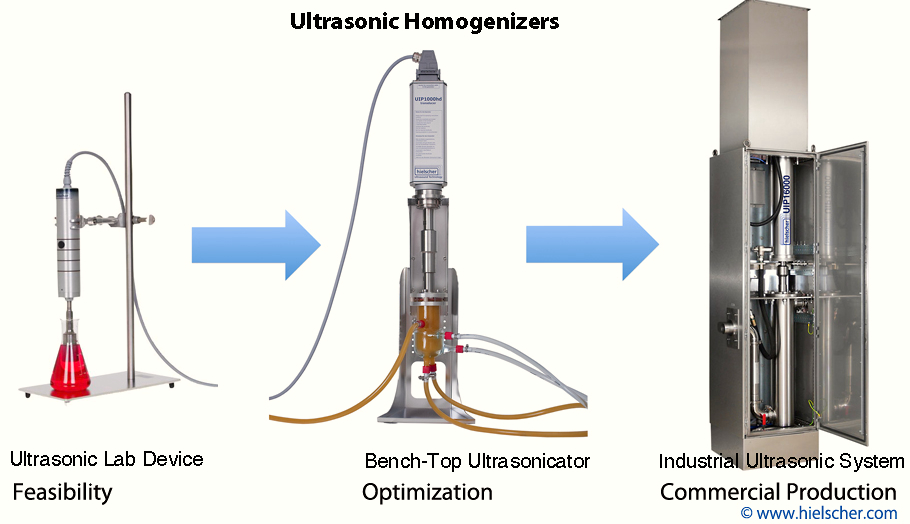
Hielscher Ultrasonics manufactures high-performance ultrasonic homogenizers from lab to industrial size.