Sonication Enables a New Level of Control in Cellulose Nanocrystal Self-Assembly
, Kathrin Hielscher, published in Hielscher News
A brand-new study shows sonication as a powerful tool for controlling how cellulose nanocrystals (CNCs) self-assemble into cholesteric liquid crystal structures. In this 2026 published study, researchers show that applying power ultrasound does more than disperse CNC aggregates – it directly shifts the onset of ordering and kinetic arrest, allowing the helical pitch evolution to be tuned during drying. By tracking CNC assembly inside spherical droplets in real time, the work reveals a novel platform for programming structurally colored CNC materials with high reproducibility. These insights highlight the industrial relevance of scalable ultrasonic processing for reliable CNC synthesis and advanced photonic applications.
What are Cellulose Nanocrystals?
Cellulose nanocrystals (CNCs) are one of the most exciting bio-based nanomaterials emerging for sustainable coatings, photonic pigments, packaging, and advanced composites. Their unique ability to spontaneously self-organize into cholesteric liquid crystal structures means they can generate brilliant structural colors – without dyes or synthetic additives.

Sonication is a powerful processing tool for modulating how cellulose nanocrystals (CNCs) self-assemble into cholesteric liquid crystalline structures.
But there’s a challenge: getting CNCs to assemble reliably and reproducibly at industrial scale.
Now, new research shows that one of the most powerful levers for controlling CNC self-assembly may be something surprisingly simple: sonication.
A recent study from Utrecht University (Saraiva et al., 2026) reveals that power ultrasound doesn’t just disperse CNCs – it fundamentally tunes how they organize, when they arrest into gels, and how their optical pitch evolves during drying.
The Science of CNC Self-Assembly: from Suspension to Structural Color
When CNCs are dispersed in water, they behave like rigid rod-shaped colloids. Once their concentration rises above a critical threshold, they begin forming a cholesteric liquid crystalline phase, where the rods twist into a helical arrangement.
As water evaporates, this helical pitch compresses, eventually producing solid materials that reflect visible light through Bragg-like structural coloration.
Most studies observe this process in flat films. But the Utrecht team used a more revealing platform: micron-sized water-in-oil droplets, allowing real-time visualization of CNC ordering in spherical confinement.
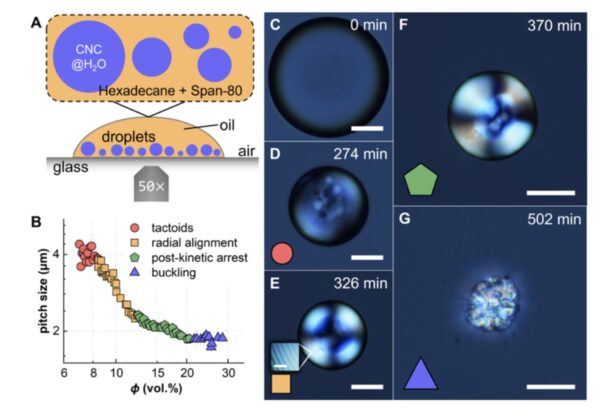
(A) CNC self-assembly in an evaporating water droplet dispersed in hexadecane/Span-80. (B) Cholesteric pitch evolution versus CNC volume fraction for a sample sonicated at 8 J/mL with 150 mmol/kg NaCl, showing four stages: tactoids, radial alignment, kinetic arrest, and buckling. (C–G) Crossed-polarized micrographs of the assembly pathway: (C) isotropic phase, (D) tactoid growth, (E) coalescence and radial alignment, (F) kinetic arrest, (G) final buckling. Scale bars: 50 µm; inset: 5 µm. Study and image: ©Saraiva et al., 2026
The researchers tracked CNC assembly through four distinct stages:
- isotropic suspension
- tactoid nucleation
- cholesteric coalescence and alignment
- kinetic arrest and buckling
Sonication: Not Just Mixing, but Structural Programming

Probe-type sonication is often used in nanomaterial processing simply to break up aggregates. But this study demonstrates that ultrasound plays a far deeper role in CNC systems.
The researchers prepared CNC suspensions and applied controlled power ultrasound doses using a Hielscher UP200St sonicator with a 7 mm titanium probe (sonotrode S26d7).
They found that increasing sonication dose:
- increases cholesteric pitch size at a given concentration
- delays the onset of cholesteric ordering
- shifts kinetic arrest to higher volume fractions
In other words, sonication changes the “assembly clock” of CNCs.
The team attributes this to fragmentation of chiral bundles and aggregates, reducing the effective twisting strength needed for early cholesteric ordering.
Two Regimes of Self-Assembly: Before and After Arrest
One of the study’s most important contributions is identifying two distinct scaling regimes:
Pre-arrest regime: fast structural evolution
Before gelation, CNC tactoids can grow, merge, and reorganize dynamically. During this stage, pitch decreases rapidly.
The researchers quantified this with an exponent ε₁, showing that sonication dramatically accelerates pitch reduction dynamics:
ε₁ shifts from −1.14 to −2.46 as ultrasound dose increases
This confirms that sonication is not merely mechanical dispersion – it directly reshapes the self-assembly pathway.
Post-arrest regime: universal compression scaling
After kinetic arrest, all samples converge to the same scaling law:
ε₂ ≈ −1/3
This reflects a purely geometric compression effect governed by droplet shrinkage, not particle rearrangement.
This universality is crucial for industry: once arrest occurs, CNC structure becomes locked in.

Droplet surface area plotted over time for droplets
with varying salt and sonication levels. Linear fits (dashed
lines) follow the D2 law.
Study and image: ©Saraiva et al., 2026
Why this Matters for Industrial CNC Production
For CNC-based materials to succeed commercially–in photonic coatings, biodegradable plastics, rheology modifiers, or high-strength composites–manufacturers need:
- reproducible self-assembly
- predictable gelation windows
- scalable dispersion control
- tunable optical and mechanical outcomes
This study highlights that both salt and sonication shift the tactoid annealing window and arrest concentration, meaning processing conditions directly determine final material performance.
In highly salted systems, tactoids may gel within minutes, leaving little time for ordering – an industrial risk if not controlled.
Sonication, by contrast, offers a clean physical tool for delaying arrest and improving process flexibility.
Sonication as a Scalable Industrial Lever
In the lab, tip sonicators like the UP200St provide precise energy dosing. But in manufacturing, the real advantage is that ultrasound is one of the few nanomaterial processing technologies that is:
- linearly scalable from R&D to production
- controllable by energy per volume (J/mL)
- compatible with continuous flow operation
- already used in industrial dispersions worldwide
This makes sonication uniquely suited for reliable CNC synthesis and formulation, where batch-to-batch reproducibility is essential.

TEM image of “Never Dried Cotton” (NDC) submitted to enzymatic hydrolysis and sonicated with Hielscher’s UP400S for 20 minutes. [Bittencourt et al. 2008]
Industrial-Grade Sonication Solutions from Hielscher Ultrasonics
Hielscher Ultrasonics provides the full range of ultrasound systems needed to translate CNC self-assembly control from bench to plant scale:
- Lab sonicators such as the UP200St for formulation development and pilot trials
- Mid-scale ultrasonic processors (e.g. UIP1000hdT) for kilo-scale CNC dispersions
- Industrial flow-through systems (e.g. UIP6000hdT) delivering consistent energy input at ton-scale
Because CNC self-assembly is extremely sensitive to morphology, bundling, and ionic environment, industrial-grade ultrasonic processing becomes a key enabling technology for:
- photonic CNC pigments
- structurally colored sustainable coatings
- high-performance cellulose nanocomposites
- reproducible rheology control in bio-based formulations
The Takeaway: Sonication Tunes CNC Self-Assembly
This work establishes droplet confinement as a quantitative platform for studying CNC self-assembly kinetics and demonstrates that sonication is not just a preparation step – it is a design parameter.
By tuning ultrasonic energy, manufacturers can shift the onset of ordering, control kinetic arrest, and ultimately program the optical and mechanical properties of CNC-based materials.
As the authors conclude, sonication modifies CNC morphology rather than evaporation kinetics, confirming sonciation as a direct structural lever.
For industry, that means one thing:
Sonication brings CNC self-assembly under scalable, reproducible control – opening the door to next-generation sustainable photonic materials.
Literature / References
- Diogo Vieira Saraiva, Anne Meike Hogeweg, Lisa Tran (2026): Tuning cholesteric cellulose nanocrystal self-assembly in spherical confinement via salt and sonication. arXiv Soft Condensed Matter (cond-mat.soft); arXiv:2601.07429
- Bittencourt, Edison (2011): Preliminary Studies on the Production of Nanofibrils of Cellulose from Never Dried Cotton, Using Eco-Friendly Enzymatic Hydrolysis and High-Energy Sonication. 3rd Int’l. Workshop: Advances in Cleaner Production. Sao Paulo, Brazil, May 18th – 20th 2011.
- Mohamed, Yasser; El-Gamal, Hassan; Zaghloul, Moustafa Mahmoud (2018): Micro-hardness behavior of fiber reinforced thermosetting composites embedded with cellulose nanocrystals. Alexandria Engineering Journal 57, 2018
- Jamileh Shojaeiarani, Dilpreet Bajwa, Greg Holt (2020): Sonication amplitude and processing time influence the cellulose nanocrystals morphology and dispersion. Nanocomposites 6:1, 2020. 41-46.
Frequently Asked Questions
What are the Applications of Cellulose Nanocrystals?
Cellulose nanocrystals are used in a wide range of applications including high-strength and lightweight nanocomposites, rheology modifiers, barrier coatings, biodegradable packaging, drug delivery systems, sensors, and photonic materials that display structural color. Their renewable origin and tunable self-assembly make them especially attractive for sustainable advanced materials.
What are the Material Properties of Cellulose Nanocrystals?
Cellulose nanocrystals exhibit high axial stiffness and strength, low density, high aspect ratio, large specific surface area, and surface charge arising from sulfate or carboxyl groups. They show liquid crystalline behavior in suspension, form percolating networks at higher concentrations, and can assemble into chiral nematic (cholesteric) structures with optically active properties.
What Role Plays Emulsification in the Self-Assembly of CNCs?
Emulsification provides geometric confinement that strongly influences CNC self-assembly by imposing spherical boundary conditions and uniform volumetric concentration during solvent removal. In water-in-oil droplets, emulsification enables controlled evaporation, promotes radial alignment of cholesteric layers, and allows direct observation and tuning of out-of-equilibrium assembly pathways that are difficult to resolve in planar systems.
What are Tactoids?
Tactoids are birefringent, spindle-shaped liquid crystalline domains that nucleate from an initially isotropic CNC suspension once a critical concentration is reached. They represent an intermediate self-assembly stage, growing and coalescing before forming a continuous cholesteric phase and eventually undergoing kinetic arrest during drying.

Hielscher Ultrasonics manufactures high-performance ultrasonic homogenizers from lab to industrial size.