Producing Biodegradable Nanospheres
Biodegradable micro- and nanospheres can be produced in a continuous, contact- and contamination-free process that can be readily run under sterile conditions.
Introduction
Biodegradable micro- and nanospheres (MS, NS) made of poly(lactide-coglycolide) (PLGA) or other materials are very potent drug and antigen delivery systems with inherent potential for drug and antigen targeting. Present methods to produce PLGA NS are typical batch processes and suffer from difficulties of upscaling under sterile conditions. Here, we present a novel and elegant method to produce PLGA nano-spheres in a continuous, contact- and contamination-free process that can be readily run under sterile conditions. During the entire manufacturing process, the product is in direct contact only with sterile glass and Teflon® tubes. The process can be run in a closed system to prevent any environmental contamination.
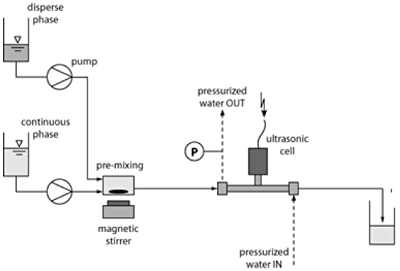
Scheme of setup for a contamination-free synthesis of nanparticles using the Hielscher non-contact sonication flow-cell Dmini
Method of Ultrasonic Contact-Free Nano-Sphere Production
PLGA50:50 nanoparticles (Resomer® RG503H, Boehringer Ingelheim) were produced using a modified solvent extraction/evaporation process. PLGA dissolved in dichloromethane (2 or 5%) was dispersed in aqueous 0.5% (w/w) PVA-solution by means of the novel experimental set-up involving a contact-free flow-through ultrasonication cell Dmini. The coarse O/W-dispersion was first premixed by a magnetic stirrer and then homogenized in the contact-free ultrasonic flow-through cell Dmini (flow rates of O- and W-phases were at 1:8). The initially formed PLGA-solvent nanodroplets gradually solidified during the passage in the tubes to become PLGA nanoparticles. Final hardening of the particles was achieved in a larger volume of 0.5% PVA solution.
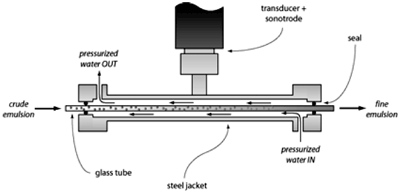
Ultrasonic non-contact flow cell Dmini for contamination-free nanoparticle synthesis
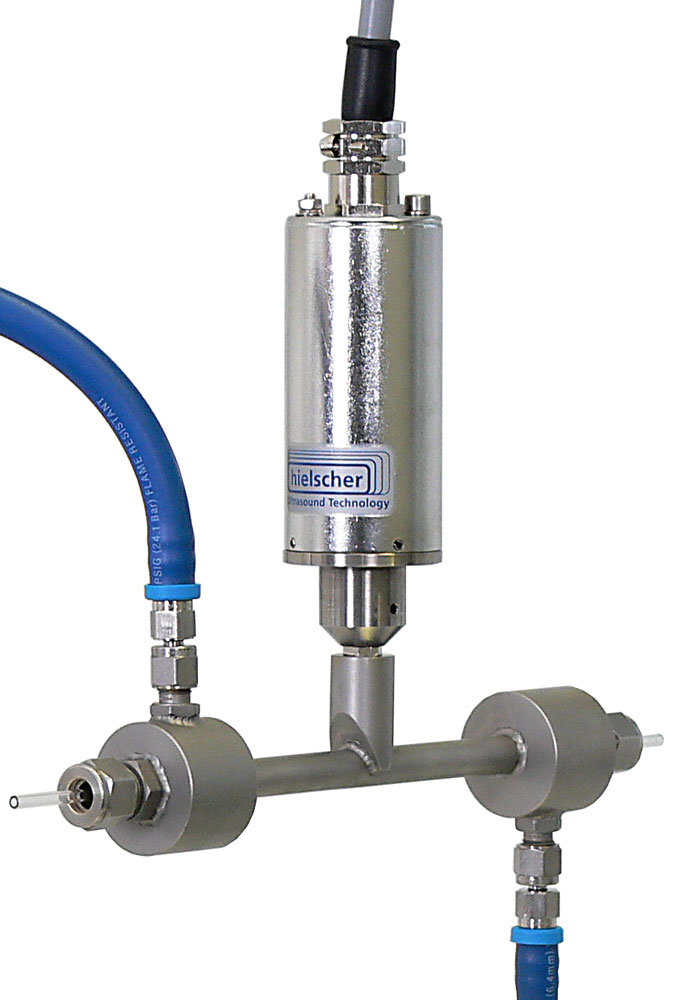
UIS250 Dmini – Ultrasonic Mini Flow Cell for non-invasive, sterile sonication
Results
Nanoparticles with a mean diameter of 485 nm were readily prepared from a 2% PLGA solution in DCM at 32W sonication power (Tab. 1). The size distribution was mono-modal with a slight tailing (Fig. 3A). Nanoparticle sizes extended from 175 to 755 nm according to the 10 and 90% percentiles. Repeatability of the production process was consistently good, as reflected by only minor variability in the mean particle diameter. Lowering the 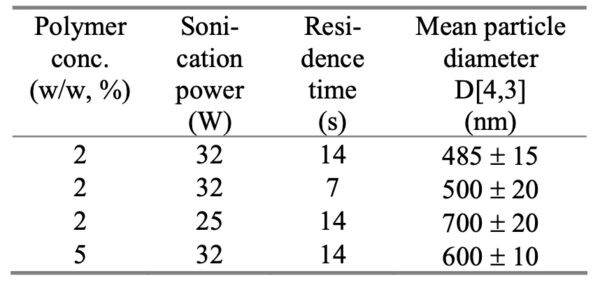 Table 1. Mean diameter of PLGA50:50 nanospheres prepared under different conditions. Mean of two batches ± absolute deviation.[/caption]
Finally, the more hydrophilic PLGA was exchanged for the more hydrophobic and lower molecular weight PLA without noticeable changes in particle mean size and size distribution. No differences were observed in the morphology of the different batches of particles prepared from 2% polymer solutions. They all exhibited perfectly spherical shapes and smooth surfaces (Fig. 3B). The particles made from the 5% PLGA solution, however, were less spherical, showed slightly wrinkly surfaces, and fusions of two or sometimes more particles (Fig. 3C).

Fig. 3: PLGA nanoparticles. (A): Size distribution of particles prepared at polymer concentration/ sonication power of 2%/ 32W, 5%/ 32W, and 2%/ 25W%; residence time = 14 s. (B),(C): SEM pictures of particles prepared from 2 and 5% polymer solutions, respectively. Residence time = 14s; sonication power = 32W. Bars represent 1 micron.
(Study and pictures: © Freitas et al., 2006)
Discussion and Conclusion
The ultrasonic flow-through cell was found to be well suited for emulsion-solvent extraction/evaporation based production of biodegradable polymeric nanospheres. Future research will be directed towards scaling-up the process and increasing the power input to yield even finer emulsions. In addition, the suitability of the cell for the preparation of water-in-oil emulsions, e.g. for further processing into drug-loaded microspheres, will be studied.
Literature
- Freitas, S.; Hielscher, G.; Merkle, H. P.; Gander, B.: A Fast and Simple Method for Producing Biodegradable Nanospheres, in: European Cells and Materials Vol. 7. Suppl. 2, 2004 (page 28). This study was presented at the Swiss Society of Biomaterials.
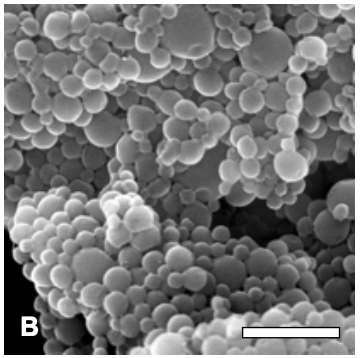
SEM image of ultrasonically synthesized nano-spheres prepared from 2% polymer solution