Prodhimi i nanosferave të biodegradueshme
Mikro dhe nanosferat e biodegradueshme mund të prodhohen në një proces të vazhdueshëm, pa kontakt dhe pa kontaminim, i cili mund të përdoret lehtësisht në kushte sterile.
Prezantimi
Biodegradable micro- and nanospheres (MS, NS) made of poly(lactide-coglycolide) (PLGA) or other materials are very potent drug and antigen delivery systems with inherent potential for drug and antigen targeting. Present methods to produce PLGA NS are typical batch processes and suffer from difficulties of upscaling under sterile conditions. Here, we present a novel and elegant method to produce PLGA nano-spheres in a continuous, contact- and contamination-free process that can be readily run under sterile conditions. During the entire manufacturing process, the product is in direct contact only with sterile glass and Teflon® tubes. The process can be run in a closed system to prevent any environmental contamination.
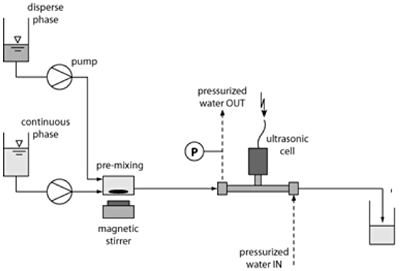
Scheme of setup for a contamination-free synthesis of nanparticles using the Hielscher non-contact sonication flow-cell Dmini
Method of Ultrasonic Contact-Free Nano-Sphere Production
PLGA50:50 nanoparticles (Resomer® RG503H, Boehringer Ingelheim) were produced using a modified solvent extraction/evaporation process. PLGA dissolved in dichloromethane (2 or 5%) was dispersed in aqueous 0.5% (w/w) PVA-solution by means of the novel experimental set-up involving a contact-free flow-through ultrasonication cell Dmini. The coarse O/W-dispersion was first premixed by a magnetic stirrer and then homogenized in the contact-free ultrasonic flow-through cell Dmini (flow rates of O- and W-phases were at 1:8). The initially formed PLGA-solvent nanodroplets gradually solidified during the passage in the tubes to become PLGA nanoparticles. Final hardening of the particles was achieved in a larger volume of 0.5% PVA solution.
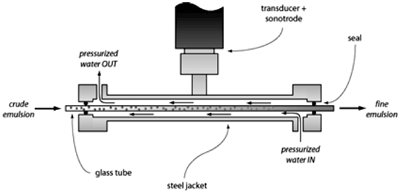
Qeliza tejzanor pa kontakt Dmini për sintezën e nanogrimcave pa ndotje
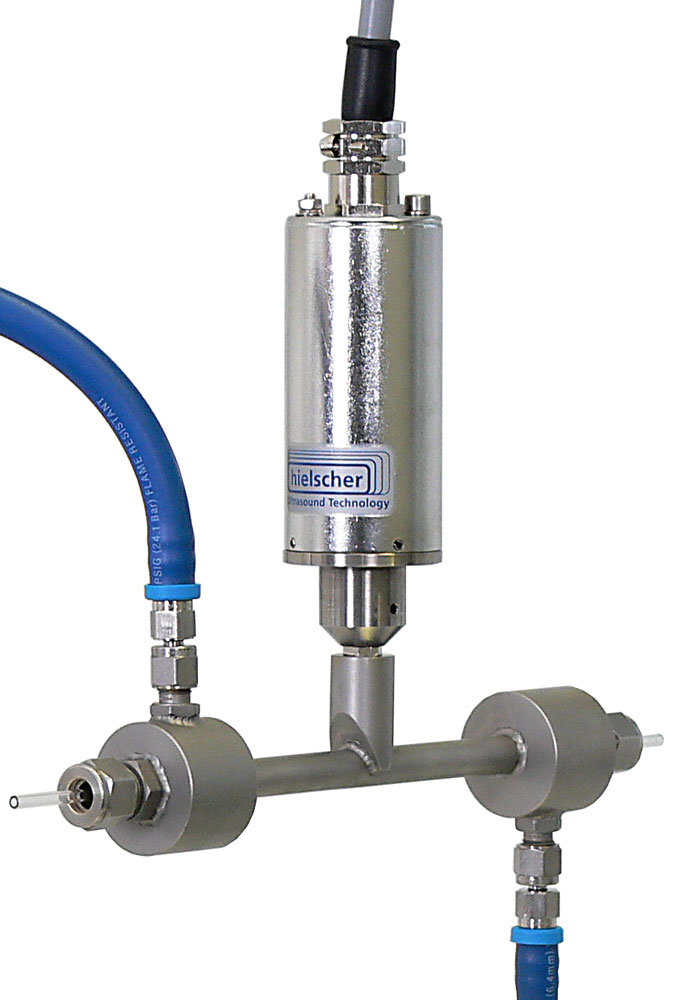
UIS250 Dmini – Qeliza tejzanor e rrjedhës mini për tingëllim jo-invaziv, steril
Rezultatet
Nanogrimcat me një diametër mesatar prej 485 nm u përgatitën lehtësisht nga një solucion PLGA 2% në DCM me fuqi sonikimi 32 W (Tab. 1). Shpërndarja e madhësisë ishte mono-modale me një përmbytje të lehtë (Fig. 3A). Madhësitë e nanogrimcave shtriheshin nga 175 në 755 nm sipas përqindjeve 10 dhe 90%. Përsëritshmëria e procesit të prodhimit ishte vazhdimisht e mirë, siç reflektohet vetëm nga ndryshueshmëria e vogël në diametrin mesatar të grimcave. Ulja e 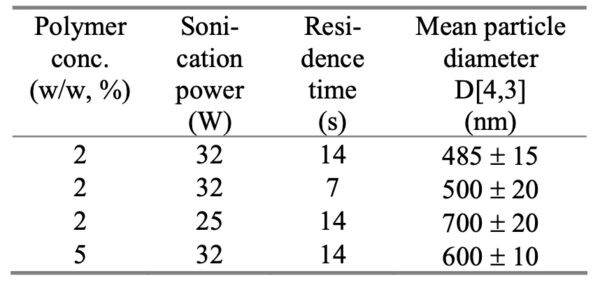 Table 1. Mean diameter of PLGA50:50 nanospheres prepared under different conditions. Mean of two batches ± absolute deviation.[/caption]
Më në fund, PLGA më hidrofile u këmbye për PLA më hidrofobike dhe me peshë molekulare më të ulët pa ndryshime të dukshme në madhësinë mesatare të grimcave dhe shpërndarjen e madhësisë. Nuk u vunë re dallime në morfologjinë e grupeve të ndryshme të grimcave të përgatitura nga tretësira polimer 2%. Ata të gjithë shfaqnin forma të përkryera sferike dhe sipërfaqe të lëmuara (Fig. 3B). Grimcat e bëra nga tretësira 5% PLGA, megjithatë, ishin më pak sferike, shfaqën sipërfaqe pak të rrudhosura dhe shkrirje të dy ose ndonjëherë më shumë grimcave (Fig. 3C).

Fig. 3: Nanogrimcat PLGA. (A): Shpërndarja e madhësisë së grimcave të përgatitura në përqendrimin e polimerit/ fuqinë e sonikimit prej 2%/32W, 5%/32W dhe 2%/25W%; koha e qëndrimit = 14 s. (B), (C): Fotot SEM të grimcave të përgatitura nga solucione polimer 2 dhe 5%, respektivisht. Koha e qëndrimit = 14 s; fuqia e sonikimit = 32W. Shufrat përfaqësojnë 1 mikron.
(Studimi dhe fotografitë: © Freitas et al., 2006)
Discussion and Conclusion
The ultrasonic flow-through cell was found to be well suited for emulsion-solvent extraction/evaporation based production of biodegradable polymeric nanospheres. Future research will be directed towards scaling-up the process and increasing the power input to yield even finer emulsions. In addition, the suitability of the cell for the preparation of water-in-oil emulsions, e.g. for further processing into drug-loaded microspheres, will be studied.
Letërsia
- Freitas, S.; Hielscher, G.; Merkle, H. P.; Gander, B.: A Fast and Simple Method for Producing Biodegradable Nanospheres, in: European Cells and Materials Vol. 7. Suppl. 2, 2004 (page 28). This study was presented at the Swiss Society of Biomaterials.
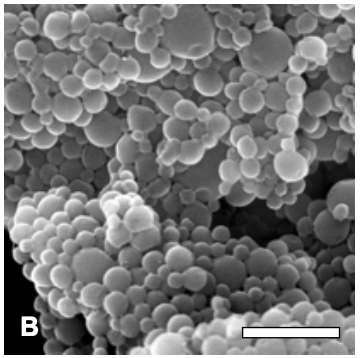
SEM image of ultrasonically synthesized nano-spheres prepared from 2% polymer solution