Acoustic Levitation for Particle-Armored Liquid Robots
A particle-armored liquid robot is a field-actuated soft machine rather than a miniature rigid robot. Its liquid body can change shape, flow around obstacles, engulf a compatible object and merge with a neighbor, while a particulate skin prevents the liquid from wetting the environment. The 2025 Science Advances study that introduced the Particle-armored liquid roBot, or PB, used a Hielscher UP400S ultrasonic transducer (400 W, 24 kHz) with a 22 mm sonotrode to exert acoustic radiation force from a distance. The force pushed and rolled the PB across ordinary substrates; the transducer was inclined 10 degrees for navigation tasks and oriented vertically for merging.
From Acoustic Propulsion to Acoustic Suspension
True acoustic levitation changes the boundary condition. Instead of using a progressive wave to overcome rolling resistance, an opposed sonotrode-reflector pair produces a standing pressure field that supports the robot against gravity. Removing the floor eliminates solid contact, but it also removes the friction that helped convert acoustic force into rolling motion. A practical machine therefore needs two functions: a vertical trap for lift and an independently controllable gradient or progressive wave for translation. The result is best viewed as a hybrid acoustic workcell with levitate, steer, merge and dock modes.
Explore how a precisely controlled Hielscher ultrasonic system could enable contact-free levitation of particle-armored liquid robots. Talk to our ultrasonic specialists about testing your concept.
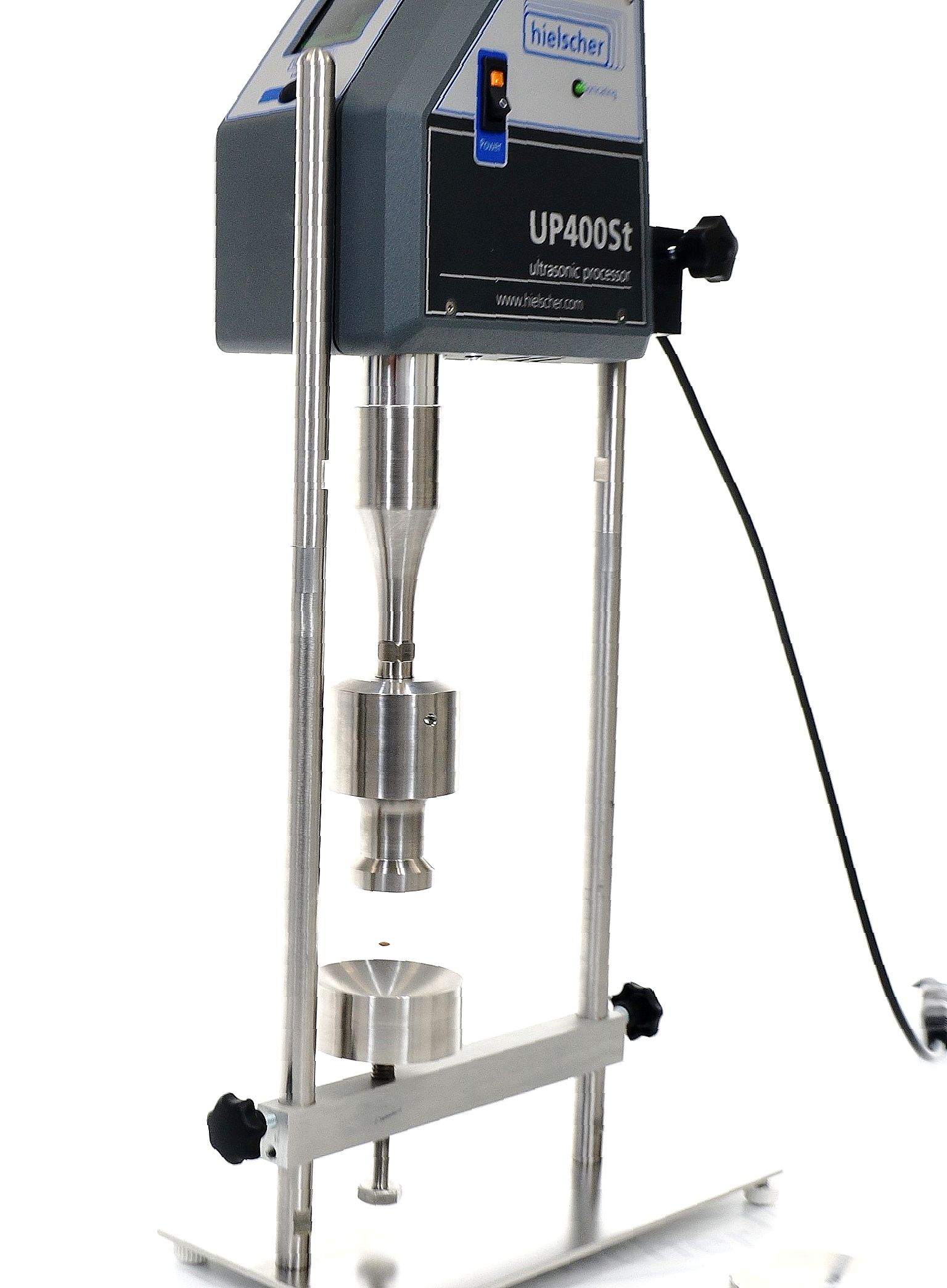
Acoustic levitator UP400St (400W, 24kHz) holding a particle mid-air suspendend
The Working Principle of Acoustic Levitation
Acoustic levitation uses acoustic radiation forces to suspend an object without mechanical contact. In a typical ultrasonic levitator, a sonotrode emits high-frequency sound toward an opposing reflector. The incident and reflected waves interfere to form a standing wave containing alternating pressure nodes and antinodes. A particle-armored liquid robot placed near a stable node experiences a time-averaged acoustic force that counteracts gravity, while pressure gradients restore small displacements and keep the robot trapped. The reflector spacing, acoustic frequency and vibration amplitude must be tuned to the robot’s size, mass and shape. Additional horns or controlled movement of the acoustic field can provide lateral steering, rotation and docking. Unlike acoustic cavitation, which involves the growth and collapse of bubbles inside a liquid, acoustic levitation primarily relies on radiation pressure transmitted through the surrounding air. Excessive sound pressure should nevertheless be avoided because it can deform the liquid core, dislodge armor particles or destabilize the robot.
Levitation as Lifting Mechanism
In an air-coupled levitator, the desired force is the time-averaged acoustic radiation force created by scattering and absorption of the sound field. A reflector sends the incident wave back toward the horn, and the two waves interfere to produce nodes and antinodes. A dense millimetric object in air can be trapped near a stable pressure node when the upward radiation force balances its weight and the force gradient restores small displacements. Cavitation, by contrast, occurs inside a liquid when negative pressure cycles drive bubbles. The two phenomena can coexist only if enough acoustic energy enters the droplet, but they should not be conflated.

Acoustic levitation of a small rigid sphere at the pressure node of a plane standing wave established between a transducer/levitator and a reflector.
(study and pictures: © Andrade et al. 2018)
What are Particle-Armored Liquid Robots?
Conventional liquid marbles are droplets coated with hydrophobic powder. Capillary forces hold the particles at the liquid-gas interface, and particle rearrangement gives the surface a shell-like response. The PB concept strengthens that architecture by loading substantially more particles per unit liquid volume. In the reported fabrication route, a cuboid ice precursor was coated with flake-like PTFE particles with an average basal-plane diameter of 34 micrometers. When the ice melted and contracted, the particles jammed into a dense, uniformly distributed layer around a prolate water core.
For the geometries studied, PBs carried about 59% more particle mass than conventional liquid marbles, with a reported packing ratio of 0.983 rather than 0.956. At a liquid volume of 75 cubic millimeters, an aspect ratio near 1.55 gave the highest measured compression resistance; its maximum compression force was 252% greater than that of the comparison liquid marble. Too slender a shape weakened the sides, so more armor and more elongation are not automatically better.
That reserve of mobile surface particles lets a PB survive transient increases in interfacial area. The reported robots squeezed through hydrophilic pillar arrays, engulfed hydrophilic glass beads, merged under vertical acoustic loading, skimmed across water, transported reagents and discharged their contents when a surfactant fractured the armor. The word robot here describes externally controlled, task-capable matter; the PB has no onboard actuator, sensor or power source.
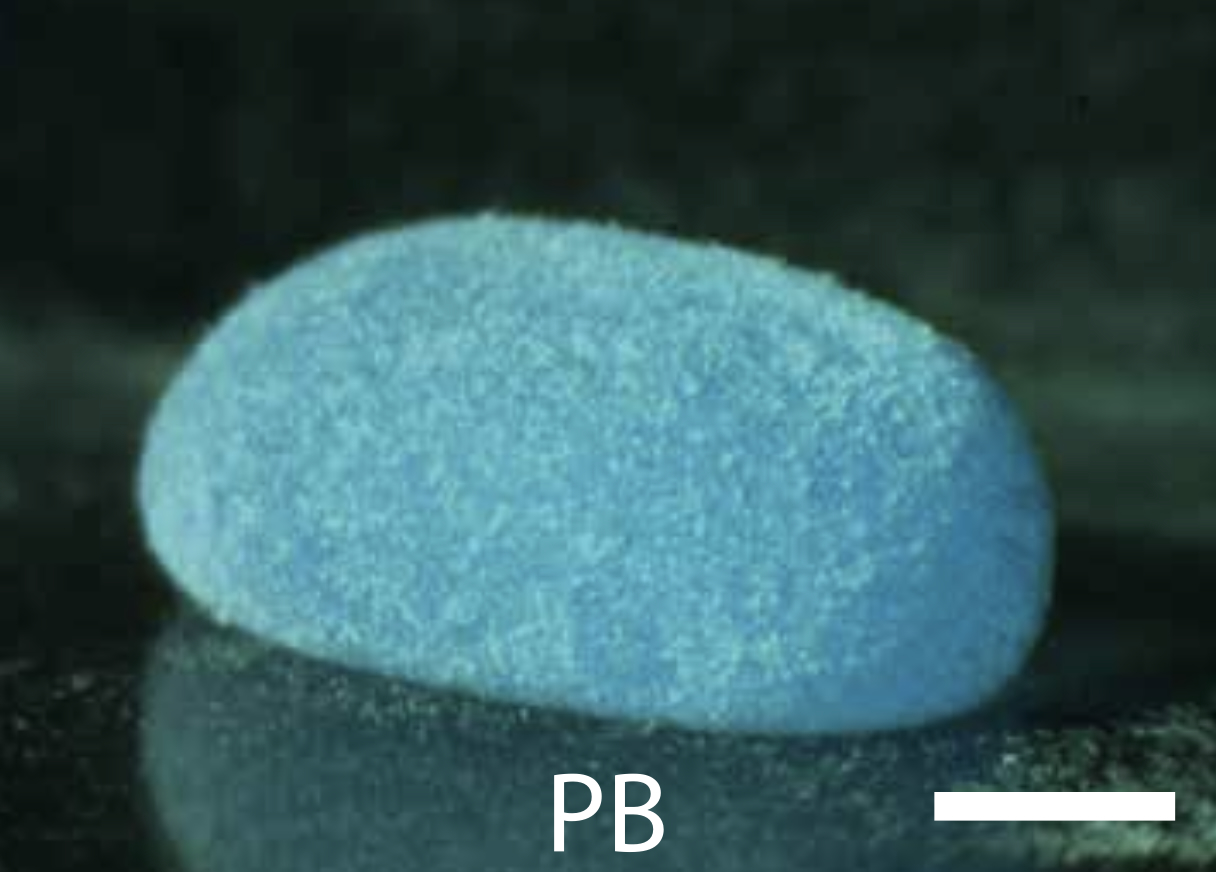
Particle-armored liquid robot
Study and image: ©Jeon et al., 2025
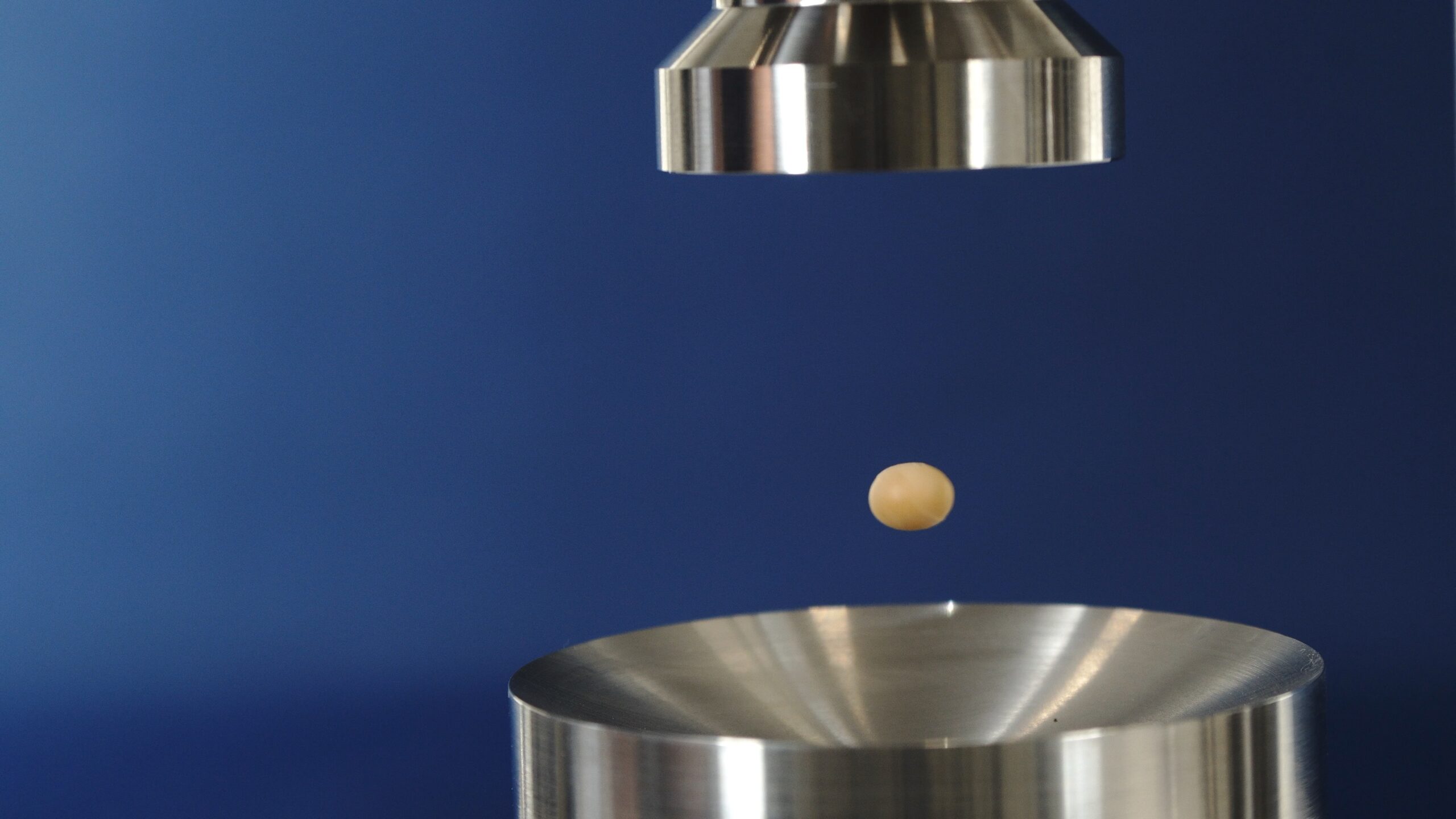
The 400 watts acoustic levitator UP400St levitates a small particle at a stable pressure node, demonstrating precise acoustic positioning without surface contact.
Why Acoustic Levitation is Useful for Liquid Robots
It removes the most troublesome mechanical interface
Surface travel exposes a liquid robot to friction, roughness, adhesion, contamination and unpredictable wetting. Levitation replaces that contact with a programmable field. This can preserve a delicate particle shell, prevent loss of high-purity cargo and allow the robot to pass over gaps or surfaces that would pin a water droplet. It also makes the method compatible with electrically neutral and nonmagnetic payloads, so the armor does not need to be loaded with field-responsive additives.
It creates a containerless microreactor
A suspended PB is both a mobile package and a small reaction vessel. Multiple traps can keep reagents apart; controlled motion can then bring robots into contact to initiate coalescence. Acoustic-levitation studies on conventional liquid marbles have already demonstrated controlled shell opening, coalescence and a triggered indicator reaction. The stronger PB shell should enlarge the usable manipulation window, although that specific advantage remains to be measured in mid-air.
It enables new measurement and transfer modes
With gravity supported acoustically, cameras can measure free deformation, shell buckling, rotation and evaporation without a contact patch. The apparatus can hand a PB between three operating environments: levitate for clean transport, dock onto a surface for penetration or cargo pickup, and return to the trap for reaction or inspection. This hybrid sequence preserves the paper’s strongest surface-based behaviors while adding a contact-free transfer layer.
Levitation is not automatically gentler. High sound pressure can flatten the droplet, drive internal circulation, heat the liquid, strip particles or atomize the interface. The usable operating window lies between the minimum pressure needed to trap the PB and the first sign of irreversible shell rearrangement. That window must be mapped for every combination of volume, aspect ratio, core liquid and armor material.
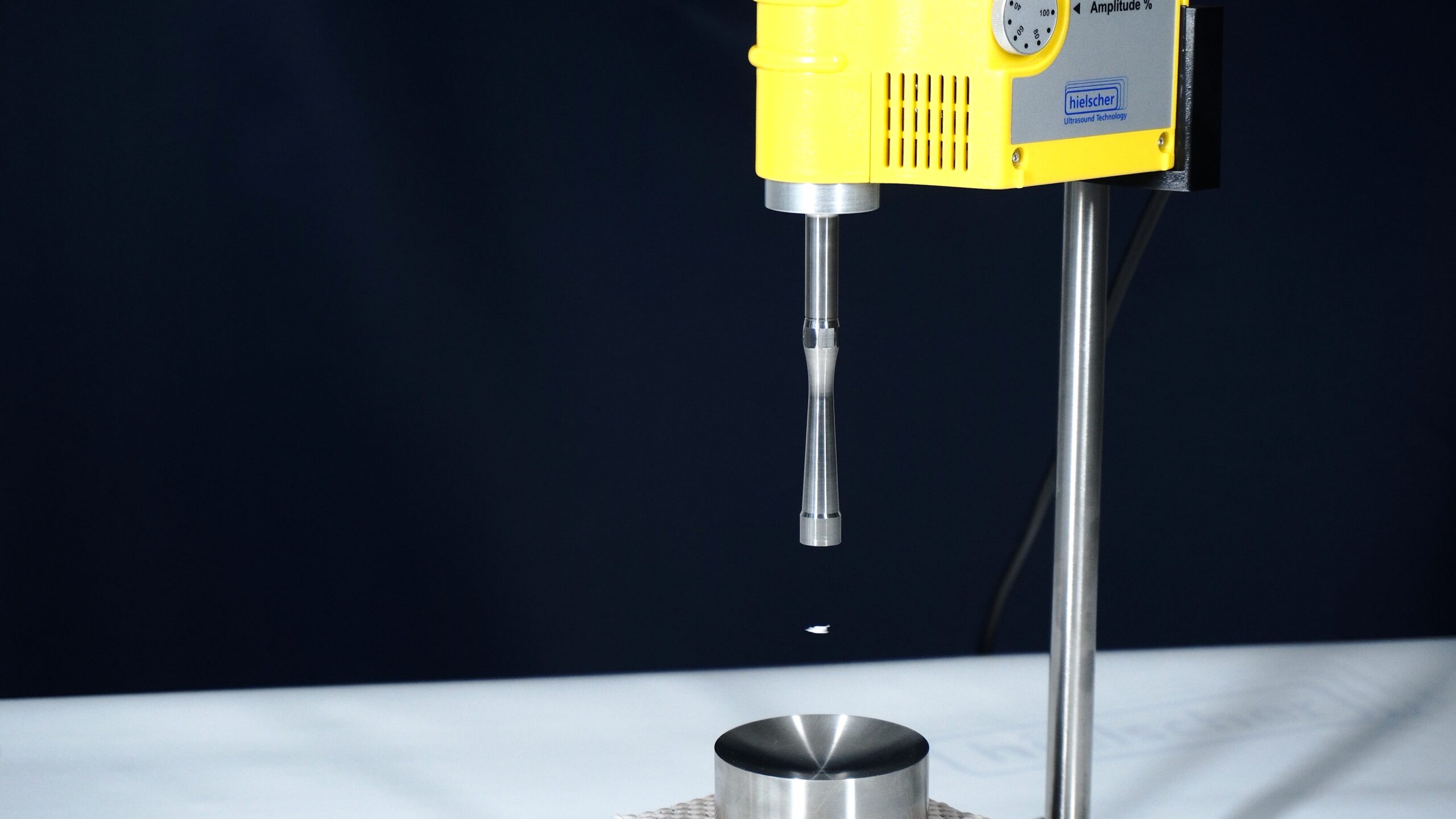
The acoustic levitator UP100H suspends a liquid droplet in a standing ultrasonic field for contact-free handling.
Strengths of Hielscher Ultrasonic Levitators
A direct experimental lineage
Take advantage of the established starting points published by Jeon and colleagues (2025). The PB study used the Hielscher UP400S at 24 kHz and 400 W with a 22 mm sonotrode. Moving to the digital model UP400St preserves the same nominal power-frequency class while adding modern control, programmable settings and data logging. This reduces uncertainty in the progressive-wave steering channel, even though the standing-wave cavity remains a new subsystem.
High amplitude with practical adjustability
The sonicator UP400St reliabley levitates solid and liquid particles. The sonotrode can reach 118 micrometers of displacement at the 100% setting. The UP400St provides 20-to-100% amplitude adjustment, programmable interval operation, automatic frequency tuning and a choice of sonotrodes, including the 22 mm titanium model used in the study by Jeon et al., 2025. This combination supports threshold mapping, gentle ramps and repeatable pulses rather than a single on/off operating point.
Instrumentation and automation
The UP400St records amplitude, power, time and temperature to an SD card and can be monitored or controlled through a browser interface. Those features are unusually useful for a research levitator because acoustic stability is sensitive to thermal drift, geometry and load. Logged settings can be synchronized with camera-derived position and deformation to produce a reproducible operating map.
A path from bench to robust installation
 Hielscher levitators can be installed singly or in parallel; additionally custom levitators are available on request. The UIP500hdT separates generator and transducer and uses an IP64-rated transducer, which is attractive when an enclosure must handle moisture or accidental robot rupture. These are manufacturer claims and should be verified against the exact quoted configuration.
For acoustic levitation, Hielscher offers three standard types of levitators:
- UP100H – a 30kHz, 100 W levitator
- UP400ST – a 24kHz, 400W levitator
- UIP500hdT – a 20kHz, 500W levitator
Lift your Liquid Robots Reliably with Levitation!
Frequently Asked Questions about Acoustic Levitation and Liquid Robots
What is acoustic levitation?
Acoustic levitation is a contact-free method of suspending and positioning an object with sound. An ultrasonic emitter and reflector create a standing pressure wave, and the resulting acoustic radiation force can balance gravity and hold an object near a stable pressure node.
Read more about acoustic levitation and its applications!
How does an ultrasonic levitator work?
An ultrasonic levitator directs high-frequency sound from a sonotrode toward an opposing reflector. The incident and reflected waves interfere to form nodes and antinodes. When the acoustic pressure, reflector spacing and object position are properly adjusted, a particle or droplet can be trapped at a stable node.
What is a particle-armored liquid robot?
A particle-armored liquid robot is a deformable liquid body enclosed by a densely packed shell of hydrophobic particles. This armor limits wetting and helps the robot retain its contents while it moves, changes shape, merges with other droplets or transports small payloads.
How is a particle-armored liquid robot different from a liquid marble?
Both systems consist of liquid surrounded by hydrophobic particles. However, a particle-armored liquid robot has a particularly dense, mechanically resistant particle shell designed to support controlled movement and functional tasks. Its additional surface particles also allow the armor to rearrange as the liquid body deforms.
Can Hielscher sonicators levitate particle-armored liquid robots?
Hielscher ultrasonic equipment can be configured for standing-wave acoustic levitation, and a Hielscher UP400S has already been used to actuate particle-armored liquid robots on solid surfaces. Direct mid-air levitation of these specific robots remains an engineering concept that must be validated experimentally for trap stability, heating, deformation and particle loss.
Which Hielscher sonicator is suitable for acoustic levitation research?
The Hielscher UP400St, rated at 400 watts and 24 kilohertz, is a logical starting point for laboratory development because it offers adjustable amplitude, pulsed operation, automatic frequency tuning and process-data recording. The appropriate sonicator, sonotrode and reflector geometry ultimately depend on the robot’s dimensions, mass, shape and required operating modes.
What is the difference between acoustic levitation and acoustic cavitation?
Acoustic levitation relies primarily on radiation pressure in a gas, usually air, to suspend an object. Acoustic cavitation occurs within a liquid when pressure cycles cause bubbles to grow and collapse. Cavitation can generate intense shear, microjets and heating, so it should not be confused with the gentler standing-wave mechanism used for routine levitation.
Why is acoustic levitation useful for liquid robots?
Levitation removes contact with solid surfaces and therefore reduces friction, adhesion, contamination and uncontrolled wetting. It can enable clean transport, containerless reactions and inspection of a liquid robot without a supporting substrate. The robot may also be moved between levitated and surface-based operating modes.
Can acoustic levitation steer, rotate or merge liquid robots?
Yes, but vertical suspension alone is not enough. Lateral motion can be produced by moving the acoustic trap, shifting the reflector or applying a controlled pressure gradient with an additional ultrasonic source. Camera feedback can help regulate steering, rotation, docking and the controlled merging of multiple robots.
Literature / References
- Hyobin Jeon, K. Park, j.-Y. Sun, H.-Y. Kim (2025): Particle-armored liquid robots.Science Advances Volume 11, Issue 12, 21 Mar 2025.
- Andrade, M.A.B.; Pérez, N.; Adamowski, J.C. (2018): Review of Progress in Acoustic Levitation. Brazilian Journal of Physics 48, 2018. 190–213.
- Malte Junk, Jörn Hinrichs, Fritz Polt, Jonas Fechner, Werner Pauer (2020): Quantitative experimental determination of evaporation influencing factors in single droplet levitation. International Journal of Heat and Mass Transfer, Volume 149, 2020.
- Wonhyuk Jo, Johannes Möller, Jörg Hallmann, James Wrigley, Jan-Etienne Pudell, Ulrike Boesenberg, Felix Brausse, Angel Rodriguez-Fernandez, Alexey Zozulya, Roman Shayduk, Anders Madsen (2025): MHz X-ray photon correlation spectroscopy using an acoustic levitator at the European XFEL. Journal of Synchrotron Radiation 32, 2025. 669–677.

Hielscher Ultrasonics manufactures high-performance ultrasonic homogenizers from lab to industrial size.