Ultrasonic topic: "Homogenizer"
What is a Homogenizer?
Homogenizers play a vital role in countless industries, including food production, pharmaceuticals, cosmetics, and biotechnology. They create uniform mixtures through intense mechanical forces.
This homogenizer principle spans a range of equipment designs, such as a high pressure homogenizer, high shear homogenizer, and ultrasonic homogenizer. Each homogenizer machine shears particles or cells mechanically to achieve consistent dispersions or emulsions. Industries commonly rely on a tissue homogenizer or cell homogenizer to process biological samples, while an industrial homogenizer, often called an industrial mixer homogenizer, handles larger production volumes. The use of homogenizer technology ensures reliable results in everything from lab homogenizer applications to full-scale production processes.
How Does a Homogenizer Work?
Understanding how a homogenizer works requires a look at its core mechanisms. The homogenizer working principle, or homogenizer machine working principle, involves intense shearing, cavitation, or impact forces that break down materials into smaller particles. A high pressure homogenizer uses elevated pressure and valve systems, while a high shear homogenizer relies on mechanical shear in a rotor-stator setup. Ultrasonic homogenizers apply powerful ultrasonic waves for reliable cell disruption and particle size reduction. Lab technicians often use an ultrasonicator homogenizer in research settings, whereas ultrasonic production scale homogenizer systems process bulk quantities for large-scale manufacturing.
Ultrasonic Homogenizers
Hielscher homogenizers stand out in this field due to their robust performance and versatility. The ultrasonic homogenizer line covers both lab homogenizer devices and larger production scale homogenizer machines. The homogenizer ultrasonic technology enables precise control over processing parameters, which optimizes the consistency and quality of final products. Researchers appreciate how quickly a Hielscher ultrasonic tissue homogenizers or cell homogenizers break down samples, while industrial clients benefit from systems that easily integrate into existing production lines. Hielscher homogenizers achieve reproducible results and minimize maintenance demands.
Users often adopt Hielscher ultrasonic homogenizers because these devices excel in various homogenizer uses. Their high efficiency simplifies the use of homogenizer in fields requiring gentle tissue homogenizer action or aggressive particle reduction in an industrial mixer homogenizer. Operators can adjust amplitude, pressure, and flow to match specific process requirements. This flexibility demonstrates how a homogenizer mixer can tackle everything from delicate biological samples to viscous emulsions. By combining reliability, scalability, and consistent performance, Hielscher homogenizers answer the question of how to select the ideal homogenizer machine for any application, whether at lab scale or in full-scale production.
Below you will find a list of technical articles and ultrasonic homogenizers. Please contact us for more information!

Found 16 hits. Showing results 13 - 16.

GDmini2 – Ultrasonic Inline Micro-Reactor
The GDmini2 is an ultrasonic micro-reactor for the indirect, temperature-controlled sonication of liquid media. Applications include: Homogenization, emulsification, particle synthesis, solvent extraction, cell lysis and fragmentation. The GDmini2 is an ultrasonic homogenizer in the shape of a straight glass tube.…
https://www.hielscher.com/gdmini2-ultrasonic-inline-micro-reactor.htm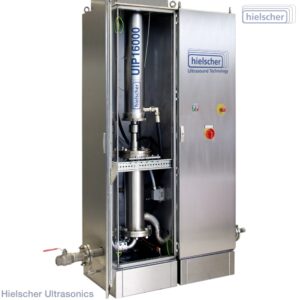
Ultrasonic Wet-Milling: Fine Particles, Precisely Engineered
Hielscher sonicators are efficient milling equipment for high-efficiency particle size reduction, nano-dispersion, and emulsification through controlled, high-intensity ultrasonic cavitation. Engineered for both research and industrial scale, these systems reliably break down agglomerates, refine powders, and create homogeneous suspensions across pharmaceuticals,…
https://www.hielscher.com/mill_01.htm
Sonicator UIP1000hdT (1000 Watts) – Powerful and Versatile
The UIP1000hdT is a 1,000-watt industrial sonicator for pilot-scale process development, small production, and continuous liquid processing. It is designed for demanding ultrasonic applications such as homogenization, emulsification, dispersion, particle size reduction, extraction, cell lysis, dissolving, and sonochemical reactions. With…
https://www.hielscher.com/i1000_p.htm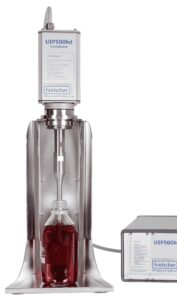
UIP500hdT – Industrial 500W Sonicator
The UIP500hdT is a 500W industrial sonicator for pilot-scale research, process development, and continuous small-scale manufacturing. It is widely used for ultrasonic homogenization, emulsification, dispersion, extraction, cell lysis, and sonochemical reactions in the chemical, pharmaceutical, food, biotechnology, and nanomaterials industries.…
https://www.hielscher.com/i500_p.htm