Reduktimi Sonokimik i Nanogrimcave të Palladiumit
Paladiumi (Pd) është i njohur për vetitë e tij katalitike dhe përdoret gjithashtu gjerësisht në kërkimin e materialeve, prodhimin e elektronikës, mjekësinë, pastrimin e hidrogjenit dhe aplikime të ndryshme kimike. Duke përdorur një rrugë sonokimike, madhësia dhe morfologjia e grimcave të paladiumit mund të kontrollohen duke rregulluar raportin PVP/Pd. Kjo mundëson sintezën tejzanor të nanogrimcave shumë të imta, monodisperse ose agregateve më të mëdha të paladiumit, duke lejuar që dimensionet e grimcave të përshtaten për performancë optimale katalitike.
Prodhimi tejzanor i Nanogrimcave të Palladiumit
 Ultrasonic palladium nanoparticle reduction offers a fast, reagent-efficient route to Pd(0) nanoparticles by using acoustic cavitation to generate localized high-energy conditions and reducing radicals in solution, enabling palladium ions to be reduced without conventional high-temperature processing.
A key advantage is process control: sonication time and stabilizer concentration, such as the PVP/Pd ratio, can influence whether the product forms as well-dispersed, rounded nanoparticles around 5 nm or as larger aggregates around 20 nm, which is industrially relevant because palladium performance in catalysis depends strongly on particle size, morphology, dispersion, and surface area. Since palladium nanoparticles are widely valuable as heterogeneous catalysts, electrocatalysts, and functional materials, ultrasonic reduction is attractive for producing finely dispersed Pd catalysts under comparatively mild liquid-phase conditions, with potential benefits for chemical synthesis, environmental catalysis, fuel-cell technologies, and other processes where high catalytic activity and efficient noble-metal utilization are economically important.

Përpunimi industrial i nanogrimcave me sonifikuesin UIP2000hdT
Procedura e përgatitjes së mostrës
Mostrat u përgatitën si më poshtë:
Për mostrat, përzierjet prej 30 ml EG dhe 5·10-6mol e PVP u parapërgatitën me trazim magnetik për 15 minuta. Për mostrat e ndryshme, u shtua sasi e ndryshme e tretësirës Pd(NO₃)₂, 1.5 ml dhe 2 ml. Përzierjet e mostrave u përgatitën me raportin 2·10-3mol Pd(NO₃)₂ në mostër (a) dhe 2.66·10-3mol Pd(NO₃)₂ në mostër (b). Të dyja përzierjet u sonicated në një shishkë 20 ml duke përdorur një ultratinguj të tipit sondë. Mostrat u morën pas kohës së sonikimit prej 30, 60, 90, 120, 150 dhe 180 min.
Analiza e rezultateve eksperimentale tregon se:
- 1. Reduktimi sonokimik i Pd (II) në Pd (0) varet nga koha e sonication.
- 2. Raporti i lartë molar PVP/Pd(II) çon në formimin e grimcave të paladiumit të monodisperzuar që kanë një formë të rrumbullakosur dhe një diametër mesatar prej rreth 5 nm.
- 3. Megjithatë, raporti molar i ulët PVP/Pd(II) përfshin marrjen e agregateve të nanogrimcave të paladiumit me një shpërndarje të madhësisë së madhe të përqendruar në 20 nm.
Rruga sonokimike e reduktimit të joneve të paladiumit (II). Pd(II) tek atomet e paladiumit Pd(0) mund të supozohet se janë si më poshtë:
- (1) Piroliza e ujit: H₂O → •OH+•H
- (2) Formimi radikal: RH (agjent reduktues) + •OH(•H) → •R + H₂O(H₂)
- (3) Reduktimi i joneve: Pd(II) + radikalet reduktuese (•H, •R) → Pd(0) + R•CHO + H+
- (4) Formimi i grimcave: NPd(0) → Pdn
Rezultati: Në varësi të raportit PVP/Pd(II), Pd i shpërndarë ose i grumbulluarN janë marrë.
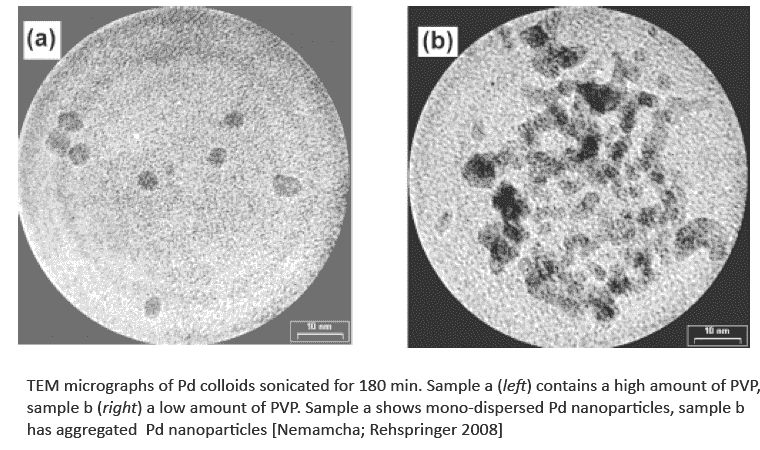
Reduktimi sonokimik i paladiumit: mostra a (majtas) përmban një sasi të lartë të PVP, mostra b (djathtas) një sasi të ulët PVP. Koha e sonikimit me UP100H: 180 min. Mostra a tregon grimcat nano Pd të shpërndara mono, grimcat nano Pd të agreguara të mostrës b.
Imazhet dhe studimi: ©Nemamcha dhe Rehspringer, 2008
Analiza dhe Rezultatet
Analizat e përthithjes së dukshme në UV konfirmojnë lidhjen midis reduktimit sonokimik të joneve të paladiumit (II) në atomet e paladiumit (0) dhe kohës së mbajtjes në fushën tejzanor. Reduktimi i joneve të paladiumit (II) në atome të paladiumit (0) përparon dhe mund të arrihet plotësisht me rritjen e kohës së sonikimit. Mikrografët e mikroskopit elektronik të transmisionit (TEM) tregojnë se:
- Kur shtohet një sasi e lartë e PVP, reduktimi sonokimik i joneve të paladiumit çon në formimin e grimcave të paladiumit të monoshpërndara me formë sferike dhe një diametër mesatar prej afërsisht 5 nm.
- Përdorimi i një sasie të vogël të PVP përfshin marrjen e agregateve të nanogrimcave të paladiumit. Matjet dinamike të shpërndarjes së dritës (DLS) zbulojnë se agregatet e nanogrimcave të paladiumit kanë një shpërndarje të madhe të përqendruar në 20 nm.

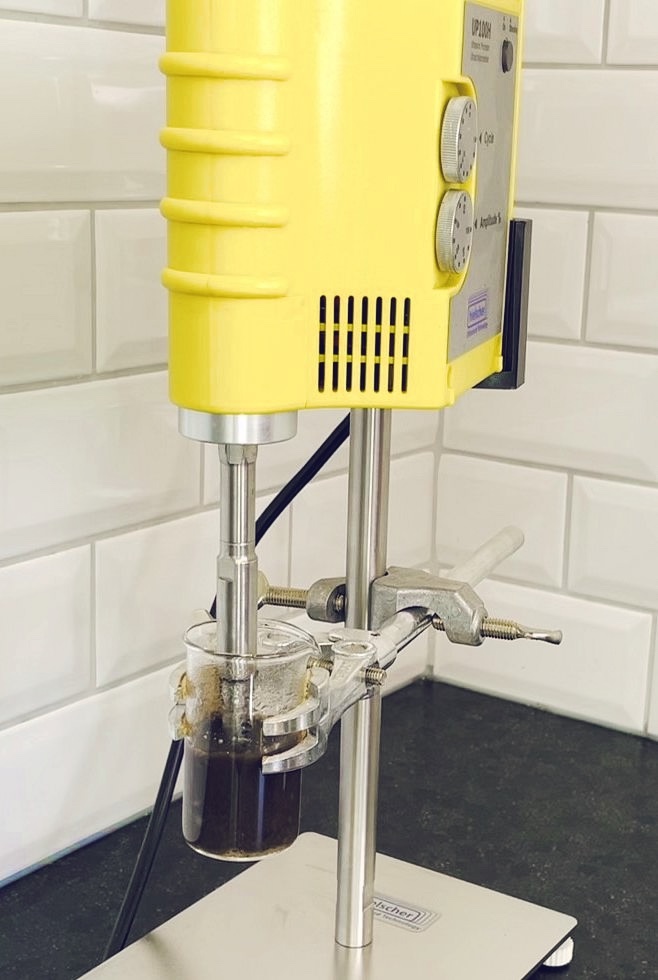
Sonicator laboratorik UP100H është përdorur për përgatitjen e nanogrimcave të paladiumit.

Nano grimcat e palladiumit (Pd) mund të përgatiten me anë të sonikacionit
Dizajn, Prodhim dhe Konsulencë – Cilësi e prodhuar në Gjermani
Ultrasonikët Hielscher janë të njohur për cilësinë e tyre më të lartë dhe standardet e dizajnit. Qëndrueshmëria dhe funksionimi i lehtë lejojnë integrimin e qetë të ultrasonikëve tanë në objektet industriale. Kushtet e vështira dhe mjediset kërkuese trajtohen lehtësisht nga ultrasonikët Hielscher.
Hielscher Ultrasonics është një kompani e certifikuar ISO dhe i kushton theks të veçantë ultratingujve me performancë të lartë që paraqesin teknologjinë më të fundit dhe lehtësinë ndaj përdorimit. Sigurisht, ultrasonikët Hielscher janë në përputhje me CE dhe plotësojnë kërkesat e UL, CSA dhe RoHs.
Literatura/Referencat
- Nemamcha, A.; Rehspringer, J. L. (2008): Morphology of dispersed and aggregated PVV-Pd nanoparticles prepared by ultrasonic irradiation of Pd(NO₃)₂ solution in ethylene glycol. Rev. Adv. Mater. Sci. 18;2008. 685-688.
- Prekob, Á., Muránszky, G., Kocserha, I. et al. (2020): Sonochemical Deposition of Palladium Nanoparticles Onto the Surface of N-Doped Carbon Nanotubes: A Simplified One-Step Catalyst Production Method. Catalysis Letters 150, 2020. 505–513.
- Haitao Zheng, Mphoma S. Matseke, Tshimangadzo S. Munonde (2019): The unique Pd@Pt/C core-shell nanoparticles as methanol-tolerant catalysts using sonochemical synthesis. Ultrasonics Sonochemistry, Volume 57, 2019. 166-171.
Fakte që ia vlen të dihen
Çfarë është Palladiumi?
Palladiumi është një metal i çmuar, i rrallë, ngjyrë argjendi e bardhë, me simbolin kimik Pd dhe numrin atomik 46. Ai i përket grupeve të metaleve të platinës dhe vlerësohet sepse është kimikisht i qëndrueshëm, përçon elektricitetin, thith hidrogjen dhe vepron si një katalizator i shkëlqyer. Palladiumi i copëtuar në pjesë të imëta është veçanërisht efektiv për reaksione hidrogjenimi dhe dehidrogjenimi, dhe palladiumi i ngrohur lejon që hidrogjeni të përhapet përmes tij, gjë që e bën të dobishëm për ndarjen dhe pastrimin e hidrogjenit.
Për çfarë përdoren Nanopartikat e Palladiumit?
Nanogrimcat e paladiumit përdoren kryesisht si katalizatorë me sipërfaqe të lartë. Për shkak se nanogrimcat ekspozojnë shumë më tepër sipërfaqe aktive sesa paladiumi me shumicë, ato mund të përmirësojnë efikasitetin e katalizatorit dhe të zvogëlojnë sasinë e metalit fisnik të shtrenjtë të kërkuar. Aplikimet tipike përfshijnë sintezën kimike, reaksionet e hidrogjenizimit, reaksionet e bashkimit karbon-karbon, elektrokatalizën, kërkimin e qelizave të karburantit, ndjesën dhe ruajtjen e hidrogjenit, katalizën mjedisore dhe disa fusha kërkimore biomjekësore si sistemet antimikrobike, fototermike dhe antikancerogjene. Sjellja katalitike e paladiumit varet shumë nga madhësia, morfologjia dhe shpërndarja e grimcave.
Nanogrimcat e paladiumit përdoren gjithashtu për të droguar grimcat e tjera në mënyrë që të arrijnë funksionalitete katalitike. Lexoni më shumë rreth rrugës ultrasonike për të sintetizuar Pd/N-BCNT si katalizator Fischer-Tropsch!
A është Palladiumi toksik?
Elemental metallic palladium is generally considered to have low toxicity and no known biological role, but palladium compounds, salts, dusts, and nanoscale forms should be handled carefully. Occupational or laboratory exposure can cause irritation or sensitization depending on the compound and route of exposure, and palladium chloride solutions, for example, may irritate mucous membranes. For industrial handling, the practical answer is: bulk metallic palladium is relatively low-risk, but palladium powders, soluble palladium salts, and palladium nanoparticles should be treated as potentially hazardous materials, with dust control, ventilation, gloves, eye protection, and proper waste handling.