Sono-Ozonation: Sinergjitë midis Sonokimisë dhe Ozonimit për Oksidim të Avancuar
Sono-Ozonimi është një proces i avancuar oksidimi që kombinon ultratingujt me ozonimin në një sistem të vetëm trajtimi. Ndërsa të dyja teknologjitë janë efektive më vete, aplikimi i tyre i njëkohshëm shpesh prodhon një efekt më të fortë se secila metodë vetëm. Kjo sinergji është veçanërisht e vlefshme në aplikimet mjedisore, ku ndotësit organikë të qëndrueshëm, mikroorganizmat, ngjyruesit, farmaceutikët, pesticidet, kimikatet industriale dhe ndotësit e tjerë duhet të degradohen në mënyrë efikase. Duke integruar kavitacionin akustik me kiminë e ozonit, sono-ozonimi rrit gjenerimin e radikaleve, përmirëson transferimin e masës dhe përshpejton reaksionet oksidative në mediat e lëngshme.
Si e përmirëson ozonimin me sonikë?
The principle of sono-ozonation is based on the interaction between ultrasonic cavitation and ozone decomposition. When high-intensity ultrasound is introduced into a liquid, alternating compression and rarefaction cycles generate microscopic cavitation bubbles. These bubbles grow and violently collapse, producing localized hot spots with extremely high temperatures and pressures for very short periods of time. Under these extreme conditions, water molecules can dissociate into highly reactive hydroxyl radicals. These radicals are among the most powerful non-selective oxidants in aqueous systems and are able to attack a broad range of organic compounds.
Merrni një Rekomandim Procesi
Na tregoni rezultatin tuaj të synuar, shpejtësinë e rrjedhës ose vëllimin e grupit dhe mënyrën e preferuar të përpunimit. Ne do t'ju ndihmojmë të zgjidhni sonikatorin dhe konfigurimin e duhur për procesin tuaj të avancuar të oksidimit.
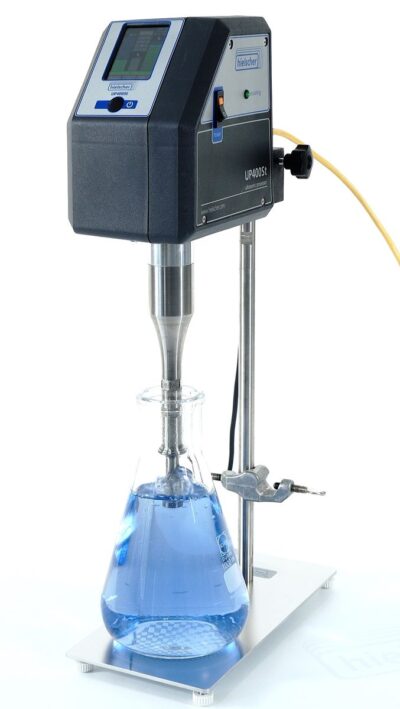
Sonicator i tipit sondë UP400St
Avantazhet e ozonimit të asistuar me ultratinguj
Ozone is also a strong oxidizing agent and is widely used for water and wastewater treatment. It can react directly with certain contaminants or decompose in water to form secondary oxidants such as hydroxyl radicals. However, ozonation can be limited by gas-liquid mass transfer, ozone solubility, and the selectivity of direct ozone reactions. Ultrasound helps overcome these limitations. Cavitation improves the dispersion of ozone gas in the liquid, reduces bubble size, renews the gas-liquid interface, and promotes turbulent micro-mixing. As a result, ozone dissolves more effectively and decomposes more readily into reactive radical species.
The combined effect is a more efficient oxidative environment. In sono-ozonation, ozone molecules may enter cavitation bubbles or concentrate near bubble interfaces, where they are exposed to intense thermal and mechanical conditions during collapse. This accelerates ozone decomposition and increases the formation of hydroxyl radicals and other reactive oxygen species. The process therefore improves the degradation rate of organic pollutants and can reduce treatment time compared with conventional ozonation. In many applications, sono-ozonation also improves mineralization, meaning that organic molecules are not only transformed into intermediate compounds but are further oxidized toward carbon dioxide, water, and inorganic ions.
One of the most important advantages of sono-ozonation is its ability to treat compounds that are resistant to conventional oxidation. Many environmental contaminants, including dyes, phenolic compounds, endocrine-disrupting chemicals, pharmaceutical residues, and surfactants, can be difficult to remove completely. Ozone may react selectively with electron-rich groups, while ultrasound-induced radicals can attack less selective molecular sites. The combination expands the range of oxidation pathways and improves the probability of contaminant breakdown. This makes sono-ozonation attractive for wastewater treatment, drinking water polishing, leachate treatment, process water recycling, and remediation of contaminated aqueous streams.
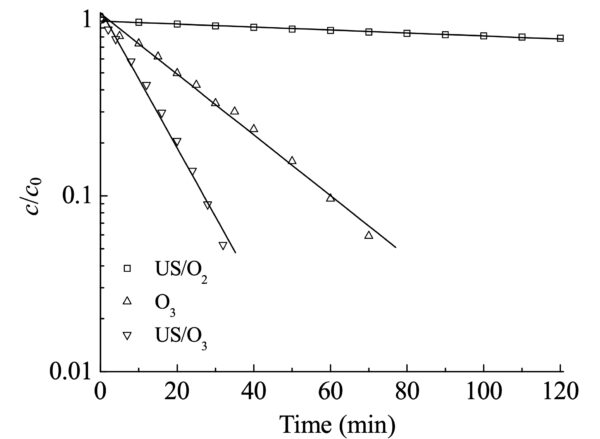
Degradimi i rendit të parë i p-nitrofenolit për shkak të sonikimit me O2, ozonimit dhe ozonimit sonolitik. Rrjedha e gazit O3 në 40 ml/min, pH=3, T=298 K. Përqendrimi fillestar i p-nitrofenolit ishte 50 mg/L. Gjenerimi i energjisë tejzanor i transduktorit ishte 125 W.
Grafik dhe studim: ©Xu et al., 2005
Aplikimet e Sono-Ozonimit
Sono-Ozonation is highly relevant for microbial inactivation. Ultrasound can physically disrupt microbial cells through shear forces, microjets, shock waves, and localized pressure changes. Ozone, meanwhile, oxidizes cell walls, membranes, enzymes, and genetic material. When both methods are applied together, the antimicrobial effect can be enhanced. Cavitation may weaken or damage cell structures, allowing ozone and radical species to attack more effectively. This combined action can improve disinfection performance against bacteria, fungi, algae, and other microorganisms. For applications where microbial control and organic contaminant degradation are both required, sono-ozonation offers a powerful multifunctional treatment approach.
Përtej degradimit kimik dhe aktivitetit antimikrobik, sono-ozonimi mund të përmirësojë vetitë fiziko-kimike të lëngjeve të trajtuara. Kavitacioni tejzanor rrit intensitetin e përzierjes, promovon degazimin dhe shpërndarjen e gazit dhe rrit kontaktin midis oksidantëve dhe ndotësve. Këto efekte mund të mbështesin reduktimin e ngjyrës, erës, kërkesës kimike për oksigjen, turbullirë dhe fraksioneve të caktuara organike zjarrduruese. Në disa procese, sono-ozonimi gjithashtu mund të përmirësojë trajtimin në rrjedhën e poshtme duke shndërruar substancat e qëndrueshme në komponime më të biodegradueshme, duke rritur kështu efikasitetin e hapave të trajtimit biologjik.
Reaktorë të mbyllur për përpunim efikas dhe shkallë të lehtë
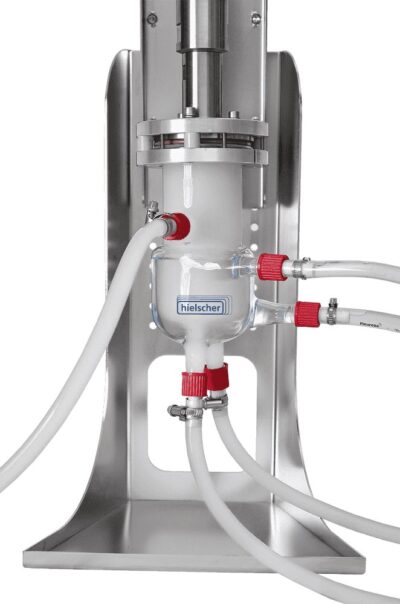
 A practical advantage of sono-ozonation is that it can be implemented in closed reactor systems. Hielscher probe-type sonicators are particularly suitable for this type of integration because they deliver high-intensity ultrasound directly into the liquid through a titanium sonotrode. The probe can be mounted into a closed vessel or flow-through reactor using appropriate ports, flanges, or fittings. At the same time, ozone can be introduced through a gas inlet, diffuser, sparger, or recirculation loop. This allows ultrasound and ozone to act simultaneously within the same reaction volume.
Such a setup is straightforward and scalable. The closed reactor contains the liquid to be treated, while the ultrasonic probe transfers acoustic energy directly into the medium. Ozone flows continuously or intermittently through the reactor, depending on the process requirements. The ultrasound improves ozone dispersion and contact with the liquid phase, while the closed configuration helps contain ozone safely and enables controlled off-gas handling. Excess ozone can be directed to an ozone destructor or suitable exhaust treatment system. Important operating parameters include ultrasonic amplitude, power input, treatment time, ozone concentration, gas flow rate, temperature, pressure, pH, and reactor geometry.
Sonicator UIP1000hdT me reaktor inline për sono-ozonim
Sonikatorët Hielscher për Ozonim dhe Oksidim të Avancuar
Sonikatorët Hielscher me sondë mund të përdoren për proceset batch ose të vazhdueshme të sono-ozonimit. Në zhvillimin laboratorik, ultrasonikatorët kompaktë lejojnë studiuesit të vlerësojnë kinetikën e reaksionit, degradimin e ndotësve, dhe reduktimin mikrobiologjik nën kushte të kontrolluara. Për operacion pilot dhe industrial, sistemet ultrasonike më të fuqishme mund të integrohen në tanka më të mëdha ose reaktorë rrjedhës kontinu. Për shkak se sonikimi me sondë fut energji në mënyrë efikase në lëng, ai është i përshtatshëm për intensifikimin e procesit ku kërkohet kavitatione e fortë dhe riprodhueshmëri e besueshme.
Sono-Ozonimi përfaqëson një metodë sinergjike shumë efektive që kombinon fuqinë kimike të oksidimit të ozonit me efektet fizike dhe sonokimike të ultratingujve. Procesi rrit formimin e radikaleve, përmirëson transferimin e masës gaz-lëng, përshpejton degradimin e ndotësve dhe rrit aktivitetin antimikrobik. Pajtueshmëria e tij me reaktorët e mbyllur dhe integrimi i drejtpërdrejtë i sonatorëve të tipit sondë Hielscher e bën sono-ozonimin një qasje praktike dhe të gjithanshme për trajtimin mjedisor, pastrimin e ujit, riparimin e ujërave të zeza dhe aplikimet e avancuara të oksidimit.
Tabela e mëposhtme ju jep një tregues të kapacitetit të përafërt të përpunimit të ultrasonikëve tanë:
| Vëllimi i grupit | Shkalla e rrjedhjes | Pajisjet e rekomanduara |
|---|---|---|
| 0.5 deri në 1.5mL | na | VialTweeter |
| 1 deri në 500 ml | 10 deri në 200 ml/min | UP100H |
| 10 deri në 2000 ml | 20 deri në 400 ml/min | UP200Ht, UP400 St |
| 0.1 deri në 20L | 0.2 deri në 4L/min | UIP2000hdT |
| 10 deri në 100 litra | 2 deri në 10 l/min | UIP4000hdT |
| 15 deri në 150 litra | 3 deri në 15 l/min | UIP6000hdT |
| na | 10 deri në 100 l/min | UIP16000hdT |
| na | më të mëdha | grumbull i UIP16000hdT |
Dizajn, Prodhim dhe Konsulencë – Cilësi e prodhuar në Gjermani
Ultrasonikët Hielscher janë të njohur për cilësinë e tyre më të lartë dhe standardet e dizajnit. Qëndrueshmëria dhe funksionimi i lehtë lejojnë integrimin e qetë të ultrasonikëve tanë në objektet industriale. Kushtet e vështira dhe mjediset kërkuese trajtohen lehtësisht nga ultrasonikët Hielscher.
Hielscher Ultrasonics është një kompani e certifikuar ISO dhe i kushton theks të veçantë ultratingujve me performancë të lartë që paraqesin teknologjinë më të fundit dhe lehtësinë ndaj përdorimit. Sigurisht, ultrasonikët Hielscher janë në përputhje me CE dhe plotësojnë kërkesat e UL, CSA dhe RoHs.

Hielscher Ultrasonics prodhon homogjenizues tejzanor me performancë të lartë për përzierjen e aplikimeve, shpërndarjen, emulsifikimin dhe nxjerrjen në shkallë laboratorike, pilot dhe industriale.
pyetjet e bëra shpesh
Çfarë është një proces i avancuar oksidimi (AOP)?
Një Proces i Avancuar i Oksidimit (AOP) është një metodë trajtimi kimik që gjeneron specie shumë reaktive të oksigjenit, veçanërisht radikalë hidroksil, për të oksiduar dhe degraduar kontaminantët organikë të qëndrueshëm në ujë, ujë të ndotur, ajër ose lëngje procesi.
Çfarë është Ozonimi?
Ozonimi është një proces oksidimi në të cilin gazi ozon injektohet në një rrjedhë lëngu ose gazi për të reaguar me ndotësit, mikroorganizmat, komponimet e erës apo ngjyruesit. Ai mund të veprojë me oksidim të drejtpërdrejtë nga ozoni ose në mënyrë indirekte përmes formimit të specieve radikale.
Çfarë është Ozone?
Ozone is a triatomic form of oxygen with the chemical formula O₃. It is a highly reactive, unstable oxidizing gas that decomposes to oxygen and reactive oxygen species, making it useful for disinfection, deodorization, and contaminant degradation.
Literatura / Referencat
- Moretti, A., E. Gover, G. Bisson, C. Comuzzi, D. Goi, M. Marino (2026): Evaluating Low-Frequency Ultrasound as a Pretreatment to Improve Ozonation Antimicrobial Efficacy in Urban Wastewater Treatment. Water Environment Research 98, no. 3: e70322.
- Rossi, G., Mainardis, M., Aneggi, E. et al. (2021): Combined ultrasound-ozone treatment for reutilization of primary effluent – a preliminary study. Environmental Science and Pollution Research 28, 2021. 700–710.
- Xu XW, Shi HX, Wang DH. (2005): Ozonation with ultrasonic enhancement of p-nitrophenol wastewater. J Zhejiang Univ Sci B. 2005 May;6(5):319-323.
- efikasitet të lartë
- teknologjinë më të fundit
- besueshmëria & qëndrueshmëri
- kontroll i rregullueshëm, i saktë i procesit
- grumbull & ne rresht
- për çdo vëllim
- softuer inteligjent
- karakteristika inteligjente (p.sh., të programueshme, protokollim të dhënash, kontroll në distancë)
- e lehtë dhe e sigurt për t'u përdorur
- mirëmbajtje e ulët
- CIP (i pastër në vend)
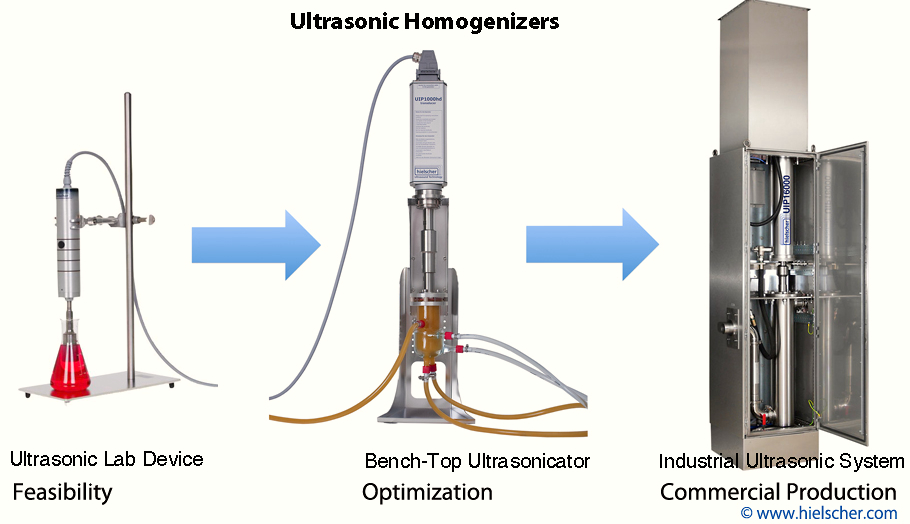
Hielscher Ultrasonics prodhon homogjenizues tejzanor me performancë të lartë nga laboratori te madhësia industriale.