Sonochemische Reduktion von Palladium-Nanopartikeln
Palladium (Pd) ist für seine katalytischen Eigenschaften bekannt und findet zudem breite Anwendung in der Materialforschung, der Elektronikfertigung, der Medizin, der Wasserstoffreinigung sowie in verschiedenen chemischen Anwendungen. Mithilfe eines sonochemischen Verfahrens lassen sich Größe und Morphologie von Palladiumpartikeln durch Anpassung des PVP/Pd-Verhältnisses steuern. Dies ermöglicht die Ultraschallsynthese entweder sehr feiner, monodisperser Nanopartikel oder größerer Palladiumaggregate, wodurch die Partikelgröße für eine optimale katalytische Leistung angepasst werden kann.
Ultraschall-gestützte Produktion von Palladium-Nanopartikeln
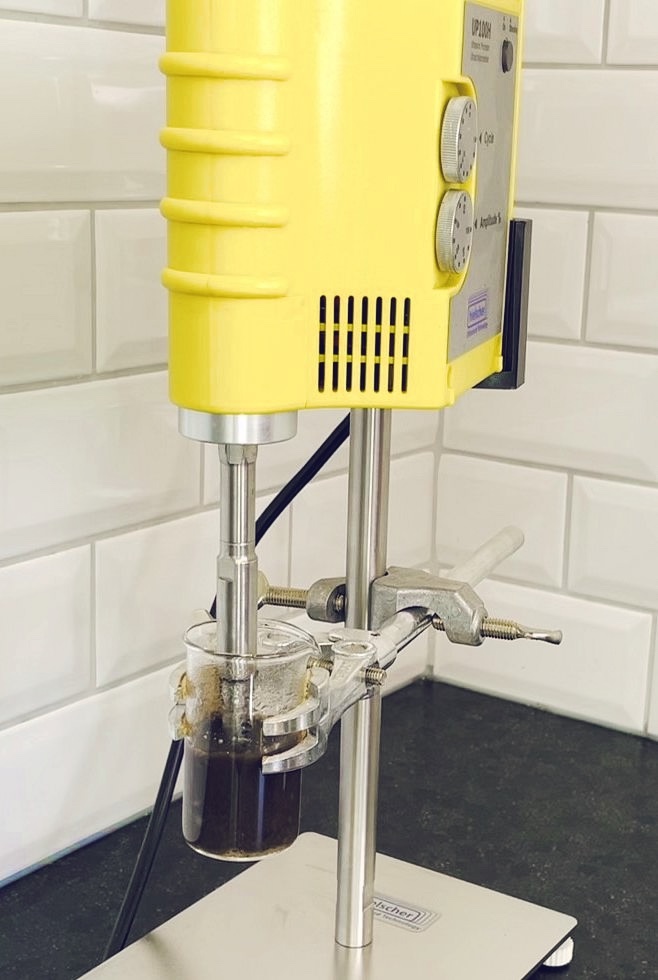 Die Reduktion von Palladium-Nanopartikeln mittels Ultraschall bietet einen schnellen und reagenzsparenden Weg zur Herstellung von Pd(0)-Nanopartikeln, indem durch akustische Kavitation lokal hochenergetische Bedingungen erzeugt und Radikale in der Lösung reduziert werden, wodurch Palladiumionen ohne herkömmliche Hochtemperaturverfahren reduziert werden können.
Ein wesentlicher Vorteil ist die Prozesssteuerung: Die Ultraschallbehandlungszeit und die Stabilisatorkonzentration, wie beispielsweise das PVP/Pd-Verhältnis, können beeinflussen, ob das Produkt als gut dispergierte, rundliche Nanopartikel mit einer Größe von etwa 5 nm oder als größere Aggregate mit einer Größe von etwa 20 nm vorliegt. Dies ist industriell relevant, da die Leistung von Palladium in der Katalyse stark von der Partikelgröße, der Morphologie, der Dispersion und der Oberfläche abhängt. Da Palladium-Nanopartikel als heterogene Katalysatoren, Elektrokatalysatoren und Funktionsmaterialien weit verbreitet sind, ist die Ultraschallreduktion attraktiv für die Herstellung fein dispergierter Pd-Katalysatoren unter vergleichsweise milden Flüssigphasenbedingungen – mit potenziellen Vorteilen für die chemische Synthese, die Umweltkatalyse, Brennstoffzellentechnologien und andere Prozesse, bei denen eine hohe katalytische Aktivität und eine effiziente Edelmetallausnutzung wirtschaftlich wichtig sind.

Industrielle Nanopartikelverarbeitung mit dem Beschallungsgerät UIP2000hdT
Verfahren zur Probenvorbereitung
Die Proben wurden wie folgt vorbereitet:
Für die Proben wurden 30ml EG und 5·10-6mol PVP wurden durch 15-minütiges Rühren mit einem Magnetrührer hergestellt. Den verschiedenen Proben wurden unterschiedliche Mengen an Pd(NO₃)₂-Lösung – 1,5 ml bzw. 2 ml – zugesetzt. Die Probenmischungen wurden im Verhältnis von 2·10-3mol Pd(NO₃)₂ in Probe (a) und 2,66·10-3mol Pd(NO₃)₂ in Probe (b). Beide Mischungen wurden in einem 20-ml-Küvettenfläschchen mit einem Ultraschallgerät mit Sonde beschallt. Proben wurden nach Beschallungszeiten von 30, 60, 90, 120, 150 und 180 min entnommen.
Die Analyse der Versuchsergebnisse zeigte, dass:
- (1) Die sonochemische Reduktion von Pd(II) zu Pd(0) ist von der Beschallungsdauer abhängig.
- 2. Das hohe Molverhältnis führt zur Bildung von einzeln/ mono-dispergierten Palladiumpartikeln mit runder Form und einem Durchmesser von ca. 5nm.
- 3. Das niedrige PVP/Pd(II) Molverhältnis zieht allerdings nach sich, dass Palladium-Nanopartikel aggregieren, so dass Aggregate mit ca. 20nm entstehen.
Der sonochemische Weg zur Reduktion von Palladium(II)-Ionen PD(II) zu Palladiumatomen Pd(0) lautet vermutlich folgendermaßen:
- (1) Wasserpyrolyse: H₂O → •OH + •H
- (2) Radikalbildung: RH (Reduktionsmittel) + •OH(•H) → •R + H₂O(H₂)
- (3) Ionenreduktion: Pd(II) + reduzierende Radikale (•H, •R) → Pd(0) + R•CHO + H+
- (4) Partikelbildung: nPd(0) → Pdn
Ergebnis: Je nach PVP/Pd(II)-Verhältnis wurde dispergiertes oder aggregiertes Pdn entstehen.
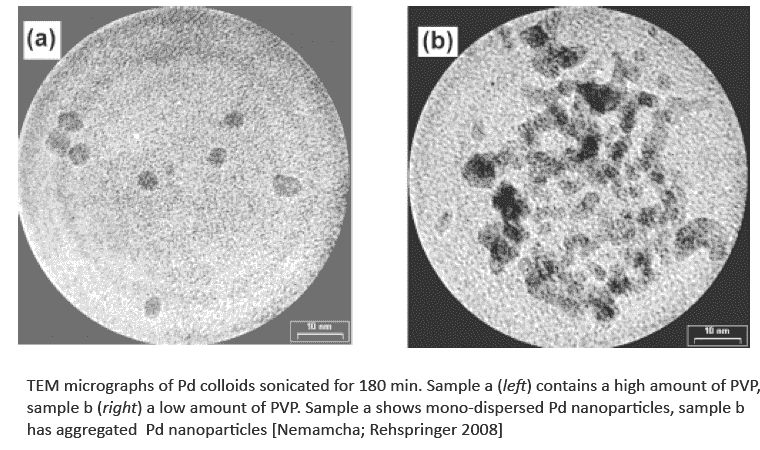
Sonochemische Reduktion von Palladium: Probe a (links) enthält einen hohen Anteil an PVP, Probe b (rechts) einen geringen Anteil an PVP. Ultraschallbehandlungsdauer mit dem UP100H: 180 min. Probe a weist monodisperse Pd-Nanopartikel auf, Probe b aggregierte Pd-Nanopartikel.
Bilder und Studie: ©Nemamcha und Rehspringer, 2008
Analyse und Ergebnis
Die spektrophotometrischen Analysen im UV-Bereich bestätigen die Korrelation zwischen der sonochemischen Reduktion der Palladium(II)-Ionen zu Palladium(0)-Atomen und der Verweilzeit im Ultraschallfeld. Die Reduktion der Palladium(II)-Ionen zu Palladium(0)-Atomen schreitet mit zunehmender Beschallungsdauer fort und kann durch Ultraschall vollständig erreicht werden. Die Aufnahmen mit dem Transmissionselektronenmikroskop (TEM) zeigen, dass:
- Wird eine hohe Menge an PVP zugegeben, führt die sonochemische Reduktion von Palladiumionen zur Bildung monodisperser Palladiumpartikel mit kugelförmiger Gestalt und einem mittleren Durchmesser von ca. 5 nm.
- Durch die Verwendung einer geringen Menge PVP entstehen Aggregate aus Palladium-Nanopartikeln. Die Messungen mittels dynamischer Lichtstreuung (DLS) zeigen, dass die Aggregate aus Palladium-Nanopartikeln eine breite Größenverteilung aufweisen, deren Zentrum bei 20 nm liegt.

Der Labor-Ultraschallapparat UP100H wurde zur Herstellung von Palladium-Nanopartikeln verwendet.

Palladium (Pd)-Nanopartikel können mittels Ultraschall synthetisiert werden
Design, Herstellung und Beratung – Qualität Made in Germany
Hielscher Ultraschallgeräte sind bekannt für höchste Qualität und Designstandards. Robustheit und einfache Bedienung ermöglichen die problemlose Integration unserer Ultraschallgeräte in industrielle Anlagen. Raue Bedingungen und anspruchsvolle Umgebungen sind für Hielscher Ultraschallgeräte kein Problem.
Hielscher Ultrasonics ist ein ISO-zertifiziertes Unternehmen und legt großen Wert darauf, Hochleistungs-Ultraschallgeräte zu entwickeln und zu produzieren, die sich durch modernste Technik und Benutzerfreundlichkeit auszeichnen. Selbstverständlich sind Hielscher Sonicators CE-konform und erfüllen die Anforderungen von UL, CSA und RoHs.
Literatur
- Nemamcha, A.; Rehspringer, J. L. (2008): Morphology of dispersed and aggregated PVV-Pd nanoparticles prepared by ultrasonic irradiation of Pd(NO₃)₂ solution in ethylene glycol. Rev. Adv. Mater. Sci. 18;2008. 685-688.
- Prekob, Á., Muránszky, G., Kocserha, I. et al. (2020): Sonochemical Deposition of Palladium Nanoparticles Onto the Surface of N-Doped Carbon Nanotubes: A Simplified One-Step Catalyst Production Method. Catalysis Letters 150, 2020. 505–513.
- Haitao Zheng, Mphoma S. Matseke, Tshimangadzo S. Munonde (2019): The unique Pd@Pt/C core-shell nanoparticles as methanol-tolerant catalysts using sonochemical synthesis. Ultrasonics Sonochemistry, Volume 57, 2019. 166-171.
Wissenswertes
Was ist Palladium?
Palladium ist ein seltenes, silberweißes Edelmetall mit dem chemischen Symbol Pd und der Ordnungszahl 46. Es gehört zu den Metallen der Platingruppe und wird geschätzt, weil es chemisch stabil ist, Strom leitet, Wasserstoff absorbiert und als hervorragender Katalysator wirkt. Fein verteiltes Palladium ist besonders wirksam bei Hydrierungs- und Dehydrierungsreaktionen, und erhitztes Palladium lässt Wasserstoff durch sich hindurchdiffundieren, was es für die Wasserstoffabscheidung und -reinigung nützlich macht.
Wofür werden Palladium-Nanopartikel verwendet?
Palladium-Nanopartikel werden hauptsächlich als Katalysatoren mit großer Oberfläche eingesetzt. Da Nanopartikel eine weitaus größere aktive Oberfläche aufweisen als massives Palladium, können sie die Katalysatoreffizienz verbessern und den Bedarf an teurem Edelmetall verringern. Zu den typischen Anwendungsbereichen zählen chemische Synthese, Hydrierungsreaktionen, Kohlenstoff-Kohlenstoff-Kupplungsreaktionen, Elektrokatalyse, Brennstoffzellenforschung, Wasserstoffsensorik und -speicherung, Umweltkatalyse sowie einige biomedizinische Forschungsbereiche wie antimikrobielle, photothermische und krebsbekämpfende Systeme. Das katalytische Verhalten von Palladium hängt stark von der Partikelgröße, der Morphologie und der Dispersion ab.
Palladium-Nanopartikel werden auch zur Dotierung anderer Partikel verwendet, um katalytische Eigenschaften zu erzielen. Erfahren Sie mehr über das Ultraschallverfahren zur Synthese von Pd/N-BCNT als Fischer-Tropsch-Katalysator!
Ist Palladium giftig?
Elementares metallisches Palladium gilt allgemein als wenig toxisch und hat keine bekannte biologische Funktion; Palladiumverbindungen, -salze, -stäube und nanoskalige Formen sollten jedoch mit Vorsicht gehandhabt werden. Eine Exposition am Arbeitsplatz oder im Labor kann je nach Verbindung und Expositionsweg zu Reizungen oder Sensibilisierung führen; so können beispielsweise Palladiumchlorid-Lösungen die Schleimhäute reizen. Für den industriellen Umgang lautet die praktische Antwort: Metallisches Palladium in großen Mengen birgt ein relativ geringes Risiko, doch Palladiumpulver, lösliche Palladiumsalze und Palladium-Nanopartikel sollten als potenziell gefährliche Stoffe behandelt werden – mit Staubschutz, Belüftung, Handschuhen, Augenschutz und ordnungsgemäßer Abfallentsorgung.