Ultralydsforstærkede reaktorer med fast leje
Ultralydbehandling kan forbedre katalytiske reaktioner i fastlejsreaktorer, hovedsageligt ved at intensivere masseoverførslen omkring og inde i det pakkede katalysatorleje. Derudover fjerner ultralydbehandlingen passiverings- og tilsmudsningslag fra katalysatoroverfladen og regenererer dermed katalysatoren løbende.
Hvordan ultralydsbehandling forbedrer katalyse i fast leje
I en fastlejesreaktor forbliver katalysatorpartiklerne stationære, mens flydende, gasformige eller flerfasede reaktanter strømmer gennem lejet. Reaktionsydelsen begrænses ofte af ekstern masseoverførsel, porediffusion, kanalisering, tilstopning og varmeoverførselsgradienter. Ultralyd kan mindske flere af disse begrænsninger ved at frembringe akustisk kavitation, mikrostrømning, forskydningskræfter og tryksvingninger.

Soniker UIP2000hdT integreret i en fastlejerreaktor
Vigtige effekter af ultralydsforstærkede reaktioner i fast leje
- Forbedret ekstern masseoverførsel: Ultralydsbaseret mikrostrømning mindsker det stillestående grænselag omkring katalysatorpartiklerne, hvilket gør det muligt for reaktanterne at nå de aktive steder mere effektivt.
- Forbedret adgang til porerne: Kavitationsbetingede trykudsving og væskebevægelser kan forbedre reaktanternes indtrængning i katalysatorens porer og fjernelsen af produkter fra porerne.
- Reduktion af tilsmudsning og passivering: Ultralydsbehandling kan bidrage til at fjerne aflejringer, polymerfilm, koksforstadier eller andre passiverende lag fra katalysatoroverfladerne, hvilket sikrer, at den katalytiske aktivitet opretholdes i længere tid.
- Reduceret kanalering i pakkede lejer: I undersøgelser af mikropakket leje har ultralyd vist sig at ændre strømningsadfærden og mindske spredningen, hvilket bidrager til, at reaktoren nærmer sig en mere ideel plug-flow-adfærd.
- Forbedret varmeoverførsel: Akustisk strømning og turbulens forbedrer den lokale varmeafledning, hvilket mindsker forekomsten af varme- eller kuldeområder i katalysatorlejet.
- Højere konverteringsgrad og udbytte: Ved at forbedre masseoverførslen og adgangen til katalysatoren kan ultralydsbehandling øge reaktionshastigheden, omdannelsesgraden og produktudbyttet, især når reaktionen er transportbegrænset snarere end rent kinetisk begrænset.
Forbedret kontakt mellem væske og fast stof: Ultralyd fremmer en bedre befugtning af katalysatorpartiklerne, hvilket er særligt nyttigt i dryp-leje-, slurry-fodrede eller fastleje-systemer i væskefase.
Hvordan forbedrer ultralydsbehandling katalysen i et fast leje?
Den primære mekanisme er akustisk kavitation: Ultralydsbølger danner mikroskopiske bobler, der vokser og kollapser voldsomt. Deres kollaps genererer lokal forskydning, mikrostråler, chokbølger og intens omrøring. I nærheden af katalysatoroverflader kan disse effekter rense, aktivere og forny grænsefladen mellem fast stof og væske. I oversigtsartikler om sonokatalyse beskrives dette som en synergi mellem ultralyd og faste katalysatorer, der medfører forbedret varmeoverførsel, masseoverførsel og lokaliserede effekter ved de katalytiske overflader.
Ultralydbehandling er mest effektiv, når reaktionen i et fast leje er præget af:
- langsom diffusion ind i katalysatorens porer,
- dårlig befugtning af katalysatorpartiklerne,
- ophobning af produkt i porerne,
- tilsmudsning eller overfladepassivering,
- kinetik begrænset af masseoverførsel,
- ujævn fordeling i flerfasestrømning,
- gennemstrømning gennem det pakkede leje.
Katalysatorer med fast leje
Faste senge (nogle gange også kaldet pakket bed) er almindeligvis fyldt med katalysatorpiller, som normalt er granulater med diametre fra 1-5 mm. De kan læsses ind i reaktoren i form af et enkelt leje, som separate skaller eller i rør. Katalysatorerne er for det meste baseret på metaller som nikkel, kobber, osmium, platin og rhodium.
Effekterne af kraftig ultralyd på heterogene kemiske reaktioner er velkendte og udnyttes i vid udstrækning i industrielle katalytiske processer. Katalytiske reaktioner i en fastlejerreaktor drager ligeledes fordel af ultralydsbehandling. Ultralydsbestråling af fastlejekatalysatoren skaber meget reaktive overflader, øger massetransporten mellem væskefasen (reaktanterne) og katalysatoren og fjerner passiverende belægninger (f.eks. oxidlag) fra overfladen.
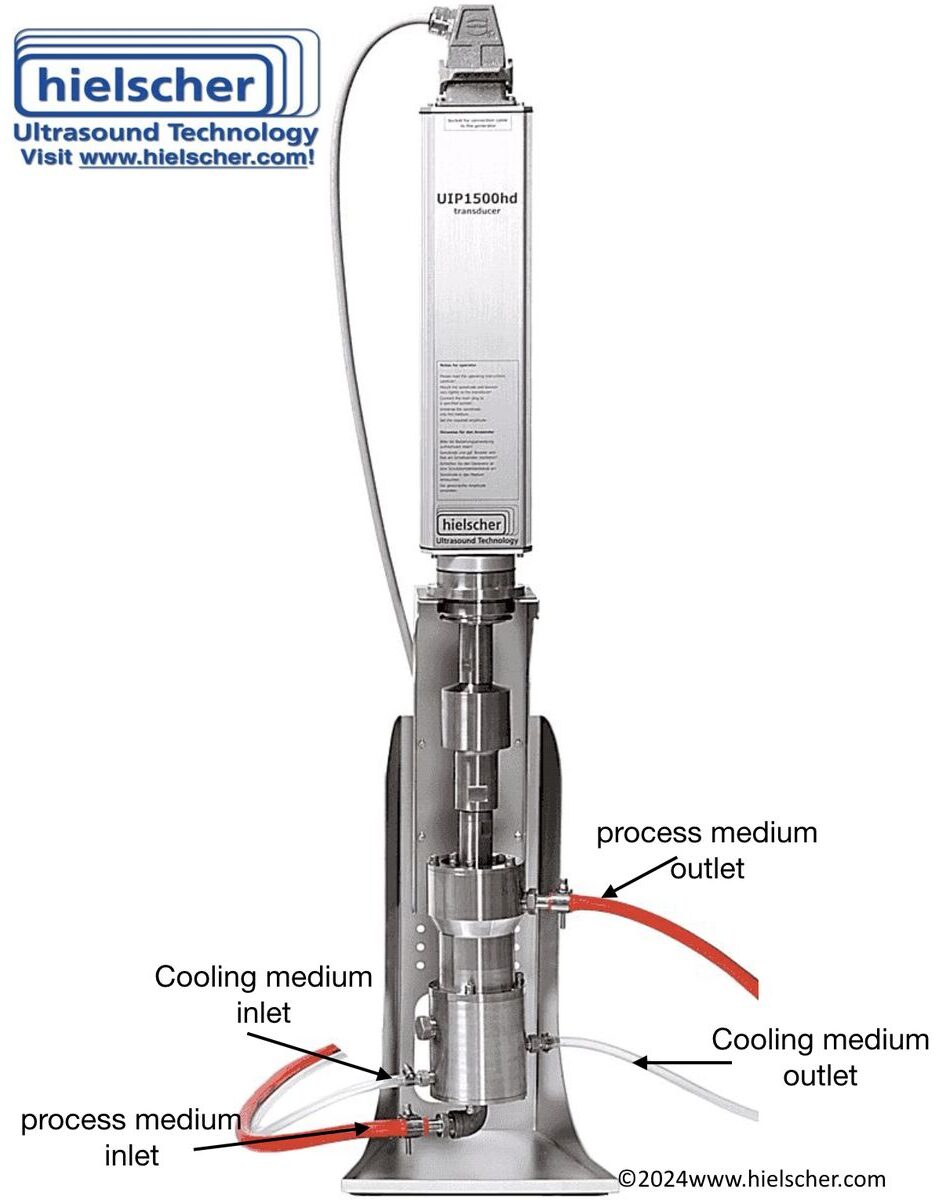
Sonicator UIP1500hdT med gennemstrømningscelle til reaktivering og genanvendelse af brugte katalysatorer
- Forbedret effektivitet
- Øget reaktivitet
- Øget konverteringsrate
- Højere udbytte
- Genanvendelse af katalysator
Ultralydsintensivering af katalytiske reaktioner
Ultralydsblanding og omrøring forbedrer kontakten mellem reaktant- og katalysatorpartikler, skaber meget reaktive overflader og initierer og / eller forbedrer den kemiske reaktion.
Ultralydskatalysatorforberedelse kan forårsage ændringer i krystallisationsadfærd, dispersion / deagglomerering og overfladeegenskaber. Desuden kan egenskaberne ved præformede katalysatorer påvirkes ved at fjerne passiverende overfladelag, bedre dispersion, øge masseoverførslen.
Eksempler på reaktioner, der er forbedret ved hjælp af ultralyd
- Ultralydsforbehandling af Ni-katalysator til hydrogeneringsreaktioner
- Sonikeret Raney Ni-katalysator med vinsyre resulterer i en meget høj enantioselektivitet
- Ultralydssyntetiserede Fischer-Tropsch-katalysatorer
- Sonokemisk behandlede amorfe pulverkatalysatorer for øget reaktivitet
- Sono-syntese af amorfe metalpulvere
Gendannelse af ultralydskatalysator
Faste katalysatorer i fastlejsreaktorer anvendes typisk i form af sfæriske perler, pellets, ekstruderede produkter eller cylindriske partikler. Under kemiske reaktioner kan katalysatoroverfladen blive passiveret af et aflejringslag, hvilket medfører et gradvist tab af katalytisk aktivitet og/eller selektivitet over tid.
Tidsrammen for katalysatorens deaktivering varierer betydeligt. For eksempel kan deaktiveringen af en krakningskatalysator finde sted inden for få sekunder, mens en jernkatalysator, der anvendes til ammoniaksyntese, kan forblive aktiv i 5–10 år. Ikke desto mindre observeres katalysatorens deaktivering i stort set alle katalytiske processer. Selvom der kan forekomme forskellige deaktiveringsmekanismer – herunder kemisk, mekanisk og termisk nedbrydning – Aflejringer er en af de mest almindelige årsager til katalysatorens nedbrydning.
Med »tilstopning« menes den fysiske afsætning af stoffer fra væskefasen på katalysatoroverfladen og inde i dens porer. Disse aflejringer blokerer reaktive steder, begrænser adgangen til porerne og mindsker kontakten mellem reaktanterne og den aktive katalysatoroverflade. Tilstopning af katalysatoren med koks eller kulstofholdige aflejringer er ofte en hurtig proces; i mange tilfælde kan den dog delvist eller fuldstændigt vendes ved hjælp af ultralydsregenerering.
Ultralydskavitation er en effektiv metode til fjernelse af passiverende belægningslag fra katalysatoroverflader. Under ultralydsbehandlingen genererer højintensivt ultralyd kavitationsbobler i et flydende medium. Når disse bobler kollapser, frembringes lokaliserede forskydningskræfter, mikrostråler, chokbølger og intens mikroblanding. Disse effekter bidrager til at løsne forureningsrester fra katalysatoroverfladen, genåbne tilstoppede porer og genoprette adgangen til de aktive steder.
Genvinding af katalysatorer ved hjælp af ultralyd foregår typisk ved at dispergere katalysatorpartiklerne i en væske, såsom deioniseret vand eller et egnet opløsningsmiddel, og udsætte suspensionen for en kontrolleret ultralydsbehandling. Denne proces kan fjerne tilsmudsningsrester fra forskellige katalysatormaterialer, herunder platin/silicafiber-katalysatorer, nikkelkatalysatorer og andre metal-katalysatorer på bærer. Som følge heraf kan ultralydsbehandling bidrage til regenerering af katalysatoren, forlænget levetid for katalysatoren og forbedret bæredygtighed i processen.
Klik her for at læse mere om ultralydsregenerering af udtjente katalysatorer!
Ultralydsenheder til integration i kemiske reaktorer
 Hielscher Ultrasonics tilbyder forskellige ultralydsprocessorer og variationer til integration af ultralyd i reaktorer med fast leje. Forskellige ultralydssystemer er tilgængelige til installation i reaktorer med fast bed. Til mere komplekse reaktortyper tilbyder vi Tilpasset ultralyd Løsninger.
Lær, hvordan ultralyd forbedrer kemiske reaktioner i forskellige reaktortyper!
Hvis du vil undersøge, hvordan ultralyd påvirker din kemiske reaktion, er du velkommen til at besøge vores ultralydslaboratorium og tekniske center i Teltow!
Kontakt os i dag! Vi er glade for at diskutere ultralydsintensiveringen af din kemiske proces med dig!
Tabellen nedenfor giver dig en indikation af den omtrentlige behandlingskapacitet for Hielschers sonikatorer:

Ultralyd flowsystem
- Hydrogenering
- Alcylering
- Cyanering
- Etherificering
- Esterificering
- polymerisering
- Allylering
- Bromering
(f.eks. Ziegler-Natta-katalysatorer, metallocener)
Litteratur / Referencer
- Francisco J. Navarro-Brull; Andrew R. Teixeira; Jisong Zhang; Roberto Gómez; Klavs F. Jensen (2018): Reduction of Dispersion in Ultrasonically-Enhanced Micropacked Beds. Industrial & Engineering Chemistry Research 57, 1; 2018. 122–128.
- Yasuo Tanaka (2002): A dual purpose packed-bed reactor for biogas scrubbing and methane-dependent water quality improvement applying to a wastewater treatment system consisting of UASB reactor and trickling filter. Bioresource Technology, Volume 84, Issue 1, 2002. 21-28.
- Argyle, M.D.; Bartholomew, C.H. (2015): Heterogeneous Catalyst Deactivation and Regeneration: A Review. Catalysts 2015, 5, 145-269.
- Oza, R.; Patel, S. (2012): Recovery of Nickel from Spent Ni/Al2O3 Catalysts using Acid Leaching, Chelation and Ultrasonication. Research Journal of Recent Sciences Vol. 1; 2012. 434-443.
- Sana, S.; Rajanna, K.Ch.; Reddy, K.R.; Bhooshan, M.; Venkateswarlu, M.; Kumar, M.S.; Uppalaiah, K. (2012): Ultrasonically Assisted Regioselective Nitration of Aromatic Compounds in Presence of Certain Group V and VI Metal Salts. Green and Sustainable Chemistry, 2012, 2, 97-111.
- Suslick, K. S.; Skrabalak, S. E. (2008): “Sonocatalysis” In: Handbook of Heterogeneous Catalysis, vol. 4; Ertl, G.; Knözinger, H.; Schüth, F.; Weitkamp, J., (Eds.). Wiley-VCH: Weinheim, 2008. 2006-2017.
Fakta, der er værd at vide
Hvad er ultralydskavitation?
Ultralydskavitation er dannelsen, væksten og det voldsomme sammenbrud af mikroskopiske damp- eller gasbobler i en væske, der udsættes for højintensivt ultralyd. Under boblernes sammenbrud kan der i meget korte perioder opstå ekstreme lokale forhold, herunder høj temperatur, højt tryk, chokbølger, mikrostråler og intense forskydningskræfter.
Hvad er sonokemi?
Sono-kemi er anvendelsen af disse ultralydskavitationsvirkninger til at igangsætte, fremskynde eller modificere kemiske og fysisk-kemiske processer. Det er især relevant i væskefasesystemer, da kavitation forbedrer blanding, masseoverførsel, emulgering, partikeldispersion, rensning af katalysatoroverflader og, i visse tilfælde, dannelsen af frie radikaler. Som følge heraf anvendes sonokemi til at intensivere reaktioner såsom heterogen katalyse, oxidation, ekstraktion, polymerisering, krystallisering og syntese af nanomaterialer.
Hvad er en heterogen katalytisk reaktion?
I kemi refererer heterogen katalyse til den type katalytisk reaktion, hvor faserne af katalysatoren og reaktanterne adskiller sig fra hinanden. I forbindelse med heterogen kemi bruges fase ikke kun til at skelne mellem fast, flydende og gas, men det refererer også til ikke-blandbare væsker, f.eks. olie og vand.
Under en heterogen reaktion gennemgår en eller flere reaktanter en kemisk ændring ved en grænseflade, f.eks. på overfladen af en fast katalysator.
Reaktionshastigheden afhænger af koncentrationen af reaktanter, partikelstørrelsen, temperaturen, katalysatoren og yderligere faktorer.
Reaktant koncentration: Generelt øger en stigning i koncentrationen af en reaktant reaktionshastigheden på grund af den større grænseflade og derved større faseoverførsel mellem reaktantpartikler.
Partikelstørrelse: Når en af reaktanterne er en fast partikel, kan den ikke vises i hastighedsligningen, da hastighedsligningen kun viser koncentrationer, og faste stoffer ikke kan have en koncentration, da de er i en anden fase. Imidlertid påvirker partikelstørrelsen af det faste stof reaktionshastigheden på grund af det tilgængelige overfladeareal til faseoverførsel.
Reaktionstemperatur: Temperaturen er relateret til hastighedskonstanten via Arrhenius-ligningen: k = Ae-Ea/RT
Hvor Ea er aktiveringsenergien, er R den universelle gaskonstant og T er den absolutte temperatur i Kelvin. A er Arrhenius-faktoren (frekvens). e-Ea/RT angiver antallet af partikler under kurven, der har energi større end aktiveringsenergien, Ea.
Katalysator: I de fleste tilfælde sker reaktioner hurtigere med en katalysator, fordi de kræver mindre aktiveringsenergi. Heterogene katalysatorer giver en skabelonoverflade, hvor reaktionen finder sted, mens homogene katalysatorer danner mellemprodukter, der frigiver katalysatoren under et efterfølgende trin i mekanismen.
Andre faktorer: Andre faktorer såsom lys kan påvirke visse reaktioner (fotokemi).
Hvilke former for katalysatordeaktivering findes der?
- Katalysatorforgiftning er betegnelsen for den stærke kemisorption af arter på katalytiske steder, der blokerer steder for katalytisk reaktion. Forgiftning kan være reversibel eller irreversibel.
- Tilsmudsning refererer til en mekanisk nedbrydning af katalysatoren, hvor arter fra væskefase aflejres på den katalytiske overflade og i katalysatorporer.
- Termisk nedbrydning og sintring resulterer i tab af katalytisk overfladeareal, støtteareal og aktive fasestøttereaktioner.
- Dampdannelse betyder en kemisk nedbrydningsform, hvor gasfasen reagerer med katalysatorfasen for at producere flygtige forbindelser.
- Damp-faste og faste-faste reaktioner resulterer i kemisk deaktivering af katalysatoren. Damp, støtte eller promotor reagerer med katalysatoren, så der produceres en inaktiv fase.
- Nedslidning eller knusning af katalysatorpartiklerne resulterer i tab af katalytisk materiale på grund af mekanisk slid. Katalysatorens indre overfladeareal går tabt på grund af mekanisk induceret knusning af katalysatorpartiklen.
Læs mere om, hvordan ultralyd kan genaktivere udtjente katalysatorer!
Hvad er nukleofil substitution?
Nukleofil substitution er en grundlæggende reaktionsklasse inden for organisk (og uorganisk) kemi, hvor et nukleofil selektivt danner en binding i form af en Lewis-base (som elektronpar-donor) med et organisk kompleks eller angriber den positive eller delvist positive (+) ladning af et atom eller en gruppe af atomer for at erstatte en afgående gruppe. Det positive eller delvist positive atom, som er elektronparacceptoren, kaldes et elektrofil. Den samlede molekylære enhed bestående af elektrofilet og den afgående gruppe kaldes normalt substratet.
Den nukleofile substitution kan observeres som to forskellige veje – SN1 og SN2 reaktion. Hvilken form for reaktionsmekanisme – sN1 eller SN2 – finder sted, afhænger af strukturen af de kemiske forbindelser, typen af nukleofil og opløsningsmidlet.