Ultrasonically Intensified Fixed Bed Reactor(초음파 강화 고정층 반응기)
초음파 처리는 주로 충진된 촉매층 주변 및 내부에서 물질 이동을 강화함으로써 고정층 반응기 내의 촉매 반응을 개선할 수 있습니다. 또한, 초음파 처리는 촉매 표면의 패시베이션층과 오염층을 제거하여 촉매를 지속적으로 재생시킵니다.
초음파 처리가 고정층 촉매 반응을 어떻게 개선하는가
고정층 반응기에서는 촉매 입자가 고정된 상태로 유지되는 반면, 액체, 기체 또는 다상 반응물이 반응층을 통과하여 흐릅니다. 반응 성능은 대개 외부 물질 전달, 기공 내 확산, 채널링, 오염 및 열전달 구배에 의해 제한을 받습니다. 초음파는 음향 캐비테이션, 미세 유동, 전단력 및 압력 진동을 발생시켜 이러한 제한 요인 중 상당수를 줄일 수 있습니다.

소닉 케이터 UIP2000hdT 고정층 반응기에 통합됨
초음파 강화 고정층 반응의 주요 효과
- 개선된 외부 물질 전달: 초음파 미세유동은 촉매 입자 주변의 정체된 경계층을 줄여주어, 반응물들이 활성 부위에 더 효율적으로 도달할 수 있게 합니다.
- 모공 접근성 향상: 캐비테이션에 의한 압력 변동과 액체의 이동은 반응물이 촉매 기공으로 침투하는 것과 생성물이 기공에서 제거되는 과정을 촉진할 수 있다.
- 오염 감소 및 부동태화: 초음파 처리는 촉매 표면의 침전물, 고분자 막, 코크스 전구체 또는 기타 패시베이션 층을 제거하는 데 도움이 되어 촉매 활성을 더 오랫동안 유지할 수 있게 해줍니다.
- 충진층에서 채널링 현상 감소: 미세충진층 연구에 따르면, 초음파는 유동 거동을 변화시키고 분산을 감소시켜 반응기가 보다 이상적인 플러그 흐름 거동에 가까워지도록 돕는 것으로 밝혀졌다.
- 향상된 열 전달: 음향 스트리밍과 난류는 국부적인 열 방출을 촉진하여 촉매층 내의 과열 부위나 저온 구역을 줄여줍니다.
- 더 높은 전환율과 수율: 초음파 처리는 물질 전달 및 촉매 접근성을 향상시킴으로써, 특히 반응이 순수한 동역학적 제한이 아닌 전달 제한에 의해 좌우되는 경우 반응 속도, 전환율 및 생성물 수율을 높일 수 있다.
액체-고체 접촉 개선: 초음파는 촉매 입자의 습윤성을 향상시키며, 이는 특히 트리클 베드, 슬러리 공급 방식 또는 액상 고정층 시스템에서 유용합니다.
초음파 처리는 고정층 촉매 반응을 어떻게 개선하는가?
주요 작용 기전은 음향 캐비테이션입니다. 초음파는 미세한 기포를 생성하며, 이 기포들은 성장했다가 격렬하게 붕괴됩니다. 기포의 붕괴로 인해 국부적인 전단력, 미세 분사류, 충격파 및 강력한 혼합 현상이 발생합니다. 촉매 표면 근처에서 이러한 효과는 고체-액체 계면을 세정하고, 활성화하며, 재생시킬 수 있습니다. 초음파 촉매 반응에 대한 문헌 고찰에서는 이를 초음파와 고체 촉매 간의 시너지 효과로 설명하며, 여기에는 열전달 및 물질전달의 향상과 촉매 표면에서의 국소적 효과가 포함됩니다.
고정층 반응에서 다음과 같은 문제가 발생할 때 초음파 처리가 가장 효과적입니다:
- 촉매 기공으로의 느린 확산,
- 촉매 입자의 습윤성이 불량한,
- 모공 내부의 제품 잔여물,
- 오염 또는 표면 패시베이션,
- 질량 전달에 의해 제한되는 반응 속도론,
- 다상 유동의 불균일 분포,
- 충진층을 통과하며.
고정층 촉매
고정 베드(때로는 포장 베드라고도 함)에는 일반적으로 촉매 펠릿이 적재되어 있으며, 이는 일반적으로 직경이 1-5mm인 과립입니다. 그들은 단일 베드, 별도의 쉘 또는 튜브 형태로 반응기에 적재 할 수 있습니다. 촉매는 주로 니켈, 구리, 오스뮴, 백금 및 로듐과 같은 금속을 기반으로 합니다.
고출력 초음파가 이종 화학 반응에 미치는 영향은 잘 알려져 있으며, 산업용 촉매 공정에서 널리 활용되고 있습니다. 고정층 반응기 내의 촉매 반응 역시 초음파 처리를 통해 이점을 얻습니다. 고정층 촉매에 초음파를 조사하면 반응성이 높은 표면이 생성되고, 액상(반응물)과 촉매 간의 물질 전달이 증가하며, 표면의 부동태화 피막(예: 산화막)이 제거됩니다.
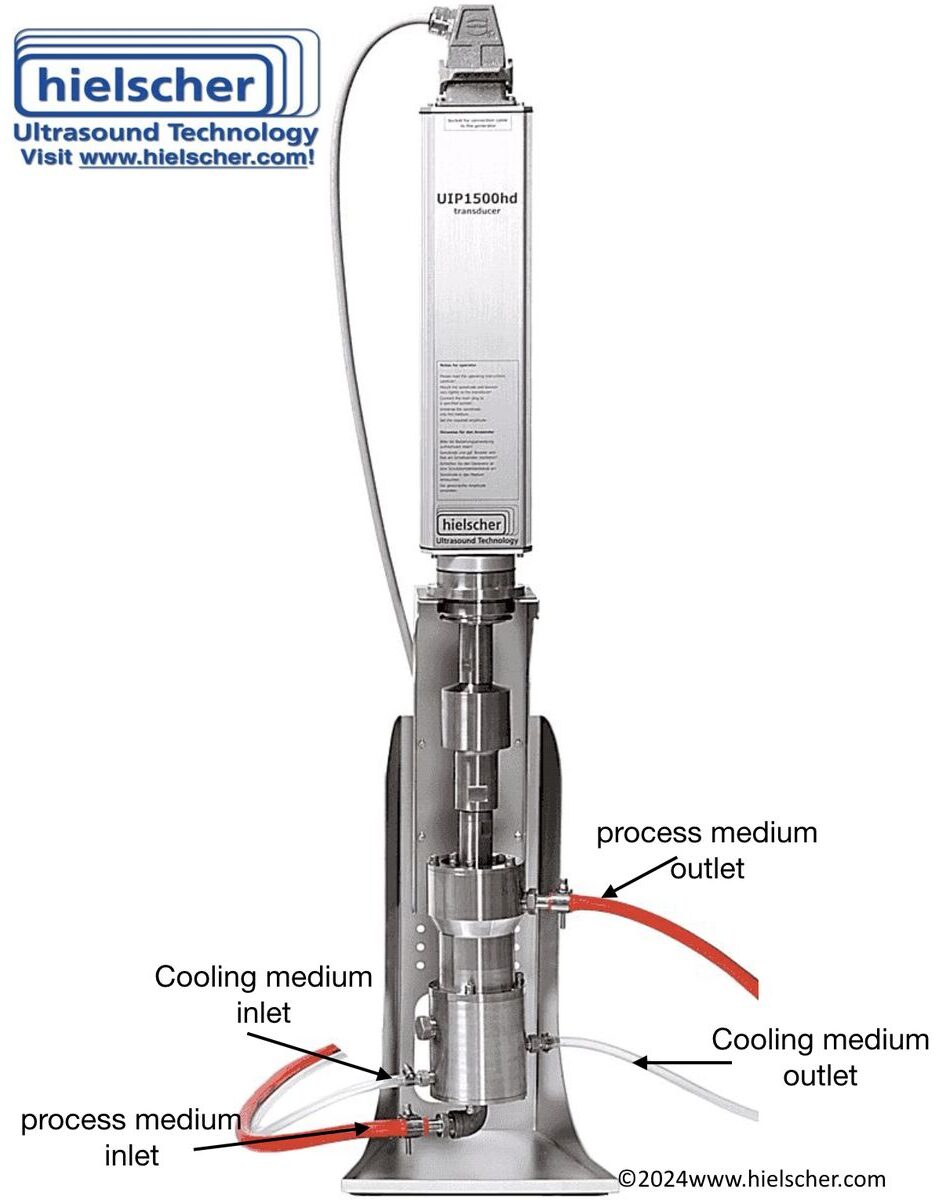
사용 후 촉매의 재활성화 및 재활용을 위한 유동 셀이 장착된 소니케이터 UIP1500hdT
- 효율성 향상
- 반응성 증가
- 전환율 증가
- 더 높은 수율
- 촉매의 재활용
촉매 반응의 초음파 강화
초음파 혼합 및 교반은 반응물과 촉매 입자 사이의 접촉을 개선하고 반응성이 높은 표면을 생성하며 화학 반응을 시작 및/또는 향상시킵니다.
초음파 촉매 제조는 결정화 거동, 분산/응집 해제 및 표면 특성의 변화를 일으킬 수 있습니다. 또한, 미리 형성된 촉매의 특성은 부동태화 표면층을 제거하고, 분산을 개선하고, 물질 전달을 증가시킴으로써 영향을 받을 수 있습니다.
초음파를 통해 반응 효율이 향상된 사례
- 수소화 반응을 위한 Ni 촉매의 초음파 전처리
- 주석산이 있는 초음파 처리된 Raney Ni 촉매는 매우 높은 거울상 선택성을 제공합니다.
- 초음파 합성 피셔-트로프슈 촉매
- 반응성 증가를 위해 Sonochemically 처리된 비정질 분말 촉매
- 비정질 금속 분말의 Sono 합성
초음파 촉매 회수
고정층 반응기에서 고체 촉매는 일반적으로 구형 비드, 펠릿, 압출물 또는 원통형 입자의 형태로 사용된다. 화학 반응이 진행되는 동안 촉매 표면은 오염층에 의해 부동태화될 수 있으며, 이로 인해 시간이 지남에 따라 촉매 활성과/또는 선택성이 점차 저하된다.
촉매 비활성화의 시간적 범위는 상당히 다양하다. 예를 들어, 분해 촉매의 비활성화는 몇 초 만에 일어날 수 있는 반면, 암모니아 합성에 사용되는 철 촉매는 5~10년 동안 활성을 유지할 수 있다. 그럼에도 불구하고, 촉매 비활성화는 사실상 모든 촉매 반응 과정에서 관찰된다. 비록 다양한 비활성화 메커니즘이 발생할 수 있지만 – 화학적, 기계적, 열적 열화 등을 포함하여 – 오염은 촉매 성능 저하의 가장 흔한 원인 중 하나입니다.
‘오염’이란 유체 상에 존재하는 물질이 촉매 표면 및 기공 내부에 물리적으로 침착되는 현상을 말합니다. 이러한 침착물은 반응 부위를 막고, 기공 접근성을 제한하며, 반응물과 활성 촉매 표면 간의 접촉을 감소시킵니다. 코크스나 탄소질 침전물에 의한 촉매 파울링은 대개 급속하게 진행되지만, 많은 경우 초음파 재생 처리를 통해 부분적으로 또는 완전히 회복될 수 있습니다.
초음파 캐비테이션은 촉매 표면의 부동태화 오염층을 제거하는 효과적인 방법입니다. 초음파 처리가 진행되는 동안 고강도 초음파는 액체 매체 내에서 캐비테이션 기포를 생성합니다. 이 기포가 붕괴되면서 국소적인 전단력, 미세 제트, 충격파 및 강렬한 미세 혼합 현상이 발생합니다. 이러한 효과는 촉매 표면의 오염 잔류물을 분리하고, 막힌 기공을 다시 열며, 활성 부위로의 접근을 회복하는 데 도움을 줍니다.
초음파를 이용한 촉매 회수는 일반적으로 촉매 입자를 탈이온수나 적절한 용매와 같은 액체에 분산시킨 후, 이 현탁액을 제어된 초음파 처리에 노출시키는 방식으로 수행됩니다. 이 공정을 통해 백금/실리카 섬유 촉매, 니켈 촉매 및 기타 지지체 부착 금속 촉매를 비롯한 다양한 촉매 물질에서 오염 잔류물을 제거할 수 있습니다. 결과적으로, 초음파 처리는 촉매 재생, 촉매 수명 연장, 공정 지속 가능성 향상에 기여할 수 있습니다.
사용 후 촉매의 초음파 재생 기술에 대해 더 자세히 알아보려면 여기를 클릭하세요!
화학 반응기에 통합하기 위한 초음파 처리기
 Hielscher 초음파는 전력 초음파를 고정층 반응기에 통합하기위한 다양한 초음파 프로세서와 변형을 제공합니다. 다양한 초음파 시스템을 고정층 반응기에 설치할 수 있습니다. 더 복잡한 반응기 유형의 경우 다음을 제공합니다. 맞춤형 초음파 솔루션.
초음파 처리가 다양한 반응기 설계에서 화학 반응을 어떻게 향상시키는지 알아보세요!
초음파 처리가 화학 반응에 미치는 영향을 테스트해 보시려면, 텔토우에 위치한 당사의 초음파 공정 연구실 및 기술 센터를 방문해 주시기 바랍니다!
오늘 저희에게 연락하십시오! 우리는 당신과 함께 화학 공정의 초음파 강화에 대해 논의하게되어 기쁩니다!
아래 표는 Hielscher 소닉레이터의 대략적인 처리 용량을 나타냅니다:

초음파 흐름 시스템
- 수소 첨가
- 알실화(Alcylation)
- 시안화
- 에테르화
- 에스테르화
- 중합
- 앨릴화(Allylation)
- 브롬화
(예: Ziegler-Natta 촉매, 메탈로센)
문헌 / 참고문헌
- Francisco J. Navarro-Brull; Andrew R. Teixeira; Jisong Zhang; Roberto Gómez; Klavs F. Jensen (2018): Reduction of Dispersion in Ultrasonically-Enhanced Micropacked Beds. Industrial & Engineering Chemistry Research 57, 1; 2018. 122–128.
- Yasuo Tanaka (2002): A dual purpose packed-bed reactor for biogas scrubbing and methane-dependent water quality improvement applying to a wastewater treatment system consisting of UASB reactor and trickling filter. Bioresource Technology, Volume 84, Issue 1, 2002. 21-28.
- Argyle, M.D.; Bartholomew, C.H. (2015): Heterogeneous Catalyst Deactivation and Regeneration: A Review. Catalysts 2015, 5, 145-269.
- Oza, R.; Patel, S. (2012): Recovery of Nickel from Spent Ni/Al2O3 Catalysts using Acid Leaching, Chelation and Ultrasonication. Research Journal of Recent Sciences Vol. 1; 2012. 434-443.
- Sana, S.; Rajanna, K.Ch.; Reddy, K.R.; Bhooshan, M.; Venkateswarlu, M.; Kumar, M.S.; Uppalaiah, K. (2012): Ultrasonically Assisted Regioselective Nitration of Aromatic Compounds in Presence of Certain Group V and VI Metal Salts. Green and Sustainable Chemistry, 2012, 2, 97-111.
- Suslick, K. S.; Skrabalak, S. E. (2008): “Sonocatalysis” In: Handbook of Heterogeneous Catalysis, vol. 4; Ertl, G.; Knözinger, H.; Schüth, F.; Weitkamp, J., (Eds.). Wiley-VCH: Weinheim, 2008. 2006-2017.
알아 둘 만한 가치가 있는 사실
초음파 캐비테이션이란 무엇입니까?
초음파 캐비테이션이란 고강도 초음파에 노출된 액체 내에서 미세한 증기 또는 기포가 형성되고 성장한 뒤 격렬하게 붕괴되는 현상을 말합니다. 기포가 붕괴되는 동안 극히 짧은 시간 동안 고온, 고압, 충격파, 미세 분사류 및 강렬한 전단력 등 극한의 국부적 조건이 발생할 수 있습니다.
Sonochemistry 란 무엇입니까?
초음파 화학(Sonochemistry)이란 이러한 초음파 캐비테이션 효과를 이용하여 화학적 및 물리화학적 과정을 개시, 가속 또는 조절하는 것을 말합니다. 캐비테이션은 혼합, 물질 전달, 유화, 입자 분산, 촉매 표면 세정 및 경우에 따라 라디칼 형성을 촉진하기 때문에, 특히 액상 시스템에서 중요한 역할을 합니다. 그 결과, 초음파화학은 이종 촉매 반응, 산화, 추출, 중합, 결정화 및 나노물질 합성과 같은 반응을 강화하는 데 활용됩니다.
이종 촉매 반응이란 무엇인가?
화학에서 이종 촉매 작용은 촉매와 반응물의 상이 서로 다른 촉매 반응 유형을 나타냅니다. 이종 화학의 맥락에서 위상은 고체, 액체 및 기체를 구별하는 데 사용될 뿐만 아니라 기름과 물과 같은 혼합되지 않는 액체를 의미하기도 합니다.
이종 반응 중에는 하나 이상의 반응물이 계면(예: 고체 촉매의 표면)에서 화학적 변화를 겪습니다.
반응 속도는 반응물의 농도, 입자 크기, 온도, 촉매 및 기타 요인에 따라 달라집니다.
반응물 농도: 일반적으로 반응물의 농도가 증가하면 계면이 커지기 때문에 반응 속도가 증가하고 이에 따라 반응물 입자 간의 상 전달이 커집니다.
입자 크기: 반응물 중 하나가 고체 입자인 경우 속도 방정식은 농도만 표시하고 고체는 다른 상에 있기 때문에 농도를 가질 수 없기 때문에 속도 방정식에 표시할 수 없습니다. 그러나 고체의 입자 크기는 상 전달에 사용할 수 있는 표면적으로 인해 반응 속도에 영향을 미칩니다.
반응 온도: 온도는 Arrhenius 방정식을 통해 속도 상수와 관련이 있습니다 : k = Ae-EA/RT
여기서 Ea는 활성화 에너지, R은 보편적 기체 상수, T는 켈빈의 절대 온도입니다. A는 Arrhenius(주파수) 인자입니다. e-EA/RT 는 활성화 에너지 Ea보다 큰 에너지를 가진 곡선 아래의 입자 수를 제공합니다.
촉매: 대부분의 경우 촉매를 사용하면 활성화 에너지가 덜 필요하기 때문에 반응이 더 빠르게 발생합니다. 이종 촉매는 반응이 발생하는 템플릿 표면을 제공하는 반면, 균질 촉매는 메커니즘의 후속 단계에서 촉매를 방출하는 중간 생성물을 형성합니다.
다른 요인들: 빛과 같은 다른 요인은 특정 반응(광화학)에 영향을 줄 수 있습니다.
촉매 비활성화의 유형에는 어떤 것들이 있나요?
- 촉매 중독은 촉매 반응 부위를 차단하는 촉매 부위에서 종의 강력한 화학 흡착을 나타내는 용어입니다. 중독은 되돌릴 수도 있고 되돌릴 수도 있습니다.
- 파울링(fouling)은 촉매의 기계적 분해를 말하며, 유체 상의 종이 촉매 표면과 촉매 공극에 침착됩니다.
- 열 분해 및 소결은 촉매 표면적, 지지 면적 및 활성 위상 지지 반응의 손실을 초래합니다.
- 증기 형성은 기체 상이 촉매 상과 반응하여 휘발성 화합물을 생성하는 화학적 분해 형태를 의미합니다.
- 증기-고체 및 고체-고체 반응은 촉매의 화학적 비활성화를 초래합니다. 증기, 지지체 또는 프로모터는 촉매와 반응하여 비활성상이 생성됩니다.
- 촉매 입자의 마모 또는 파쇄는 기계적 마모로 인해 촉매 물질의 손실을 초래합니다. 촉매의 내부 표면적은 촉매 입자의 기계적 유도 분쇄로 인해 손실됩니다.
초음파 처리가 사용 후 촉매를 어떻게 재활성화할 수 있는지 자세히 알아보세요!
친핵성 치환 반응이란 무엇인가?
친핵성 치환 반응은 유기(및 무기) 화학의 기본적인 반응 유형으로, 이 반응에서 친핵체는 루이스 염기(전자쌍 공여체)의 형태로 유기 복합체와 선택적으로 결합하거나, 이탈하는 기를 대체하기 위해 양전하 또는 부분 양전하 (+) 전하를 가진 원자나 원자 그룹을 공격하여 이탈기를 치환하는 반응이다. 전자쌍 수용체인 양전하 또는 부분 양전하를 띤 원자를 친전자체라고 한다. 친전자체와 이탈기로 구성된 전체 분자 단위를 일반적으로 기질이라고 부른다.
친핵성 치환은 두 가지 다른 경로로 관찰할 수 있습니다 – 더 에스N1 및 SN2 반응. 어떤 형태의 반응 메커니즘 – sN1 또는 SN2 – 일어나고, 화합물의 구조, 친핵체의 유형 및 용매에 따라 다릅니다.