Riduzione sionochimica di nanoparticelle di palladio
Il palladio (Pd) è ben noto per le sue proprietà catalitiche ed è inoltre ampiamente utilizzato nella ricerca sui materiali, nella produzione elettronica, in medicina, nella purificazione dell’idrogeno e in varie applicazioni chimiche. Utilizzando un processo sonochimico, è possibile controllare le dimensioni e la morfologia delle particelle di palladio regolando il rapporto PVP/Pd. Ciò consente la sintesi ultrasonica sia di nanoparticelle monodisperse molto fini sia di aggregati di palladio più grandi, permettendo di adattare le dimensioni delle particelle per ottenere prestazioni catalitiche ottimali.
Produzione a ultrasuoni di nanoparticelle di palladio
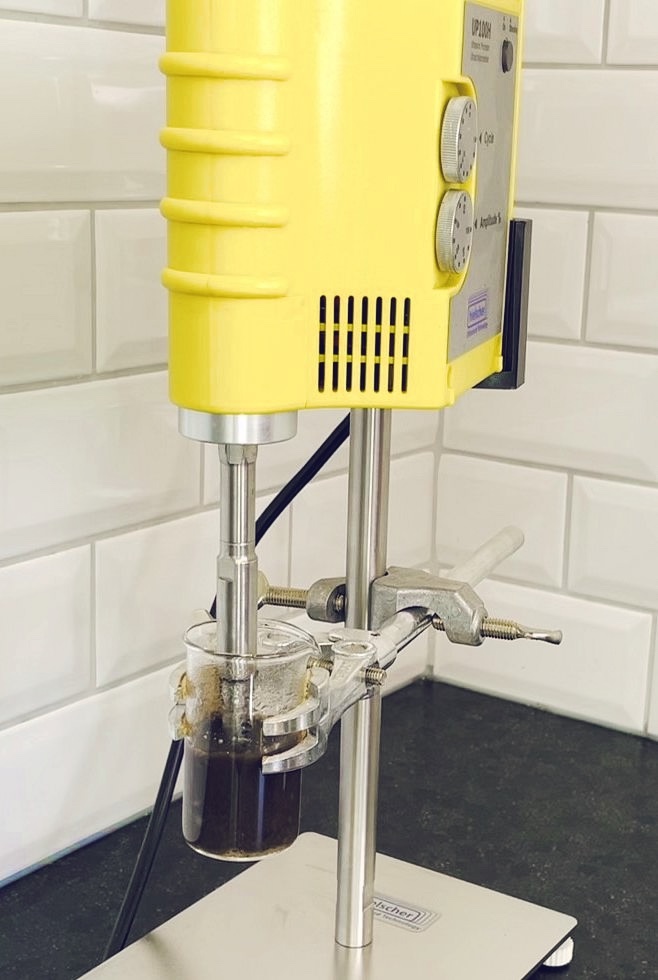 La riduzione ultrasonica delle nanoparticelle di palladio offre un metodo rapido ed efficiente in termini di consumo di reagenti per ottenere nanoparticelle di Pd(0), sfruttando la cavitazione acustica per generare condizioni localizzate ad alta energia e radicali riducenti in soluzione, consentendo così la riduzione degli ioni di palladio senza ricorrere ai tradizionali processi ad alta temperatura.
Un vantaggio fondamentale è il controllo del processo: il tempo di sonicazione e la concentrazione dello stabilizzante, come il rapporto PVP/Pd, possono influenzare se il prodotto si forma come nanoparticelle ben disperse e arrotondate di circa 5 nm o come aggregati più grandi di circa 20 nm; ciò è rilevante dal punto di vista industriale poiché le prestazioni del palladio nella catalisi dipendono fortemente dalla dimensione delle particelle, dalla morfologia, dalla dispersione e dall’area superficiale. Poiché le nanoparticelle di palladio sono ampiamente apprezzate come catalizzatori eterogenei, elettrocatalizzatori e materiali funzionali, la riduzione ultrasonica rappresenta una soluzione interessante per la produzione di catalizzatori al Pd finemente dispersi in condizioni di fase liquida relativamente blande, con potenziali benefici per la sintesi chimica, la catalisi ambientale, le tecnologie delle celle a combustibile e altri processi in cui un’elevata attività catalitica e un efficiente utilizzo dei metalli nobili rivestono importanza economica.

Lavorazione industriale delle nanoparticelle con il sonicatore UIP2000hdT
Procedura di preparazione dei campioni
I campioni sono stati preparati come segue:
Per i campioni, miscele di 30mL di EG e 5-10-6Si sono preparati mol di PVP mediante agitazione magnetica per 15 min. Ai diversi campioni sono state aggiunte quantità diverse di soluzione di Pd(NO₃)₂, ovvero 1,5 mL e 2 mL. Le miscele dei campioni sono state preparate con un rapporto di 2·10-3mol di Pd(NO₃)₂ nel campione (a) e 2,66·10-3mol di Pd(NO₃)₂ nel campione (b). Entrambe le miscele sono state sottoposte a sonicazione in una fiala da 20 mL utilizzando un sonicatore a sonda. Sono stati prelevati campioni dopo tempi di sonicazione di 30, 60, 90, 120, 150 e 180 min.
L'analisi dei risultati sperimentali mostra che:
- 1. La riduzione stereochimica del Pd(II) in Pd(0) dipende dal tempo di sonicazione.
- 2. L'elevato rapporto molare PVP/Pd(II) porta alla formazione di particelle di palladio monodisperse di forma arrotondata e con un diametro medio di circa 5 nm.
- 3. Tuttavia, il basso rapporto molare PVP/Pd(II) comporta l'ottenimento di nanoparticelle di palladio aggregate con un'ampia distribuzione dimensionale centrata su 20 nm.
La via sicochimica per la riduzione degli ioni di palladio (II) Pd(II) agli atomi di palladio Pd(0) può essere assunto come il seguente:
- (1) Pirolisi dell'acqua: H₂O → •OH + •H
- (2) Formazione di radicali: RH (agente riducente) + •OH(•H) → •R + H₂O(H₂)
- (3) Riduzione degli ioni: Pd(II) + radicali riducenti (-H, -R) → Pd(0) + R-CHO + H+
- (4) Formazione di particelle: nPd(0) → Pdn
Risultato: A seconda del rapporto PVP/Pd(II), il Pd disperso o aggregato è stato ottenuto con la tecnica dell'idrogeno.n sono stati ottenuti.
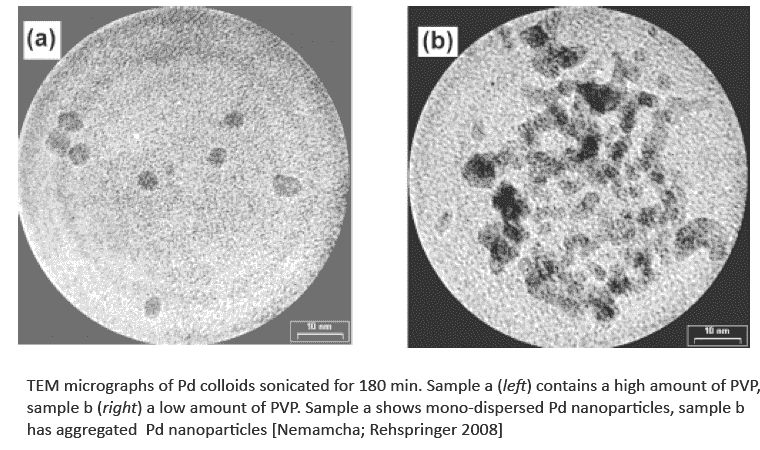
Riduzione sonochimica del palladio: il campione a (a sinistra) contiene un’elevata quantità di PVP, mentre il campione b (a destra) ne contiene una bassa. Tempo di sonicazione con UP100H: 180 min. Il campione a presenta nanoparticelle di Pd monodisperse, mentre il campione b presenta nanoparticelle di Pd aggregate.
Immagini e studio: ©Nemamcha e Rehspringer, 2008
Analisi e risultati
Le analisi di assorbimento UV-visibile confermano la relazione tra la riduzione stereochimica degli ioni palladio(II) ad atomi di palladio(0) e il tempo di ritenzione nel campo ultrasonico. La riduzione degli ioni palladio(II) ad atomi di palladio(0) progredisce e può essere completamente raggiunta con l'aumento del tempo di sonicazione. Le micrografie della microscopia elettronica a trasmissione (TEM) mostrano che:
- Quando viene aggiunta una quantità elevata di PVP, la riduzione sonochimica degli ioni palladio porta alla formazione di particelle di palladio monodisperse di forma sferica e con un diametro medio di circa 5 nm.
- L'uso di una piccola quantità di PVP porta alla formazione di aggregati di nanoparticelle di palladio. Le misurazioni mediante diffusione dinamica della luce (DLS) rivelano che gli aggregati di nanoparticelle di palladio presentano un'ampia distribuzione granulometrica con un picco a 20 nm.

Il sonicatore da laboratorio UP100H è stato utilizzato per la preparazione di nanoparticelle di palladio.

Le nano particelle di palladio (Pd) possono essere preparate per sonicazione
Progettazione, produzione e consulenza – Qualità Made in Germany
Gli ultrasuoni Hielscher sono noti per i loro elevati standard di qualità e design. La robustezza e la facilità d'uso consentono un'agevole integrazione dei nostri ultrasuoni negli impianti industriali. Gli ultrasuonatori Hielscher sono in grado di gestire facilmente condizioni difficili e ambienti impegnativi.
Hielscher Ultrasonics è un'azienda certificata ISO e pone particolare enfasi sugli ultrasuonatori ad alte prestazioni, caratterizzati da tecnologia all'avanguardia e facilità d'uso. Naturalmente, gli ultrasuoni Hielscher sono conformi alla normativa CE e soddisfano i requisiti UL, CSA e RoH.
Letteratura/riferimenti
- Nemamcha, A.; Rehspringer, J. L. (2008): Morphology of dispersed and aggregated PVV-Pd nanoparticles prepared by ultrasonic irradiation of Pd(NO₃)₂ solution in ethylene glycol. Rev. Adv. Mater. Sci. 18;2008. 685-688.
- Prekob, Á., Muránszky, G., Kocserha, I. et al. (2020): Sonochemical Deposition of Palladium Nanoparticles Onto the Surface of N-Doped Carbon Nanotubes: A Simplified One-Step Catalyst Production Method. Catalysis Letters 150, 2020. 505–513.
- Haitao Zheng, Mphoma S. Matseke, Tshimangadzo S. Munonde (2019): The unique Pd@Pt/C core-shell nanoparticles as methanol-tolerant catalysts using sonochemical synthesis. Ultrasonics Sonochemistry, Volume 57, 2019. 166-171.
Particolarità / Cose da sapere
Che cos’è il palladio?
Il palladio è un metallo prezioso raro, di colore bianco-argenteo, con simbolo chimico Pd e numero atomico 46. Appartiene ai metalli del gruppo del platino ed è molto apprezzato perché è chimicamente stabile, conduce l’elettricità, assorbe l’idrogeno e funge da eccellente catalizzatore. Il palladio finemente suddiviso è particolarmente efficace nelle reazioni di idrogenazione e deidrogenazione, mentre il palladio riscaldato consente all’idrogeno di diffondersi al suo interno, rendendolo utile per la separazione e la purificazione dell’idrogeno.
A cosa servono le nanoparticelle di palladio?
Le nanoparticelle di palladio vengono utilizzate principalmente come catalizzatori ad alta superficie specifica. Poiché le nanoparticelle presentano una superficie attiva molto più estesa rispetto al palladio in forma massiccia, sono in grado di migliorare l’efficienza del catalizzatore e ridurre la quantità di costoso metallo nobile necessaria. Tra le applicazioni tipiche figurano la sintesi chimica, le reazioni di idrogenazione, le reazioni di accoppiamento carbonio-carbonio, l’elettrocatalisi, la ricerca sulle celle a combustibile, il rilevamento e lo stoccaggio dell’idrogeno, la catalisi ambientale e alcuni settori della ricerca biomedica, quali i sistemi antimicrobici, fototermici e antitumorali. Il comportamento catalitico del palladio dipende fortemente dalle dimensioni delle particelle, dalla morfologia e dalla dispersione.
Le nanoparticelle di palladio vengono utilizzate anche per drogare altre particelle al fine di ottenere funzionalità catalitiche. Scopri di più sul processo a ultrasuoni per la sintesi di Pd/N-BCNT come catalizzatore Fischer-Tropsch!
Il palladio è tossico?
Il palladio metallico elementare è generalmente considerato a bassa tossicità e privo di un ruolo biologico noto, ma i composti, i sali, le polveri e le forme su scala nanometrica del palladio devono essere maneggiati con cautela. L’esposizione sul posto di lavoro o in laboratorio può causare irritazione o sensibilizzazione a seconda del composto e della via di esposizione; le soluzioni di cloruro di palladio, ad esempio, possono irritare le mucose. Per quanto riguarda la manipolazione industriale, la risposta pratica è la seguente: il palladio metallico sfuso presenta un rischio relativamente basso, ma le polveri di palladio, i sali solubili di palladio e le nanoparticelle di palladio devono essere trattati come materiali potenzialmente pericolosi, con misure di controllo delle polveri, ventilazione, guanti, protezione degli occhi e corretto smaltimento dei rifiuti.