Réacteurs chimiques optimisés par sonication – Types, modèles et mécanismes
Les réacteurs chimiques sont au cœur de la chimie industrielle, de la synthèse des matériaux, de la production de produits chimiques fins, de la fabrication pharmaceutique et du traitement environnemental. Alors que les industries recherchent des procédés plus rapides, plus propres et plus économes en énergie, la sonication, également appelée traitement par ultrasons, est devenue une méthode de plus en plus pertinente pour l'intensification des réacteurs. La technologie des réacteurs à ultrasons révolutionne le traitement chimique en améliorant le mélange, le transfert de masse, la cinétique des réactions et la catalyse hétérogène dans les systèmes de réacteurs discontinus et continus.
Comment la sonication améliore les réacteurs chimiques
En introduisant des ultrasons de forte puissance dans un réacteur chimique, les ingénieurs peuvent générer un mélange par écoulement oscillatoire ultrasonique et une cavitation acoustique au sein du milieu réactionnel. Ces mécanismes améliorent le contact entre les réactifs, accélèrent le transfert de masse et peuvent augmenter les vitesses de réaction, la sélectivité et le rendement. La sonication est particulièrement efficace dans les systèmes solide-liquide, tels que la catalyse hétérogène, et dans les systèmes liquide-liquide, tels que l’émulsification, l’extraction et les réactions biphasiques. Elle est moins fréquemment utilisée dans les mélanges gaz-liquide, car la cavitation acoustique est générée moins efficacement dans les liquides à forte teneur en gaz.
Dans la conception moderne des réacteurs sonochimiques, les fluides sont agités par des oscillations ultrasoniques et la cavitation, généralement avec des amplitudes comprises entre 10 et 200 µm. Cela permet d'obtenir de puissants effets de mélange microscopiques, difficiles à obtenir uniquement par agitation mécanique classique.
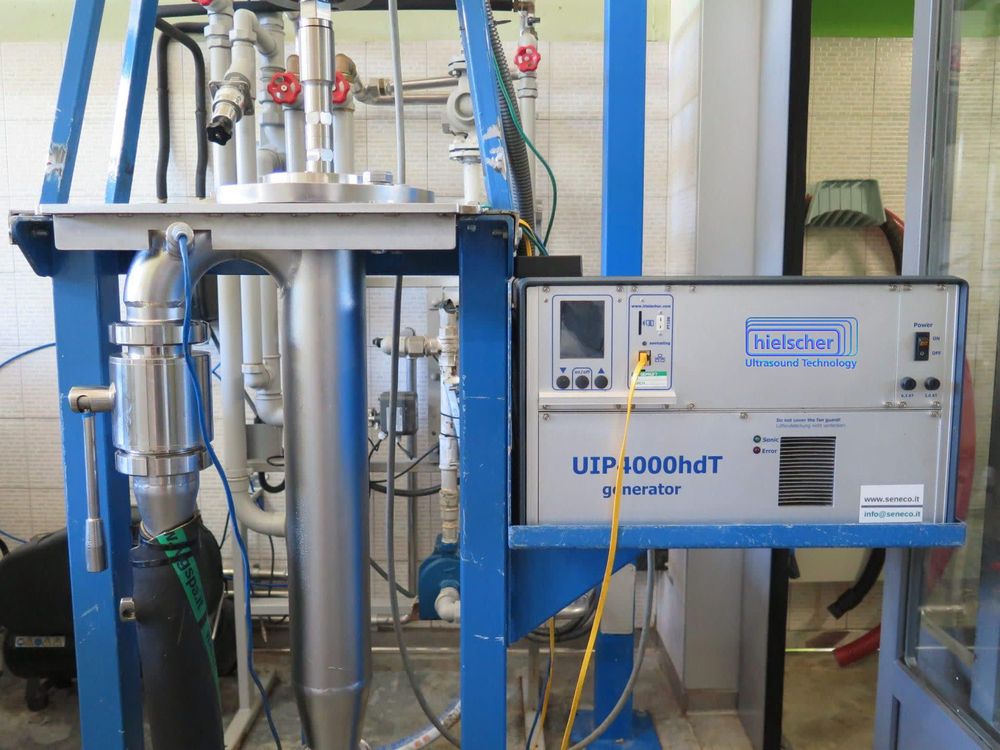
Sonicateur en ligne UIP4000hdT avec une cellule d'écoulement permettant d'intensifier les réactions chimiques
Pourquoi la sonication améliore l'efficacité des réacteurs chimiques
L'intérêt industriel de la sonication réside dans sa capacité à influencer les phénomènes de transport chimique et physique à l'échelle micro et méso. Contrairement à l'agitation classique, les ultrasons ne se contentent pas de déplacer le liquide en masse. Ils génèrent des ondes de pression, des mouvements oscillatoires, des bulles de cavitation et des zones localisées à haute énergie.
Lorsque des bulles de cavitation acoustique se forment, grossissent puis s'effondrent, elles créent des micro-environnements très intenses. Ces phénomènes peuvent entraîner :
- forces de cisaillement locales élevées
- micro-jets à proximité de surfaces solides
- ondes de choc
- micro-mélange rapide
- dispersion améliorée des particules
- meilleur contact interfacial
- transfert accéléré de masse et de chaleur
- Effets du nettoyage de surface et de l'activation du catalyseur
Ces phénomènes confèrent à la sonication un intérêt particulier pour l'intensification des procédés, notamment lorsque les réactions sont limitées par la diffusion, un contact insuffisant entre les phases, l'encrassement du catalyseur ou un mélange insuffisant.
La sonication dans les réacteurs discontinus
Les réacteurs discontinus sont largement utilisés dans les laboratoires, les installations pilotes et la production de produits chimiques spécialisés. Ils offrent une grande souplesse, sont faciles à utiliser et conviennent au criblage de réactions, à la synthèse en petits volumes et à la fabrication de produits à forte valeur ajoutée.
Lorsque la sonication est appliquée à des réacteurs discontinus, elle peut améliorer considérablement l'homogénéité du mélange et de la réaction. Des sondes ultrasoniques, des cellules d'écoulement ou des transducteurs montés à l'extérieur permettent d'introduire directement de l'énergie acoustique dans le milieu réactionnel.
Dans les systèmes discontinus, la sonication est particulièrement utile pour :
- catalyse hétérogène
- synthèse de nanoparticules
- contrôle de la cristallisation
- émulsification
- extraction
- Polymérisation
- dissolution et dispersion des solides
Dans le cas des réactions solide-liquide, les ultrasons peuvent empêcher l'agglomération des particules et améliorer l'accès aux surfaces catalytiques ou réactives. Dans les systèmes liquide-liquide, la sonication permet de créer des émulsions fines et d'augmenter la surface interfaciale entre des phases non miscibles, ce qui se traduit souvent par une accélération des vitesses de réaction.
Réacteurs à écoulement continu pour le traitement sonochimique en continu
Les réacteurs à écoulement continu comptent parmi les configurations les plus importantes en matière de sonication industrielle. Au lieu de traiter un volume fixe de liquide, le mélange réactionnel traverse en continu la chambre d'un réacteur à ultrasons.
Cette conception présente un grand intérêt pour la mise à l'échelle, car elle permet aux ingénieurs de contrôler avec plus de précision le temps de séjour, le débit, la température, la pression et l'apport d'énergie ultrasonique. Les réacteurs sonochimiques à flux continu sont souvent utilisés lorsqu'une qualité constante du produit et un fonctionnement en continu sont requis.
Les principaux avantages des réacteurs à circulation continue à ultrasons sont les suivants :
- capacité de production en continu
- une meilleure reproductibilité du processus
- un meilleur contrôle de la température
- répartition contrôlée des temps de séjour
- une intégration plus aisée dans les chaînes de production industrielles
- architecture de réacteur évolutive
Dans ces systèmes, le mélange par écoulement oscillatoire ultrasonique permet d'améliorer le mélange radial et axial, de réduire les gradients de concentration et d'optimiser l'interaction entre les réactifs. Cela s'avère particulièrement utile dans les procédés où l'efficacité de la réaction dépend d'un contact rapide entre les phases ou d'une dispersion rapide.
Insert pour cellule de débit à ultrasons MultiPhaseCavitator
 L'insert MultiPhaseCavitator-MPC48 est un insert spécialisé destiné aux réacteurs à cellule d'écoulement ultrasoniques Hielscher, conçu pour intensifier les processus liquide/liquide et liquide/gaz directement dans la zone de cavitation ultrasonique. En injectant une deuxième phase liquide ou gazeuse à travers 48 fines canules dans le flux de liquide principal, le MultiPhaseCavitator crée de très petites gouttelettes ou bulles de gaz présentant une surface interfaciale spécifique élevée. Cela le rend particulièrement efficace pour l’émulsification par ultrasons, où des phases non miscibles sont dispersées en émulsions fines, ainsi que pour les réactions catalytiques en présence de gaz, où la phase gazeuse injectée est rapidement dispersée et mise en contact intime avec la phase liquide, les réactifs dissous ou les catalyseurs en suspension. Le cisaillement par cavitation, le micro-mélange et le transfert de masse amélioré qui en résultent peuvent optimiser la cinétique de réaction, le contact aux interfaces de phase et l’efficacité du procédé, que ce soit en fonctionnement continu ou par lots.

Sonicateur UIP2000hdT avec un réacteur chimique discontinu
Conception des réacteurs chimiques et avantages de la sonication
| Type de réacteur | Application type | Principaux effets de la sonication | Pertinence technique |
|---|---|---|---|
| Réacteurs à suspension | Catalyse hétérogène utilisant des particules solides de catalyseur en suspension dans une phase liquide ; utilisée dans l'hydrogénation, l'oxydation, la conversion de la biomasse, les procédés de type Fischer-Tropsch, la photocatalyse et le traitement des eaux usées. | La sonication améliore la dispersion du catalyseur, la désagglomération des particules, la réduction de la couche limite, le renouvellement de la surface, le transfert de masse liquide-solide, le nettoyage de la surface du catalyseur et la réduction de l'encrassement. | Ce phénomène revêt une importance particulière, car de nombreuses réactions catalytiques en suspension sont limitées par l'efficacité avec laquelle les réactifs atteignent les sites actifs. La cavitation acoustique favorise le contact à l'interface catalyseur-liquide et peut améliorer la cinétique de la réaction. |
| Réacteurs à cuve à agitation continue (CSTR) | Réactions en phase liquide en continu, émulsification, réactions catalytiques, précipitation, cristallisation, réactions polymères et suspensions solide-liquide. | Les ultrasons favorisent le micro-mélange, la mise en suspension des particules, l'émulsification, la dispersion et l'apport local d'énergie. Ils peuvent être associés à une agitation mécanique afin d'améliorer à la fois le macro-mélange et le micro-mélange. | Les réacteurs CSTR traités par ultrasons s'avèrent utiles lorsque les agitateurs classiques ne parviennent pas à éliminer totalement les zones mortes, une dispersion insuffisante ou les limitations locales de transfert de masse. Les ultrasons favorisent des conditions de réaction plus homogènes et permettent une intensification accrue du procédé. |
| Réacteurs à lit fixe | Lits catalytiques fixes utilisés dans l'hydrogénation, l'oxydation, la catalyse environnementale, les procédés pétrochimiques et la catalyse hétérogène en phase liquide. | La sonication peut améliorer le mouillage du catalyseur, la circulation du liquide à travers le lit, la réduction de la couche limite, le nettoyage des surfaces, la limitation de l'encrassement et le transfert de masse vers les sites catalytiques. | Les performances des lits fixes sont souvent limitées par la formation de canaux, un mauvais mouillage, la résistance à la diffusion et la formation de dépôts. L'intensification du procédé par ultrasons peut améliorer l'utilisation du catalyseur et l'uniformité de la réaction. |
| Réacteurs à lit fluidisé | Lits dynamiques de particules en suspension utilisés en catalyse, dans le traitement des particules, le revêtement, la polymérisation, le séchage et les réactions solide-liquide. | L'excitation par ultrasons peut améliorer la dispersion des particules, réduire l'agglomération, optimiser le contact entre le fluide et le solide, stabiliser les suspensions et améliorer l'accessibilité de la surface du catalyseur. | La sonication est particulièrement efficace dans les lits fluidisés liquide-solide, où la cavitation peut être générée de manière efficace. Dans les systèmes riches en gaz, la cavitation est moins efficace, ce qui rend les ultrasons plus adaptés aux applications de réacteurs à base de liquide. |
| Réacteurs à membrane | Systèmes intégrés de réaction-séparation utilisés pour l'élimination sélective des produits, le dosage des réactifs, les procédés catalytiques à membrane et les réactions assistées par filtration. | Les ultrasons permettent de réduire l'encrassement des membranes, d'améliorer le débit de perméat, d'optimiser le nettoyage des surfaces, de réduire la polarisation de concentration et d'améliorer le mélange à proximité de l'interface membranaire. | La sonication fait le lien entre l'ingénierie des réactions et la science de la séparation. Elle s'avère particulièrement utile lorsque l'encrassement, la résistance au transfert de masse ou un couplage faible entre la réaction et la séparation limitent les performances d'un réacteur à membrane. |
Mécanismes d'intensification des réacteurs à ultrasons
Les avantages de la sonication dans les réacteurs chimiques reposent sur plusieurs mécanismes qui agissent en synergie.
- La cavitation acoustique est le mécanisme le plus important. Elle implique la formation, la croissance et l'éclatement de bulles microscopiques dans un liquide exposé à des ultrasons de forte intensité. L'éclatement des bulles génère un dégagement d'énergie localisé et de fortes forces mécaniques.
- Le « streaming acoustique » génère un mouvement constant du fluide sous l'effet d'ondes ultrasonores. Cela améliore le mélange et le transport dans les zones où l'agitation mécanique peut s'avérer insuffisante.
- Le mélange par écoulement oscillatoire se produit lorsque des vibrations ultrasoniques provoquent un mouvement rapide de va-et-vient du liquide. Dans les systèmes de réacteurs, des amplitudes comprises entre environ 10 et 200 µm peuvent générer une agitation très efficace et améliorer le transfert de masse.
- Des micro-jets et des ondes de choc se produisent à proximité des bulles de cavitation qui s'effondrent, en particulier près des surfaces solides. Ces effets peuvent nettoyer les surfaces des catalyseurs, perturber les couches limites et améliorer l'accès du liquide aux sites actifs.
- L'augmentation de la surface interfaciale revêt une importance particulière dans les systèmes liquide-liquide. Les ultrasons permettent de créer de fines gouttelettes et des dispersions stables, augmentant ainsi la surface disponible pour la réaction ou le transfert de masse.
Ensemble, ces mécanismes font de la sonication un outil puissant pour l'intensification des réacteurs chimiques.
Pertinence industrielle de la conception des réacteurs sonochimiques
L'importance industrielle des réacteurs à ultrasons ne se limite pas à un mélange plus rapide. La sonication permet de contrôler les conditions de réaction à des échelles que les équipements conventionnels ne peuvent pas facilement atteindre.
En génie chimique, de nombreuses contraintes liées aux réacteurs découlent des phénomènes de transport plutôt que des vitesses de réaction intrinsèques. Il arrive que les réactifs n'atteignent pas les sites catalytiques assez rapidement. Les liquides non miscibles peuvent présenter une surface de contact insuffisante. Les solides peuvent s'agglomérer. Les membranes peuvent s'encrasser. Les surfaces catalytiques peuvent se colmater.
La sonication permet de surmonter ces contraintes en améliorant directement les conditions physiques à l'intérieur du réacteur. Elle s'inscrit ainsi dans plusieurs axes prioritaires de la recherche et de l'industrie :
- procédés chimiques plus respectueux de l'environnement
- réduction des besoins en énergie et en solvants
- amélioration de l'efficacité du catalyseur
- une sélectivité de réaction plus élevée
- accélération du développement des procédés
- fabrication en continu
- systèmes de réacteurs modulaires perfectionnés
- synthèse de matériaux avancés
- valorisation durable de la biomasse et des flux de déchets
Pour les chercheurs, la sonication constitue une méthode contrôlée permettant d'étudier la relation entre l'apport d'énergie acoustique, le comportement de cavitation, l'amélioration du transport et les performances chimiques. Pour l'industrie, elle offre une voie pratique vers la mise au point de systèmes de réacteurs compacts, efficaces et évolutifs.

Homogénéisateur à ultrasons UIP2000hdT pour les réactions chimiques dans un réacteur à écoulement
Avantages de la sonication dans les réacteurs chimiques
L'intégration des ultrasons dans la conception des réacteurs présente plusieurs avantages tant sur le plan opérationnel que scientifique :
- des vitesses de réaction plus élevées grâce à un meilleur transfert de masse
- un meilleur mélange dans les systèmes multiphasiques
- une meilleure dispersion des solides et des gouttelettes
- meilleure utilisation du catalyseur
- limitations liées à la diffusion réduite
- surfaces plus propres du catalyseur et de la membrane
- une meilleure reproductibilité des procédés dans les systèmes à flux continu
- baisse potentielle de la température, de la pression ou du temps de réaction
- compatibilité avec le fonctionnement par lots et en continu
- une grande pertinence pour la catalyse hétérogène et les réactions biphasiques
Ces avantages rendent la technologie des réacteurs à ultrasons particulièrement intéressante pour la chimie fine, la chimie de spécialité, la catalyse, les nanomatériaux, la chimie verte et l'intensification des procédés.

Cellule à écoulement ultrasonique en verre
Optimisez les performances de votre réacteur chimique grâce aux soniqueurs Hielscher !
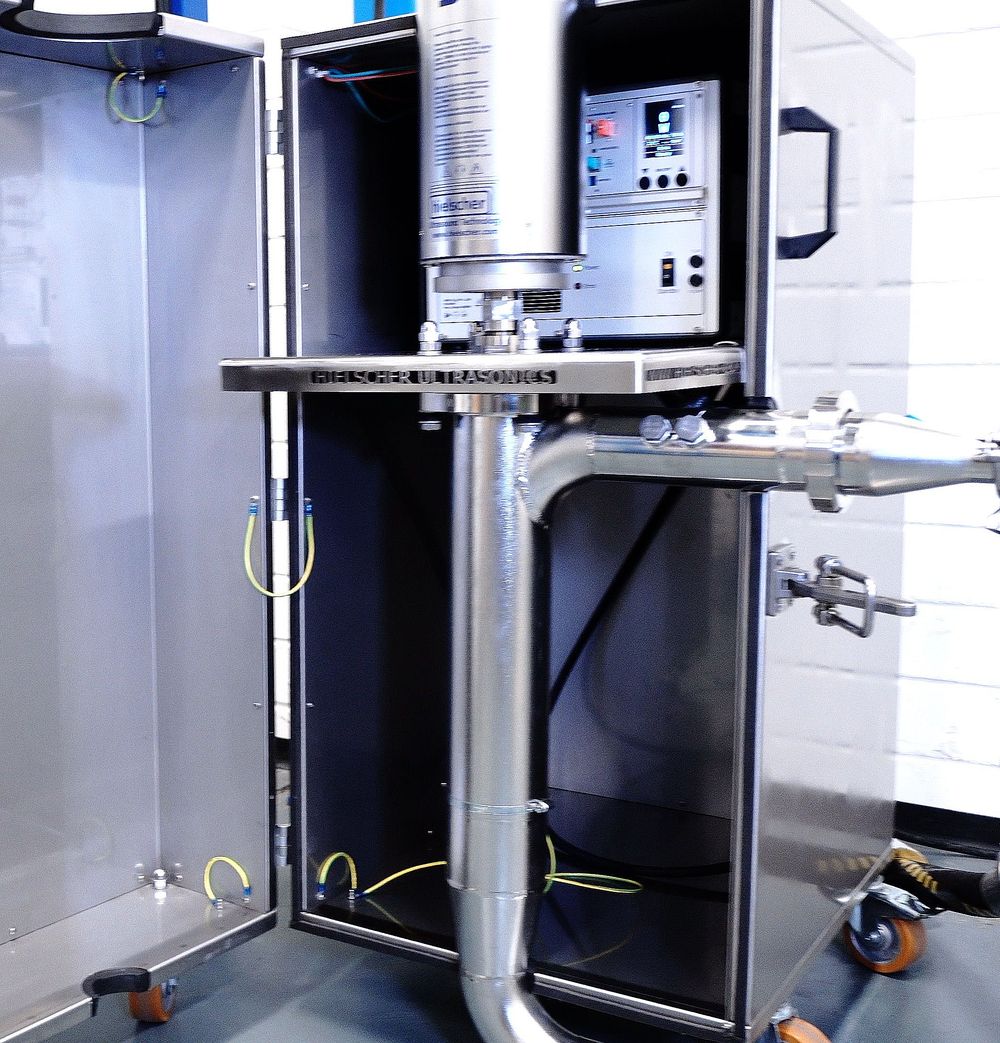 Les sonateurs Hielscher sont parfaitement adaptés à une intégration sur mesure dans des réacteurs chimiques, car ils se présentent sous la forme de systèmes ultrasoniques robustes et puissants, dotés de sonotrodes adaptables, de cellules d'écoulement, d'inserts de réacteur et d'accessoires spécifiques au procédé. En fonction de la configuration de la réaction, les processeurs ultrasoniques Hielscher peuvent être installés dans des réacteurs discontinus, des réacteurs à cuve agitée en continu, des réacteurs à flux en ligne, des boucles de recirculation, des systèmes sous pression, ainsi que dans des installations pilotes ou à l'échelle industrielle. Cette flexibilité permet d’appliquer les ultrasons exactement là où la cavitation est la plus efficace : à l’interface liquide-solide, liquide-liquide ou liquide-gaz. Hielscher Ultrasonics propose également divers types de réacteurs ultrasoniques discontinus et en ligne, permettant un traitement sonochimique contrôlé, l’émulsification, la dispersion, l’activation de catalyseurs, le nettoyage de surfaces, l’intensification des transferts de masse et l’accélération des réactions. Grâce à un contrôle précis de l’amplitude, de la puissance d’entrée, de la température, de la pression, du débit et du temps de séjour, les soniqueurs Hielscher peuvent être adaptés aux exigences spécifiques de la recherche en laboratoire, du développement de procédés, de la mise à l’échelle et de la production chimique industrielle.
Le tableau ci-dessous vous donne une indication de la capacité de traitement approximative de nos ultrasons :
| Volume du lot | Débit | Dispositifs recommandés |
|---|---|---|
| 1 à 500mL | 10 à 200mL/min | UP100H |
| 10 à 2000mL | 20 à 400mL/min | UP200Ht, UP400St |
| 0.1 à 20L | 0.2 à 4L/min | UIP2000hdT |
| 10 à 100L | 2 à 10L/min | UIP4000hdT |
| 15 à 150L | 3 à 15L/min | UIP6000hdT |
| n.d. | 10 à 100L/min | UIP16000hdT |
| n.d. | plus grande | groupe de UIP16000hdT |
Conception, fabrication et conseil – Qualité Made in Germany
Les ultrasons Hielscher sont réputés pour leur qualité et leurs normes de conception les plus élevées. La robustesse et la facilité d'utilisation permettent une intégration aisée de nos ultrasons dans les installations industrielles. Les conditions difficiles et les environnements exigeants sont facilement gérés par les ultrasons Hielscher.
Hielscher Ultrasonics est une entreprise certifiée ISO et met l'accent sur les ultrasons de haute performance, dotés d'une technologie de pointe et d'une grande facilité d'utilisation. Bien entendu, les ultrasons Hielscher sont conformes à la norme CE et répondent aux exigences des normes UL, CSA et RoHs.

Homogénéisateur à ultrasons UIP1500hdT avec un réacteur à flux continu équipé d'une chemise de refroidissement permettant de contrôler la température du procédé pendant la sonication.
Questions fréquemment posées
Qu'est-ce qu'un réacteur chimique ?
Les réacteurs chimiques sont des cuves ou des systèmes spécialement conçus dans lesquels des réactions chimiques se déroulent dans des conditions contrôlées, telles que la température, la pression, l'agitation, le temps de séjour et la concentration des réactifs. Leur objectif est de transformer des matières premières en produits souhaités, avec un rendement, une sélectivité et une efficacité de procédé bien définis.
Quels sont les principaux types de réacteurs chimiques ?
Les principaux types de réacteurs chimiques comprennent les réacteurs discontinus, les réacteurs à cuve agitée en continu, les réacteurs à écoulement piston, les réacteurs à lit fixe, les réacteurs à lit fluidisé, les réacteurs à suspension, les réacteurs à membrane, ainsi que les réacteurs photochimiques ou électrochimiques. Chaque type de réacteur se distingue par son comportement en termes d'écoulement, son régime de mélange, ses caractéristiques de transfert de chaleur et de masse, ainsi que par son adéquation aux réactions homogènes ou hétérogènes.
Quelle est la différence entre un réacteur à lit fluidisé et un réacteur à lit fixe ?
Dans un réacteur à lit fixe, les particules de catalyseur solide restent immobiles tandis que les réactifs s'écoulent à travers le lit de catalyseur. Dans un réacteur à lit fluidisé, un fluide s'écoulant vers le haut met en suspension et déplace les particules solides, créant ainsi un lit dynamique caractérisé par un mélange intense, un transfert thermique amélioré et un meilleur contact entre les particules et le fluide. Les lits fixes sont plus simples et mécaniquement stables, tandis que les lits fluidisés offrent une efficacité de mélange et de transfert thermique supérieure, mais nécessitent un contrôle de l'écoulement plus complexe.
Qu'est-ce qu'un lit catalytique ?
Un lit catalytique est un volume défini de particules de catalyseur solide disposées à l'intérieur d'un réacteur. Il fournit la surface active sur laquelle se produisent les réactions chimiques. Les lits catalytiques peuvent être stationnaires, comme dans les réacteurs à lit fixe, ou en suspension dynamique, comme dans les réacteurs à lit fluidisé. Leurs performances dépendent de l'activité du catalyseur, de la taille des particules, de la porosité, de la surface spécifique, de la répartition du flux, du transfert de chaleur et du transfert de masse.
Littérature / Références
- Yu, Hang Gao, Jing; Zhong, Qili; Guo, Yahui; Xie, Yunfei; Yao, Weirong; Zhou, Weibiao (2018): Acoustic pressure and temperature distribution in a novel continuous ultrasonic tank reactor: a simulation study. IOP Conference Series: Materials Science and Engineering 2018.
- Francisco J. Navarro-Brull; Andrew R. Teixeira; Jisong Zhang; Roberto Gómez; Klavs F. Jensen (2018): Reduction of Dispersion in Ultrasonically-Enhanced Micropacked Beds. Industrial & Engineering Chemistry Research 57, 1; 2018. 122–128.
- M. Ajmal, S. Rusli, G. Fieg (2016): Modeling and experimental validation of hydrodynamics in an ultrasonic batch reactor. Ultrasonics Sonochemistry, Volume 28, 2016. 218-229.
- L. Castrillón, E. Marañón, Y. Fernández-Nava, P. Ormaechea, G. Quiroga (2013): Thermophilic co-digestion of cattle manure and food waste supplemented with crude glycerin in induced bed reactor (IBR). Bioresource Technology, Volume 136, 2013. 73-77.
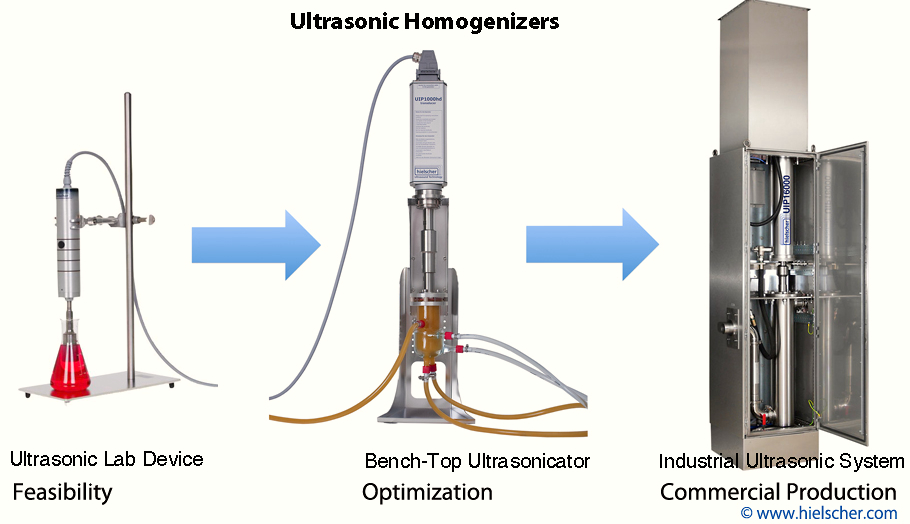
Hielscher Ultrasonics fabrique des homogénéisateurs à ultrasons très performants à partir de laboratoires à taille industrielle.