Hefezellläsion an Mikroplatten mat héichintensiver Sonikatioun
Mikrobiologen an Liewenswisseschafter, déi mat saccharomyces cerevisiae, Pichia pastoris / Komagataella phaffii, an anere Hefesystemer kennen d'Herausfuerderung: Hefezellen si robust, reproduzéierbar Lysis kann schwéier sinn, an manuell Probeschued gëtt séier zu engem Flaschenhals wann vill Stämm, Klonen, Kulturbedingungen oder Expressionskonstrukter iwwerpréift missten ginn.
High-Throughput Yeast Lysis for Microbiology, Molecular Biology and Protein Analytics
Hielscher microplate sonicators such as the UIP400MTP (400 W) and UIP550MTP (550 W) provide a high-throughput solution for mechanical yeast cell lysis directly in microplates. Instead of processing samples one by one with a probe, entire microplates can be sonicated under uniform conditions. This makes ultrasonic yeast lysis faster, more reproducible, and easier to integrate into modern microbiology, protein expression, enzyme screening, and omics workflows.
Whether you need to release recombinant proteins from P. pastoris, prepare yeast lysates for enzyme assays, disrupt S. cerevisiae for protein analysis, or screen dozens of yeast clones in parallel, Hielscher microplate sonicators deliver powerful cavitation-based cell disruption with precise process control.
Need reproducible lysis of S. cerevisiae, P. pastoris, or other yeast strains in microplates? Tell us your plate format, sample volume, cell density, and target analyte. We will help you define suitable sonication parameters for your UIP400MTP or UIP550MTP workflow.

Hielscher Multi-Well Plate Sonicator for yeast lysis – sample preparation at high-throughput
Why Yeast Cells Require Efficient Mechanical Lysis
Yeast cells are more difficult to lyse than many bacterial or mammalian cells because they are protected by a rigid cell wall composed mainly of polysaccharides, glucans, mannoproteins, and chitin. This cell wall provides mechanical stability, but it also limits the release of intracellular proteins, nucleic acids, metabolites, and enzymes.
Conventional yeast lysis methods include bead beating, enzymatic digestion, freeze-thaw cycles, chemical lysis, and probe-type sonication. These methods can be effective, but they also have limitations. Bead beating can introduce debris and heating, enzymatic digestion can add cost and variability, and single-sample probe sonication is time-consuming when large sample numbers must be processed.
Héich-Intensitéit, fokusséiert ultraschall Kavitation iwwerwënnt dës Limitatioune duerch d'Uwendung vun intense mechanesche Scherrkräften, Dréckschwankungen, a Mikrostroemen op d'Hefesuspensioun. D'Resultat ass eng séier Stéierung vun Zelwänn a Membranen, verbessert intrazellulär Fräiloossung, an héich reproduzéierbar Probenvirbereedung am Plattenformat.
Mikroplätten Sonikatioun fir parallel Hefesample Virbereedung
D'Hielscher UIP400MTP an UIP550MTP sinn entwéckelt fir uniform Sonikatioun vu Mikroplätten, Multiwell-Plätten, PCR-Plätten an passend Probehalter. Am Géigesaz zur Sonikatioun mat enger Sonde mussen d'Proben net individuell behandelt ginn. D'ganz Plack gëtt kontrolléierter ultraschaller Energie ausgesat, wat de Workflow héich gëeegent mécht fir parallel Probenveraarbechtung.
Dëst ass besonnesch nëtzlech fir:
- Duerchmusterung S. cerevisiae Mutanten oder Ausdruckssorten
- Lys vu P. pastoris / K. phaffii Kloone no der Recombinant-Protein-Ausdrock
- Virbereedung vu Gärlësungen fir Enzymtester
- Proteinextraktioun fir SDS-PAGE, Western Blot, ELISA, LC-MS/MS oder Aktivitéitetstester
- Fräiloossung vu intrazellulären Metaboliten fir Metabolomics
- DNA- a RNA-Probenvirbereedung nom passende Purifikatiounsschrëtt
- Héichdrockoptimiséierung vu Lysbufferen, Additiver an Extraktiounskonditiounen
Wéi Ultraschall-Kavitatioun Gäerzellen zerstéiert
Während der Sonikatioun generéiert fokusséierte héichkraaft Ultraschall alternéierend Kompressioun- a Réckzuchzyklen an der flësseger Probe. Bei genuch Intensitéit verursaachen dës Drockschwankungen akustesch Kavitatioun. Kavitatiounsbullen bilden sech, schwingen a kollabéieren, produzéieren lokaliséiert Schafkraaften, Mikrojets, Turbulenzen a staark Drockgradienten.
In yeast suspensions, these mechanical effects weaken and rupture the cell wall and cell membrane. Intracellular proteins, enzymes, nucleic acids, and metabolites are released into the lysis buffer. Since the process is mechanical, it can be used with many different buffer systems and can be combined with protease inhibitors, reducing agents, detergents, salts, or mild enzymatic pre-treatment.
General Protocol: Yeast Cell Lysis in Microplates
The following protocol provides a practical starting point for yeast lysis using the Hielscher UIP400MTP or UIP550MTP microplate sonicator. Parameters should be optimized according to yeast strain, cell density, target molecule, buffer composition, plate type, and downstream assay.
1. Harvest and Wash Yeast Cells
Grow Saccharomyces, Pichia, Hansenula, Debaryomyces, or another yeast strain under the desired culture conditions. Harvest the cells by centrifugation and remove the culture medium. Wash the pellet with cold distilled water, PBS, or the selected lysis buffer to remove residual medium components that may interfere with downstream analysis.
For protein extraction, keep samples cold and work quickly. If proteases are a concern, pre-cool all buffers and consumables.
2. Resuspend the Cell Pellet
Resuspend the yeast pellet in a suitable cold lysis buffer. For efficient protein release, high cell density is often advantageous. As a starting point, use approximately 10–20% w/v wet cell pellet or a dense suspension corresponding to OD600 > 10, depending on the assay.
A typical yeast protein lysis buffer may contain:
- buffer system such as Tris-HCl, phosphate buffer, or HEPES
- salt such as NaCl or KCl
- Protease-Inhibitor Cocktail
- optional reducing agent such as DTT or β-mercaptoethanol
- optional detergent such as Triton X-100, NP-40, SDS, or CHAPS, depending on downstream compatibility
- optional phosphatase inhibitors for phosphorylation studies
For difficult yeast strains or very gentle protein extraction, a short pre-treatment with Zymolyase, Lyticase, or another cell-wall-digesting enzyme can be used before sonication. This enzymatic pre-treatment is optional but may improve lysis efficiency or reduce the required ultrasonic intensity.
3. Transfer Samples into a Suitable Microplate
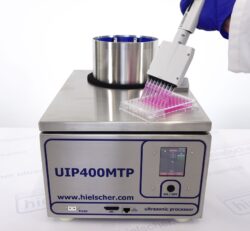 Dispense the yeast suspension into a sonication-compatible microplate. Round-bottom plates are often preferred because they improve sample collection and reduce dead zones. Use equal sample volumes across wells to improve reproducibility.
Seal the plate with a suitable sealing mat or film to prevent evaporation, aerosol formation, and cross-contamination. Ensure that the seal is compatible with the selected temperature and sonication conditions.
Typical working volumes depend on the plate format and application. Common formats include 96-well plates, deep-well plates, PCR plates, or suitable tube racks.
4. Set Up Cooling
Yeast lysis requires high ultrasonic intensity, and mechanical disruption generates heat. Temperature control is therefore critical, especially for protein, enzyme, RNA, or phosphorylation analysis.
Use an appropriate cooling strategy, such as:
- pre-chilled lysis buffer
- pre-cooled microplates
- cooling pauses between sonication intervals
- external cooling of the sonication platform, where applicable
The goal is to keep the sample cold enough to prevent protein denaturation, enzyme inactivation, RNA degradation, and heat-induced sample variability.
5. Sonicate the Yeast Suspension
Place the sealed plate into the Hielscher UIP400MTP or UIP550MTP microplate sonicator and select a pulsed sonication program. Pulsing is recommended because it allows mechanical disruption during ON phases and heat dissipation during OFF phases.
As a starting point for yeast cell lysis:
| Parameter | Recommended Starting Range | Purpose |
|---|---|---|
| amplitude | 60–100% | High cavitation intensity for robust yeast cells |
| Pulsatiounsperiod Modus | 10–30 sec ON / 30–60 sec OFF | Efficient lysis with controlled heat build-up |
| Cumulative ON-Time | 5–15 min | Adjust according to strain, density, and target molecule |
| Temperatur | Keep samples cold | Protect proteins, enzymes, RNA, and metabolites |
| Plate Sealing | Recommended | Prevents evaporation, aerosol formation, and cross-contamination |
Fir héich resistent Hefezellen, déck P. pastoris Biomass oder schwéier rekombinant Protein Extraktioun, erhéicht d'kumulativ ON-Zäit schrittweis. Fir waarmensensitive Proteinen oder Enzym Testen, benotzt méi kuerz Impulser, méi laang Ofkillpausen, an niddreg Startamplitude.
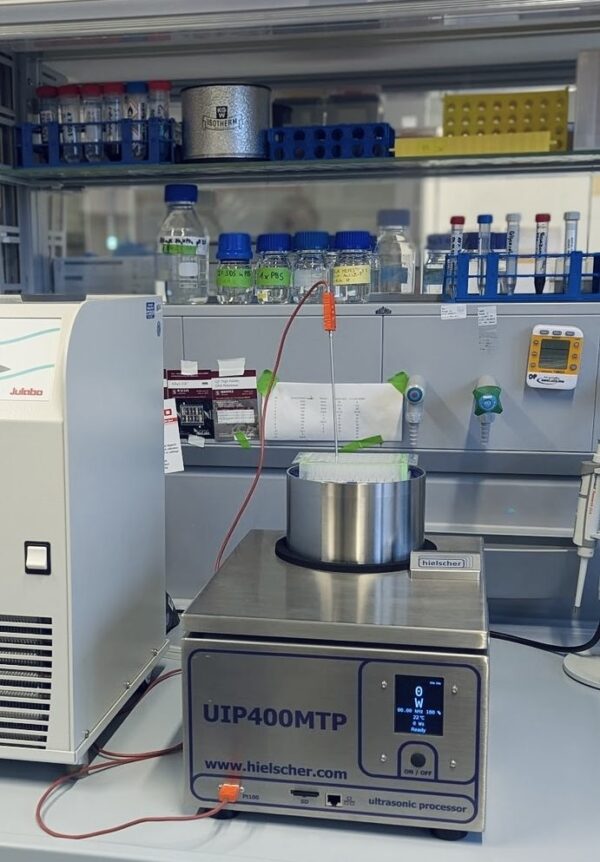
Héich-Duerchgang Hefe Lysis an Multiwell Platen mam UIP400MTP.
6. Kläer de Lysat.
No der Sonikatioun, centrifugéiert d'Mikroplack oder transferéiert d'Proben an Tuben fir Zentrifugéierung. Entfernt Zellreste duerch Zentrifugatioun bei enger geeigneter Vitesse a Temperatur. Sammle vum Supernatant fir niewenduerch Analyse.
Ofhängeg vum Uwendungsfall kann de Lysat benotzt ginn fir:
- Proteinquantifikatioun
- Enzymaktivitéit-Testen
- SDS-PAGE a Western Blotting
- ELISA a Immunoassays
- LC-MS/MS proteomics
- metabolite analysis
- DNA or RNA purification
7. Optimize and Document the Method
For reproducible yeast lysis, document all relevant parameters, including strain, culture condition, OD600, wet cell mass, buffer composition, plate type, sample volume, amplitude, pulse cycle, cumulative ON-time, cooling method, and final sample temperature.
If the Hielscher sonicator is equipped with automatic data recording, the process data can be used for documentation, method development, scale-up, and quality control.
Optimization Tips for Yeast Lysis
Fir maximal Proteinfräiheet, benotzt déck Hefe-Suspensiounen, héich Ultraschallintensitéit, a genuch kumulativ ON-Zäit. Fir sensibel Proteine, reduzéiert d'Amplitude, verlängert d'Kühlpausen, an halt d'Plack wärend der ganzer Prozedur kal.
Wann d'Lysis net komplett ass, erhéicht d'Sonikatiouns-Zäit schrittweis, test enzymatesch Virbehandlung, reduzéiert d'Sampleviskositéit oder optiméiert de Puffersystem. Wann Proteine ofbauen oder Aktivitéit verléieren, verbessert d'Kühlung, verkierzt d'ON-Intervalle, füügt Inhibitoren dobäi a vergewëssert Iech datt d'Detergentsystem mam Zilprotein kompatibel ass.
Because yeast strains differ substantially in cell wall structure, growth phase, expression system, and biomass density, a short optimization matrix is recommended. For example, test three amplitudes, two pulse cycles, and two total ON-times, then evaluate lysis efficiency and protein integrity.
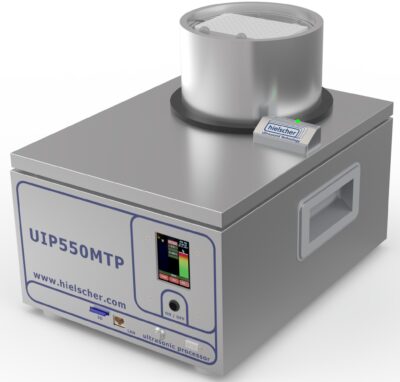
Whether you process a few assay plates or run high-throughput yeast screening, Hielscher can help you select the right microplate sonicator and develop a robust lysis protocol. Contact us with your yeast strain, workflow, and throughput requirements!
Advantages of Hielscher Microplate Sonicators for Yeast Lysis
Hielscher microplate sonicators are ideal for laboratories that need reproducible lysis across many samples. They eliminate the slow one-sample-at-a-time handling of probe sonication and reduce variability caused by manual probe positioning, immersion depth, and sample-to-sample handling differences.
Wichteg Virdeeler enthalen:
- High-Throughput Veraarbechtung: Sonicate many yeast samples in parallel in microplates or compatible sample racks.
- Reproducible conditions: Same sonication conditions across all wells for uniform, comparable lysis results.
- No probe cross-contamination: Samples remain sealed during sonication, reducing carryover and cleaning steps.
- Suitable for robust cells: High-intensity ultrasound supports the disruption of yeast cell walls.
- Efficient workflow: Ideal for screening strains, clones, expression conditions, and lysis buffers.
- Efficient workflow: Programmable settings, automated data logging and suitable for lab automation.
Applications in Yeast Biotechnology and Life Science Research
Ultrasonic yeast lysis in microplates supports many research and screening workflows. In recombinant protein expression, P. pastoris and S. cerevisiae clones can be lysed in parallel to compare expression levels or enzyme activity. In systems biology and omics, standardized lysis improves comparability across conditions. In microbiology, sonication supports rapid preparation of lysates from multiple strains, media conditions, or stress treatments.
Typical application areas include:
- yeast protein extraction
- recombinant protein screening
- enzyme activity screening
- clone selection after transformation
- fermentation optimization
- proteomics sample preparation
- metabolomics sample preparation
- cell wall disruption studies
- high-throughput microbiology assays
Reliable Yeast Lysis Starts with Controlled Sonication
Yeast lysis can be difficult when sample numbers increase, but Hielscher microplate sonicators make the process faster, cleaner, and more reproducible. The UIP400MTP and UIP550MTP allow researchers to process complete plates under defined ultrasonic conditions, improving throughput while reducing manual handling.
Fir Mikrobiologen, Molekularbiologen, Proteinspezialisten an Biotechlaboren ass Mikroplatt-Sonikatioun e mächtegt Instrument fir intrazellulär Hefe-Komponenten effizient an reproduzéierbar fräizesetzen.
Dacks gestallte Froen iwwer Hefe-Zelllyse duerch Mikroplatte-Sonikatioun
Kënne Hefe-Zellen duerch Sonikatioun geléiert ginn?
Jo. Hefe-Zellen wéi Saccharomyces cerevisiae an Pichia pastoris kënnen duerch héich-Intensitéit Sonikatioun geléiert ginn. Ultrasonic Kavitation generéiert staark mechanesch Schierkraaften, déi d'Hefe-Zellwand a Membran zerstéieren, sou datt Proteinen, Enzymen, Nukleinsäuren an Metaboliten fräigesat ginn.
Firwat sinn Hefe-Zellen méi schwéier ze lyse wéi bakteriell Zellen?
Hefe-Zellen hunn eng déck a mechanesch resistent Zellwand, déi haaptsächlech aus Glukanen, Mannoproteinen an Chitin besteet. Dës steif Struktur mécht d'Hefelyse méi schwéier wéi bei villen bakteriellen oder mënschleche Zellen. Dofir erfuerdert Hefe-Lyse normalerweis méi héich Intensitéit, méi laang Veraarbechtung oder eventuell en enzymatesche Virbehandlungsschritt.
Wéi eng Hielscher Sonikatoren sinn passend fir Hefe Lysis an Mikroplatten?
D'Hielscher UIP400MTP an UIP550MTP sinn passend fir héich-Throughput Hefe Lysis an Mikroplatten. Den UIP400MTP ass ideal fir routinéiert parallel Probenvirbereedung, während den UIP550MTP méi héich ultraschall Kraaft fir verlaangend Lysis Aufgaben, déck Suspensiounen, a robust Hefestämm bitt.
Kann Pichia pastoris an engem Mikroplattensonikator geliesst ginn?
Jo. Pichia pastoris, och bekannt als Komagataella phaffii, kann mat héich-Intensitéit Mikroplattesonikatioun geliesst ginn. Well P. pastoris eng déck Biomass kann bilden an eng robust Zellwand huet, gëtt eng Optimiséierung vun der Amplitude, Pulszyklus, Kächung, an gesamt Sonikatiounszäit recommandéiert.
Wat sinn typesch Sonikatiounsparameter fir Hefe Lysis?
Eng nëtzlech Ufanksreiw ass 50–80% Amplitud, gepulste Betrib wéi 10–30 Sekonnen AN an 30–60 Sekonnen AUS, an 5–15 Minutten kumulativ AN-Zäit. Déi genee Parameter hänken vun der Hefeart, Zelldicht, Probestuffvolumen, Plackentyp, Puffer a Zilmolekül of.
Firwat soll d'Lysis vun Hefe mat Pulsmodus duerchgefouert ginn?
De Pulsmodus reduzéiert d'Hëtztakusatioun während der Sonikatioun. Während der AN-Phase zerstéiere ultrasonesch Kavitation d'Zellen. Während der AUS-Phase kann d'Probestéck ofkillen. Dëst ass wichteg, well iwwerméisseg Hëtzt Proteinen denaturéiere kann, d'Enzymaktivitéit reduzéiere kann, RNA degradéieren an d'Reproduzéierbarkeet beeinträchte kann.
Ass enzymatesch Virbehandlung néideg ier d'Hefezellen sonikéiert ginn?
Enzymatic pre-treatment is not always required, but it can improve lysis efficiency. Enzymes such as Zymolyase or Lyticase partially digest the yeast cell wall and can reduce the ultrasonic intensity or time needed for complete lysis. This may be useful for sensitive proteins or difficult strains.
How can overheating be prevented during yeast sonication?
Use pre-chilled buffers, pulse mode, cooling pauses, and a cooled plate setup. Keep the microplate sealed and monitor temperature where possible. For sensitive proteins, use shorter ON intervals, longer OFF intervals, and process samples under cold conditions.
Can microplate sonication replace bead beating for yeast lysis?
In many workflows, yes. Microplate sonication can replace bead beating when clean, reproducible, and parallel lysis is required. It avoids bead handling, reduces consumable complexity, and simplifies automation. However, each application should be validated by comparing lysis yield, protein integrity, and assay performance.
Is microplate sonication suitable for protein extraction from yeast?
Yes. Microplate sonication is well suited for protein extraction from yeast, especially when many clones or culture conditions must be compared. Protease inhibitors, cold buffers, and controlled pulse settings help preserve protein quality.
Can the same method be used for DNA, RNA, and protein extraction?
The same basic sonication principle can be used, but the buffer and process conditions should be adapted to the target molecule. Protein workflows require protease inhibition and temperature control. RNA workflows require RNase-free handling and strong cooling. DNA workflows may require different lysis and purification conditions depending on whether intact genomic DNA or fragmented DNA is desired.
What plate type should be used for yeast lysis?
Use a sonication-compatible microplate or deep-well plate with suitable sealing. Round-bottom plates are often useful for suspension handling. The plate should withstand the selected sonication conditions, sample temperature, and centrifugation steps.
How do I know if yeast lysis is complete?
Lysis efficiency can be checked by microscopy, protein yield, enzyme activity, viscosity reduction, SDS-PAGE analysis, DNA/RNA yield, or comparison with a known lysis method. For method development, evaluate both yield and quality of the released target molecule.
UIP400MTP or UIP550MTP: Which Microplate Sonicator Should You Choose?
The UIP400MTP is a powerful microplate sonicator for routine high-throughput sample preparation, including yeast lysis, protein extraction, DNA shearing, biofilm detachment, and assay preparation. It is suitable for laboratories that need reproducible sonication in standard plate formats.
The UIP550MTP provides higher ultrasonic power and is recommended when more demanding applications require stronger acoustic intensity, shorter processing times, higher sample loads, or more robust disruption conditions. For yeast lysis, the UIP550MTP is particularly useful for dense biomass, difficult strains, larger working volumes, and high-throughput expression screening.
Can yeast lysis by microplate sonication be automated?
Jo. Mikroplaat-baséiert Sonikatioun ass gutt gëeegent fir automatiséiert Laborworfloen, well Proben am Plattenformat bleiwen. Dëst ënnerstëtzt d'Integratioun mat Pipettierungssystemer, Plattbearbechtung, Zentrifugatioun, Testvirbereedung a High-Throughput-Screening-Worfloen.
Literatur / Referenzen
- FactSheet UIP400MTP Multi-well Plate Sonicator – Non-Contact Sonicator – Hielscher Ultrasonics
- FactSheet UIP550MTP Multi-well Plate Sonicator – Non-Contact Sonicator – Hielscher Ultrasonics
- Lauren E. Cruchley-Fuge, Martin R. Jones, Ossama Edbali, Gavin R. Lloyd, Ralf J. M. Weber, Andrew D. Southam, Mark R. Viant (2024): Automated extraction of adherent cell lines from 24-well and 96-well plates for multi-omics analysis using the Hielscher UIP400MTP sonicator and Beckman Coulter i7 liquid handling workstation. Metabomeeting 2024, University of Liverpool, 26-28th November 2024.
- Cosenza-Contreras M, Seredynska A, Vogele D, Pinter N, Brombacher E, Cueto RF, Dinh TJ, Bernhard P, Rogg M, Liu J, Willems P, Stael S, Huesgen PF, Kuehn EW, Kreutz C, Schell C, Schilling O. (2024): TermineR: Extracting information on endogenous proteolytic processing from shotgun proteomics data. Proteomics 2024.
