Laboratory Sonicators for Reliable Sample Preparation
Hielscher laboratory sonicators deliver powerful, precisely controlled ultrasound for sample preparation, cell lysis, tissue homogenization, particle dispersion, emulsification, DNA/RNA shearing, protein extraction, and sonochemical reactions. From microliter samples and closed vials to beakers, flow cells, and 96-well plates, Hielscher offers the right ultrasonic homogenizer for your lab workflow.
Choose from compact handheld sonicators, digital probe-type ultrasonic homogenizers, cup horn systems, vial sonicators, and high-throughput plate sonicators. Adjustable amplitude, reproducible process control, temperature monitoring, data logging, and a wide range of probes and accessories help you achieve consistent results across research, analytical, and process-development applications.
Sot eis Äre Probesvolumen, Uwendung an Durchsatz. Mir recommandéiere Iech den am gëeegentsten Sonikator an d'Konfiguratioun.
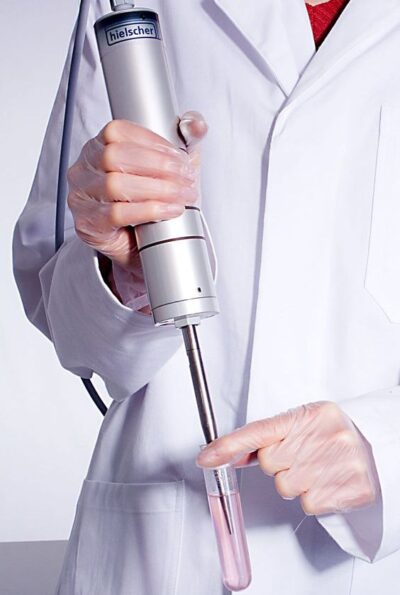
Sonicator UP200St for sample preparation workflows
| Probevirbereedung Aufgab | Recommandéiert Laborsonikator |
|---|---|
| Kleng Probevirbereedung | UP50H oder UP100H |
| Routine Laborhomogeniséierung | UP200Ht oder UP 200 St |
| Gréisser Labobatchen / Flowcellengeschäft | UP 400 St |
| Песня песня | Multi-Tube Sonicator VialTweeter |
| 96-Well an Multi-Well Placken | Microplate sonicator UIP400MTP |
| Mikroflowveraarbechtung | GDmini 2 |
Wéi wielt een e qualitativ héichwäertegen Laborsonikator
When choosing a laboratory sonicator or ultrasonic homogenizer, the most important criteria are ultrasonic power, precise amplitude control, reproducibility, sample compatibility, ease of use, and reliable documentation. Hielscher probe-type sonicators are designed for demanding sample preparation tasks such as cell lysis, tissue homogenization, protein extraction, DNA shearing, nanoparticle dispersion, emulsification, degassing, and sonochemical reactions.
Hielscher lab sonicators combine powerful ultrasound with digital process control, robust accessories, and practical safety features. This makes them suitable for research laboratories, analytical labs, process development, and industrial quality control.

Performance and Process Control
- Ultrasonic Power and Intensity: Hielscher laboratory homogenizers are available with 50, 100, 200, and 400 watts of ultrasonic power. This allows you to select the right sonicator for small samples, routine lab work, larger beaker volumes, or flow-cell processing.
- Precise Amplitude Control: Adjustable amplitude lets you define the required sonication intensity for each application. This is essential for reproducible homogenization, cell disruption, particle dispersion, emulsification, and extraction. Automatic frequency tuning keeps the sonicator operating at the optimal frequency.
- Fast and Efficient Sample Preparation: Compared with methods such as bead milling, freeze-thaw cycles, high-pressure homogenization, or lyophilization, probe sonication often reduces processing time while improving reproducibility and process efficiency.
- Temperatur Kontroll: Digital Hielscher sonicators from 200 watts upward can be used with a pluggable temperature sensor. The sonicator monitors the sample temperature continuously and can pause automatically when a defined temperature limit is reached. Pulsed sonication further helps to reduce heat build-up during sensitive sample preparation.
Sample Compatibility and Accessories
- Wide Range of Sonotrodes and Probes: Different sonotrode diameters, shapes, and materials allow optimal adaptation to sample volume, vessel geometry, and process requirements. Hielscher probes are made from robust, corrosion-resistant materials such as titanium, ceramic, or glass.
- Flexible Vessel and Volume Options: Hielscher sonicators can be used with tubes, vials, beakers, flow cells, and multi-sample accessories. This makes them suitable for microliter samples, laboratory batches, and continuous inline processing.
- Villsäiteg Uwendungen: With the right probe or accessory, one ultrasonic homogenizer can be used for cell disruption, tissue homogenization, DNA and RNA shearing, protein extraction, nanoparticle dispersion, emulsification, mixing, degassing, extraction, and sonochemistry.
- Easy Cleaning and Maintenance: Sonotrodes, probes, and flow cells are easy to disassemble and clean. Autoclavable components, clean-in-place options, and sterilize-in-place options help prevent cross-contamination and support reliable daily laboratory use.
Digital Operation and Documentation
- Digital Kontroll: Hielscher sonicators from 200 watts upward feature digital control with a color touch display, intuitive menu navigation, programmable settings, and browser-based remote control. Sample illumination on digital probe-type lab sonicators improves visibility during processing.
- Daten Logging: Digital Hielscher sonicators include automatic data recording on an integrated SD card. Process parameters such as amplitude, energy input, temperature, pressure, date, and time are saved as CSV files, supporting traceability, documentation, and GMP-oriented workflows.
- User-frëndlech Interface: The clear operating interface supports fast setup, simple parameter adjustment, and consistent operation. This is especially useful for routine sample preparation and repeated laboratory protocols.

Safety, Reliability, and Support
- Integrated Safety Features: Hielscher ultrasonic homogenizers include practical safety functions such as dry-run protection, programmable auto-stop settings, and intuitive operation. Optional sound protection boxes can further improve comfort and safety during sonication.
- Zouverlässegkeet an Haltbarkeet: Hielscher sonicators are built for long-term operation and demanding laboratory use. Their robust design helps reduce downtime, supports consistent performance, and contributes to cost-effective operation over many years.
- Compliance and Quality Standards: Hielscher Ultrasonics is an ISO-certified manufacturer. Hielscher ultrasonicators are CE-compliant and designed to meet relevant industry and safety requirements, including UL, CSA, and RoHS requirements where applicable.
- Warranty and Expert Support: Hielscher provides application support, technical guidance, and assistance with sonicator selection, installation, commissioning, process optimization, and scale-up. This helps you choose the right ultrasonic homogenizer, probe, flow cell, or accessory for your application.
Ultrasonic Flow Zell Reaktoren fir méi grouss Volumenveraarbechtung

Hielscher ultrasonic laboratory devices can run continuously in 24/7 operation without overheating. Thereby, Hielscher sonicators can be reliably used for the continuous sonication using a flow cell in inline processing. By using the laboratory devices in combination with flow cell reactors, you can comfortably process larger sample volumes. In this case, the liquid is pumped into the reactor made of glass or stainless steel. For example, a UP400St can process approx. 10 to 50 litres per hour. In the flow cell, the sample is exposed to defined intense sonication before it reaches the exit of the reactor cell. In order to cool heat-sensitive material during sonication, the flow cells are equipped with a cooling jacket to increase heat dissipation.
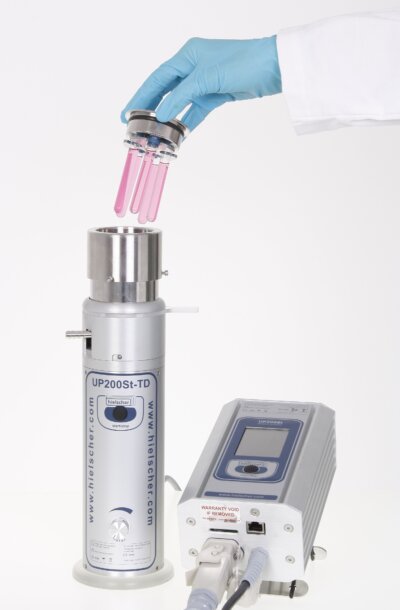
Ultraschall CupHorn for the simultaneous, sample prep of multiple samples
Kontaktéiert eis! / Frot eis!
The table below gives you an overview of Hielscher lab-size ultrasonicators and their processing capacities:
| Recommandéiert Apparater | Batch Volume | Duerchflossrate |
|---|---|---|
| UIP400MTP 96-Well Plate Sonicator | Multi-Well / Mikrotiter Placke | na |
| VialTweeter | Fläschen a Réier mat 0,5 bis 1,5 ml | na |
| UP100H Sonde-Typ Sonicator | 1 bis 500 ml | 10 bis 200 ml/min |
| UP200Ht, UP 200 St Sonde-Typ Sonicators | 10 bis 1000 ml | 20 bis 200 ml/min |
| UP400St Sonde-Typ Sonicator | 10 bis 2000 ml | 20 bis 400 ml/min |
| Ultraschall CupHorn | CupHorn fir Fläschen oder Becher | na |
| GDmini 2 | Ultraschall Mikro-Flow Reaktor | na |
| Ultrasonic Sieve Shaker | Ultraschall Labo Sief System | na |
Frequently Asked Questions About Laboratory Sonicators
What is a laboratory sonicator?
A laboratory sonicator is an ultrasonic device used to apply high-intensity ultrasound to liquid samples. In the lab, sonicators are commonly used for sample preparation, cell lysis, tissue homogenization, particle size reduction, nanoparticle dispersion, emulsification, extraction, degassing, and sonochemical reactions.
Wat ass de Ënnerscheed tëscht engem Probe-Sonikator an engem Ultraschallbad?
A probe sonicator transfers ultrasonic energy directly into the sample through a sonotrode, also called a probe or horn. This allows high intensity, precise amplitude control, and efficient processing. An ultrasonic bath applies ultrasound indirectly through the bath liquid and vessel wall, which usually results in lower and less reproducible energy transfer. For demanding sample preparation, cell disruption, dispersion, and homogenization tasks, a probe-type sonicator is typically the preferred choice.
Get a deep-dive into the difference between probe-type sonicators and ultrasonic baths!
Which lab sonicator is suitable for cell lysis and tissue homogenization?
For cell lysis, tissue homogenization, protein extraction, and DNA or RNA fragmentation, the right sonicator depends on sample volume, sample number, vessel type, and required throughput. Small samples can be processed with compact probe sonicators, while larger sample volumes or routine lab workflows often benefit from digital ultrasonic homogenizers with amplitude control, temperature monitoring, and data logging. For sterile or closed-vial processing, indirect sonication systems such as the Multi-Tube Sonicator VialTweeter, the Microplate Sonicator UIP400MTP or the CupHorn can be used.
How much sample volume can Hielscher laboratory sonicators process?
Hielscher laboratory sonicators cover a wide range of sample volumes, from very small microliter samples to larger laboratory batches. Depending on the device and setup, samples can be processed in tubes, vials, beakers, multi-well plates, or flow cells. For larger volumes, a lab sonicator can be combined with a flow cell reactor for continuous inline processing.
Can I sonicate closed tubes or vials?
Jo. Gespaart Röhre a Vialen kënnen indirekt mat ultraschall behandelt ginn duerch passend Accessoiren wéi Multi-Tube Sonicator VialTweeter, den UIP400MTP mat dem Vial Rack oder de CupHorn. Dëst ass nëtzlech wann sterile Veraarbechtung, Verhënnerung vu Kreeskontaminatioun, oder gläichzäiteg Behandlung vu ville klengen Proben erfuerderlech ass.
Can a laboratory sonicator process 96-well plates?
Yes. The UIP400MTP is a dedicated multi-well plate sonicator that can process any standard microtiter plates and 96-well plates. This is useful for high-throughput sample preparation, assays, screening workflows, cell lysis, DNA/RNA shearing, chromatin preparation, and protein extraction.
How can I prevent sample heating during sonication?
Ultrasonic processing can generate heat, especially during intense sonication. Sample heating can be controlled by using pulsed sonication, cooling the sample vessel, using a cooling jacket or flow cell, and monitoring the sample temperature. Digital sonicators with temperature control can pause sonication when a defined temperature limit is reached and continue once the sample has cooled.
Wéi eng Sonikatiounsparameter si wichteg fir reproduzéierbar Resultater?
Déi wichtegst Sonikatiounsparameter enthalen Amplitude, Sonikatiounszeit, Pulsmodus, Energieinput, Probenvolumen, Sondgréisst, Immersiounsdéift, Gefäßgeometrie an Probentemperatur. Fir reproduzéierbar Resultater sollen dës Parameter kontrolléiert, dokumentéiert an konsequent widderholl ginn.
Kann Laboratoriumsonikatioun op méi grouss Volumen skaliert ginn?
Jo. Laboratoriumsonikatioun kann duerch d'Wiel vun enger héichkraaft Ultraschallsprozessor, d'Benotzung vu méi grousse Sonden oder vum Wechsel vu Batch-Veraarbechtung op kontinuéierlech Flosszellveraarbechtung skaliert ginn. Dëst erlaabt d'Prozessentwécklung am Labor a d'Iwwerdroung op Pilot- oder industriell Ultraschallanlagen.
Wéi wielt een de richtegen Laboratoriumsonikator aus?
To choose the right lab sonicator, define your application, sample volume, vessel type, required throughput, temperature sensitivity, and documentation requirements. Hielscher can recommend a suitable ultrasonic homogenizer, probe, flow cell, sound protection box, or indirect sonication accessory based on your process.
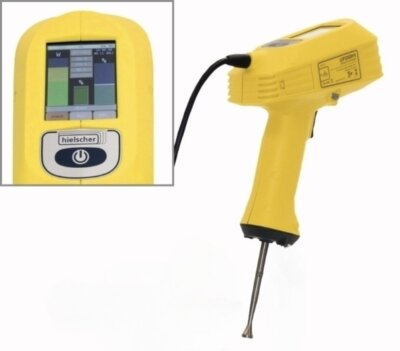
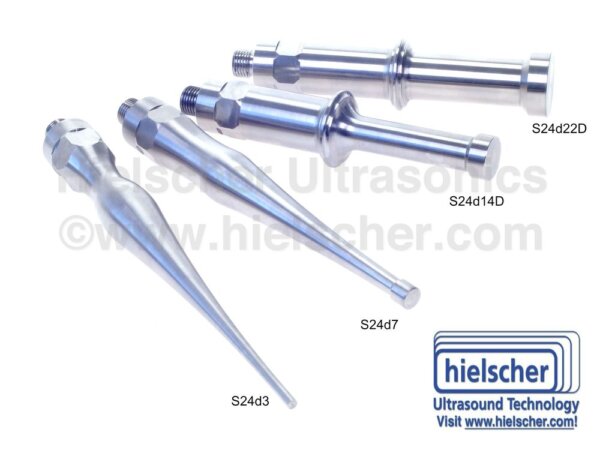
Sonotrodes vun diverse Gréissten a Geometrien erlaben déi ideal Konfiguratioun
Literatur / Referenzen
Fannt ausgewielte Studien, an deenen Hielscher Sonicatoren fir verschidde Probepräparatiounsaufgaben benotzt ginn, wéi Zellstéierung, DNA Fragmentatioun, Proteinisolatioun a Fraktioun, souwéi Dispergéierung an Emulsifikatioun.
- Nico Böhmer, Andreas Dautel, Thomas Eisele, Lutz Fischer (2012): Rekombinant Ausdrock, Reinigung a Charakteriséierung vun der natierlecher Glutamat Racemase vum Lactobacillus plantarum NC8. Protein Expr Purif. 2013 Mäerz;88(1):54-60.
- Brandy Verhalen, Stefan Ernst, Michael Börsch, Stephan Wilkens (2012): Dynamesch Ligand-induzéiert Conformational Rearrangements am P-Glykoprotein wéi ënnersicht duerch Fluorescence Resonance Energy Transfer Spectroscopy. J Biol Chem. 2012 Jan 6;287 (2): 1112-27.
- Claudia Lindemann, Nataliya Lupilova, Alexandra Müller, Bettina Warscheid, Helmut E. Meyer, Katja Kuhlmann, Martin Eisenacher, Lars I. Leichert (2013): Redox Proteomics entdeckt Peroxynitrit-empfindlech Proteinen déi Escherichia coli hëllefen Nitrosativ Stress ze iwwerwannen. J Biol Chem. 2013 Jul 5; 288(27): 19698–19714.
- Elahe Motevaseli, Mahdieh Shirzad, Seyed Mohammad Akrami, Azam-Sadat Mousavi, Akbar Mirsalehian, Mohammad Hossein Modarressi (2013): Normal an Tumor cervical Zellen reagéieren anescht op vaginale Laktobacilli, onofhängeg vum pH a Laktat. ed Microbiol. 2013 Jul; 62 (Pt 7): 1065-1072.
- Joanna Kopecka, Giuseppina Salzano, Ivana Campia, Sara Lusa, Dario Ghigo, Giuseppe De Rosa, Chiara Riganti (2013): Abléck an de chemesche Komponente vu Liposomen verantwortlech fir P-Glykoprotein Inhibitioun. Nanomedizin: Nanotechnologie, Biologie a Medizin 2013.
- Fernandes, Luz; Santos, Hugo; Nunes-Miranda, J.; Lodeiro, Carlos; Capelo, José (2011): Ultrasonic Enhanced Applications in Proteomics Workflows: Single Sonde versus Multiprobe. Journal of Integrated OMICS 1, 2011.
- Priego-Capote, Feliciano; Castro, Maria (2004): Analytesch Benotzung vun Ultraschall – I. Prouf Virbereedung. TrAC Trends an analytesch Chimie 23, 2004. 644-653.
- Welna, Maja; Szymczycha-Madeja, Anna; Pohl, Pawel (2011): Qualitéit vun der Spuerelement Analyse: Prouf Virbereedung Schrëtt. An: Breet Spektrum vu Qualitéitskontroll; InTechOpen 2011.