Probe-Sonikator vs. Ultraschallbad: Wéi eng Sonikatiounsmethod ass besser?
D'Wiel tëscht engem Probe-Typ Sonikator an engem Ultraschallbad hänkt vun der Intensitéit, Reproduzéierbarkeet an dem Prozesskontroll of, deen Är Uwendung erfuerdert. Ultraschallbäder si nëtzlech fir liicht Botzen a Behandlungen mat niddreger Intensitéit, mee si verdeelen d'Ultraschallenergie ongläichméisseg duerch de Behälter. Dëst féiert zu schwaachen, net-eneege Cavitatiounen an limitéierter Wiederholbarkeet.
Hielscher probe-type sonicators transmit high-power ultrasound directly into the sample through a sonotrode. This focused energy input creates intense acoustic cavitation exactly where it is needed. For demanding applications such as emulsification, dispersion, extraction, cell disruption, nanoparticle processing, particle size reduction, and sonochemistry, probe sonicators provide faster processing, better control, and reproducible results.
Why and How Does An Ultrasonic Probe Outperform an Ultrasonic Bath?
Probe sonicators provide:
- Higher cavitation intensity: Direct ultrasound transmission into the liquid.
- Faster processing: Shorter sonication times compared with ultrasonic baths.
- Better reproducibility: Precise control of amplitude, time, temperature, and energy input.
- Uniform results: Focused cavitation instead of uneven hot spots in a bath tank.
- Scalable performance: From small lab samples to industrial inline processing.
- Application flexibility: Suitable for emulsification, dispersion, extraction, homogenization, cell lysis, and particle size reduction.
Tell us your sample volume, material, target result, and required throughput. Hielscher will recommend the right probe sonicator, sonotrode, and processing setup.
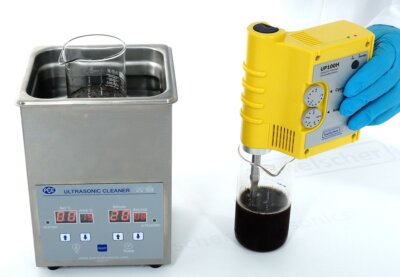
Sonde-Typ Sonicator vs Ultrasonic Bad – Entdeckt firwat Sonde-Typ Sonicatoren excel an Effizienz an Zouverlässegkeet
Why Probe Sonicators Outperform Ultrasonic Baths
Probe-type sonicators deliver ultrasonic energy directly into the sample. This creates intense acoustic cavitation, high shear forces, and efficient micro-mixing. As a result, probe sonicators process samples faster and more uniformly than ultrasonic baths.
For demanding applications such as nanoparticle dispersion, emulsification, extraction, cell disruption, homogenization, sonochemistry, and particle size reduction, process intensity matters. Probe sonicators allow users to control critical parameters such as amplitude, power, time, pulse mode, temperature, pressure, and flow rate. This control is essential for reproducible laboratory work, process development, and industrial scale-up.
Ultraschallbäder liwweren am Géigesaz nëmmen indirekt an mëll Sonikatioun. Hir Kavitatiounsintensitéit hänkt staark vun der Badgeometrie, Waasserniveau, Beispillpositioun, Gefäßform an Flëssegkeetstemperatur of. Well d'ultraschall Feld net gläichméisseg verdeelt ass, sinn Widderhuelbarkeet a Skala-Up limitéiert.
Verglach: Probe Sonikator vs Ultraschallbad
| Fonktioun | Probe-Typ Sonicator | Ultraschallbad |
|---|---|---|
| Energie Transfert | Direkt Ultraschalliwwerdroung an d'Beispill duerch eng Sonotrode. | Indirekt Ultraschalliwwerdroung duerch d'Badflëssegkeet an d'Beispillgefäß. |
| Kavitatiounsintensitéit | Kavitatioun vu hécher Intensitéit konzentréiert um Tipp vun der Probe. | Kavitatioun vu mëller Intensitéit, ongerecht verdeelt am ganzen Bad. |
| Prozess Kontroll | Präzis Kontroll vun Amplitude, Kraaft, Zäit, Temperatur, Drock an Fluxrate. | Begrenzte Kontroll; Resultater hänken staark vun der Beispillpositioun an de Badkonditiounen of. |
| reproducibility | Highly reproducible when parameters are controlled. | Poor reproducibility due to uneven ultrasonic field distribution. |
| Processing speed | Fast processing due to focused, high-power ultrasound. | Slow processing due to weak and indirect sonication. |
| Am Beschten fir | Dispersion, emulsification, extraction, cell lysis, homogenization, particle size reduction, and sonochemistry. | Cleaning, degassing, and mild low-intensity treatments. |
| Skala-up | Linear scale-up from lab tests to pilot and industrial inline processing. | Limited scale-up due to uneven cavitation and weak energy input. |
Sonicator Kavitatiounsintensitéit
Probe-type sonicators generate acoustic cavitation directly in the liquid medium. The sonotrode transmits high-power ultrasound into the sample, creating alternating high-pressure and low-pressure cycles. During the low-pressure cycle, microscopic vacuum bubbles form in the liquid. During the following high-pressure cycle, these bubbles collapse violently.
This collapse is known as cavitation. Cavitation produces intense local shear forces, liquid jets, micro-turbulence, and particle collisions. These mechanical effects are responsible for the efficiency of ultrasonic homogenization, dispersion, emulsification, extraction, and cell disruption.
In ultrasonic baths, cavitation is weak and unevenly distributed. Only certain locations in the bath receive strong cavitation, while other areas receive little ultrasonic treatment. This uneven energy distribution can cause inconsistent results, especially when processing multiple samples or when precise sonication conditions are required.
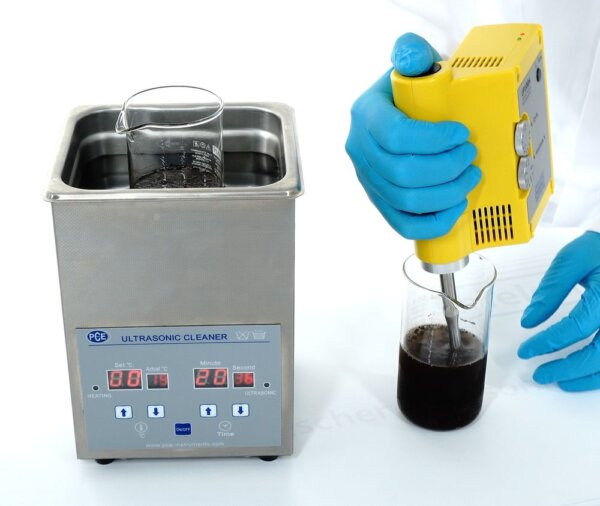
Bath sonicator vs probe-type sonicator
Hannergrond: Ultraschall Kavitatioun
Acoustic cavitation is the key mechanism behind high-intensity ultrasonication. Cavitation bubbles can show stable oscillation or transient collapse. Transient cavitation is especially important for ultrasonic processing because the collapse of cavitation bubbles generates localized pressure peaks, shear forces, and liquid microjets.
The intensity of ultrasonication depends on energy input, amplitude, sonotrode surface area, pressure, temperature, viscosity, and reactor geometry. For a given energy input, a larger sonotrode surface area reduces the ultrasonic intensity at the surface. This is why sonotrode selection is important for process optimization.
Cavitation Distribution in Ultrasonic Baths
In an ultrasonic bath, the ultrasonic field is distributed through the tank in a highly uneven way. Cavitation hot spots occur in some areas, while other parts of the tank receive only weak sonication. Sample position, bath filling level, vessel geometry, and bath loading can significantly affect the result.
This uneven cavitation field is one of the main limitations of ultrasonic baths. Even when the bath appears to operate uniformly, actual cavitation intensity can vary strongly across the tank. For this reason, ultrasonic baths are widely used for cleaning but are not ideal for controlled sample processing, reproducible nanoparticle dispersion, efficient extraction, or scale-up.

Foil test showing uneven cavitation hot spots in an ultrasonic bath.
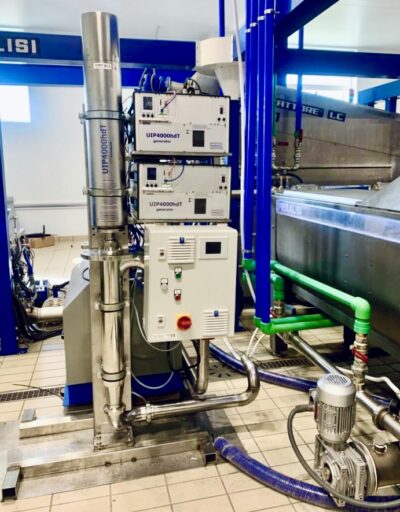
Industrial probe-type sonicator UIP4000hdT mat Stréimzellen fir kontinuéierlech Inline-Produktioun
Kraaftdicht: Firwat Sonikateuren vum Typ Sond méi effektiv sinn
Kraaftdicht ass en entscheedende Faktor an der Sonikatiounsleeschtung. Ultrasonic Badder liwweren typischerweis schwaach Ultrasonikatioun mat niddereger Kraaftdicht an ongleichméisseger Verdeedlung. Literaturanalyse reportéiert Ultrasonic Badder vu ronn 20 bis 40 Watt pro Liter fir Nanopartikel-Dispersiouns-Applikatiounen.
Sond-Typ Sonikateuren kënnen vill méi héich Kraaftdicht direkt an d'Flëssegkeet liwweren. An der ugefouerten Verglach kënnen Ultrasonic-Sondapparater ongeféier 20.000 Watt pro Liter an d'fërdere Flëssegkeet bréngen. Dëst bedeit, datt e Sond-Typ Sonikateur e Ultrasonic Bad ëm e Faktor vu ronn 1000 an der Energieinput pro veraarbechte Volumen iwwerschreiden kann.
This difference explains why probe sonicators are preferred for applications that require intensive cavitation, reliable process control, and efficient mass transfer.
Advantages of Probe-Type Sonicators
Probe-type sonicators concentrate ultrasonic power into a defined processing zone. This focused ultrasound transmission allows precise and efficient treatment of the sample. Compared with ultrasonic baths, probe sonicators offer significantly better control over sonication intensity and process outcome.
- High cavitation intensity
- Focused energy input
- Direct sample treatment
- Präzis Amplitude Kontroll
- reproducible Resultater
- Short processing times
- Efficient dispersion and emulsification
- Suitable for small and large volumes
- Batch an Inline Veraarbechtung
- linear Skala-up vu Labo bis Produktioun
Sonde-Typ Sonicators fir Open Beaker Processing
Open-beaker sonication is commonly used for laboratory samples, feasibility testing, formulation development, and small-volume processing. The sonotrode is immersed directly into the sample, and the most intense cavitation zone forms beneath the probe tip.
This setup is ideal when users need fast and direct processing of individual samples. It is frequently used for cell disruption, sample preparation, extraction, emulsification, nanoparticle dispersion, and homogenization.
Sonde-Typ Sonicators mat Flow Zell fir Inline Veraarbechtung
For larger volumes, better reproducibility, and industrial processing, probe-type sonicators can be operated with flow cells. In a closed flow-through reactor, the material passes through a defined cavitation zone. Flow rate, residence time, pressure, temperature, and amplitude can be controlled precisely.
Inline sonication ensures that all material is exposed to the same ultrasonic conditions. This makes flow-cell processing the preferred setup for scale-up, continuous production, recirculation processing, and validated manufacturing.
 UIP1000hdT ultrasonic recirculation setup with flow cell, tank, and pump.
Typical Applications: Probe Sonicator vs Ultrasonic Bath
| Applikatioun | Recommended Method | Reason |
|---|---|---|
| Zell Lysis | sonde sonicator | Requires direct, high-intensity cavitation for efficient disruption of cell membranes. |
| Nanopartikel Dispersioun | sonde sonicator | Requires high shear forces to break agglomerates and achieve uniform particle distribution. |
| Emulgatioun | sonde sonicator | Requires intense cavitation to reduce droplet size and produce stable emulsions or nanoemulsions. |
| Botanesch Extraktioun | sonde sonicator | Direct cavitation improves cell disruption, solvent penetration, and mass transfer. |
| Partikelgréisst Reduktioun | sonde sonicator | High localized shear and particle collisions support deagglomeration and wet milling. |
| Cleaning glassware or parts | Ultraschallbad | Low-intensity, distributed sonication is sufficient for many cleaning applications. |
| Mild degassing | Ultrasonic bath or probe sonicator | Baths can be sufficient for simple degassing; probes are better when complete gas removal, speed and control are required. |
| High volume processing | sonde sonicator | Ultrasonic processing of large volumes is most efficiently achieved by inline sonication using a probe-type sonicator with flow cell. |
Resumé: Sonde-Typ Sonicator vs Ultrasonic Bath
An ultrasonic bath provides weak, indirect, and uneven sonication. It is useful for cleaning and mild treatments, but it is not the best choice for demanding sample processing or reproducible process development.
A probe-type sonicator delivers focused, high-intensity ultrasound directly into the liquid. This produces stronger cavitation, faster results, better process control, and reproducible performance. For applications such as dispersion, emulsification, extraction, cell disruption, homogenization, particle size reduction, and sonochemistry, Hielscher probe-type sonicators provide the more powerful and scalable solution.

UP100H Sonde-Typ Sonicator fir Laborsprobenvirbereedung.
Dacks gestallte Froen iwwer Probe-Sonikatoren a Ultraschallbäder
Wat ass de Ënnerscheed tëscht engem Probe-Sonikator an engem Ultraschallbad?
En Probe-Sonikator iwwerdreift Ultraschall direkt an d'Probe duerch eng Sonotrode, wat intensiv Kavitatioun um Tipps vum Sonikator erzeugt. En Ultraschallbad iwwerdreift Ultraschall indirekt duerch e Behälter, wat méi mëll a manner uniform Kavitatioun produzéiert.
Ass e Probe-Sonikator méi staark wéi en Ultraschallbad?
Yes. Probe-type sonicators deliver much higher power density directly into the liquid. Ultrasonic baths typically provide low-intensity sonication with uneven cavitation distribution, while probe sonicators create focused, high-intensity cavitation.
When should I use a probe-type sonicator?
Use a probe-type sonicator for demanding applications such as cell lysis, homogenization, emulsification, nanoemulsification, nanoparticle dispersion, botanical extraction, particle size reduction, and sonochemistry.
When is an ultrasonic bath sufficient?
An ultrasonic bath is suitable for cleaning, mild degassing, and low-intensity treatment. It is not ideal when you need precise control, high cavitation intensity, reproducibility, or scale-up.
Why are ultrasonic baths less reproducible?
Ultraschallbäder hunn ongläiche Kavitatiounsfelder. D'Intensitéit vun der Kavitatioun variéiert ofhängeg vum Positioun vum Sample, der Geometrie vum Bad, dem Flëssegkeetsniveau, der Form vum Behälter, der Beladung vum Bad an der Temperatur. Dëst mécht et schwéier, exakt Soniksatiounsbedéngungen ze reproduzéieren.
Kann e Ultraschallbad fir d'Verdeelung vu Nanopartikelen benotzt ginn?
E Ultraschallbad kann hëllefen bei liicht Verdeelung, mee et ass normalerweis net staark genuch fir effizient Nanopartikel-Deagglomeratioun. Sonikatoren um Sonde-Typ ginn bevorzugt, well se héich Scherkräfte an fokusséiert Kavitatioun liwweren.
Kann e Sonikator um Sonde-Typ Emulsiounen a Nanoemulsiounen maachen?
Jo. Sonikatoren um Sonde-Typ ginn wäit verbreet fir Emulsiounen an Nanoemulsiounen ze produzéieren. Hir intensiv Kavitatioun reduzéiert d'Tröpfchengréis a verbessert d'Tröpfchendistributioun, wat d'Reißbeständegkeet vun der Emulsioun ënnerstëtzt.
Is a probe sonicator suitable for cell lysis?
Yes. Probe sonicators are commonly used for cell disruption and lysis because they deliver strong mechanical shear directly into the sample. This makes them effective for bacteria, yeast, plant cells, mammalian cells, and tissue homogenization.
Can probe sonication be scaled up?
Yes. Probe sonication can be scaled from small laboratory samples to pilot and industrial production. Hielscher ultrasonicators can be used in open vessels, batch reactors, recirculation setups, and continuous flow-through systems.
What parameters control probe sonication?
Important parameters include amplitude, sonication time, pulse mode, power input, sample volume, temperature, pressure, viscosity, solid concentration, sonotrode size, and reactor geometry.
Does a probe sonicator heat the sample?
High-intensity sonication can generate heat, but temperature can be controlled with cooling, pulse mode, short processing times, and flow-through operation. Hielscher ultrasonicators allow temperature monitoring and parameter control for reproducible processing.
Which Hielscher probe sonicator should I choose?
The right sonicator depends on your sample volume, application, viscosity, required intensity, target result, and throughput. Small laboratory samples can be processed with compact probe sonicators, while larger volumes and production processes require more powerful units or inline flow-cell systems.
Is an ultrasonic cleaner the same as a probe sonicator?
No. An ultrasonic cleaner is usually an ultrasonic bath designed for cleaning objects. A probe sonicator is a high-intensity ultrasonic processor designed for direct sample treatment, such as homogenization, emulsification, dispersion, extraction, and cell disruption.
Why choose a Hielscher probe-type sonicator?
Hielscher Sonikatoren vum Typ Sonde bidden héich Ultraschallintensitéit, präzis Amplitudekontroll, reproduzéierbar Veraarbechtung, Batch- a Inline-Konfiguratiounen, an linear Eskalatioun vun Labortester bis Industrieproduktioun.