Ultraschall verstäerkt Fixed Bett Reaktoren
Sonication can improve catalytic reactions in fixed-bed reactors mainly by intensifying mass transfer around and inside the packed catalyst bed. Additionally, sonication removes passivation and fouling layers from the catalyst surface thereby continuously regenerating the catalyst.
How Sonication Improves Fixed-Bed Catalysis
In a fixed-bed reactor, the catalyst particles remain stationary while liquid, gas, or multiphase reactants flow through the bed. Reaction performance is often limited by external mass transfer, pore diffusion, channeling, fouling, and heat-transfer gradients. Ultrasound can reduce several of these limitations by generating acoustic cavitation, microstreaming, shear forces, and pressure oscillations.

Sonicator UIP2000hdT integréiert an engem fixen Bettreaktor
Wichteg Effekter vun ultrasonesch intensivéierten fixe Bettreaktiounen
- Verbessert extern Massentransfer: Ultrasonic Mikrostroom reduzéiert d'stagnéierend Grenzschicht ronderëm Katalysatorpartikelen, wat et de Reaktanten erlaabt, effizienter op aktiv Sites ze kommen.
- Erhéicht Porenzougänglechkeet: Duerch Kavitation verursaachte Drockfluktuatiounen a Flëssegkeitsbewegung kënnen d'Duerchdréngung vun de Reaktanten an d'Katalysatorporen verbesseren an d'Entfernung vun den Produkter aus de Poren.
- Reduktioun vu Fouling a Passivatioun: Sonikatioun kann hëllefen, Oflagerungen, Polymerfilmer, Kock-Precursoren oder aner passivéierend Schichten vun de Katalysatorflächen ze entfernen, wat d'katalytesch Aktivitéit länger erhaalt.
- Reduced channeling in packed beds: In micropacked-bed studies, ultrasound has been shown to modify flow behavior and reduce dispersion, helping the reactor approach more ideal plug-flow behavior.
- Verbessert Hëtzttransfer: Acoustic streaming and turbulence improve local heat dissipation, reducing hot spots or cold zones in the catalyst bed.
- Higher conversion and yield: By improving mass transfer and catalyst accessibility, sonication can increase reaction rate, conversion, and product yield, especially when the reaction is transport-limited rather than purely kinetically limited.
Verbessert Flüsseg-Fest Kontakt: Ultrasound promotes better wetting of catalyst particles, which is especially useful in trickle-bed, slurry-fed, or liquid-phase fixed-bed systems.
How does Sonication Improve Fixed Bed Catalysis?
The main mechanism is acoustic cavitation: ultrasonic waves create microscopic bubbles that grow and collapse violently. Their collapse generates local shear, microjets, shockwaves, and intense mixing. Near catalyst surfaces, these effects can clean, activate, and refresh the solid-liquid interface. Reviews of sonocatalysis describe this as a synergy between ultrasound and solid catalysts, involving improved heat transfer, mass transfer, and localized effects at catalytic surfaces.
Sonication is most beneficial when the fixed-bed reaction suffers from:
- slow diffusion into catalyst pores,
- poor wetting of catalyst particles,
- product accumulation inside pores,
- fouling or surface passivation,
- mass-transfer-limited kinetics,
- multiphase flow maldistribution,
- channeling through the packed bed.
Fixed Bett Katalysatoren
Fixed Better (heiansdo och gepackt Bett genannt) ginn allgemeng mat Katalysatorpellets gelueden, déi normalerweis Granulat mat Duerchmiesser vu 1-5mm sinn. Si kënnen an de Reaktor a Form vun engem Eenzelbett, als getrennte Muschelen oder a Réier geluede ginn. D'Katalysatoren baséieren meeschtens op Metaller wéi Néckel, Kupfer, Osmium, Platin a Rhodium.
The effects of power ultrasound on heterogeneous chemical reactions are well known and widely used for industrial catalytic processes. Catalytic reactions in a fixed bed reactor benefit from sonication treatment, too. Ultrasonic irradiation of the fixed bed catalyst generates highly reactive surfaces, increases the mass transport between liquid phase (reactants) and catalyst, and removes passivating coatings (e.g. oxide layers) from the surface.
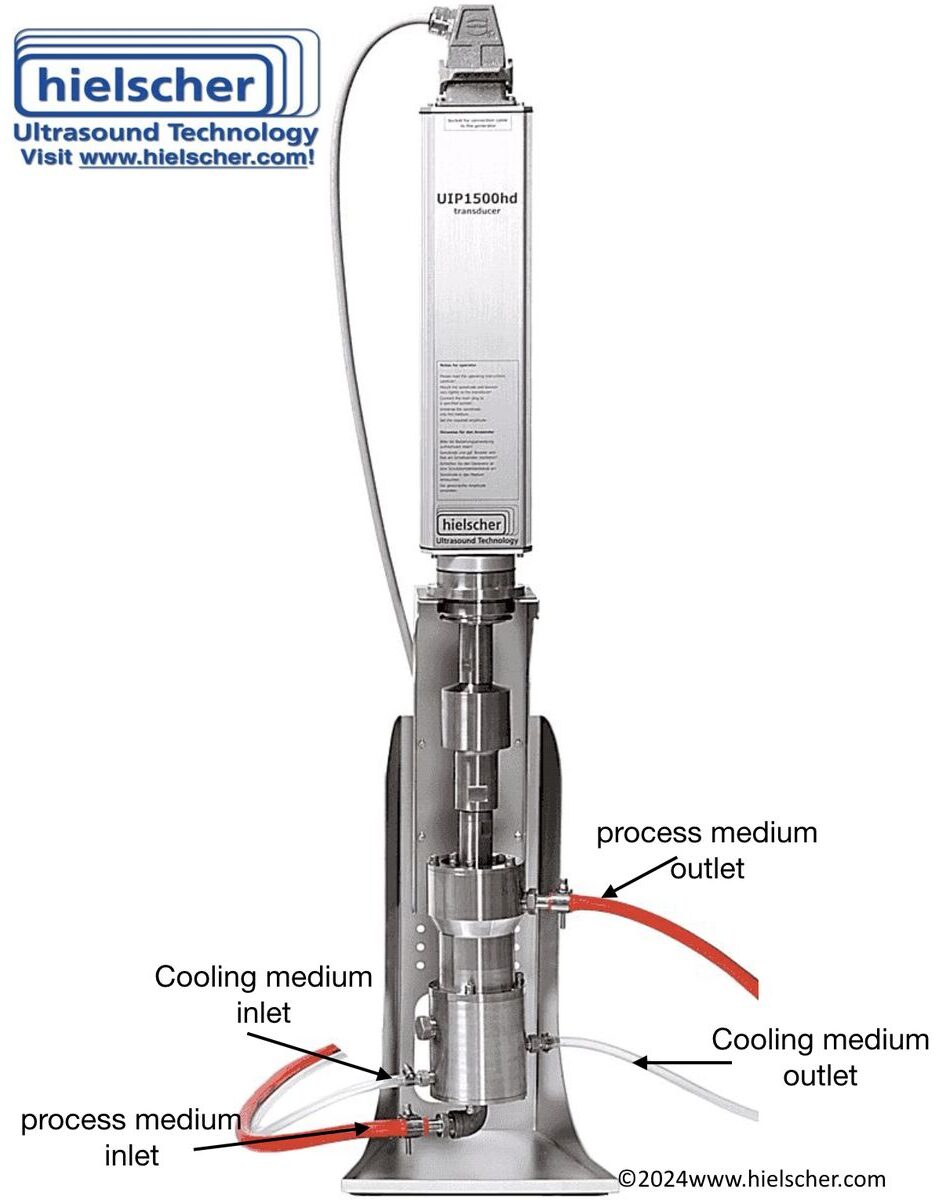
Sonicator UIP1500hdT with flow-cell for the reactivation and recycling of spent catalysts
- Verbessert Effizienz
- Erhéicht Reaktiounsfäegkeet
- Geklomm Konversioun Taux
- Méi héich Ausbezuele
- Recycling vum Katalysator
Ultraschall Intensifikatioun vu katalytesche Reaktiounen
Ultrasonic Mëschung an Agitatioun verbessert de Kontakt tëscht Reaktant a Katalysatorpartikelen, kreéiert héich reaktiv Flächen an initiéiert an / oder verbessert d'chemesch Reaktioun.
Ultrasonic Katalysator Virbereedung kann Ännerungen am Kristalliséierungsverhalen, Dispersioun / Deagglomeratioun an Uewerflächeeigenschaften verursaachen. Ausserdeem kënnen d'Charakteristike vu virgeformte Katalysatoren beaflosst ginn andeems d'passivéierend Uewerflächeschichten ewechgeholl ginn, besser Dispersioun, d'Erhéijung vun der Massentransfer.
Examples of Ultrasonically-Improved Reactions
- Ultraschall Virbehandlung vum Ni Katalysator fir Hydrogenéierungsreaktiounen
- Sonicated Raney Ni Katalysator mat tartaric Seier Resultater zu enger ganz héich Enantioselectivity
- Ultrasonic synthesized Fischer-Tropsch catalysts
- Sonochemesch behandelt amorph Pulver Katalysatoren fir erhéicht Reaktivitéit
- Sono-Synthese vun amorphen Metallpulver
Ultraschall Katalysator Erhuelung
Solid catalysts in fixed-bed reactors are commonly used in the form of spherical beads, pellets, extrudates, or cylindrical particles. During chemical reactions, the catalyst surface can become passivated by a fouling layer, resulting in a gradual loss of catalytic activity and/or selectivity over time.
The timescale of catalyst deactivation varies considerably. For example, the deactivation of a cracking catalyst may occur within seconds, whereas an iron catalyst used in ammonia synthesis may remain active for 5–10 years. Nevertheless, catalyst deactivation is observed in virtually all catalytic processes. Although different deactivation mechanisms can occur – including chemical, mechanical, and thermal degradation – fouling is one of the most common causes of catalyst decay.
Fouling refers to the physical deposition of species from the fluid phase onto the catalyst surface and within its pores. These deposits block reactive sites, restrict pore accessibility, and reduce contact between reactants and the active catalyst surface. Catalyst fouling by coke or carbonaceous deposits is often a rapid process; however, in many cases it can be partially or fully reversed by ultrasonic regeneration.
Ultrasonic cavitation is an effective method for removing passivating fouling layers from catalyst surfaces. During sonication, high-intensity ultrasound generates cavitation bubbles in a liquid medium. Their collapse produces localized shear forces, microjets, shock waves, and intense micro-mixing. These effects help detach fouling residues from the catalyst surface, reopen blocked pores, and restore access to active sites.
Ultrasonic catalyst recovery is typically carried out by dispersing the catalyst particles in a liquid, such as deionized water or a suitable solvent, and exposing the suspension to controlled ultrasonic treatment. This process can remove fouling residues from various catalyst materials, including platinum/silica fibre catalysts, nickel catalysts, and other supported metal catalysts. As a result, sonication can contribute to catalyst regeneration, extended catalyst lifetime, and improved process sustainability.
Click here to learn more about the ultrasonic regeneration of spent catalysts!
Sonicators for the Integration into Chemical Reactors
 Hielscher Ultrasonics bitt verschidde Ultraschallprozessoren a Variatiounen fir d'Integratioun vu Kraaft-Ultraschall an fixe Bettreaktoren. Verschidde Ultraschallsystemer si verfügbar fir a fixe Bettreaktoren z'installéieren. Fir méi komplex Reakteren Zorte, mir bidden personaliséiert Ultraschall Léisungen.
Learn how sonication improves chemical reactions in various reactor designs!
To test the effects of sonication on your chemical reaction, you are welcome to visit our ultrasonic process lab and technical center in Teltow!
Kontaktéiert eis haut! Mir si frou d'Ultraschallverstäerkung vun Ärem chemesche Prozess mat Iech ze diskutéieren!
D'Tabell hei drënner gëtt Iech eng Indikatioun vun der ongeféier Veraarbechtungskapazitéit vun Hielscher Sonikatoren:

Ultraschall Flow System
- Hydrogenatioun
- Alcylatioun
- Cyanatioun
- etherification
- esterification
- Polymeriséierung
- Allylatioun
- Brominéierung
(zB Ziegler-Natta Katalysatoren, Metallocenen)
Literatur / Referenzen
- Francisco J. Navarro-Brull; Andrew R. Teixeira; Jisong Zhang; Roberto Gómez; Klavs F. Jensen (2018): Reduction of Dispersion in Ultrasonically-Enhanced Micropacked Beds. Industrial & Engineering Chemistry Research 57, 1; 2018. 122–128.
- Yasuo Tanaka (2002): A dual purpose packed-bed reactor for biogas scrubbing and methane-dependent water quality improvement applying to a wastewater treatment system consisting of UASB reactor and trickling filter. Bioresource Technology, Volume 84, Issue 1, 2002. 21-28.
- Argyle, M.D.; Bartholomew, C.H. (2015): Heterogeneous Catalyst Deactivation and Regeneration: A Review. Catalysts 2015, 5, 145-269.
- Oza, R.; Patel, S. (2012): Recovery of Nickel from Spent Ni/Al2O3 Catalysts using Acid Leaching, Chelation and Ultrasonication. Research Journal of Recent Sciences Vol. 1; 2012. 434-443.
- Sana, S.; Rajanna, K.Ch.; Reddy, K.R.; Bhooshan, M.; Venkateswarlu, M.; Kumar, M.S.; Uppalaiah, K. (2012): Ultrasonically Assisted Regioselective Nitration of Aromatic Compounds in Presence of Certain Group V and VI Metal Salts. Green and Sustainable Chemistry, 2012, 2, 97-111.
- Suslick, K. S.; Skrabalak, S. E. (2008): “Sonocatalysis” In: Handbook of Heterogeneous Catalysis, vol. 4; Ertl, G.; Knözinger, H.; Schüth, F.; Weitkamp, J., (Eds.). Wiley-VCH: Weinheim, 2008. 2006-2017.
Fakten Worth Wëssen
Wat ass Ultraschall Kavitatioun?
Ultrasonic cavitation is the formation, growth and violent collapse of microscopic vapor or gas bubbles in a liquid exposed to high-intensity ultrasound. During bubble collapse, extreme local conditions can occur for very short times, including high temperature, high pressure, shock waves, microjets and intense shear forces.
Wat ass Sonochemie?
Sonochemistry is the use of these ultrasonic cavitation effects to initiate, accelerate or modify chemical and physicochemical processes. It is especially relevant in liquid-phase systems because cavitation enhances mixing, mass transfer, emulsification, particle dispersion, catalyst surface cleaning and, in some cases, radical formation. As a result, sonochemistry is used to intensify reactions such as heterogeneous catalysis, oxidation, extraction, polymerization, crystallization and nanomaterial synthesis.
What is a Heterogeneous Catalytic Reaction?
An der Chimie bezitt heterogen Katalyse op d'Aart vu katalytescher Reaktioun wou d'Phasen vum Katalysator an de Reaktanten vuneneen ënnerscheeden. Am Kontext vun der heterogener Chimie gëtt d'Phase net nëmme benotzt fir tëscht Feststoff, Flëssegkeet a Gas z'ënnerscheeden, awer et bezitt sech och op onmëschbar Flëssegkeeten, zB Ueleg a Waasser.
Wärend enger heterogener Reaktioun ënnerleien een oder méi Reaktanten eng chemesch Ännerung op engem Interface, zB op der Uewerfläch vun engem festen Katalysator.
D'Reaktiounsquote hänkt vun der Konzentratioun vun de Reaktanten, der Partikelgréisst, der Temperatur, dem Katalysator a weidere Faktoren of.
Reaktant Konzentratioun: Am Allgemengen erhéicht eng Erhéijung vun der Konzentratioun vun engem Reaktant den Taux vun der Reaktioun wéinst der méi grousser Interface an doduerch méi grousser Phasetransfer tëscht Reaktantpartikelen.
Partikelgréisst: Wann ee vun de Reaktanten e feste Partikel ass, da kann et net an der Geschwindegkeetgleichung ugewise ginn, well d'Geschwindegkeetgleichung nëmmen Konzentratioune weist a Feststoffer kënnen net eng Konzentratioun hunn zënter datt se an enger anerer Phase sinn. Wéi och ëmmer, d'Partikelgréisst vum Feststoff beaflosst d'Reaktiounsquote wéinst der verfügbarer Uewerfläch fir Phasentransfer.
Reaktioun Temperatur: D'Temperatur ass mat der Geschwindegkeetskonstant iwwer d'Arrhenius Equatioun verbonnen: k = Ae-Ea/RT
Wou Ea d'Aktivéierungsenergie ass, R ass d'Universal Gaskonstant an T ass déi absolut Temperatur am Kelvin. A ass den Arrhenius (Frequenz) Faktor. e-Ea/RT gëtt d'Zuel vun de Partikelen ënner der Kurve déi Energie méi grouss hunn wéi d'Aktivéierungsenergie, Ea.
Katalysator: An deene meeschte Fäll kommen Reaktiounen méi séier mat engem Katalysator op, well se manner Aktivéierungsenergie erfuerderen. Heterogen Katalysatoren bidden eng Schablounfläch op där d'Reaktioun geschitt, wärend homogen Katalysatoren Zwëscheprodukter bilden, déi de Katalysator während engem spéidere Schrëtt vum Mechanismus befreien.
Aner Faktoren: Aner Faktore wéi Liicht kënne verschidde Reaktiounen beaflossen (Fotochemie).
What are the Types of Catalyst Deactivation?
- Katalysatorvergëftung ass de Begrëff fir déi staark Chemisorptioun vun Arten op katalytesche Site déi Site fir katalytesch Reaktioun blockéieren. Vergëftung kann reversibel oder irreversibel sinn.
- Fouling bezitt sech op eng mechanesch Degradatioun vum Katalysator, wou Spezies aus der flësseger Phase op d'katalytesch Uewerfläch an an de Katalysatorporen deposéieren.
- Thermesch Degradatioun a Sintering resultéiert am Verloscht vun der katalytescher Uewerfläch, Ënnerstëtzungsfläch an aktive Phase-Ënnerstëtzungsreaktiounen.
- D'Dampbildung bedeit eng chemesch Degradatiounsform, wou d'Gasphase mat der Katalysatorphase reagéiert fir flüchteg Verbindungen ze produzéieren.
- Damp-fest a fest-fest Reaktiounen féieren zu der chemescher Deaktivéierung vum Katalysator. Damp, Ënnerstëtzung oder Promoteur reagéiert mam Katalysator sou datt eng inaktiv Phase produzéiert gëtt.
- Ausschnëtter oder Zerdréckung vun de Katalysatorpartikelen resultéiert am Verloscht vu katalytesche Material wéinst mechanesche Abrasiounen. D'intern Uewerfläch vum Katalysator gëtt verluer wéinst der mechanescher induzéierter Zerstéierung vum Katalysatorpartikel.
Read more about how sonication can reactivate spent catalysts!
What is Nucleophilic Substitution?
Nucleophilic substitution is a fundamental class of reactions in organic (and inorganic) chemistry, in which a nucleophile selectively bonds in form of a Lewis base (as electron pair donator) with an organic complex with or attacks the positive or partially positive (+) charge of an atom or a group of atoms to replace a leaving group. The positive or partially positive atom, which is the electron pair acceptor, is called an electrophile. The whole molecular entity of the electrophile and the leaving group is usually called the substrate.
Déi nukleophil Substitutioun kann als zwee verschidde Weeër observéiert ginn – den SN1 an SN2 reaktioun. Wéi eng Form vu Reaktiounsmechanismus – sN1 oder SN2 – stattfënnt, hänkt vun der Struktur vun de chemesche Verbindungen, der Aart vum Nukleophil an dem Léisungsmëttel of.