Phytochemistry and Sonication: High-Efficiency Ultrasonic Extraction of Plant Bioactives
Phytochemistry is the science of plant-derived chemical compounds – from polyphenols, flavonoids and alkaloids to terpenes, saponins, glycosides, pigments, antioxidants and essential oil constituents. These phytochemicals are valuable for nutraceuticals, pharmaceuticals, cosmetics, food ingredients, natural colorants, fragrances, herbal extracts and analytical research.
Upgrade Your Phytochemical Extraction with Hielscher Sonicators
Extract More Bioactives in Less Time
Hielscher probe-type sonicators intensify botanical extraction by breaking open plant cells and accelerating mass transfer. This enables high-yield extraction of phytochemicals from herbs, roots, leaves, flowers, fruits, seeds, bark, algae and other plant materials.
Why Choose Hielscher Ultrasonic Extraction Systems
- Higher extraction yields: Recover more target compounds from the same botanical raw material.
- Shorter processing times: Replace long maceration or heat-intensive extraction steps with fast ultrasonic processing.
- Mild, non-thermal extraction: Preserve heat-sensitive phytochemicals such as polyphenols, terpenes, anthocyanins, vitamins and antioxidants.
- Solvent flexibility: Use water, ethanol, hydroethanolic mixtures, glycerin, oils, deep eutectic solvents or other suitable extraction media.
- Precise process control: Adjust amplitude, power, energy input, time, temperature, pressure and flow rate.
- Linear scale-up: Develop extraction parameters in the lab and transfer them to pilot and industrial production.
- Batch and inline operation: Choose beaker-scale sonication, stirred tank processing or continuous flow-through extraction.
- Robust industrial design: Hielscher Ultraschallgeräte sinn fir gefuerdert Produktiounsumwelt entwéckelt, fir reproduzéierbar Operatioun an einfach Integratioun.

Sonicator UIP1000hdT fir d'Extraktioun vu Phytochemikalien
Déi déifgréng Faarf vum Ultraschall-Ribwort-Extrakt beliicht déi super Effizienz vun der Ultraschalltechnologie fir e Vollspektrumextrakt ze produzéieren. Ultraschall botanesch Extraktioun ass méi séier, méi potent a méi effizient. Déi héich effizient Ultraschallextraktioun mam UP200Ht produzéiert e Vollspektrum Ribbwort Extrakt.
Déi déifgréng Faarf vum Ultraschall-Ribwort-Extrakt beliicht déi super Effizienz vun der Ultraschalltechnologie fir e Vollspektrumextrakt ze produzéieren. Ultraschall botanesch Extraktioun ass méi séier, méi potent a méi effizient. Déi héich effizient Ultraschallextraktioun mam UP200Ht produzéiert e Vollspektrum Ribbwort Extrakt.
Ultraschallbehandlung fir méi séier, méi propper an méi komplett Phytochemikalie-Extraktioun
 To use phytochemicals in formulations, assays or commercial products, they must first be released from the plant matrix. This is where sonication has become one of the most effective extraction technologies. Probe-type ultrasonicators generate intense acoustic cavitation in liquids and slurries. The resulting microturbulence, shear forces and pressure fluctuations disrupt plant cells, improve solvent penetration and accelerate the transfer of bioactive molecules into the extraction medium.
Hielscher Ultrasonics liwwert héichleeschtungs Ultrasonikateuren fir phytochemesch Extraktioun vu Laborfuerschung bis hin zu voller industrieller Produktioun. Wuert et wann Dir e botanëschen Extrakt entwéckelt, analytisch Proben virbereet oder e planzebaséierten Zutatenprozess skaliert, gëtt Sonikatioun Iech präzis Kontroll iwwer Extraktiounsintensitéit, Reproduzéierbarkeet an Drëpsesaz.
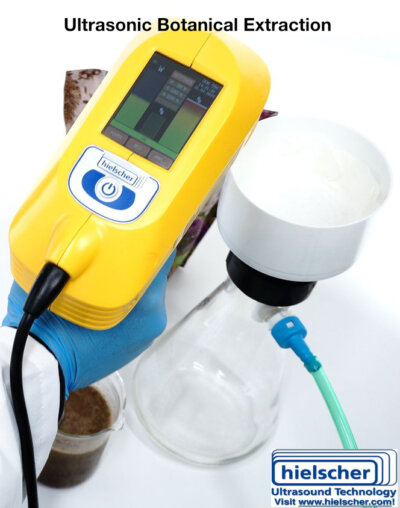
Sonicator UP200Ht fir d'Extraktioun vun Phytochemikalien
Wat ass Sonikatioun an der Phytochemie?
Sonikatioun ass d'Uwendung vu héichkraaft Ultraschall op eng Flëssegkeet oder Slurry. An der Phytochemie gëtt Sonikatioun am heefegsten fir ultraschallgestëtzte Extraktioun, Probenvirbereedung, Zellstéierung, Dispersioun, Emulgatioun a Prozessintensivéierung benotzt.
When a high-intensity ultrasonic probe transmits sound waves into an extraction medium, alternating high-pressure and low-pressure cycles create acoustic cavitation. Cavitation bubbles grow and collapse violently. This collapse produces localized shear forces, liquid microjets and intense mixing effects.
In botanical extraction, these effects help to:
- rupture cell walls and membranes
- increase solvent access to intracellular compounds
- reduce boundary layers around plant particles
- improve diffusion of phytochemicals into the solvent
- shorten extraction time
- increase reproducibility
- reduce the need for excessive heat or prolonged solvent exposure
The result is a faster, more efficient and often gentler extraction process compared with conventional maceration, infusion, percolation or reflux methods.
Firwat Sonikatioun wichteg fir modern Phytochemikalieextraktioun ass
Botanescht Rohmaterial ass komplex. Bioaktiv Verbindunge sinn an Planzzellen ageschloss, un strukturell Komponenten gebonnen oder iwwer verschidde Geweiser verdeelt. Konventionell Extraktioun erfuerdert dacks laang Kontaktzäiten, héich Léisungsmëttelvolumen oder erhéichte Temperaturen. Dës Konditiounen kënnen ineffizient sinn an thermolabil Verbindunge degradéieren.
Ultraschall-ënnerstëtzt Extraktioun adresséiert dës Limiteure duerch d'Verstäerkung vum physeschen Fräiloss vun Phytochemikaler. Amplaz sech nëmmen op passiv Diffusioun ze verloossen, zerstéiert Sonikatioun aktiv d'Planzmatrix a féiert Massemovertrag.
Dëst mécht ultraschallbaséiert Extraktioun besonnesch nëtzlech wann Veraarbechter brauchen:
- héijer Ausbeute vun deier Botanicals
- kierzere Produktiounszäiten
- Méi niddereg Léisungsmëttelverbrauch
- verbessert Extraktioun vun hëtzesensitive Verbindunge
- reproduzéierbar Extraktioun fir Qualitéitskontroll
- skaléierbar Veraarbechtung vum Labor op d'Produktioun
- Kompatibilitéit mat gréngen Léisungsmëttel a propper-Label Zutate
Fir phytochemesch Fuerschung verbessert Sonikatioun och d'Analysbeispillvirbereedung. Laboratoiren kënnen Zilverbindunge séier a konsequent extrahéieren virum HPLC, GC-MS, LC-MS, UV-Vis, Antioxidantassays oder anere analytesche Methoden.
Konventionell vs Extraktiouns Methodë – Eng Verglach
| Konventionell Extraktiouns Method | Limiten vun der konventioneller Method | Virdeel vun der Sonikatioun |
|---|---|---|
| maceration | Maceratioun ass einfach mä lues. Et kann Stonnen, Deeg oder souguer Wochen daueren fir eng akzeptabel Extraktiounsausbezuelung z'erreechen. | Sonikatioun beschleunegt datselwecht Léisungsmëttel-Extraktiounsprinzip duerch aktiv d'Planzenzellen ze stéieren an d'Diffusioun ze verbesseren. Dëst kann d'Veraarbechtungszäit dramatesch reduzéieren. |
| Reflux-Extraktioun | Reflux extraction uses heat to improve solubility and mass transfer. However, heat can degrade sensitive phytochemicals and increase energy consumption. | Sonication achieves high extraction efficiency at lower temperatures, making it suitable for heat-sensitive plant compounds. |
| Soxhlet Extraktioun | Soxhlet extraction is widely used in laboratories but is solvent-intensive and time-consuming. | Ultrasonic extraction can reduce solvent volume and extraction time, making it attractive for analytical work, R&D and process development. |
| mechanesch Agitatioun | Stirring improves mixing but does not provide the same cavitation-driven cell disruption as probe-type ultrasound. | Sonication combines mixing, particle deagglomeration and cell rupture in one process step, resulting in more intensive extraction. |
Batch and Inline Sonication for Botanical Extracts
Batch Ultrasonic Extraction
Batch sonication is ideal for laboratory research, formulation development, small-scale production and flexible processing. A probe sonicator is inserted into a vessel containing the plant-solvent slurry. Batch processing is easy to set up and excellent for screening parameters such as solvent type, amplitude, extraction time and temperature.
Continuous Inline Ultrasonic Extraction
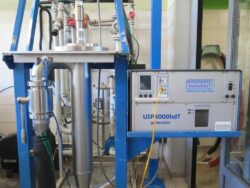 For larger production volumes, continuous inline sonication is the preferred setup. The botanical slurry is pumped through an ultrasonic flow cell where it is exposed to controlled cavitation. Inline processing improves reproducibility, process control and throughput. It also makes scale-up more predictable because energy input, residence time and flow rate can be defined precisely.
Hielscher industrial ultrasonicators are designed for continuous operation and can be integrated with pumps, heat exchangers, holding tanks, filtration systems, solvent recovery and downstream concentration.
The table below gives you an indication of the approximate processing capacity of our sonicators for botanical extraction
| Batch Volume | Duerchflossrate | Recommended Sonicator |
|---|---|---|
| 1 bis 500 ml | 10 bis 200 ml/min | UP100H |
| 10 bis 2000 ml | 20 bis 400 ml/min | UP200Ht, UP 400 St |
| 0.1 bis 20L | 02 bis 4 l/min | UIP2000hdT |
| 10 bis 100 l | 2 bis 10 l/min | UIP4000hdT |
| 15 bis 150 l | 3 bis 15 l/min | UIP6000hdT |
| na | 10 bis 100 l/min | UIP16000hdT |
| na | méi grouss | Stärekoup vun UIP16000hdT |
Phytochemicals Extracted by Sonication
Sonication is suitable for a wide range of phytochemical classes. The extraction result depends on plant material, particle size, solvent, temperature, ultrasonic amplitude, residence time and downstream separation.
Polyphenols and Flavonoids
Polyphenols and flavonoids are among the most studied phytochemicals because of their antioxidant properties and relevance in food, nutraceutical and cosmetic formulations. Ultrasonic extraction enhances the release of phenolic acids, catechins, quercetin, rutin, anthocyanins and related compounds from leaves, fruits, peels, flowers, seeds and bark.
Terpenes and Essential Oil Constituents
Terpenes and aroma compounds are important for herbal extracts, fragrances, flavors and cannabis or hemp processing. Sonication can improve extraction from plant tissues while allowing mild temperature control, which is important for volatile and oxidation-sensitive compounds.
Alkaloiden
Alkaloids occur in many medicinal plants and are often extracted for analytical, pharmaceutical or nutraceutical purposes. Ultrasonic treatment improves matrix disruption and can accelerate alkaloid transfer into suitable solvents.
Saponins, Glycosides and Tannins
Many roots, herbs, legumes and medicinal plants contain saponins, glycosides and tannins. Sonication helps release these compounds from fibrous or dense plant matrices and can be optimized to balance extraction yield with selectivity.
Pigments and Antioxidants
Natural pigments such as anthocyanins, chlorophylls, carotenoids and betalains are valuable for food, beverage, cosmetic and analytical applications. Since many pigments are sensitive to heat, oxygen and pH, ultrasonic extraction under controlled temperature conditions is highly advantageous.
Cannabinoids and Hemp Phytochemicals
Hemp and cannabis contain cannabinoids, terpenes, flavonoids and other plant constituents. Ultrasonic extraction improves the release of these compounds from milled biomass and can be adapted to ethanol, hydroethanolic or other solvent systems.
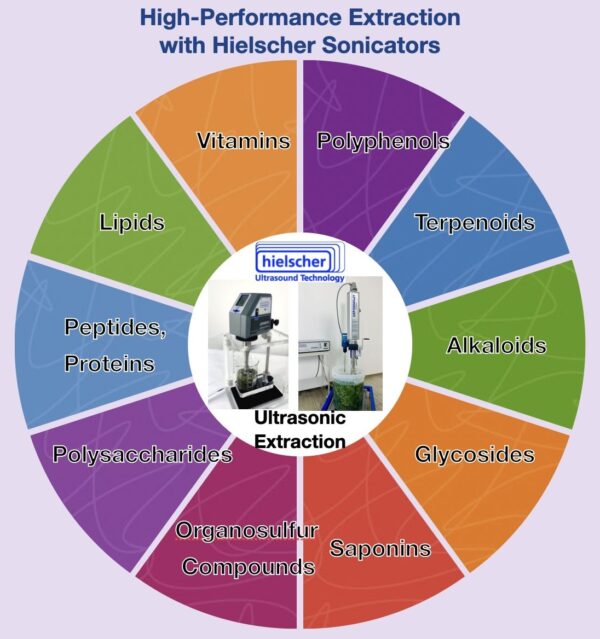
Ultrasonic extraction of phytochemicals
FAQ: Sonication and Phytochemistry
Wat ass Sonikatioun an der Phytochemie?
Sonikatioun an der Phytochemie ass d'Benotzung vu héichkraaft Ultraschall fir chemesch Verbindungen aus Planzen ze extrahéieren, fräiloossen oder ze verschaffen. Et gëtt dacks fir d'Ultraschall-ënnerstëtzt Extraktioun vu Phytochemikalien wéi Polyphenolen, Flavonoiden, Terpenen, Alkaloiden, Pigmenter, Antioxidantien an essentiellen Ueleger benotzt.
Wéi extrahéiert Sonikatioun Phytochemikalien aus Planzen?
Sonikatioun generéiert akustesch Kavitation an der Extraktiounsflëssegkeet. Kavitation produzéiert Scherrkräfte, Mikrojets an intensiv Mëschung, déi d'Planzezellstrukturen zerstéiere an d'Léisungsmëtteldurchdréngung verbesseren. Dëst beschleunegt de Transfer vu Phytochemikalien aus der Planzenmatrix an d'Léisungsmëttel.
Wéi eng Phytochemikalien kënne mat Ultraschall extrahéiert ginn?
Ultrasonesch Extraktioun kann fir Polyphenoler, Flavonoiden, Anthocyane, Terpener, Cannabinoiden, Alkaloiden, Saponiner, Tanninen, Glycosiden, Chlorophyllen, Carotenoiden, Bestanddeeler vun äthereschen Ueleger an vill aner vu Planzen ofgeleet Komponente benotzt ginn.
Ass ultrasonesch Extraktioun gëeegent fir hitzesensitiv Phytochemikalien?
Jo. Sonikatioun gëtt als eng mëll, net-thermesch Extraktiounsmethod ugesinn wann d'Temperatur richteg kontrolléiert gëtt. Dat mécht et gëeegent fir hitzesensitiv Verbindungen wéi Antioxidantien, Pigmenter, Terpene an bestëmmte Vitaminnen.
Ass Sonikatioun mat enger Sonde besser wéi e ultrasonescht Buedzëmmer fir Phytochemikalien-Extraktioun?
For efficient extraction, probe-type sonication is generally much more powerful and controllable than an ultrasonic bath. A probe sonicator transmits energy directly into the liquid, creating intense cavitation in the sample or process stream. Ultrasonic baths are significantly less intense and lack in reproducible results for demanding extraction tasks. Watch the difference in ultrasonic extraction results comparing a probe-type sonicator with an ultrasonic bath!
Which solvents can be used for ultrasonic phytochemical extraction?
Common solvents include water, ethanol, ethanol-water mixtures, glycerin, oils and other application-specific solvents. For analytical extraction, methanol or other laboratory solvents may be used. Sonication can also be combined with deep eutectic solvents and natural deep eutectic solvents.
Can sonication reduce extraction time?
Yes. Ultrasonic extraction can significantly shorten extraction time compared with conventional maceration, infusion or solvent extraction because cavitation accelerates cell disruption and mass transfer.
Can ultrasonic extraction be scaled up?
Yes. Hielscher sonicators are available from laboratory to industrial scale. Processes developed with controlled parameters such as amplitude, energy input, temperature and residence time can be transferred to larger batch or continuous inline systems.
Is sonication suitable for industrial botanical extraction?
Yes. Industrial ultrasonicators with flow-through reactors can process botanical slurries continuously. This makes sonication suitable for commercial production of nutraceutical extracts, herbal tinctures, cosmetic actives, food ingredients and plant-derived bioactives.
What are the main advantages of Hielscher ultrasonicators for phytochemistry?
Hielscher sonicators provide powerful cavitation, precise parameter control, reproducible extraction, batch and inline operation, scalable equipment options and compatibility with many solvents and botanical materials. They are suitable for research, process development and full-scale production.
How do I choose the right ultrasonic extractor?
The best ultrasonic extractor depends on your plant material, target compounds, solvent, volume, solids content, temperature limits and required throughput. Hielscher can recommend a suitable lab, pilot or industrial sonicator based on your extraction process.
Literatur / Referenzen
- Turrini, Federica; Donno, Dario; Beccaro, Gabriele; Zunin, Paola; Pittaluga, Anna; Boggia, Raffaella (2019): Pulsed Ultrasound-Assisted Extraction as an Alternative Method to Conventional Maceration for the Extraction of the Polyphenolic Fraction of Ribes nigrum Buds: A New Category of Food Supplements Proposed by The FINNOVER Project. Foods. 8. 466; 2019
- Larasati, I.D.; Oktaviani, N.M.D.; Lioe, H.N.; Estiasih, T.; Palma, M.; Setyaningsih, W. (2023): Optimization of Ultrasound-Assisted Cold-Brew Method for Developing Roselle (Hibiscus sabdariffa L.)-Based Tisane with High Antioxidant Activity. Beverages, 9, 58; 2023.
- Turrini, F.; Beruto, M.; Mela, L.; Curir, P.; Triglia, G.; Boggia, R.; Zunin, P.; Monroy, F. (2021): Ultrasound-Assisted Extraction of Lavender (Lavandula angustifolia Miller, Cultivar Rosa) Solid By-Products Remaining after the Distillation of the Essential Oil. Applied Sciences 11, 2021.
- Petigny L., Périno-Issartier S., Wajsman J., Chemat F. (2013): Batch and Continuous Ultrasound Assisted Extraction of Boldo Leaves (Peumus boldus Mol.). International Journal of Molecular Science 14, 2013. 5750-5764.
- Dogan Kubra, P.K. Akman, F. Tornuk(2019): Improvement of Bioavailability of Sage and Mint by Ultrasonic Extraction. International Journal of Life Sciences and Biotechnology, 2019. 2(2): p.122- 135.
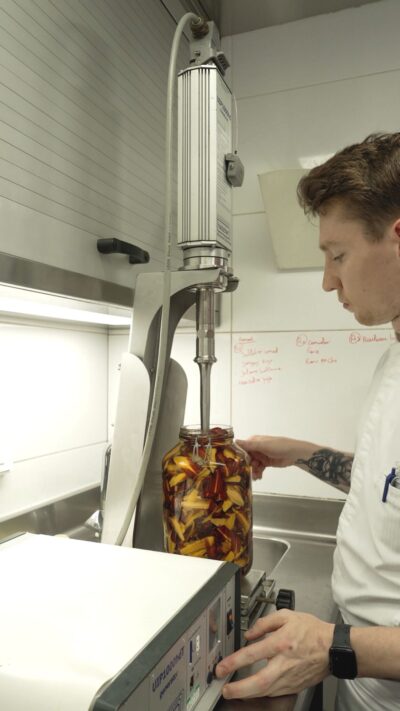
- héich Effizienz
- Staat-vun-der-Konscht Technologie
- Zouverlässegkeet & Robustheet
- justierbar, präzis Prozess Kontroll
- batch & an der Schlaang
- fir all Volumen
- intelligent Software
- Smart Features (zB programmierbar, Datenprotokoll, Fernbedienung)
- einfach a sécher ze bedreiwen
- niddereg Ënnerhalt
- CIP (clean-in-place)
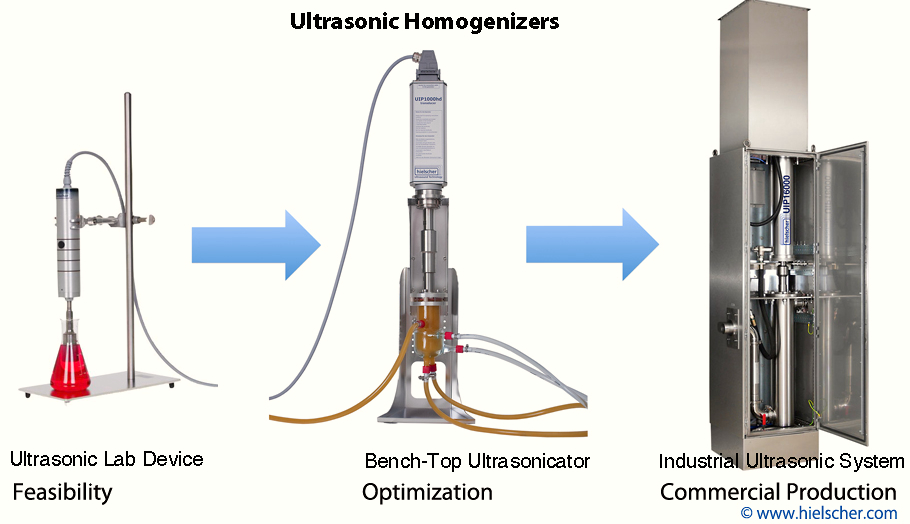
Hielscher Ultrasonics fabrizéiert High-Performance Ultrasonic Homogenisatoren aus Labo zu industriell Gréisst.